
There is no safe number, because Meta’s policy bans buying or exchanging engagement outright, regardless of quantity. The only compliant answer is zero. Hootsuite’s own experiment found that purchased followers raised the visible count but did not move engagement or sales. The rest of this guide covers the policy risk, the evidence, the pricing you will actually see, and how to measure whether any purchase delivered real value.
TL;DR:
- Meta can remove flagged accounts months after delivery, and gradual delivery or weekly caps reduce neither the policy violation nor the risk of enforcement.
- Hootsuite’s experiment found purchased followers increased visible counts without reliably lifting engagement or sales; organic posts earned more likes and comments.
- Compare engagement with Instagram’s 1% to 5% benchmark, then track profile visits, saves, shares, qualified follows, website clicks, and conversions for 30 to 90 days.
- If you test anyway, buy the smallest package, never share your password, exclude purchased followers from ad targeting, and redirect spending if conversions stay flat.
Table of Contents
- Why platform policy and enforcement rule out a numeric ‘safe’ answer
- What buying followers actually changes: engagement and measurement contamination
- Market reality: pricing, delivery patterns and why vendor claims don’t guarantee safety
- When buying followers might be considered, and the trade-offs
- How to judge whether a purchase worked: a 30 to 90 day checklist
- Ethical considerations and the impact on brand reputation
- Long-term consequences for account credibility and trust
- How to identify legitimate versus fake follower providers
- Legal implications across different jurisdictions
- Case studies and examples: what buying followers actually produces
- How we think about the ‘how many should I buy’ question
- Greedier Social Media: a labelled option and how to try it responsibly
- FAQ
- Sources
Why platform policy and enforcement rule out a numeric ‘safe’ answer
Meta’s Community Standards specifically list buying, selling or exchanging engagement, including follows, as prohibited behaviour. There is no quantity threshold written into that rule: one follower bought the same way as 10,000 breaks the same policy. Any “safe number” you see quoted by a vendor is a marketing claim, not a platform guarantee, because Meta’s enforcement reporting shows fake account detection and removal happening continuously and at scale.
That detection is what makes purchased followers unreliable as an asset. Accounts flagged as inauthentic get purged in batches, sometimes months after delivery, which means a follower count built through a purchase can simply fall again without warning.
Vendors often promise heuristics meant to dodge detection:
- Gradual, staggered delivery spread over days or weeks rather than an instant dump
- Caps on the percentage of followers added per week
- Mixed delivery profiles designed to resemble organic growth patterns
None of these change the underlying policy violation. They are risk-management tactics aimed at reducing the chance of detection, not proof of compliance, and they offer no contractual protection if your account is actioned.
What buying followers actually changes: engagement and measurement contamination
The clearest evidence comes from Hootsuite’s own purchase experiment, which found that follower counts rose after buying but engagement and conversions generally did not follow. Organic posts in the same test produced more likes and comments than anything tied to the purchased audience.
A typical organic engagement rate on Instagram runs between 1% and 5%, and that range is the benchmark against which any follower purchase should be judged: if your engagement rate falls well below it after a purchase, the new followers are not interacting with your content.
That dilution has knock-on effects beyond a single vanity metric:
- Engagement rate drops because the denominator (follower count) grows while interactions stay flat
- Audience insights used for ad targeting get skewed by accounts that were never real prospects
- Later campaign decisions, including lookalike audiences and creative testing, inherit the distortion because the platform cannot distinguish bought followers from genuine ones in your existing base
This is measurement contamination: once fake followers sit inside your audience data, every downstream decision that relies on “who follows us” becomes less trustworthy, a problem research on the fake-engagement market also flags as a structural harm, not just a one-off risk.
Market reality: pricing, delivery patterns and why vendor claims don’t guarantee safety
Market reporting from Search Engine Journal shows vendor pricing for 1,000 followers commonly sitting in low-dollar ranges, with volume discounts common for larger packages. Delivery comes in two broad forms, and the choice between them says nothing about compliance:
- Instant delivery: the full order lands within hours, visible immediately but more conspicuous to detection systems
- Gradual delivery: the same order spreads over days or weeks to mimic organic growth patterns
- Password-free delivery: increasingly standard across vendors, since any service asking for your login credentials is a fraud risk worth avoiding
Neither delivery style makes the purchase policy-compliant. They are just different bets on detection risk, and the underlying violation of Meta’s rules is identical either way.
When buying followers might be considered, and the trade-offs
A handful of narrow cases exist where the stakes are genuinely low:
- A short-lived personal account or meme page with no commercial goal attached
- A one-off test to see how a purchase affects your own analytics, run with full awareness of the risk
- A low-stakes vanity use where credibility and sales are not the point
If you go ahead regardless, some guardrails limit the damage: never hand over your password to a vendor, buy the smallest quantity that answers your question rather than the biggest package on offer, and keep bought followers out of any ad targeting or lookalike audience you build later. For anyone chasing real growth rather than a number, targeted ads, creator partnerships and a modest content budget tend to produce outcomes that survive scrutiny.
How to judge whether a purchase worked: a 30 to 90 day checklist
Follower count on its own tells you nothing. Track the metrics that actually move a business forward over the following three months:
- Profile visits and the ratio of visits to new followers
- Saves and shares, which signal content resonance rather than passive counting
- New follows coming specifically from accounts in your target market
- Website clicks and conversions attributed to social traffic
- Engagement rate recalculated against your new, larger follower base
A genuine improvement shows engagement per follower holding steady or rising alongside the count, plus a measurable lift in qualified traffic or sales. A purchase that only inflates the headline number while these other metrics stay flat is vanity growth, and it is worth reviewing how any bought followers affect ad performance before you build a campaign on that audience. If the 30 to 90 day numbers come back negative, request a refund where the vendor offers one and redirect the budget towards organic content or paid ads instead.
Pro Tip: Set your baseline engagement rate before you buy anything, so you have a real number to compare against afterwards rather than a guess.
Ethical considerations and the impact on brand reputation
Buying followers misrepresents your reach to anyone who looks at your profile, whether that is a customer deciding whether to trust you, a brand considering a partnership, or an investor assessing traction. The number itself becomes a kind of claim, implying an audience that engages with and believes in what you post, when in fact a portion of it never will.
For businesses and creators, this matters more than it might for a casual personal account. A brand that leans on an inflated follower count to signal credibility is making an implicit promise to customers and partners that the account does not back up with real engagement. When that gap surfaces, through a visibly low engagement rate or a sudden drop after a platform purge, it tends to damage trust more than a smaller, honest number ever would.
There is also a fairness dimension. Creators and brands that build their following through content and genuine audience relationships compete in the same spaces as accounts that bought their way to a bigger number. Purchased followers distort that competition, which is part of why platforms treat the practice as inauthentic behaviour rather than a grey area.
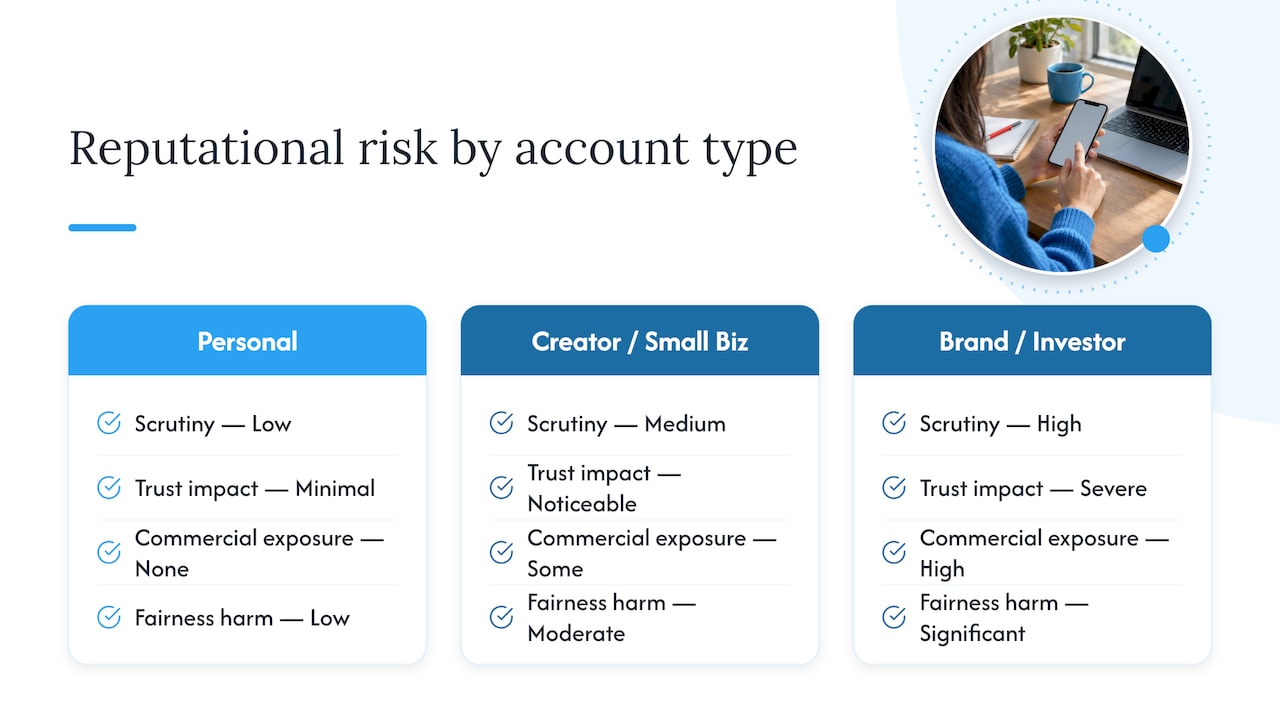
The reputational risk scales with how publicly the account is scrutinised. A personal account with a small, low-stakes audience carries little exposure. A business account that pitches partnerships, seeks sponsorship deals or asks customers to trust its scale carries a great deal more, because the follower count is doing commercial work that a fake number cannot actually support.
Long-term consequences for account credibility and trust
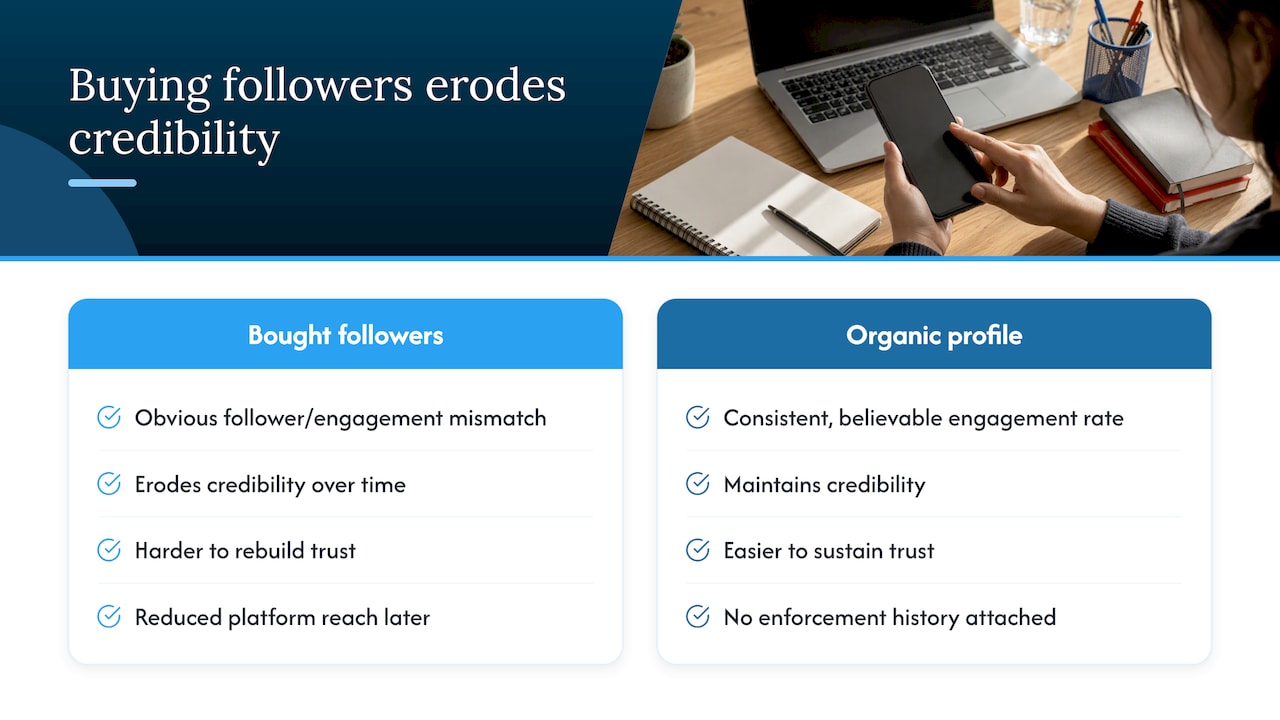
The damage from buying followers rarely shows up immediately. It accumulates. An account with a large follower count and a thin engagement rate becomes easy to spot, and anyone evaluating that account, a potential business partner, a sponsor, a new follower deciding whether to engage, can see the mismatch within a few scrolls.
That mismatch erodes credibility in a way that is hard to reverse. Once an audience notices that an account’s numbers do not add up, they tend to discount everything else about it too, including genuine content and real achievements. Rebuilding that trust usually takes longer than it took to lose it, because scepticism about one metric spreads to scepticism about the account generally.
There is also the platform-side risk that compounds over time. Accounts flagged for inauthentic activity can face reduced reach even after the purchased followers are removed, because the enforcement history sits attached to the account rather than resetting cleanly. A single early purchase can shape how the platform treats that account’s content for a long stretch afterwards.
For anyone building a presence with commercial intent, long-term credibility is the actual asset. A smaller account with a consistent, believable engagement rate tends to convert better and partner better than a larger one that cannot explain its own numbers.
How to identify legitimate versus fake follower providers
Not every provider in this market operates the same way, and the differences matter if you decide to buy regardless of the risk. A handful of signals separate the two:
Password requests are the clearest red flag. Any vendor asking for your account login is asking for more access than a follower delivery requires, and handing that over exposes you to account takeover, not just a bad purchase.
Pricing that looks too good against the market range is another signal. Search Engine Journal’s market reporting shows typical pricing bands for common package sizes, and a provider pricing far below that range is often cutting corners on the quality or origin of the accounts it delivers.
Vendor transparency about delivery method also tells you something. A provider willing to state whether delivery is instant or gradual, and roughly how long an order takes, is operating with more accountability than one that is vague about timing and process.
Finally, treat customer support responsiveness as a proxy for legitimacy. A provider you can actually reach before and after a purchase behaves differently from one that disappears once payment clears, which is relevant given how concentrated the fake-engagement market is around intermediaries with little accountability to buyers.
Legal implications across different jurisdictions
Buying followers is not illegal in the way that, say, fraud or counterfeiting is, but it sits inside a market that researchers have linked to real legal exposure. The ACM FAccT 2026 study analysed more than 2,000 fake-engagement services across jurisdictions and found the market relies heavily on cross-border intermediaries and payment processors, with regional variation in how the practice is treated.
That cross-border structure matters because it is part of what creates fraud and privacy risk for buyers: payments and account data often pass through processors and intermediaries outside the buyer’s own country, with limited recourse if something goes wrong. The same research links this market structure to the privacy and fraud risks buyers face, separate from any platform enforcement action.
For individual buyers and small businesses, the practical legal exposure is less about criminal liability and more about consumer protection and fraud risk: chargeback disputes, data handed to an unaccountable third party, and no guarantee of service if a provider simply stops responding. Businesses making claims to investors, partners or advertisers based on an inflated following could also face separate scrutiny if those numbers are shown to misrepresent reach, though that risk depends heavily on how the numbers are used rather than on the purchase itself. None of this amounts to a settled legal framework, which is itself part of the risk: the rules that would protect a buyer are thin compared with the rules that already ban the practice on the platform side.
Case studies and examples: what buying followers actually produces
The clearest documented example comes from Hootsuite’s own experiment, where the team purchased followers specifically to observe the outcome. The follower count rose as promised. Engagement did not follow at a comparable rate, and organic posts published during the same period generated more likes and comments than content associated with the purchased audience.
That pattern, a visible jump in one metric with no corresponding lift in the metrics that matter commercially, is consistent with the broader market research into fake-engagement services, which frames the entire market around distorted social proof rather than genuine audience building. The count goes up. The things that count, profile visits, saves, website clicks, qualified leads, stay where they were.
The practical lesson from these documented outcomes is to treat follower count as a vanity metric unless it is accompanied by a matching rise in engagement and conversions. It has gained a number that complicates every later attempt to understand who is actually interested in what it posts.
How we think about the ‘how many should I buy’ question
We would rather see a reader invest in measurement-driven, authentic engagement first, because that is what survives a platform audit and a sceptical customer. We only see a case for a follower package when someone has already weighed the policy risk, picked the smallest test size, and has a 30 to 90 day plan to check whether it actually moved anything beyond the count.
— Irwin Lee
Greedier Social Media: a labelled option and how to try it responsibly
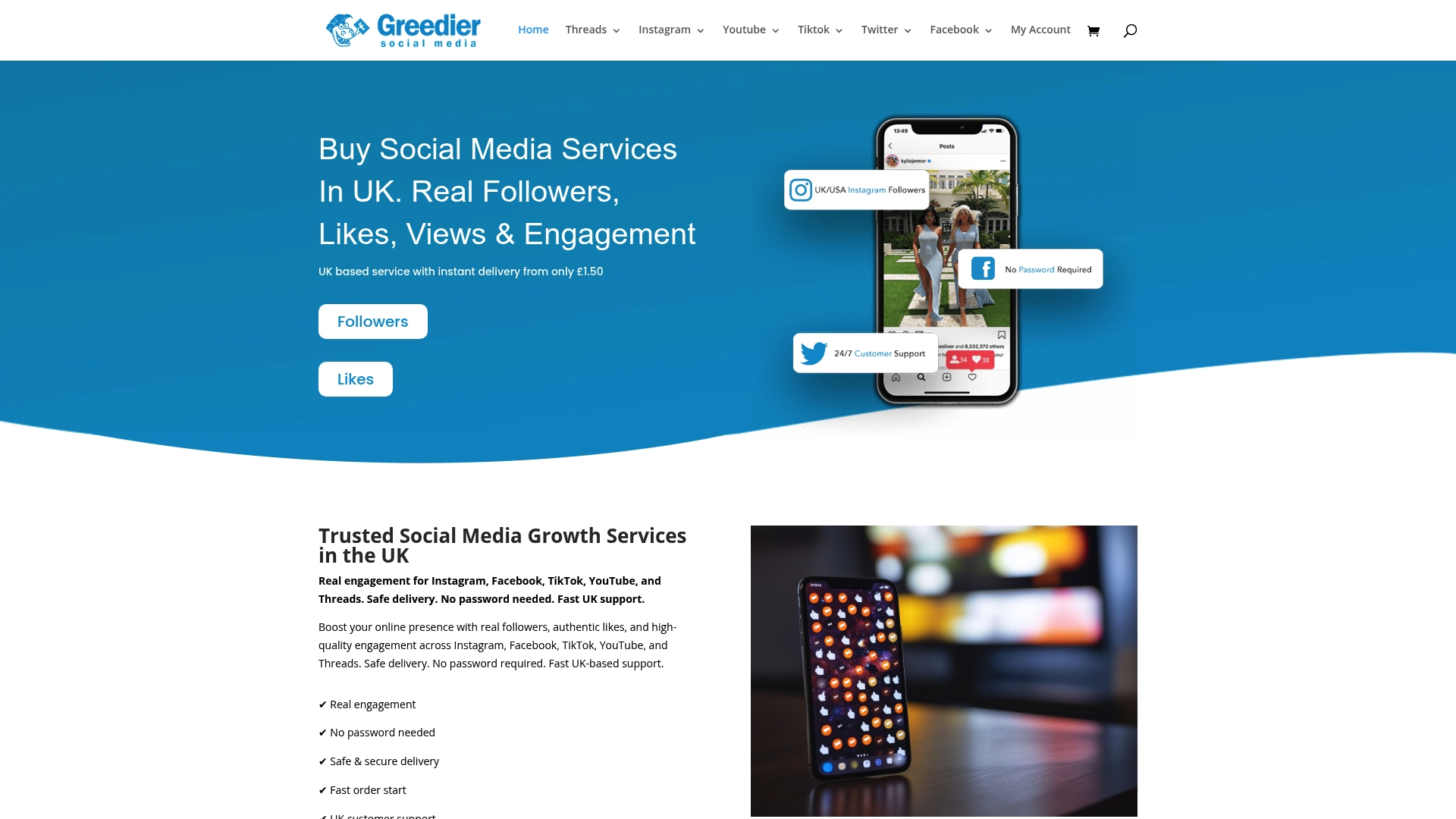
If you have read all of the above and still want to test a purchase, Greedier Social Media offers password-free delivery, UK-based support and packages across Instagram, Facebook, TikTok, YouTube and Threads, which removes at least one common risk (handing over your login) from the equation.
This suits buyers who want a contained, low-commitment test rather than a long-term growth strategy: someone checking what a small purchase does to their own analytics, or a brand wanting a short-term visibility boost while a content plan ramps up. Before ordering, ask any provider, including us, about delivery timing, refund terms if the purchase underperforms, and whether the followers are delivered gradually or instantly.
- Start with the smallest package that answers your question, such as Instagram followers priced across a range rather than the largest tier on offer
- Run the 30 to 90 day checklist above before deciding whether to repeat or scale the purchase
- If engagement and conversions do not move, redirect the next budget towards targeted ads or creator partnerships instead
FAQ
How much does 1,000 followers cost?
Pricing varies by platform and package size, but market reporting shows 1,000 followers commonly sitting in low-dollar ranges with volume discounts for larger orders. On Greedier Social Media, Instagram follower packages run from £1.99 to £229.99 depending on quantity.
Is buying followers a good idea?
Generally no, because Meta’s policy prohibits buying or exchanging engagement, and experiments show it raises the visible count without reliably improving engagement or sales. It makes more sense as a small, measured test than as a growth strategy.
Can I legally buy Instagram followers?
It is not criminally illegal in most places, but the practice violates platform policy and sits inside a market linked to cross-border fraud and privacy risks. Your account itself can still face enforcement action regardless of whether any law was broken.
How do I buy 1,000 followers on Instagram?
You choose a package size from a provider’s catalogue, such as Greedier Social Media’s Instagram followers category, and complete checkout without sharing your account password. Delivery then arrives either instantly or gradually over several days, depending on the provider’s delivery model.
Sources
- Fighting scammers: protecting people with new technology and partnerships (Meta)
- We bought Instagram followers to see what happens (Hootsuite blog)
- Accountability gaps in the fake follower market (ACM FAccT 2026)
- Should we buy Instagram followers and likes? (Search Engine Journal)
- Community standards enforcement — fake accounts (Meta Transparency)