
Auto views are a set-and-forget service. You link an account, the service watches for each new video you post, and a batch of views is sent to that video shortly afterwards, without you placing a fresh order every time. How well that works depends on three things: how the views are delivered, how each platform counts a view, and whether the platform treats the traffic as genuine. This guide covers all three, with the UK rules that apply to businesses.
TL;DR
- Auto views monitor your profile and trigger a set number of views on every new video, so each post gets an early boost without a manual order.
- A view means different things on each platform: Instagram and TikTok count a play, while YouTube filters out non-genuine traffic and reviews what is counted.
- Views are not watch time. They help a video look established, but they do not make people watch, follow or buy.
- For UK businesses, the risk is as much about reputation and advertising rules as about the platform. Know where the line sits before you order.
- Start small, test on one account and judge it by your real results, not by the counter.
Table of Contents
- What auto views actually are
- How the process works, step by step
- What counts as a view on each platform
- Views, watch time and why they are not the same
- Where auto views help, and where they do not
- The UK angle: advertising rules and reputation
- Our perspective
- How to test auto views without wasting money
- Choosing a provider: what to check
- Our related services
- FAQ
- Sources
What auto views actually are
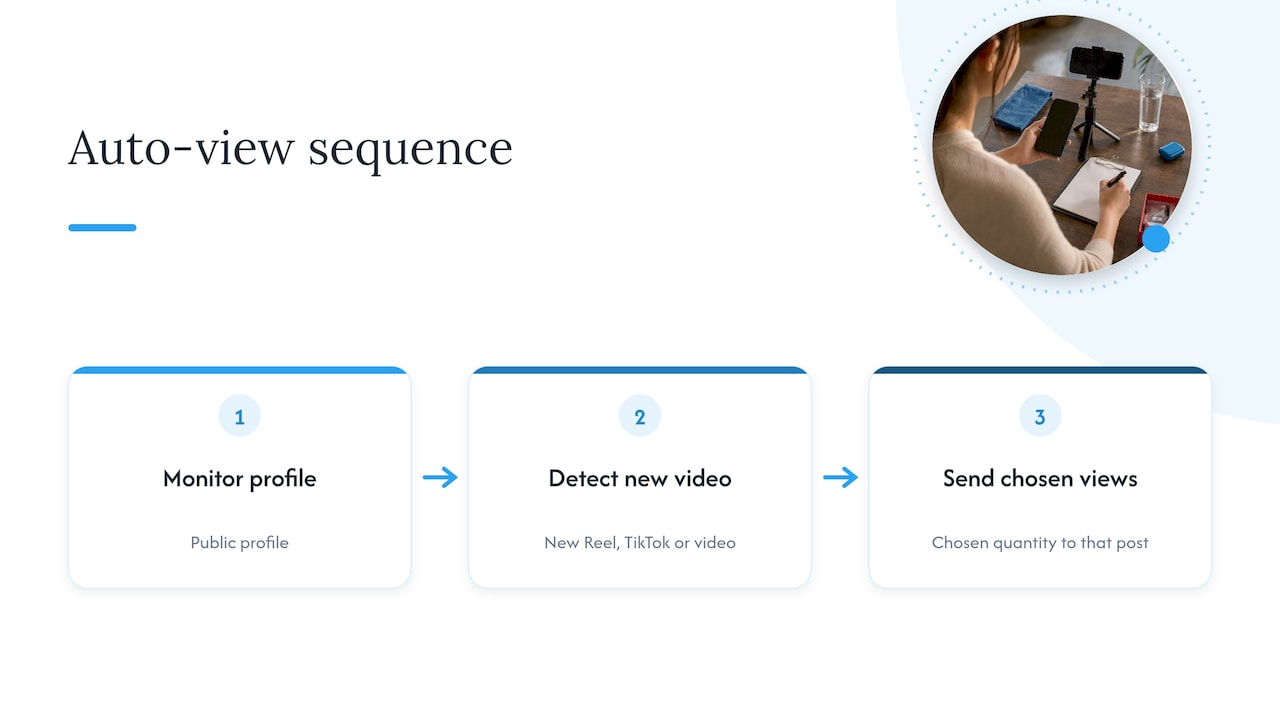
A one-off view order is simple. You pick a video, choose a quantity and the views arrive. Auto views automate that step. The service keeps an eye on your public profile, and when a new Reel, TikTok or video appears, it sends the view quantity you chose to that post.
The idea behind it is early momentum. Most people judge a video in a second or two, and a post that sits on a handful of plays looks quiet next to one that shows a healthy number. Sellers of the service describe it as giving every post the same starting push, rather than leaving the first hour to chance.
Auto views should not be confused with autoplay. Autoplay is a viewer setting that plays the next video automatically. The two are unrelated, though the confusion is common, and it is why searches for the term often surface YouTube help pages about autoplay rather than anything to do with ordering views.
How the process works, step by step
The details differ between providers, but the flow is broadly the same.
- You choose a plan and a quantity. For example, a set number of views per new video.
- You give a public profile name or link. A properly built service never needs your password. Anyone who asks for your login is asking for access they do not need, and you should walk away.
- The service detects a new post. It checks your public profile at intervals, so there is usually a short gap between you posting and the first views arriving.
- Views are sent to that video. Delivery may be instant or spread over time.
- The cycle repeats on each new post until the plan ends or you cancel.
Because it relies on seeing your public posts, an account switched to private will generally stop the service working. Check this before you blame the provider.
Instant delivery or a gradual drip
Timing is the setting that matters most. Views that land all at once in the first minute can look unusual next to a normal pattern, where plays build up over hours as the post reaches people. A drip, where delivery is spread across a period, mirrors that curve more closely.
The same logic applies if you run more than one automated service. Giving auto likes and auto views different delays produces a more natural sequence than firing both at the same moment. We cover this in more depth in our guide on making purchased engagement look natural.
What counts as a view on each platform
This is where most expectations go wrong. A counter going up is not the same as a platform recognising value.
| Platform | What a view means | What to expect from auto views |
|---|---|---|
| Instagram (Reels, video) | Counted when the video starts playing, with no minimum watch time | The counter rises; it measures exposure, not attention |
| TikTok | A play of the video, with watch time and completion driving how far it is pushed | A higher count helps the look of a post, but the algorithm rewards viewers who stay |
| YouTube | A view is counted when a video starts to play, but non-genuine traffic is filtered out | Highest scrutiny of the three; counts can be removed |
On YouTube the position is documented. From 24 August 2026, views are counted the moment a video starts to play across Shorts, long-form videos and live streams. The same help page explains that only legitimate views, meaning real people with genuine intent, contribute to public totals.
That last point is the one to understand. YouTube describes invalid traffic as any activity that does not come from a real user or a user with genuine interest. Its fake engagement policy goes further and does not allow anything that artificially increases views, likes, comments or other metrics by using automatic systems.
The platform also warned about this practice many years ago. YouTube’s blog post on views and third-party services says its systems work to detect and remove illegitimate views. In practice that can mean the views simply disappear, so the money spent buys nothing lasting.
So on YouTube specifically, the honest answer to whether auto views are safe is: not without risk. You can read our fuller view in why the 2026 count change makes engaged views matter more.
Views, watch time and why they are not the same
A view tells you a video started. Watch time tells you whether anyone stayed. Platforms lean on the second.
On TikTok, community discussion keeps coming back to the same point: watch time drives reach. Videos that people drop in the first seconds tend to stall, however many plays they have. On YouTube, monetisation is tied to higher-quality measures rather than raw counts. YouTube’s help page on ad and view metrics describes engaged and qualified views separately from basic view counts, which is why a big number of raw plays does not satisfy what creators need for the YouTube Partner Program.
What this means in practice:
- Auto views can make a post look established. They cannot make a viewer watch to the end.
- A video with strong views and no likes, comments or shares looks lopsided to people who know what to look for.
- Content quality still decides whether the views turn into anything. Our comparison of watch time versus views on YouTube explains which one to prioritise.
Where auto views help, and where they do not
Situations where they can make sense
- A new account with a good video and an empty counter. First impressions matter, and a post that looks watched is easier for a stranger to give a few seconds to.
- A business that posts on a schedule. Regular Reels or TikToks each get the same starting push, so the profile looks active across the grid.
- A campaign with a short window. A launch or event post benefits from looking busy on day one.
Situations where they will disappoint
- Weak or off-topic content. Views do not fix a poor hook.
- A channel chasing monetisation. As covered above, raw views are not the thing YouTube pays on.
- Accounts that sell on trust, such as professional services, where a mismatch between views and genuine interaction is noticeable.
The UK angle: advertising rules and reputation
If you run a UK business, the platform’s rules are not the only ones in play.
The Advertising Standards Authority applies the CAP Code to social media marketing. Marketing communications must be obviously identifiable as such, and the ASA’s influencer ad disclosure report says clear labels such as Ad should come first, up front in the post. The Digital Markets, Competition and Consumers Act 2024, in force from 6 April 2025, adds to the pressure on commercial transparency.
What does this mean for buying views? Boosting a counter is not itself an advertisement, but it sits next to promotional content. The ASA’s concern is people being misled about what they are looking at. A post that is paid-for promotion should say so, and a view count should not be used to create a false impression of popularity around a claim you make to customers. Brands and influencers are held jointly responsible for disclosure, so it is worth checking how an influencer’s reach is reported before you pay them. Our guide to spotting fake engagement in influencer marketing shows the signs, and a piece on influencer marketing, brand visibility and return on investment sets out why transparency protects a brand over the long run.
The practical rule: use views as a supporting signal, label ads properly, and never let a number on the screen carry a claim about your product.
Our perspective
We have worked with UK creators and small businesses since 2013, and the same pattern repeats. People who are happiest with purchased views treat them as a small part of a plan, not the plan itself. They post consistently, they make the first three seconds count, and they use the extra plays to give a good video a fair start.
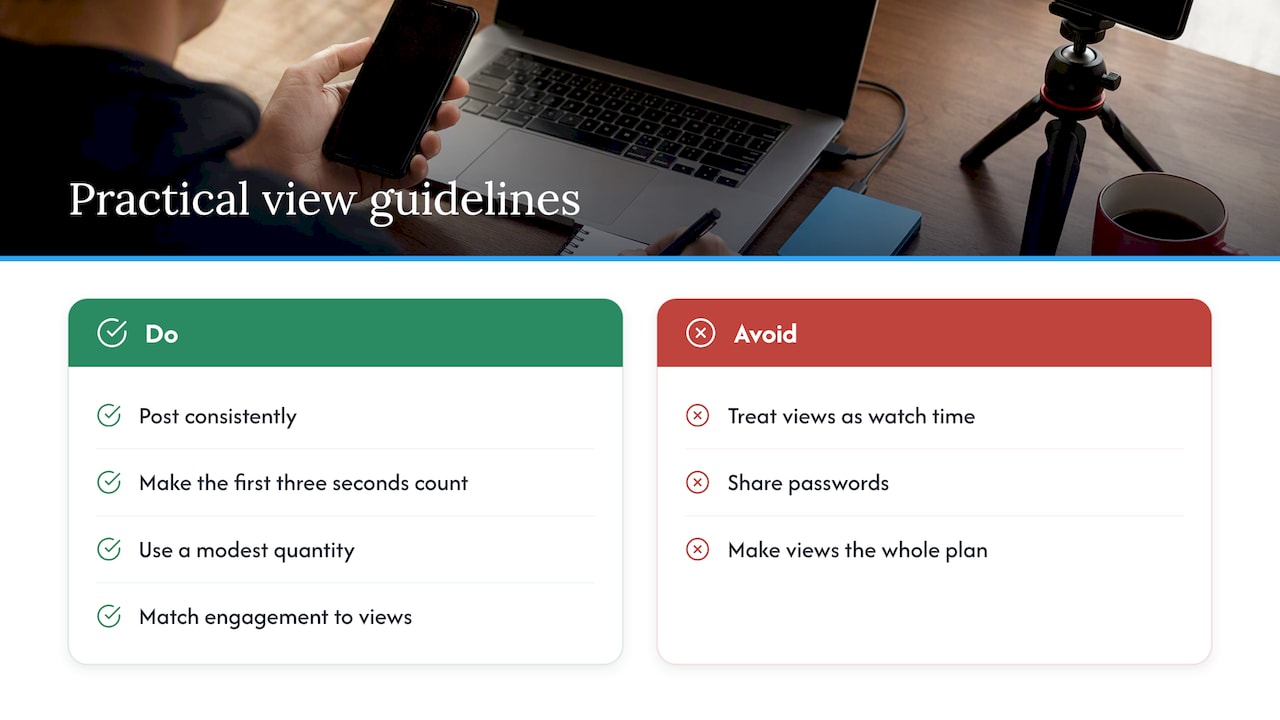
We also think sellers should be straight about limits. Views do not equal watch time. YouTube filters and reviews what it counts, and it has policies against artificial metrics. On Instagram and TikTok the risk of a flagged post is lower than on YouTube, but a counter that jumps out of line with likes and comments still looks odd. That is why we encourage a gradual approach, a modest quantity and engagement that matches the views.
Our own rule is simple: no passwords, ever, and delivery aimed at UK audiences where you need it. If a service asks for your login, that tells you everything about it.
— Irwin Lee
How to test auto views without wasting money
- Pick one platform and one account. Do not roll out across everything at once.
- Set a small quantity. You are testing the effect, not buying a headline number.
- Note your baseline. Record average views, likes, comments and profile visits for your last ten posts.
- Run the plan for a few posts. Then compare the same measures.
- Judge by outcomes. Did profile visits, follows, enquiries or sales move? If only the counter rose, the spend is not earning anything and you should stop.
- Keep the content strong. Better hooks, captions and posting times give the views something to work with. Our guide to increasing Instagram likes organically covers the organic side.
Choosing a provider: what to check
Whatever type of service you consider, run it through these questions.
- Does it ask for a password? It should not.
- Is the pricing clear and in pounds? Hidden recurring charges are a warning sign.
- Can you control the quantity and timing? A single fixed blast is less flexible than a drip.
- Is support reachable in UK hours? You want a person to answer if delivery stalls.
- Does the provider make claims it cannot keep? Anyone promising guaranteed virality or monetisation is overselling.
Our related services
If you want to try this on Instagram, we sell Reel and video views as one-off packages. Instagram video, Reel and IGTV views start from £0.59 and go up to £54.99, so you can test the effect on a single post before committing to anything bigger. If you prefer automation, our auto plans are priced monthly: auto Instagram followers run from £15.00 to £100.00 per month, and auto Instagram likes start from £9.99 per month. Delivery is password-free, and our UK-based support can help you pick a sensible starting quantity.
For TikTok, TikTok views are priced from £1.99 to £49.99. For YouTube, views run from £4.99 to £269.99, but read our notes on YouTube view retention and drip feeding first, given the platform’s stricter filtering.
FAQ
Do auto views work on Instagram?
They raise the play count on each new post, because Instagram counts a view when a video starts playing. They do not guarantee more followers or sales, since those depend on what viewers do next. Match the quantity to your normal reach so the numbers look believable.
Are auto views on YouTube safe?
YouTube is the strictest of the three platforms. Its policy does not allow artificially increased views, and it says it filters invalid traffic. Views may be removed, and in serious cases a channel can lose monetisation. If your channel depends on YouTube income, put your effort into content and retention rather than purchased counts.
Does autoplay on YouTube count as a view?
That is a viewer-side setting and is separate from auto views as a service. YouTube’s own help pages explain how views from different placements are treated, and the rules have changed in 2026, so check the current counting rules for your format.
Why does my video have only a few views on TikTok?
TikTok tests a video with a small audience first and pushes it further if people watch it. Low early watch time tends to keep reach small. Stronger hooks and shorter videos often help more than extra plays do.
Do I need to give my password?
No. A genuine service needs only your public profile name or video link. Never share a login with any provider.
Sources
- How engagement metrics are counted, YouTube Help
- Invalid traffic on your videos, YouTube Help
- Fake engagement policy, YouTube Help
- Views and 3rd party services, YouTube Blog
- About YouTube ads and view metrics, YouTube Help
- Influencer Ad Disclosure on Social Media: Instagram and TikTok, ASA