
Trying to grow multiple social platforms simultaneously without a system usually leads to burnout.
TL;DR:
- Managing multiple social media platforms effectively requires a unified system that combines automation, content workflows, and the right tools. Focus on selecting platforms appropriate for your audience, content style, and business goals to maximize growth. Using account isolation tools and structured workflows helps prevent linking issues and ensures consistent, scalable success.
Growing multiple social media platforms simultaneously means combining automation, structured content workflows, and a consistent brand voice to expand your audience across channels without burning out or spreading thin. The challenge is not creating content. It is creating the right content, in the right format, for the right platform, all at once. Tools like Sprout Social, Buffer, and Postory have made this achievable for small businesses and solo creators. AI-driven social media management is now considered a crucial daily skill by 97% of marketing leaders in 2026. That figure signals a clear shift: manual posting across platforms is no longer a viable growth strategy.
How do you grow multiple social platforms simultaneously?
The core principle is simple. You build one system that feeds every platform, rather than running separate strategies for each. This is what separates creators who grow social media channels together from those who stall after a few months. The system starts with platform selection, moves through content creation, and ends with continuous analysis. Skip any stage and growth plateaus.

The Hub and Spoke model is the most effective structural framework for this. Public platforms like TikTok, Instagram Reels, and LinkedIn act as spokes. They attract attention and drive reach. Your owned channels, such as an email list or a private community group, form the hub where deeper conversion happens. This separation of roles prevents you from trying to do everything on every platform.
Which platforms should you prioritise?
Choosing the wrong platforms wastes more time than any other mistake in multi-platform growth. The right choice depends on three factors: where your audience already spends time, which formats suit your content style, and which platforms align with your business model.
A B2B service business belongs on LinkedIn and YouTube. A product-led brand targeting under-35s belongs on Instagram and TikTok. A local service business in the UK often sees stronger returns from Facebook and Instagram combined. Trying to maintain a presence on five platforms with the same effort spread equally produces weak results on all of them.
Pro Tip: Start with two platforms and master them before adding a third. Depth on two channels outperforms shallow activity across five.
The key evaluation criteria are:
- Audience demographics: Check each platform’s published data on age, location, and interests.
- Engagement rates: Short-form video consistently outperforms static posts on most platforms in 2026.
- Business model fit: Platforms with strong shopping features, such as Instagram and TikTok Shop, suit product businesses. LinkedIn suits professional services.
- Content format: If you cannot produce video, TikTok is the wrong starting point.
Focusing on fewer, well-chosen platforms produces compounding returns. Each piece of content you publish builds on the last, and your audience grows with coherence rather than confusion.
What tools enable efficient management of multiple social media channels?
The right tools remove the manual labour from multi-platform management. They handle scheduling, content recommendations, and performance reporting so you can focus on strategy and creation.
| Tool | Best For | Key Feature | Pricing |
|---|---|---|---|
| Sprout Social | Mid-size businesses and agencies | AI-powered scheduling, analytics, and community management | From £199/month |
| Buffer | Small businesses and solo creators | Simple cross-platform scheduling and engagement tracking | Free tier available; paid from £5/month |
| Postory | Creators using the Analyze-Plan-Create-Manage-Publish framework | Batch content creation and pillar-based planning | Subscription-based |
| Multilogin | Agencies managing multiple client accounts | Account isolation via separate device profiles and IP addresses | From £19/month |
Sprout Social and Buffer handle the scheduling and analytics side of multi-platform management. Postory is built specifically around the structured content workflow that prevents growth plateaus. Multilogin addresses a different problem entirely: keeping multiple accounts safe from being linked by platform algorithms.
AI agents now handle tier-1 community queries and surface performance insights automatically. This means a single person can manage engagement across four or five platforms without hiring a social media team. The practical implication is significant: you can scale your presence without scaling your headcount.
Pro Tip: Use Buffer or Sprout Social for scheduling and pair it with a dedicated analytics tool. Separating these functions gives you cleaner data and faster decisions.
How to implement a structured content workflow for multi-platform growth
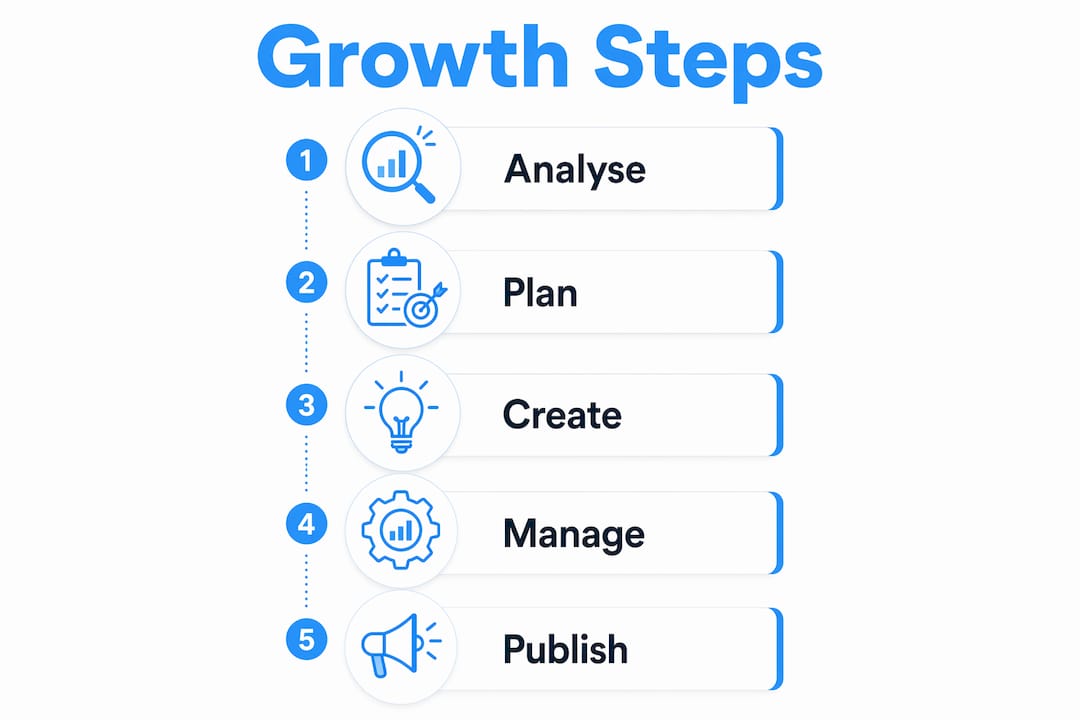
A structured workflow is the difference between consistent growth and erratic posting. The Analyze-Plan-Create-Manage-Publish framework is the most effective method for managing content across multiple channels in 2026.
Analyse: Review performance data from the previous period. Identify which content types, formats, and topics drove the most engagement on each platform. This stage prevents you from repeating content that does not work.
Plan: Map out your content calendar using 3–5 content pillars. A pillar is a core theme your brand consistently covers. For a fitness brand, pillars might be nutrition, training, mindset, product spotlights, and community stories. Planning within pillars keeps your brand voice consistent across platforms.
Create: Batch-create content weekly or fortnightly. Write captions, record videos, and design graphics in dedicated sessions rather than daily. This method reduces the mental cost of context-switching and produces more coherent output.
Manage: Schedule posts using a tool like Buffer or Sprout Social. Set up automated responses for common queries. Assign engagement windows, specific times each day when you actively reply to comments and messages, rather than reacting all day.
Publish and review: After publishing, track performance against the goals set in the Plan stage. Feed findings back into the next Analyse stage. Missing this feedback loop is the single most common reason accounts plateau after initial growth.
The most common workflow mistake is skipping the Analyse stage when things are going well. Growth feels self-sustaining until it suddenly stops. Regular analysis catches declining engagement before it becomes a problem.
How do you scale and safeguard accounts across multiple platforms?
Scaling social media activity across multiple accounts introduces risks that most guides ignore. Platforms actively detect and flag accounts that appear linked. When one account is penalised, linked accounts often face restrictions too.
The primary risk factors are:
- Shared IP addresses: Logging into multiple accounts from the same IP signals to platforms that one person controls them all.
- Device fingerprints: Browsers and devices leave unique identifiers. Platforms use these to map account relationships.
- Behavioural patterns: Posting at identical times, using the same hashtag sets, or mirroring engagement patterns across accounts triggers automated flags.
Account isolation technology prevents platforms from linking multiple accounts via device or IP. Tools like Multilogin create separate browser profiles, each with a unique device fingerprint and IP address. Agencies and businesses managing client accounts rely on this infrastructure to keep accounts compartmentalised.
“Professionals differentiate themselves by employing infrastructure layers, such as account isolation and cloud collaboration, to prevent accounts from being linked and flagged.” — Multilogin, 2026
Cloud-based collaboration tools also allow teams to manage accounts without sharing login credentials. This protects both account security and client confidentiality. For small businesses working with a freelancer or part-time social media manager, this is a practical and necessary step.
Authentic engagement remains the strongest safeguard of all. Platforms reward accounts that generate genuine interactions. Buying low-quality engagement from bot networks triggers the same flags as linked accounts. The benefits of consistent posting compound over time, but only when the engagement underneath is real.
Key takeaways
Growing multiple social platforms simultaneously requires a unified system built on platform selection, structured workflows, and account safety infrastructure.
| Point | Details |
|---|---|
| Choose platforms deliberately | Match platform selection to your audience demographics, content format, and business model. |
| Use the Hub and Spoke model | Drive reach on public platforms and convert through owned channels like email lists. |
| Adopt the five-stage workflow | The Analyze-Plan-Create-Manage-Publish cycle prevents plateaus and keeps content consistent. |
| Batch-create within content pillars | Weekly or fortnightly batch creation reduces context-switching and strengthens brand coherence. |
| Protect accounts with isolation tools | Separate device profiles and IP addresses prevent platforms from linking and flagging your accounts. |
What I have learned from managing growth across multiple channels
The biggest mistake I see creators and small business owners make is treating multi-platform growth as a content volume problem. They post more, spread thinner, and wonder why nothing compounds. The real problem is almost always infrastructure. Without a proper workflow, every platform feels like a separate job.
The Analyze-Plan-Create-Manage-Publish cycle changed how I think about this entirely. When you treat your content as a single pipeline feeding multiple outputs, the workload actually decreases. You stop reinventing the wheel for each platform and start adapting one core idea into multiple formats. A long-form LinkedIn post becomes a Twitter thread, a short Instagram caption, and a TikTok script. The idea does the work once. The formats do the distribution.
I have also watched AI shift from a scheduling aid to something far more capable. AI agents now handle community engagement and surface insights that would take hours to compile manually. That is not a future prediction. It is the current reality for anyone using tools like Sprout Social or Emplifi at scale. The creators who treat AI as a core part of their workflow, rather than an optional extra, are the ones growing fastest right now.
The uncomfortable truth is that vanity metrics still distract most people. Follower counts feel good. Reach feels good. But the accounts that actually convert focus on engagement quality and audience depth. A social media growth strategy built around real interactions will always outperform one built around inflated numbers.
— Luna
How Greediersocialmedia supports your multi-platform growth
Greediersocialmedia has supported over a million UK clients since 2013, helping small businesses and creators build genuine visibility across platforms like Instagram and Facebook. The approach is built on real followers, likes, and views, with no password required and no shortcuts that compromise your account standing.
If you are ready to put the frameworks in this article into practice, Greediersocialmedia offers growth tactics and resources that align with authentic, sustainable expansion across channels. For creators and businesses looking to increase presence across channels without the risk of bot-driven penalties, the social media growth strategy guide is a strong next step. Real growth, built on real engagement, is what turns a small account into a significant one.
FAQ
What does it mean to grow multiple social platforms simultaneously?
It means building one structured content system that feeds several platforms at once, using tools like Buffer or Sprout Social to schedule, track, and refine output across channels without managing each one separately.
How many platforms should a small business manage at once?
Start with two platforms that match your audience and content format. Mastering two channels produces stronger results than spreading effort thinly across five.
What is the Hub and Spoke model in social media?
The Hub and Spoke model uses high-reach public platforms like TikTok and Instagram as spokes to attract attention, while owned channels like email lists act as the hub for direct conversion and deeper audience relationships.
How do I protect multiple social media accounts from being flagged?
Use account isolation tools that assign separate device profiles and IP addresses to each account. Shared IPs and device fingerprints are the primary triggers for linked-account flags on most platforms.
Does AI actually help with managing multiple social media accounts?
Yes. AI agents now handle community management tasks and aggregate performance data automatically, meaning one person can manage engagement across multiple platforms without a dedicated team.