
No, buying Facebook page likes is rarely safe, and it usually backfires within weeks rather than helping you. Meta’s Page Quality Score now weighs meaningful interaction over raw like counts, so a page stacked with silent, low-quality likes can see its organic reach fall rather than rise. Bought likes also get caught in integrity sweeps that strip out fake or inactive accounts, often within days to weeks of purchase.
Two things to watch immediately after any like purchase:
- Reach dipping, not climbing. If your organic reach drops within the first two weeks, the likes you bought are dead weight, not fuel.
- Unusual account security prompts. Sudden login checks, disabled features, or a paused ad account are classic signs Meta has flagged unusual activity tied to the page.
Quick fact: Meta’s own guidance warns that pages using deceptive growth tactics can have features restricted or the Like button removed entirely, which is a heavier penalty than most sellers admit exists.
Key Takeaways
Buying Facebook page likes rarely improves reach because Meta’s Page Quality Score rewards genuine interaction, not raw like counts, and low-quality likes get removed in integrity sweeps.
| Point | Details |
|---|---|
| Likes rarely move reach | Meta separated likes from follows in 2021, so followers, not likes, decide who sees your posts. |
| Removals happen fast | Integrity sweeps typically strip out fake or bot-driven likes within days to weeks of purchase. |
| Token-based apps are riskiest | Auto-liker apps requesting passwords or access tokens carry the highest chance of account compromise. |
| Audit before you pay | Sample twenty likers, check interaction rate, and track reach over 7 to 14 days before trusting any provider. |
| Choose transparency over volume | Services like Greedier Social Media avoid passwords and tokens, focusing on genuine, UK-targeted delivery instead. |
Table of Contents
- What happens when you buy Facebook page likes: the real risks
- Why likes and followers aren’t the same metric anymore
- Which bought-like services carry the most risk?
- How do you spot fake likers or a risky provider?
- What actually grows Facebook reach safely?
- What a safer paid option should look like
- The gap between what a like promises and what it delivers
- Grow your Facebook presence without the guesswork
- Sources
- FAQ
What happens when you buy Facebook page likes: the real risks
The core problem isn’t that buying likes gets you caught, it’s that it actively works against the metric Meta uses to decide who sees your posts. Page Quality Score aggregates interaction rate, content diversity, and user reports, and a wall of likes that never comment or share drags that score down rather than up. You end up paying to make your own distribution worse.
Reach collapses quietly, not dramatically. There’s rarely a single event. Instead, your posts start reaching a smaller slice of your existing audience week by week, and because the decline is gradual, most page owners blame “the algorithm” rather than the like purchase that triggered it.
Removals follow a predictable pattern. Meta periodically runs integrity sweeps that catch and delete clusters of fake or bot-driven accounts. Providers rarely warn you that a chunk of what you bought will vanish, so your like count can drop by hundreds overnight with zero explanation from the seller. Expect this within the first few weeks after any bulk purchase, not months later.
Beyond the numbers, there’s real operational disruption to think about:
- Account locks and identity checks triggered by sudden, unnatural spikes in likes from a new page.
- Ad account disruption, where Meta’s ad review flags a page with suspicious engagement history, slowing or blocking campaign approval.
- Moderation overload, since some bought-like batches come attached to spam comments or duplicate accounts that clutter your inbox and reviews.
- Wasted budget, because money spent on likes that get removed or ignored is money not spent on anything that builds a real audience.
There’s a reputational cost too, and it’s the one most sellers never mention. A prospective customer who checks your page and finds thousands of likes but almost no comments will notice the mismatch, and that gap between vanity metric and visible activity can do more damage to trust than having a smaller, more active following ever would.
Pro Tip: Before spending anything on likes, check your Page Quality panel in Meta Business Suite. If it already flags low interaction, adding more disengaged likes on top will only push that score further down.
If you want a fuller breakdown of what an audit of purchased likes typically uncovers, this guide to the risk of buying Facebook page likes walks through the mechanics in more depth.
Why likes and followers aren’t the same metric anymore
Since 2021, Facebook split likes and follows into two separate actions, and that split changes everything about what a purchase actually buys you. Liking a page is now closer to a public endorsement. Following a page is what determines whether that account actually sees your content in its feed. Buy a stack of likes and you’ve bought applause, not an audience.
What actually moves distribution is what Meta calls meaningful interaction: comments, shares, saves, and how long someone lingers on a post before scrolling past. These signals feed directly into the ranking system that decides who your next post reaches. A like sits at the bottom of that hierarchy, close to background noise.
There’s a second, quieter cost. If you build Custom Audiences or Lookalike Audiences from your page’s engagement data, low-quality bought likes pollute that source pool. Meta’s lookalike modelling works by finding real people who resemble your existing engaged audience, and feeding it thousands of inactive or fake accounts gives it a worse blueprint to copy from.
Where does a raw like count still earn its keep? Two places:
- Social proof at first glance. A visitor deciding whether to trust an unfamiliar page still glances at the like count as a quick credibility check.
- A marginal test-pool effect. A slightly larger base can occasionally widen the sample Meta draws on for early ad delivery, though this effect is small and easily outweighed by poor interaction quality.
Neither of those benefits comes close to replacing followers and genuine engagement as the thing that actually decides your reach.
Which bought-like services carry the most risk?
Not every “buy likes” offer works the same way, and the risk varies enormously depending on how the provider actually delivers.
- Exchange and credit networks. Users like each other’s pages in a mutual credit system. These rarely trigger account bans because no money or bots are technically involved, but the likes come from people with zero interest in your niche, so engagement stays flat and the audience quality gap never closes.
- Bot farms and scripted accounts. Cheap, fast, and the highest removal risk of any method, since these accounts are exactly what integrity sweeps are built to catch. Expect a visible drop in your like count within weeks and a real chance of a Page Quality flag.
- Real-account pools. Genuine profiles paid a small fee to like pages on request. They survive sweeps longer than bots, but the “engagement” ends at the click. There’s no follow-through, no comments, and no future interaction to build on.
- Token-based auto-liker apps. Apps that request access tokens or login credentials to automate likes are, by a wide margin, the most dangerous option. Handing over that access can let a third party post from your account, change settings, or lock you out entirely.
Pro Tip: Any service asking for your Facebook password or an app permission token isn’t selling you likes, it’s asking for control of your account. Walk away regardless of the price.
How do you spot fake likers or a risky provider?
A short audit before you spend anything will tell you more than any seller’s promise.
- Sample twenty of the page’s likers. Click through profiles and check for complete bios, real post history, and a plausible follower-to-following ratio, not a blank profile with a stock photo and three posts.
- Check the interaction rate, not the like count. Divide comments plus shares by total likes over your last ten posts. A healthy page usually sees some meaningful interaction on a noticeable share of posts; a page stuffed with bought likes often shows almost none.
- Measure reach over 7 to 14 days after any purchase. A genuine boost shows reach climbing alongside the like count. A fake boost shows the like count rising while reach stays flat or falls.
Provider red flags worth rejecting outright:
- Requests for your password, an access token, or admin rights to your page.
- No clear explanation of where the likes actually come from.
- Pricing that swings wildly between sellers for what’s marketed as an identical product, a known pattern in this market where quality and sourcing vary far more than sellers admit.
- No refund policy if delivered likes get removed during an integrity sweep.
For a longer list of warning signs specific to fake followers and likes, this guide to fake follower red flags is worth bookmarking before your next purchase decision.
What actually grows Facebook reach safely?
If the goal is more reach, more trust, and more customers, the tactics that deliver those things are well documented and none of them involve buying a stack of likes.
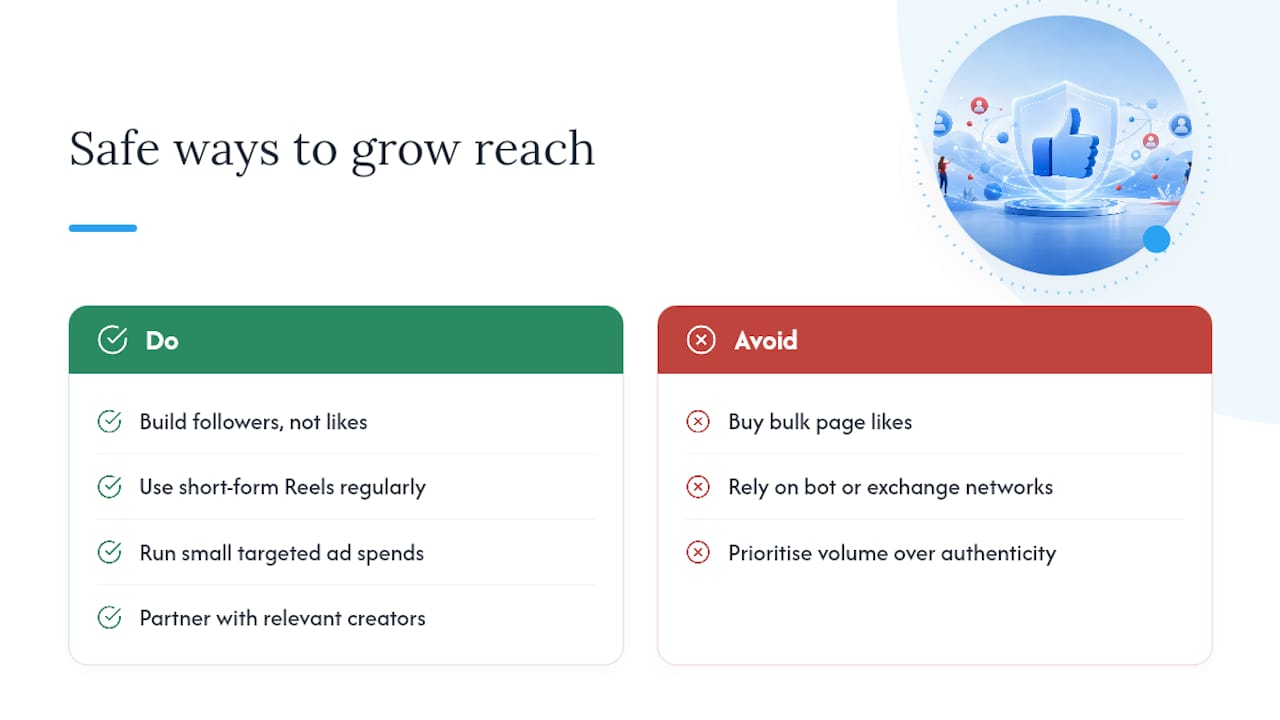
Followers first, always. Because Facebook now separates likes from follows, the smarter move is building your follower base directly. A page with 2,000 real followers who see your posts consistently will outperform a page with 10,000 likes and a hollow follow rate every time. Short-form Reels remain one of the most reliable ways to earn that following organically, since Meta continues to favour video formats in distribution.
Small, targeted ad spends beat bulk like purchases on almost every measure. Even a modest budget aimed at a well-defined audience seeds your page with people who actually match your customer profile, and those same engaged followers become the foundation for a Lookalike Audience that Meta can model accurately. Guides across the industry consistently point to targeted ads and content quality over purchased engagement precisely because the algorithm rewards interaction it can trust.
Partnerships and influencer collaborations bring exposure that reads as authentic because it is. A relevant creator sharing your page in front of their existing, engaged audience does what a bought like never can: it introduces you to people who are already primed to care.
Where does paid help still make sense? When it’s built around genuine accounts and transparent delivery rather than volume at any cost. A managed engagement service that sources real followers and interaction, rather than clicks from disinterested accounts, gives you the speed of a paid boost without the quality collapse that comes from bots or exchange networks. This breakdown of when paid options actually move reach covers the distinction in more detail, and this organic reach guide from a partner publication makes a similar case for prioritising sustainable growth over shortcuts.
Pro Tip: If you’re choosing between a like package and a follower package, take the followers every time. Followers are the only one of the two Meta actually uses to decide who sees your next post.
What a safer paid option should look like
If you decide paid help is worth it, the standard to hold any provider to is transparency about where the engagement actually comes from. Greedier Social Media has supported over a million users since 2013 with UK-focused delivery that never asks for passwords or account tokens, which is precisely the safeguard that separates a legitimate service from the risky auto-liker apps covered earlier.
That distinction matters because managed services that source genuine accounts and disclose their process sit in a different risk category to bot farms or token-based apps entirely. Before paying anyone for engagement, insist on these safeguards:
- No request for your password or an access token under any circumstance.
- A clear, plain-English explanation of where the accounts or engagement originate.
- A sample or trial delivery you can check against your own analytics before committing to a larger package.
- A refund or replacement policy if delivered engagement gets removed during a platform sweep.
Even ‘real-account’ likes often do not translate into engagement. The actual goal is engaged followers, not a bigger counter, and bought likes stay cosmetic unless paired with a genuine follow or interaction strategy.
A managed, authentic-engagement approach fits best when you need a credibility boost fast, for a product launch or a new page that looks too quiet to trust, provided the provider can show you exactly how the accounts behind that boost were sourced.
Pro Tip: Ask any provider for a small sample delivery first and check your Page Quality panel a week later. If nothing has moved in the wrong direction, you’ve got a reasonable signal the rest of the order will behave the same way.
The gap between what a like promises and what it delivers
Most advice on this topic still treats likes as a vanity metric to dismiss and moves on, which misses the more useful point: likes aren’t worthless, they’re just misapplied. A like is a credibility signal for a human visitor glancing at your page, not a lever for Meta’s distribution system. Conventional wisdom conflates the two and tells small business owners to either buy likes wholesale or ignore them completely, when the smarter move is treating them as one small piece of trust-building sitting well below followers and interaction in priority.
What the evidence actually supports is a hierarchy: real followers first, meaningful interaction second, and like count a distant third, useful mainly for that first-glance credibility check. Where paid help earns its place isn’t in bulk like purchases but in services that build the first two properly, genuine accounts, transparent sourcing, no token access. That’s a fundamentally different product to what most “1,000 likes for $10” sellers are offering, and businesses that conflate the two end up disappointed by the wrong thing.
If you take one action from this guide, make it the audit in the checklist above, run before you spend a penny, not after.
— Luna
Grow your Facebook presence without the guesswork
Greediersocialmedia gives you a faster route to a credible-looking, active Facebook page than sorting through anonymous like sellers yourself, because every package is built around genuine accounts and UK-targeted delivery rather than bot volume. No passwords, no access tokens, just real engagement delivered instantly to pages that need to look established fast.
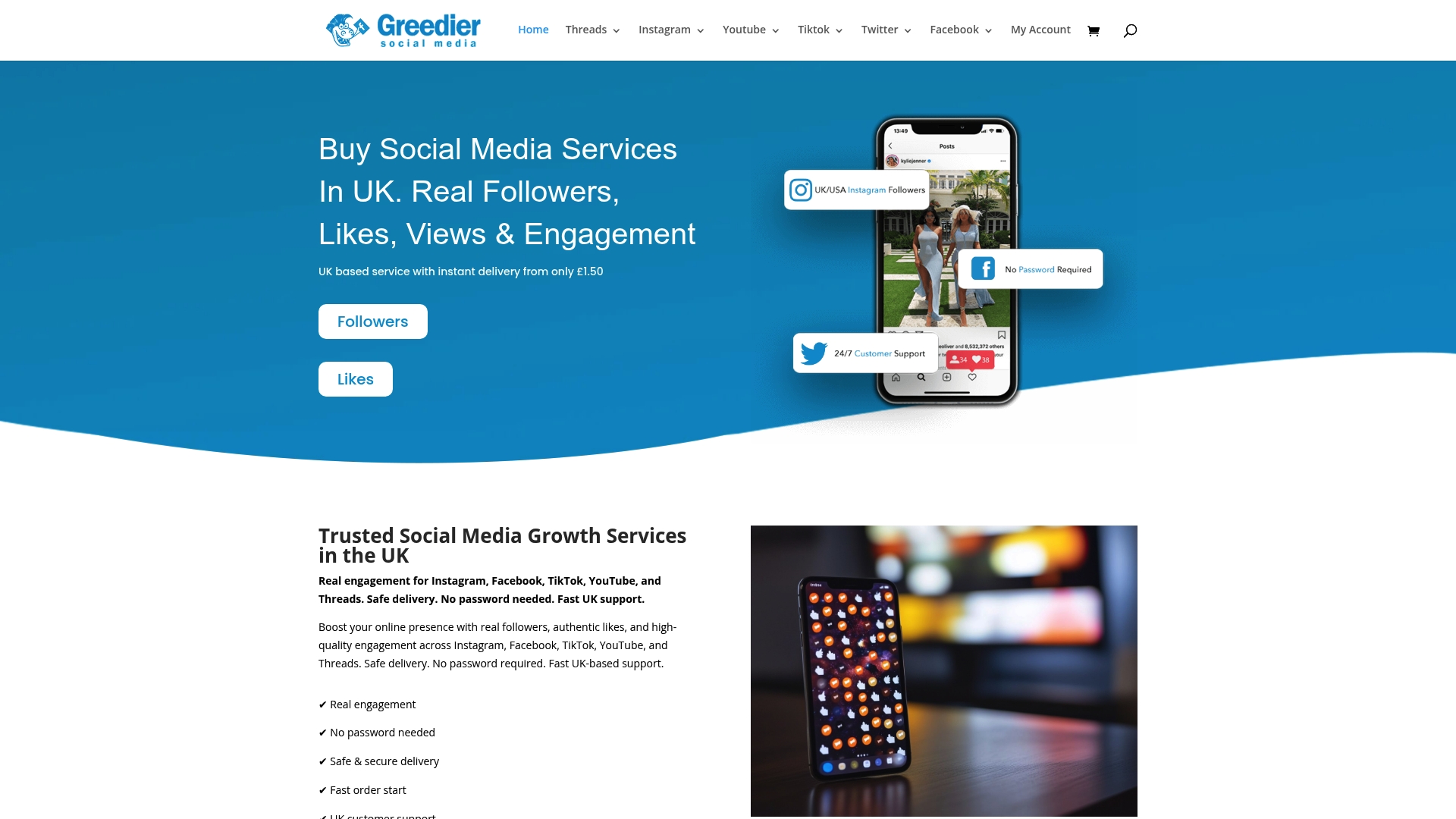
That matters most for a new page or a launch that needs social proof quickly, where a managed service closes the credibility gap without the removal risk that comes from bot farms or the security risk that comes from token-based apps. Since 2013, Greediersocialmedia has supported over a million users looking to turn a quiet page into one that reads as active and trustworthy from the first visit. If you’re weighing up paid options after reading this guide, browse the social media growth tactics available and pick a package that matches where your page stands today.
Sources
- Buying Facebook Page Likes: Why It Matters Less Now (2026) — Stormlikes
- Here’s what will happen if you buy Facebook likes — Tinuiti
- Messengerbot
- Facebook Page likes vs followers: what’s the difference? — HowSociable
FAQ
Is buying Facebook likes a good idea?
Generally, no. Bought likes rarely translate into engagement Meta rewards, and low-quality likes often get removed during integrity sweeps, leaving your page worse off than before you paid.
Can I make my liked pages private on Facebook?
Yes, you can adjust your privacy settings so your list of liked pages is visible only to you rather than to friends or the public.
Can others see what I have liked on Facebook?
By default, some liked pages may be visible depending on your privacy settings, but you can restrict this list to yourself at any time through your Facebook privacy controls.
How much does Facebook pay for 1,000 likes?
Facebook doesn’t pay page owners for likes at all. Any offer suggesting Facebook pays for likes is unrelated to how the platform actually works; instead, third-party sellers charge businesses for like packages, with market prices for “real” likes typically ranging widely depending on targeting and sourcing quality.