
Followers determine who is eligible to see your Facebook Page’s organic posts; likes are a public endorsement and a rough creative signal, nothing more. Track follower growth to protect your distribution pool, and treat likes as a diagnostic you pair with one attention metric and one action metric. Chase either number alone and you’ll misread your Page’s real performance.
TL;DR:
- Follower count determines who is eligible to see your Facebook posts, while likes are mainly a static measure of public endorsement.
- A Page can have many likes but fewer followers, which means organic reach is limited to the follower number, not likes.
- Growing followers through consistent posting and paid strategies offers a more predictable way to increase organic reach than relying solely on likes.
- Pair likes with a normalized Like Rate and action metrics like click-through rate to accurately assess content resonance and conversion.
- Regularly audit the gap between followers and likes in Page Insights to prevent chasing misleading metrics and focus on actual growth opportunities.
Table of Contents
- Facebook followers vs likes: what each one actually measures
- Why follower count drives your organic reach
- Reading likes properly: Like Rate, pairing metrics and 2026 benchmarks
- Settings, drift and how to audit the gap between your numbers
- The page owner’s checklist: what to track and what to do about it
- What operators actually watch when the numbers disagree
- Why growth services still have a place in a metrics-first strategy
- The metric that matters depends on the question you’re asking
- Sources
- FAQ
Facebook followers vs likes: what each one actually measures
Since Meta rolled out the New Pages Experience, followers and likes have been two genuinely separate metrics, not two names for the same thing. A follower subscribes to receive your Page’s updates in their feed. A like is a public endorsement, closer to a bookmark than a subscription. Meta’s own reporting reflects that split with two distinct fields: fan_count for likes and followers_count for follows, and Facebook’s Page metrics documentation confirms only the follower figure decides who is in line to receive your content.
Before the New Pages Experience, the two numbers moved together almost automatically, because liking a Page and following it were bundled into a single action. That’s no longer true. A person can:
- Like your Page without following it, keeping the public endorsement visible on their profile while opting out of your posts appearing in their feed.
- Follow your Page without ever liking it, quietly receiving updates with no public trace of the relationship.
- Unfollow after years of being a fan, so your like count sits untouched while your effective distribution pool quietly shrinks.
Here’s a scenario that trips up a lot of Page owners. A local bakery has built up 8,200 likes over six years but only 5,100 followers. Nothing is broken. A chunk of those original 8,200 people liked the Page back in 2015, moved city, muted the Page, or simply never followed it in the first place once Meta separated the actions. The like count is historical residue; the follower count is the live, working number.
This matters because the two figures answer different questions. Likes answer “how many people have publicly endorsed this Page, ever?” Followers answer “how many people are currently eligible to see what I post?” Confuse the two and you’ll either overestimate your organic reach or underestimate how much social proof your Page actually carries with new visitors.
Why follower count drives your organic reach
Followers are the eligible pool. Meta’s distribution system pulls from your follower list first, then applies its own relevance prediction to decide which of those followers actually see a given post in their feed. Likes play no comparable role in that mechanic. A Page could have 50,000 likes and 12,000 followers, and its organic reach ceiling is still set by the 12,000, not the 50,000.
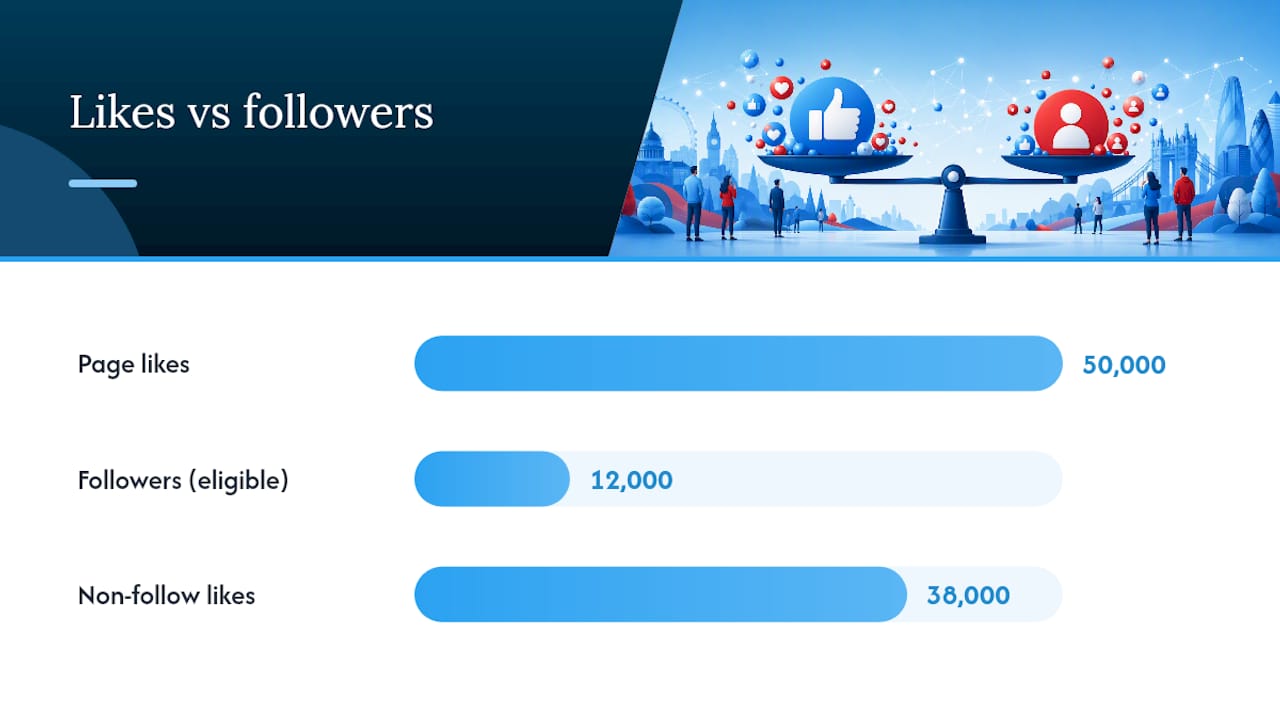
That ceiling isn’t a guarantee, either. Meta’s ranking system still filters within the follower pool based on predicted interest, which means a post rarely reaches every follower even on a good day. But the follower count sets the maximum; the algorithm decides how much of that maximum you get to use.
This is why two Pages with identical like counts can have wildly different organic performance. One has converted its likers into followers through consistent posting and clear calls to follow; the other has a large legacy like count sitting idle from a viral moment years ago, with most of that audience never having followed at all.
A few practical implications follow from this:
- Follower growth is the metric with a predictable payoff. More followers means a larger eligible audience, all else being equal.
- Like growth alone has no guaranteed reach effect. A spike in likes with no matching follow doesn’t expand who can see your next post.
- Paid distribution bypasses both. If you need reach now rather than in six months, boosting a post reaches beyond your follower pool entirely, which is one reason many Pages run organic follower building alongside a paid layer for anything time-sensitive.
- Engagement bait damages both metrics long-term. Explicit “like if you agree, share if you don’t” prompts are the kind of tactic UK regulatory guidance flags as manipulative, and Meta’s own ranking systems actively downrank it, so any short-term bump tends to cost you real distribution later.
If reach is genuinely the goal, growing followers is the lever with the clearer, more predictable return. Growing followers, whether through the tactics covered in Facebook Page growth guidance or through a faster paid route, gives you more control over your own distribution than hoping a post goes viral on likes alone.
Reading likes properly: Like Rate, pairing metrics and 2026 benchmarks
A raw like count tells you almost nothing on its own. A post with 400 likes could be a triumph or a disaster depending on whether it reached 2,000 people or 200,000. The fix is normalising the number, and the standard way to do that is Like Rate: likes divided by impressions (or likes divided by reach, if you prefer a person-based denominator).
Like Rate = Likes ÷ Impressions × 100
A post with 4,000 impressions and 60 likes has a Like Rate of 1.5%. That figure means nothing in isolation either, which is why you always pair it with two other numbers: one attention metric (watch time or 3-second video views) and one action metric (click-through rate or conversions). Like Rate tells you whether the creative resonates emotionally. The action metric tells you whether that resonance converts into anything you actually want.
Directional benchmarks for 2026 give you a rough sense of where “normal” sits:
These ranges, drawn from InfluencerDB’s 2026 Facebook likes analysis, are directional rather than absolute. Your own numbers will shift with industry, format, and how warm your audience actually is. What they’re useful for is spotting outliers: a cold-audience post pulling a 5% Like Rate is worth investigating, and a warm-audience post limping in at 0.4% probably has a creative problem.
Here’s a worked example. Say a Page runs two versions of the same offer as separate posts to a warm audience of existing followers.
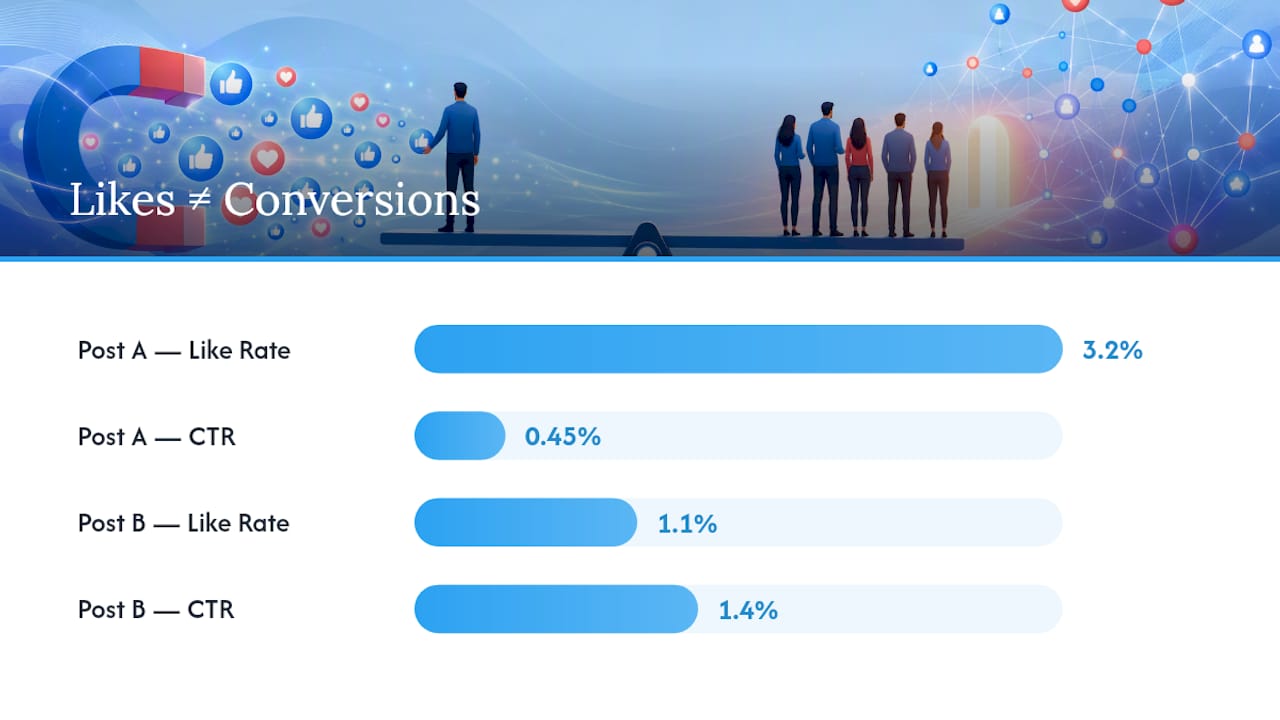
- Post A: 10,000 impressions, 320 likes, 45 clicks. Like Rate = 3.2%. CTR = 0.45%.
- Post B: 10,000 impressions, 110 likes, 140 clicks. Like Rate = 1.1%. CTR = 1.4%.
Post A looks like the crowd favourite on likes alone. But Post B, with a much lower Like Rate, is converting clicks at more than three times the rate. That’s the classic mismatch pattern flagged in InfluencerDB’s worked measurement example: high Like Rate with low CTR usually means the creative resonates but the call to action or offer doesn’t land. The fix isn’t to scrap the creative that got the likes. It’s to keep the hook or the visual that earned that resonance and rewrite the caption’s call to action or the landing page it points to.
Other mismatch patterns worth knowing:
- Low Like Rate, high CTR. The post isn’t emotionally sticky but the offer is strong. Fine for direct-response content, less fine if you’re trying to build brand affinity.
- High Like Rate, low reach. Often a distribution problem, not a creative one. Check whether the post was actually served to enough of your follower pool before blaming the content.
- Sudden like spike, flat CTR. Usually traceable to a share landing in an unrelated community or geography, not fraud. Worth a quick geographic breakdown before you assume anything sinister.
Pro Tip: Run every new hook or thumbnail through a Like Rate test on a small paid budget before committing spend to it at scale. If Like Rate clears your warm-audience benchmark but CTR lags, don’t discard the creative, fix the destination it points to.
Settings, drift and how to audit the gap between your numbers
Followers and likes drift apart for reasons that have nothing to do with your content quality, and most of them are mundane. Understanding the mechanics stops you chasing phantom problems.
- Historic likes with no follow attached. Anyone who liked your Page before the New Pages Experience split the two actions may never have actively followed. Their like still counts; their eligibility to see posts doesn’t.
- Active unfollows that leave the like intact. A person can unfollow a Page in their settings while their like remains visible on their profile. This is one of the most common causes of a like count that looks healthy against a shrinking follower count.
- Mutes and feed preference changes. Some users stay followers technically but adjust their preferences to see your Page rarely. This won’t show up as a number change but will show up in your reach.
- Geographic mismatch from boosted or shared posts. A post shared into a Page group or boosted to a broad location can pick up likes from people who never become followers, inflating the like count against a flat follower line.
- Bulk unlikes during audience clean-ups or rebrands. Rare, but a Page rename or a wave of bot-account removals by Meta can cause a visible dip in likes with no corresponding follower change.
To audit the gap, open Page Insights and compare the trend lines for followers_count and fan_count over the same period rather than looking at either number in isolation. If followers are flat or falling while likes stay level, your organic reach potential is quietly eroding even though the Page looks stable to a casual visitor. If likes spike sharply on a single post with no follower movement, check that post’s share and reach breakdown before assuming anything unusual is happening. Nine times out of ten it’s one shared post reaching a pocket of people who liked and moved on.
The page owner’s checklist: what to track and what to do about it
A workable Facebook reporting sheet doesn’t need to be complicated. It needs the right columns and a handful of calculated fields that turn raw numbers into decisions.
Minimum columns per post: date, format, impressions, reach, likes, comments, shares, clicks, watch time, and conversions. That’s it. Add spend if you’re running paid alongside organic.
From those raw numbers, calculate:
- Like Rate (likes ÷ impressions): your creative quality gauge.
- Engagement Rate (all interactions ÷ reach): a broader resonance check.
- CTR (clicks ÷ impressions): whether the resonance converts to action.
- CPM and CPA, if any spend is involved: whether that action is affordable.
One figure worth keeping in view here: genuinely meaningful engagement, saves, shares, and clicks, is a stronger indicator of content value than raw like volume, which is why a smaller group of highly engaged followers can outperform a larger group of passive ones on every metric that actually matters to a business.
Six actions to run this month:
- A/B test two hooks or thumbnails on a small paid budget before committing to either at scale.
- Verify your audience settings match your actual target geography and age range.
- Set a CTR threshold below which a high-Like-Rate post still doesn’t get scaled.
- Run a quick geography check whenever likes spike without a matching reach increase.
- Move to paid distribution once you’ve validated a creative organically and want reach beyond your current follower pool.
- Log every result in the same sheet, month over month, so patterns show up instead of one-off noise. A structured measurement approach makes this comparison far easier than eyeballing Insights every week.
What operators actually watch when the numbers disagree
Some social media growth services have been helping Facebook and Instagram Pages since 2013, and the pattern that shows up again and again in client reporting is the same one covered above: followers move the reach ceiling, likes move perception. When a client’s follower count climbs steadily, their organic reach tends to follow within a few weeks. When likes spike from a single shared post with flat follower growth, reach usually stays flat too.
In practice, the term “followers” has become the working industry standard for the audience a Page can actually reach, while a like now functions mostly as public social proof rather than a distribution signal. That distinction shapes how reporting gets built for clients: follower count sits in the reach column, like count sits in the credibility column, and the two are never averaged together into one vanity figure.
Three habits worth adopting from that reporting approach:
- Never report a single combined “audience” number. Split followers and likes on every report, always.
- Treat any like spike as a prompt to check reach and share origin before celebrating it.
- Set a minimum follower growth target every month, separate from any engagement target, because reach compounds and likes mostly don’t.
Why growth services still have a place in a metrics-first strategy
Building followers organically through consistent posting works, but it’s slow, and slow is expensive when a competitor launches this quarter. Some services exist for the gap between “we know followers drive reach” and “we don’t have eighteen months to build 10,000 of them.” The service delivers real followers and likes without ever asking for a password, which keeps account security entirely in the client’s hands while the growth happens.
That’s the practical difference from doing it all yourself: instant, supported growth on the metric that actually expands your reach ceiling, paired with the measurement discipline covered above so the new followers translate into a bigger eligible audience, not just a bigger number on the page. Clients typically layer this growth on top of their own creative testing, using Like Rate and CTR to keep refining posts while the follower base itself expands faster than an organic-only strategy would allow. If reach is the bottleneck holding your Page back, Greedier Social Media’s Facebook follower packages are built for exactly that, with UK-targeted delivery and support if anything needs sorting out after checkout.
— Irwin Lee
The metric that matters depends on the question you’re asking
Followers answer the reach question; likes answer the credibility question, and 2026’s measurement tools finally make that split usable rather than academic. Pair every like figure with an action metric before you trust it, and treat a rising follower count as the one number that reliably widens what your Page can achieve organically. The Pages that get this wrong aren’t failing at content, they’re measuring the wrong half of the equation and wondering why the other half won’t move.
Sources
FAQ
Are Facebook likes and followers the same?
No. A like is a public endorsement of your Page, while a follower has subscribed to see your posts; since the New Pages Experience they’re tracked as two separate figures that can move independently.
How many followers on Facebook are considered good?
There’s no universal target, because engagement quality matters more than raw volume: a smaller group of highly engaged followers can outperform a larger group of passive ones on reach and conversions alike.
Can you tell if someone keeps looking at your Facebook Page?
Facebook doesn’t surface individual viewing behaviour to Page owners; Page Insights shows aggregate reach and engagement figures only, never who specifically viewed a post.
Is it better to have friends or followers on Facebook?
For a personal profile, friends work differently to Page followers, but for any business or public Page, followers are what determine organic reach, so building that number matters more than friend counts ever will.
What’s the quickest way to grow followers rather than just likes?
Consistent posting with a clear “follow for updates” prompt converts likers into followers over time, and pairing that with a dedicated follower growth service speeds up the process considerably for Pages that need reach sooner.