
Comparing engagement pods vs buying likes comes down to which risk you’re more willing to accept.
Neither engagement pods nor bought likes build an audience that sticks around or spends money. Engagement pods give you a burst of early comments from other growth-hungry accounts, while bought likes inflate a single number without adding real interest, and both raise your risk of algorithmic penalties. Evidence-backed routes involve authentic engagement paired with proven paid reach options, which is what actually protects your account while growing it. The sections below explain when either shortcut might still be worth a cautious, time-boxed try.
TL;DR:
- Engagement pods require significant time investment for minimal organic reach and rarely lead to meaningful audience growth or conversions.
- Bought likes often come from fake or inactive accounts, offering quick increases in numbers but failing to produce engaged, converting followers.
- Both shortcuts produce short-term metric spikes but do not foster sustainable, genuine audience engagement or sales.
- Instagram’s detection systems target patterns like reciprocal interactions and generic comments that signal artificial activity.
- Authentic engagement, such as replying to comments and partnering with micro-influencers, outperforms artificial boosts in building lasting growth.
Table of Contents
- Engagement pods vs buying likes: what pods actually are
- Engagement pods vs buying likes: how paid likes get delivered
- Pods vs bought likes: comparing the real outcomes
- What does Instagram look for when detecting fake engagement?
- When, if ever, should you use pods or buy likes?
- What does the evidence say about authentic engagement?
- What actually works for growth: an editorial take
- A safer route than pods or bought likes
- Sources
- FAQ
Engagement pods vs buying likes: what pods actually are
An engagement pod is a group of Instagram accounts, usually organised on Telegram, WhatsApp or Discord, that agree to like and comment on each other’s posts within minutes of publishing. Some pods run manually, with members dropping links into a group chat and racing to engage before a set deadline. Others use semi-automated bots that ping members the moment someone posts, then track who reciprocates and who freeloads.

The theory behind pods is straightforward: Instagram’s algorithm rewards posts that get engagement fast, so a coordinated burst in the first 30 to 60 minutes should signal to the platform that content is worth pushing to more feeds. Membership usually comes with quotas. Miss too many posts and you get removed. Larger pods split into niche subgroups, food accounts with food accounts, fitness with fitness, on the theory that relevant engagement looks more credible than random cross-niche activity.
What you actually get for that effort is patchy. Comments in pods tend to be generic: “Great post!”, “Love this!”, emoji strings, the kind of text that adds nothing and, according to Hootsuite’s engagement research, carries far less algorithmic weight than a comment showing genuine interest.
Running a pod properly eats time:
- Checking group chats multiple times a day to hit engagement windows
- Writing dozens of reciprocal comments on posts you have no real interest in
- Managing quota tracking or getting removed for inactivity
- Coordinating post timing around the pod’s active hours rather than your own audience’s habits
Short-term, your like and comment counts jump. Reach barely moves, because the audience doing the liking is other pod members chasing the same trick, not people who discovered you organically.
Engagement pods vs buying likes: how paid likes get delivered
Buying likes means paying a vendor a fixed sum to add a set number of likes to a post, usually delivered within hours rather than the days or weeks a pod takes to build momentum. The market splits into three rough tiers. At the bottom, bot networks generate likes from fake or dormant accounts with no profile photo and zero posting history. In the middle, click farms use real people, often paid a fraction of a penny per action, to tap “like” on request. At the top, more reputable providers deliver likes from active, categorised accounts and offer some geographic or interest targeting.
Vendor pages love to promise instant delivery and precise geographic targeting, phrases like “likes from UK-based accounts” or “delivered within 30 minutes.” Those claims are often only loosely verified. Bot farms rarely disclose account origin honestly, and geographic targeting on cheap packages is frequently a marketing flourish rather than a technical guarantee.
The trade-off compared with pods:
- Bought likes cost money but almost no time; pods cost time but no direct fee
- Paid likes typically appear within hours; pod-driven growth builds over weeks of sustained participation
- Quality varies enormously by provider, cheap bot packages carry higher detection risk than vetted services
- Neither option, done cheaply, produces likes from people who will ever see your next post organically
Price and speed are the obvious selling points. What vendors rarely mention is that a like from a bot account contributes nothing to the engagement quality that actually signals audience interest: comments, shares and saves.
Pods vs bought likes: comparing the real outcomes
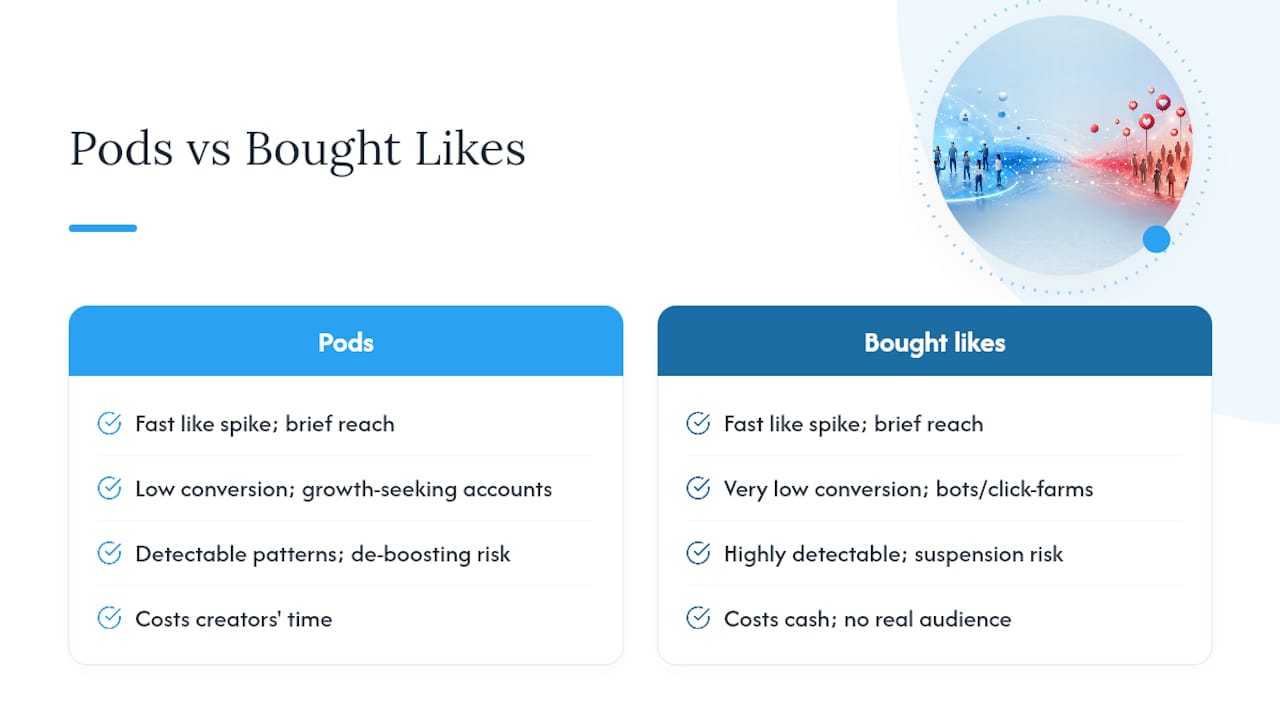
Both tactics produce the same illusion in the first 24 hours: numbers climb, the post looks popular, and it feels like momentum. That is where the similarity ends.
1. Immediate metric lift. Pods and bought likes both spike your like or comment count quickly. Instagram’s algorithm does register early activity, so a post can briefly reach a slightly wider audience before the effect fades.
2. Audience quality and conversion. This is where both tactics collapse. Pod engagement comes from other accounts trying to grow, not from people interested in what you sell, and research on pod outcomes shows this rarely converts into a sustainable, buying audience. Bought likes are worse still, since bot or click-farm accounts never click a link, never message you, and never buy anything. An audience built from growth-seeking accounts rarely clicks through or saves content, so conversion numbers lag even when the like count looks strong.
3. Platform risk and detectability. Instagram’s systems flag unnatural patterns: identical comment text, reciprocal engagement clusters, and sudden like spikes from accounts with no history. The likely penalty path runs from quiet de-boosting, where your content simply stops reaching people, to shadowbanning, to outright suspension for repeat offenders.
4. Time versus money. Pods cost hours you could spend on content or genuine community building. Bought likes cost cash you could put toward legitimate paid reach. Either way, the opportunity cost is the same: effort or budget spent on something that does not build the audience you actually need.
Pro Tip: Check your insights for a mismatch between likes and profile visits. If a post gets hundreds of likes but almost no profile clicks or link taps, that gap is usually the first visible sign of artificial engagement, yours or a competitor’s.
What does Instagram look for when detecting fake engagement?
Instagram’s detection systems watch for patterns that real audiences almost never produce naturally.
- Reciprocal engagement clusters: the same set of accounts liking and commenting on each other’s posts repeatedly
- Near-identical comment text appearing across unrelated accounts within minutes of each other
- Engagement velocity that spikes far faster than a post’s normal reach history would support
- Networks of accounts with thin posting history suddenly engaging together.
One figure worth sitting with: engagement pods can deliver a visible short-term lift but typically fail to build a sustainable, converting audience, and can quietly dilute the quality of your follower base over time. That dilution is the real cost, since it shows up months later as a following that never buys, never shares, and drags down your average engagement rate.
The consequences build gradually rather than arriving as a single ban notice. Reach on individual posts drops first. Then discovery through hashtags and the Explore tab thins out. Reputationally, savvy followers and brand partners can often spot inflated numbers just by comparing your like count against comment quality and profile visits.
To check your own account, look at three things together: whether recent likes came from accounts with genuine posting history, whether comments read as generic or specific, and whether link clicks or saves track proportionally with likes. A wide gap there is your earliest warning sign. If you spot it, pause any pod activity or paid engagement immediately and let your metrics settle before assessing the damage.
When, if ever, should you use pods or buy likes?
There are narrow situations where a cautious test carries limited downside, but they are the exception, not the strategy.
- Time-boxed, low-stakes experiments. Testing a small, genuinely niche pod, five or six accounts in your exact sub-niche, for a fortnight, then reviewing whether comment quality and profile visits actually improved, is a reasonable trial. Anything transactional and larger than that rarely justifies the risk.
- Choose official paid reach over bought likes when you need real audience targeting. Instagram’s own ad tools target actual demographics and interests and tie spend to measurable outcomes such as clicks and conversions. This is something paid reach that targets genuine audiences can offer and bought likes structurally cannot.
- Walk away from both if you see red flags. These include vendors promising specific follower counts within hours, pods with mandatory quotas and no niche relevance, or any offer requiring your password.
- Run through a short checklist first: Does this tactic target people who might actually buy from me? Can I explain the source of this engagement to a client or partner without embarrassment? Would I still do this if Instagram announced tomorrow it was cracking down on exactly this pattern?
What does the evidence say about authentic engagement?
Platforms that study engagement at scale keep arriving at the same conclusion: quality beats quantity, and speed of response beats volume of likes. Buffer’s research on engagement strategy finds that replying to comments doesn’t just flatter individual followers, it fosters repeat interactions that compound into longer-term reach. Sprout Social’s findings go further, showing that fast comment replies correlate with higher subsequent engagement, one of the simplest levers available to any creator.
Comments, shares and saves carry more algorithmic weight than a like ever will, because they require more effort from the person doing them, and effort is the signal platforms trust.
That single distinction, effort as a proxy for genuine interest, explains why a pod comment reading “Nice!” does almost nothing while a real question in your comments section does quite a lot.
Practical tactics that consistently outperform artificial shortcuts include:
- Building a daily routine of replying to every comment within the first hour of posting
- Using formats that invite interaction directly: polls, either/or questions, carousel posts that reward a second swipe
- Partnering with micro-influencers in your niche whose followers overlap with your target customers
- Tracking saves and shares alongside likes, since those metrics correlate far more closely with people who eventually convert
A UK skincare brand that swapped a monthly pod subscription for a strict one-hour comment-reply routine and two influencer collaborations a month is a fair illustration of the shift creators tend to see: engagement quality rises even when the raw like count grows more slowly. Greediersocialmedia has watched similar patterns across the businesses it works with, where targeted, real engagement consistently outlasts anything artificial.
What actually works for growth: an editorial take
Authentic engagement wins for most creators because it is the only tactic that compounds. A reply you write today shapes whether that follower comments again next week, and that pattern is what Instagram’s algorithm has been trained to reward. Pods and bought likes don’t compound, they decay, because the “engagement” behind them was never connected to genuine interest in what you post.
That said, a short, tightly scoped test isn’t reckless if you treat it as data rather than strategy: a fortnight in a genuinely niche pod, measured against real profile visits, tells you something honest about your content that a permanent subscription never will.
The trade-off is patience versus risk. Authentic growth is slower to show on a dashboard and far less likely to cost you your account.
— Luna
A safer route than pods or bought likes
Greediersocialmedia exists precisely because pods and cut-price bought likes put your account at risk for a number that does nothing for your business. Instead of coordinating with strangers in a Telegram group or gambling on bot-driven vendors, you get real followers, likes and views delivered without ever handing over your password, with UK-based support if something looks off.
The difference that actually matters here is control: you choose the package, the delivery is instant, and there’s no ongoing group quota or vendor guesswork about where the engagement came from. If you want to see what a properly built engagement strategy looks like in practice, the social media growth tactics guide walks through the approach Greediersocialmedia uses with its clients. Start with a small package on your next post, compare the profile visits against a typical pod-boosted post, and judge the difference for yourself.
Sources
- Social media engagement guide — Buffer
- Social media engagement: how to boost yours — Hootsuite
- Social media engagement: advice and findings — Sprout Social
- Socialk
FAQ
What is the 5-3-1 rule on Instagram?
The 5-3-1 rule is a content routine suggesting you engage consistently with multiple accounts, comment thoughtfully on several posts, and share content daily to build genuine relationships rather than relying on artificial boosts.
Can Instagram detect bought likes?
Yes. Instagram’s systems flag unnatural patterns like rapid like spikes from accounts with thin posting history, and detection typically leads to gradual de-boosting rather than an immediate ban.
Is 40 likes on Instagram a lot?
It depends entirely on your follower count and niche; a certain number of likes on a smaller follower base may suggest healthy engagement, while the same number on a much larger follower base signals a problem worth investigating.
What are engagement pods?
Engagement pods are coordinated groups, often organised on Telegram or Discord, where members agree to like and comment on each other’s posts quickly after publishing to trigger algorithmic visibility, though the resulting audience rarely converts.