
TL;DR:
- Community social media engagement emphasizes meaningful two-way interactions that foster trust and loyalty.
- It differs from basic metrics by focusing on quality, peer-to-peer dialogue, and sustained relationships.
Community social media engagement is the active, quality-driven interaction between a brand and its online community, creating mutual value through meaningful dialogue rather than passive content consumption. Most social media managers track likes and follower counts, yet those numbers tell you almost nothing about whether your audience trusts you, advocates for you, or returns to you. This guide explains what community engagement actually means, how it differs from standard social media metrics, which strategies move the needle, and how to measure what genuinely matters. Platforms like Instagram, LinkedIn, and Threads all reward it differently, and the gap between brands that understand this and those that do not is widening fast.
What is community social media engagement?
Community social media engagement is the practice of building participatory, two-way relationships between a brand and its members, rather than broadcasting content and counting passive reactions. The industry term for the broader activity is social media engagement, defined by Brandwatch as likes, comments, shares, saves, clicks, and direct messages that signal active participation, with engagement rate normalising these actions across audience sizes. Community engagement goes a step further. It prioritises the quality and depth of those interactions over their raw volume.
Think of it this way: a post with 500 comments debating a real question your brand raised is worth more than a post with 5,000 likes and zero replies. The comments show that members are talking to each other and to you. That peer-to-peer dialogue is the defining feature of genuine community engagement, and it is what separates a community from a simple audience.
How does community engagement differ from general engagement?
General social media engagement is largely transactional. A user sees a post, taps a heart, and scrolls on. Community engagement is participatory. Members respond to each other, share experiences, and contribute ideas that shape the brand’s direction. That shift from one-way to many-to-many interaction is the critical distinction.

Buffer’s research on community building confirms that the mindset shift from “getting more engagement” to “helping members connect deeply” increases community health and long-term sustainability. The brand becomes a facilitator rather than a broadcaster. Members derive value from each other, not just from the brand’s content.
The qualitative benefits compound over time:
- Trust: Members who feel heard are far more likely to defend a brand publicly during a crisis.
- Loyalty: Peer connections within a community create switching costs that no discount can replicate.
- Advocacy: Satisfied community members recommend the brand without being asked.
Sprout Social notes that genuine engagement is harder to manufacture than vanity metrics, and that sustained meaningful interactions and user-generated content are the most reliable indicators of brand health. That is the commercial case for investing in community over reach.
Pro Tip: Before your next campaign, ask yourself whether your content invites a reply or simply expects a reaction. Reframe one post per week as a direct question to your community and track whether comment quality changes.
Which strategies effectively boost community engagement?
Effective community engagement strategies share one quality: they prioritise participation over performance. Here are the approaches that consistently produce results.
Reply to every comment. This is the single highest-return activity available to most social media managers. Replying to every comment can lift engagement by up to 42% on Threads, 30% on LinkedIn, 21% on Instagram, and 8% on X. Those are not marginal gains. They reflect the fact that algorithms treat reply activity as a signal of content quality and reward it with greater reach.
Use social listening to join existing conversations. Your community is already talking about topics relevant to your brand. Tools like Brandwatch and Sprout Social surface those conversations so you can participate authentically rather than waiting for people to come to you. Joining a thread where someone has a genuine question about your industry builds more trust than any scheduled post.
Create dedicated spaces for ongoing interaction. Facebook Groups, LinkedIn Communities, and Discord servers give members a place to connect beyond your main feed. These spaces generate participatory dialogue and peer-to-peer support that a standard profile page cannot replicate.
Close the feedback loop transparently. When members suggest something and you act on it, say so publicly. The UK Government’s community engagement guidance highlights that clear expectations on how feedback is used are essential for long-term trust. A simple post saying “You asked for X, here it is” does more for loyalty than a month of promotional content.
Align your content mix with community needs. Rotate between informational posts, discussion prompts, behind-the-scenes content, and member spotlights. Variety keeps participation high and prevents the community from feeling like a one-brand broadcast channel.
Pro Tip: Respond to new comments within 15–20 minutes of publishing. Early rapid responses signal algorithms that your content is generating genuine interest, which directly increases reach and compounds engagement quality.
You can find a deeper breakdown of platform-specific tactics in this guide to growing social media organically for long-term results.
How can brands measure community social media engagement?
Measurement starts with understanding the difference between engagement count and engagement rate. Engagement count is the raw number of interactions. Engagement rate expresses those interactions as a percentage of the audience reached, which allows fair comparison across accounts of different sizes. A brand with 1,000 followers and a 12% engagement rate is performing far better than a brand with 100,000 followers and a 0.5% rate.
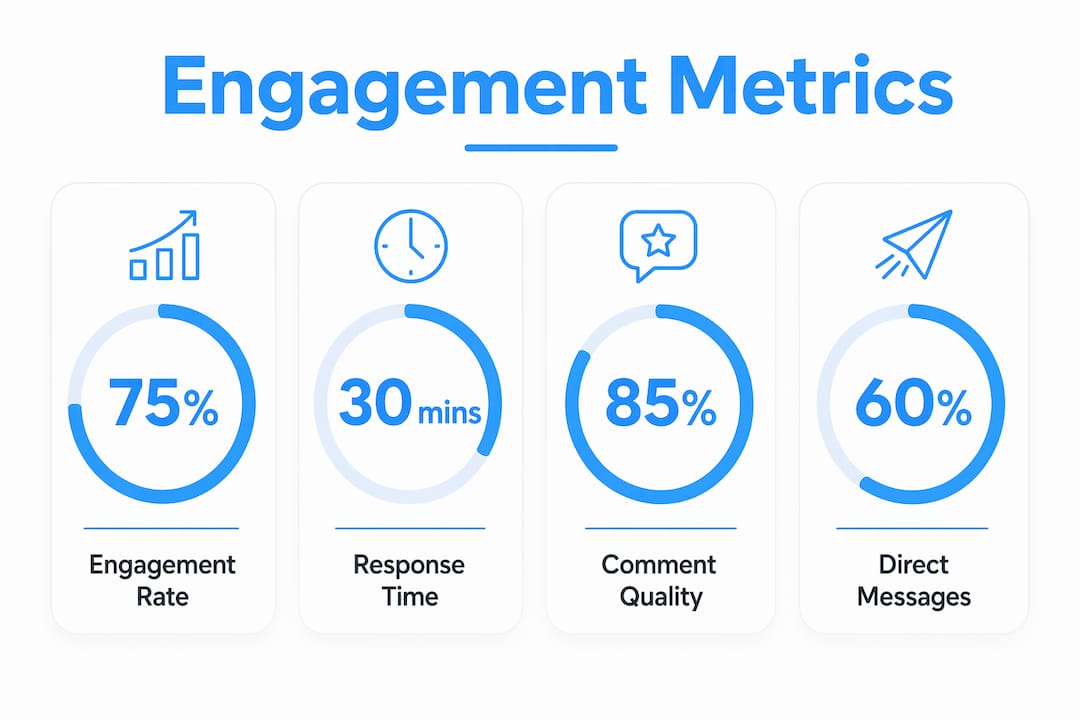
Not all engagement actions carry equal weight. The table below shows which actions signal the strongest community connection.
| Engagement Action | Signal Strength | What It Indicates |
|---|---|---|
| Direct messages | Very high | Personal trust and intent to connect |
| Comments (substantive) | High | Active participation and genuine interest |
| Shares | High | Member advocacy and content endorsement |
| Saves | Medium | Content utility and return intent |
| Likes | Low | Passive acknowledgement, minimal commitment |
| Follower count | Very low | Reach potential only, not relationship quality |
Comments, shares, and direct messages are the actions that most reliably indicate a healthy community. Likes and follower counts are reach indicators, not relationship indicators. Brands that rely on follower counts alone miss the deeper signals that predict loyalty and advocacy.
Beyond the numbers, qualitative analysis matters. Read your comments. Are members asking questions, sharing stories, or tagging friends? That texture tells you whether your community is growing in health or just in size. Engagement data also functions as consumer intelligence: recurring questions in comments reveal content gaps, product confusion, or unmet needs that no survey would surface as quickly.
What pitfalls should social media managers avoid?
The most common mistake is confusing an audience with a community. An audience receives content. A community generates many-to-many interactions where members support and converse with each other, not just with the brand. If your comment section is full of brand replies but empty of member-to-member exchanges, you have an audience, not a community.
Other pitfalls worth avoiding:
- Feature-first thinking. Launching a Facebook Group or a Discord server because a competitor has one is not a strategy. Engagement tactics must follow a clear objective, not the other way around. Define what you want the community to achieve before choosing the platform.
- Platform and tactic bloat. Spreading effort across too many channels dilutes quality. Cut the activities that do not serve your engagement objectives and concentrate resources where your community actually lives.
- Inconsistent response times. Members notice when a brand replies within minutes on some days and goes silent for a week on others. Inconsistency signals that the community is not a priority, which erodes trust faster than a single bad post.
- Treating engagement as a campaign. Community management on social media is not a sprint. It requires sustained, daily attention. Brands that treat it as a quarterly initiative consistently underperform those that build it into their operational rhythm.
Pro Tip: Review your community engagement strategy every quarter. Treat it as a living tool and remove any tactic that no longer serves your objectives. Pruning weak activities frees up time for the ones that genuinely build connection.
How to apply community engagement to boost your online presence
Applying community engagement principles effectively means connecting them to specific business goals. Vague intentions to “be more engaging” produce vague results. Instead, define whether your goal is retention, advocacy, product feedback, or new audience growth, then build your community engagement strategies around that objective.
Community advocates are among the most cost-effective assets a brand can develop. A member who regularly defends your brand, answers questions on your behalf, and shares your content organically extends your reach without any paid spend. Identifying and nurturing these advocates through recognition, early access, or direct involvement in decisions creates a self-reinforcing cycle of loyalty.
For small businesses, the comparison between paid and organic engagement is worth understanding clearly.
| Approach | Speed | Cost | Longevity | Community Depth |
|---|---|---|---|---|
| Paid engagement | Fast | High | Short-term | Low |
| Organic community engagement | Gradual | Low to medium | Long-term | High |
| Combined approach | Moderate | Medium | Sustainable | Medium to high |
Paid activity can accelerate visibility, but authentic engagement outperforms artificial metrics for long-term brand health. Organic community engagement builds the trust and loyalty that paid reach cannot buy. The most effective approach for small businesses combines a modest paid investment to reach new audiences with a consistent organic strategy to convert those new arrivals into genuine community members.
When internal capacity is limited, professional community management on social media can maintain response quality and consistency without overloading your team.
Key takeaways
Community social media engagement requires consistent, quality-driven interaction across comments, shares, and direct messages to build the trust and loyalty that follower counts alone cannot measure.
| Point | Details |
|---|---|
| Define engagement correctly | Engagement rate, not follower count, is the reliable measure of community health. |
| Prioritise two-way dialogue | Many-to-many interactions distinguish a genuine community from a passive audience. |
| Reply fast and consistently | Responding within 15–20 minutes post-publication lifts reach and signals algorithm quality. |
| Follow strategy, not features | Choose platforms and tactics based on clear objectives, not competitor behaviour. |
| Combine paid and organic effort | Paid reach builds visibility; organic community engagement builds lasting loyalty. |
Why engagement strategy beats engagement tactics every time
I have watched brands pour serious budget into content calendars, paid promotions, and follower acquisition, only to find their communities silent. The posts go out, the likes trickle in, and nothing actually happens. The problem is almost always the same: tactics without strategy.
What I have found, working with brands across different sectors, is that the ones with genuinely thriving communities share one habit. They think about their members before they think about their metrics. They ask what the community needs this week, not what the algorithm rewards this week. Those two questions often have different answers, and the brands that consistently choose the first one build something that lasts.
The shift from transactional to relational engagement is not a philosophical nicety. It shows up directly in retention rates, in the quality of user-generated content, and in how a brand weathers a public criticism. A community that trusts you will defend you. An audience that merely follows you will scroll past.
Vanity metrics are seductive because they are easy to track and easy to inflate. Genuine engagement is harder to manufacture, which is exactly why it is worth more. If your current strategy optimises for impressions and follower growth, you are measuring the wrong things. Shift your attention to comments, direct messages, and shares, and you will start to see what your community actually thinks of you.
The brands I respect most in this space treat their social media presence as a long-term investment in brand health, not a short-term traffic channel. That mindset is the foundation everything else is built on.
— Luna
How Greediersocialmedia can strengthen your community engagement
Building genuine community engagement takes time, consistency, and the right foundation. Greediersocialmedia has supported over a million users since 2013, helping UK businesses and creators grow their presence through authentic, real interactions rather than inflated numbers. Whether you are starting from scratch or looking to accelerate an existing community, the team offers tailored support that fits your goals.
Explore Greediersocialmedia’s social media growth tactics to find practical, proven approaches for building the kind of online presence that converts followers into loyal community members. From real Instagram followers to targeted engagement packages, every service is designed to complement your organic strategy and deliver measurable results without compromising your account security.
FAQ
What is community social media engagement in simple terms?
Community social media engagement is the quality-driven, two-way interaction between a brand and its online members, including comments, shares, and direct messages that build trust and loyalty over time.
How does engagement rate differ from follower count?
Engagement rate measures the percentage of your reached audience who actively interacted with your content. Follower count only indicates potential reach, not actual relationship quality or community health.
Which social media actions signal the strongest community connection?
Direct messages, substantive comments, and shares are the strongest signals of genuine community engagement. Likes indicate passive acknowledgement and carry far less weight as indicators of loyalty.
How quickly should brands respond to comments?
Responding within 15–20 minutes of publishing is the most effective window. Early replies signal algorithms that content is generating real interest, which increases reach and encourages further community interaction.
Is paid engagement worth it for small businesses?
Paid engagement accelerates visibility but does not build lasting community trust on its own. The most effective approach combines paid reach to attract new audiences with a consistent organic engagement strategy to convert them into genuine community members.