
The bought followers drop rate varies enormously depending entirely on the provider chosen.
Bought followers do drop, but how much depends entirely on who you buy from. The fix isn’t avoiding purchases altogether. It’s measuring retention at 7, 14, and 30 days, favouring staggered delivery over instant bulk drops, and treating any provider who won’t discuss refill terms as a warning sign.
TL;DR:
- Retention rates largely depend on the quality and targeting of the provider, with 90% or higher at 30 days indicating healthy followership.
- Most follower drops occur within the first seven days due to automated platform enforcement and low-quality bot accounts being removed.
- Authentic providers build refill windows around the initial 30-day period, but losses can continue beyond that with platform sweeps.
- Staggered delivery and pairing purchases with real engagement help maximize retention and reduce overall follower loss.
- Buying followers is a short-term tactic best suited for launches or early-stage boosting, not for sustained organic growth.
Table of Contents
- What is the typical bought followers drop rate?
- Why do bought followers disappear?
- When do most follower drops happen?
- How do you calculate your actual retention rate?
- How can you minimise follower loss after buying?
- How Greedier Social Media approaches retention
- When does buying followers actually make sense?
- Real followers, no password, built for UK growth
- Sources
- FAQ
What is the typical bought followers drop rate?
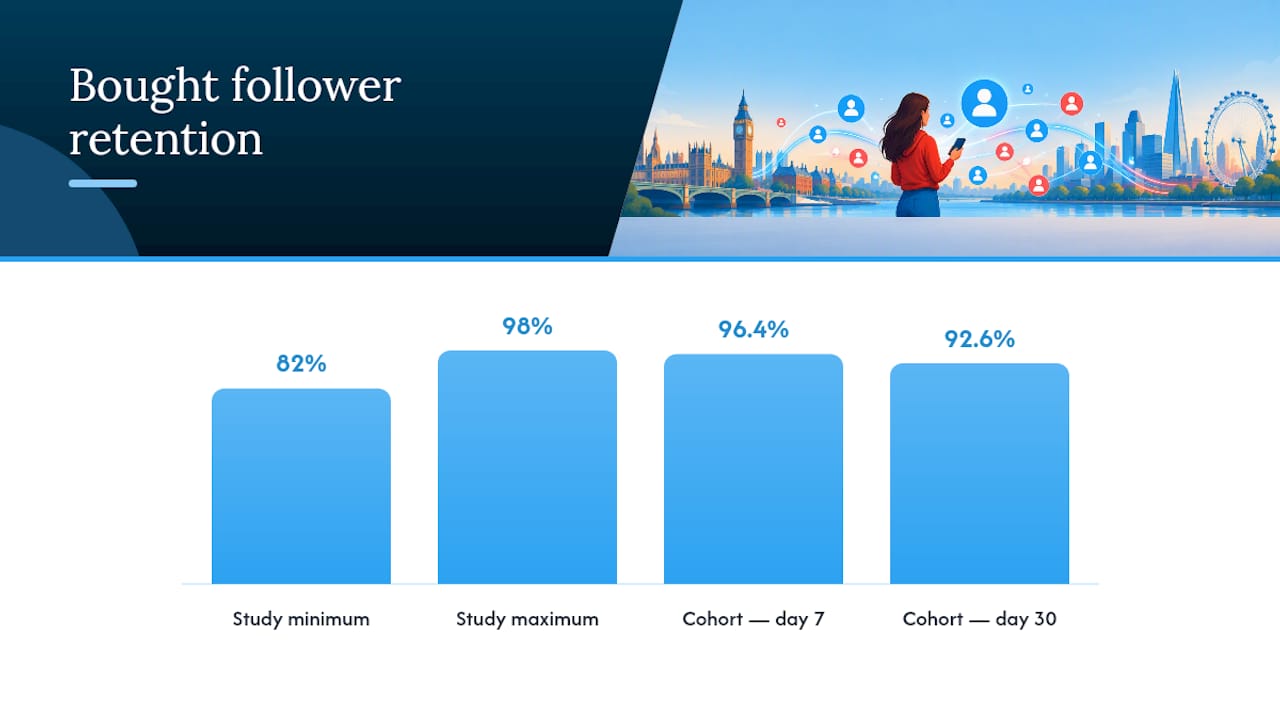
Retention varies more by provider than by platform. A 2026 retention pilot tracking real orders across several services found 30-day retention ranging from about 82% up to 98%, depending almost entirely on how the followers were sourced rather than what was paid for them, according to HowSociable’s follower retention study.
That spread gives you a working scale for judging any provider:
- 90% or higher at 30 days: healthy. This is what recruited or organically sourced followers typically deliver.
- 85–90% at 30 days: acceptable but worth watching, especially if the drop is concentrated in the first week.
- Below 85% at 30 days: a warning sign. This range usually points to bulk bot deliveries with no targeting.
- Below 75%: treat as a failed order and request a refill or refund.
Statistic to remember: the same cohort study showed retention slipping from around 96.4% at day 7 to 92.6% at day 30, which tells you most of the damage happens early rather than trickling in steadily over the month.
Platform also matters. Instagram and TikTok both run aggressive automated enforcement, so accounts that looked legitimate at delivery can vanish weeks later when a sweep catches them. Facebook and YouTube tend to show slower, steadier attrition rather than sharp cliffs, though the same quality rules apply everywhere.
Why do bought followers disappear?
Three forces drive nearly every drop you’ll see, and they rarely act alone.
- Platform enforcement. Meta’s own enforcement data shows automated systems removing millions of fake or violating accounts daily, and its Q1 2025 adversarial threat report documents multiple large-scale takedowns of coordinated inauthentic networks. Any account built purely to sell followers is a target.
- Bot-account economics. Cheap followers are disposable by design. Providers running bulk bot farms expect a chunk of their inventory to get banned, and they price accordingly. That cost gets passed to you as churn.
- Engagement mismatch. Bought followers almost never like, comment, or share. Buffer’s creator growth research points to consistent posting and genuine engagement as the actual drivers of long-term reach, and flags inauthentic audience signals as something platforms actively penalise in distribution.
The account that got you cheap numbers today can vanish next month, and the follower count was never the point. It was supposed to be social proof, and dead accounts don’t provide any.
When do most follower drops happen?
Drops follow a fairly predictable rhythm once you’ve tracked a few orders.
- Days 1 to 7: the sharpest drop-off, typically 3 to 5% of the total order, as the weakest or most obviously fake accounts get flagged fastest.
- Days 8 to 14: a smaller secondary dip as slower enforcement sweeps catch remaining low-quality accounts.
- Day 30: the number that matters most for judging a provider, since it reflects what survived the first enforcement wave.
- Every few months after: periodic platform-wide sweeps can trim a further slice of any audience, bought or organic, as coordinated networks get identified and removed months after creation.
Reputable providers build refill windows around this pattern, usually covering the first 30 days, because that’s where nearly all the predictable loss occurs. A longer-term test buying 5,000 followers found losses continuing to mount well past that window, which is exactly why a 30-day-only guarantee has limits worth understanding before you buy.
How do you calculate your actual retention rate?
The formula is simple: (followers remaining ÷ followers delivered) × 100.
Running the numbers is only half the job. You also need to sample the followers themselves:
- Check 20 to 30 random profiles for default avatars, scrambled or numeric handles, and zero posts.
- Compare follower count to following count. Accounts following thousands while having almost no followers of their own are a red flag.
- Look at engagement, not just numbers. If a post gets 5,000 followers but 12 likes, something’s wrong.
- Run the account through a free audit tool, but treat the result as a rough signal, not proof. These tools flag patterns; they can’t verify intent or confirm every account is genuinely fake.
Pro Tip: Before committing to a large order, run a small pilot purchase first and track it against this checklist. It tells you more about a provider’s real quality than any sales page will, and it costs far less to find out early.
If a refill guarantee is offered, get the scope in writing: how many days it covers, whether there’s a cap on replacements, and whether it applies to the whole order or just a percentage. Our guide to spotting fake follower warning signs covers the visual and behavioural tells in more depth.
How can you minimise follower loss after buying?
Retention is largely a provider decision, but a few habits make a measurable difference regardless of who you use.
- Choose providers using staggered delivery and demographic targeting. Services built on recruited or organically sourced followers measured 95–98% retention in testing, against 75–82% for simple bulk bot drops.
- Spread purchases over days, not minutes. A sudden spike of thousands of followers overnight is exactly the pattern automated detection looks for.
- Mix bought growth with real content and engagement. Posting consistently and replying to comments gives the algorithm genuine signals to work with, alongside whatever organic growth strategy you’re already running.
- Track your own 7/14/30-day retention on every order. Don’t rely on the provider’s word for it.
- Get refill terms in writing before you pay, not after a drop already happened.
A pattern of poor retention isn’t a one-off glitch. It’s how that provider operates.*
Know when to walk away entirely. One bad batch is worth a refund request. A pattern of consistently poor retention, evasive refill terms, or support that goes quiet is a sign to move your budget elsewhere.
How Greedier Social Media approaches retention
An established provider has supplied UK and US-targeted engagement packages since 2013, without ever requesting a client’s password, across Instagram, Facebook, TikTok, and YouTube. Retention gets monitored per campaign, with support on hand to sort refills when an order underperforms. The goal is straightforward: deliver followers that behave like a real audience, not a number that quietly bleeds out over the following month.
When does buying followers actually make sense?
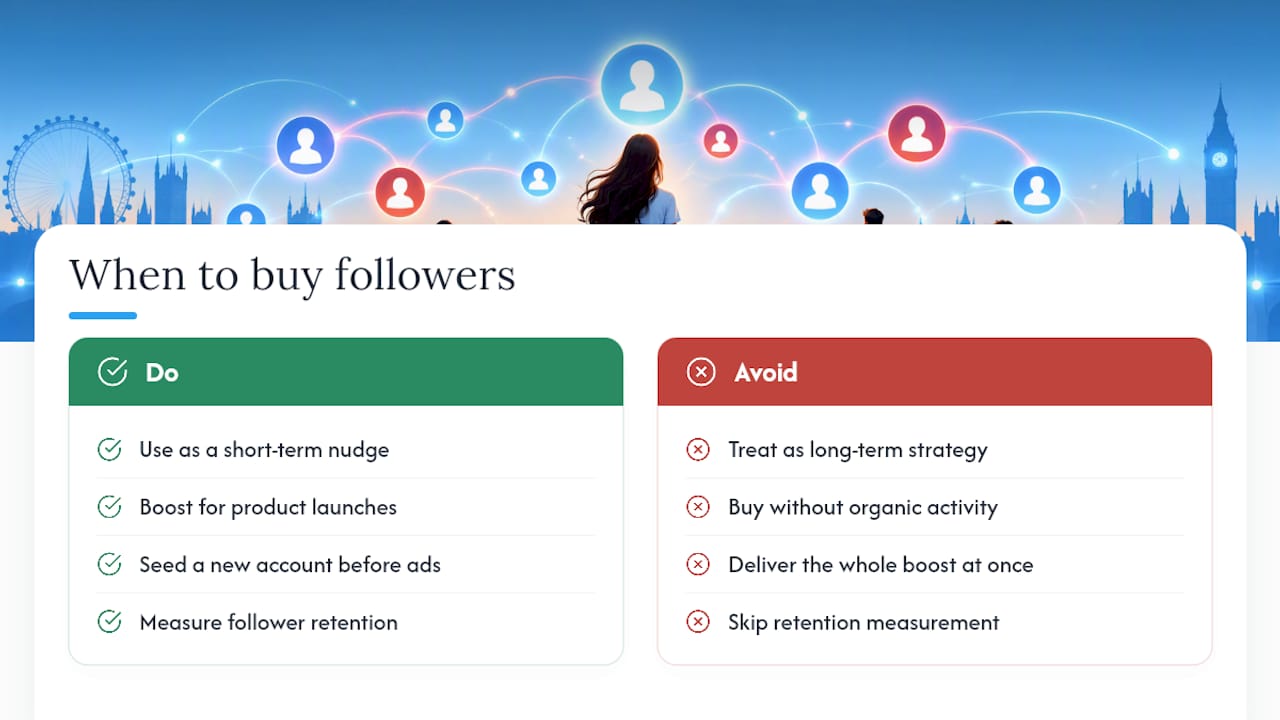
Buying followers works best as a short-term nudge, not a growth strategy. A product launch, a first campaign with zero social proof, or seeding a new account before an ad push are the cases where a follower boost genuinely helps first impressions.
The trade-off is real: paid growth without organic activity behind it fades and can flatten reach. The safeguard is the same one covered above. Measure retention, stagger delivery, and pair any purchase with real posting and engagement, or the boost you paid for won’t outlast the month.
— Irwin Lee
Real followers, no password, built for UK growth
Greediersocialmedia’s advantage over a generic bulk-bot seller is simple: real, authentic engagement delivered without ever asking for your password, backed by UK-based support that answers when a refill or a question comes up.
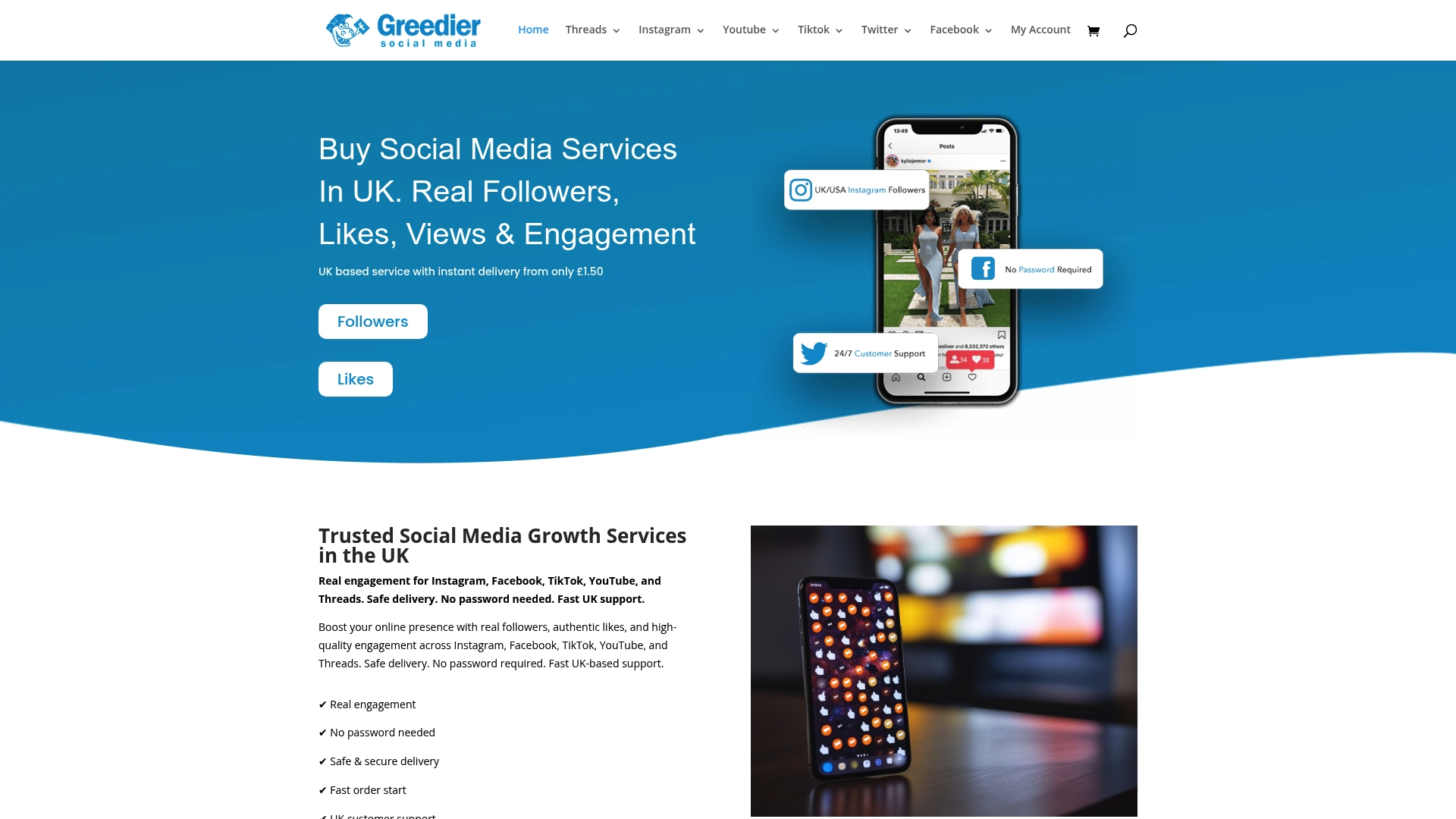
Packages cover Instagram, Facebook, TikTok, and YouTube, with UK and US-targeted delivery designed to hold up better than the bargain-bin bot drops that vanish within a fortnight. The Instagram followers and engagement range covers everything from likes to video views if you want to build a rounder profile rather than just a follower count, and the automatic Instagram followers plan is worth a look if you’d rather top up steadily each month instead of one large order. Check current packages and place a staggered starter order today to see retention for yourself.
Sources
- Meta transparency: community standards enforcement — fake accounts (Instagram)
- HowSociable: follower retention study 2026
- Buffer: creator growth playbook (2026)
- Instrack: should you buy Instagram followers? (observational test)
FAQ
Why do bought followers disappear?
Most disappear because platforms actively detect and remove fake or bot accounts, not because the follower “unfollows” you. Meta alone removes millions of violating accounts daily, and cheap bot-sourced followers are the accounts most likely to get caught.
What is the 5-3-1 rule on Instagram?
The 5-3-1 rule is a content routine some creators follow: engage with five accounts, comment on three posts, and share one piece of content daily to build organic reach. It has nothing to do with bought followers directly, but it’s a useful habit to pair with any purchase since Buffer’s research ties consistent engagement to genuine long-term growth, not follower count alone, according to Buffer’s creator growth playbook.
How much does it cost to buy 1,000 followers on Instagram?
Pricing depends heavily on quality and targeting, so there’s no single market rate worth quoting as standard. Greediersocialmedia’s Instagram followers packages start from £1.99 and scale up to £229.99 depending on volume and delivery speed.
Does buying Instagram followers really work?
It works for what it’s designed to do: an immediate social proof boost, not a substitute for organic growth. Retention studies show quality providers keeping 95% or more of delivered followers at 30 days, while poor ones drop to 75–82%, so results depend far more on the provider than the platform, according to HowSociable’s retention study.
How can I check if my bought followers are dropping too fast?
Calculate retention as followers remaining divided by followers delivered, checked at 7, 14, and 30 days.