
Buying followers is a high-risk move that commonly delivers bot accounts, recycled engagement, or a phishing attempt on your login. If you do it anyway, the one rule that matters most is this: never hand over a password or a 2FA code, and treat any guarantee of thousands of followers overnight as a scam, not a service. If you want paid growth without the risk, platform ads, verified creator deals, or a small, contract-backed test order are the safer routes.
TL;DR:
- Buying followers often results in bot accounts or hijacked profiles that do not contribute to genuine engagement or long-term growth.
- Fake growth patterns include abrupt follower spikes disproportionate to engagement, generic comments, and suspicious follower-to-following ratios.
- Never share your password or 2FA codes with sellers, and avoid payment methods like gift cards or cryptocurrency to reduce scam risk.
- Platform policies prohibit inauthentic engagement, risking shadow-bans or account suspension if violated, especially with aggressive growth guarantees.
- Testing small, password-free packages with clear refund and delivery criteria is the safest way to evaluate paid growth providers.
Table of Contents
- Common scam types you’ll meet when buying followers
- How to spot fake followers: step-by-step checks
- Red flags before you pay, and safer ways to spend
- If you’ve already paid or lost account access: what to do now
- Why you can trust this checklist
- Does buying followers hurt your algorithm performance long-term?
- Is buying followers illegal, and what do platforms actually say?
- Measured tests versus long-term shortcuts
- A password-free way to test paid growth safely
- Sources
- FAQ
Common scam types you’ll meet when buying followers
Most follower scams fall into four recognisable formats, and once you can name them, they’re far easier to walk away from.
The straight follower sale is the most common. A fixed package (say, 1,000 followers for a few pounds) delivered within hours almost always means bots or hijacked dormant accounts, not real people who chose to follow you. Genuine audience growth doesn’t arrive as a lump sum.
Then there’s the growth-manager or fake-analytics scam. Someone messages you offering to “manage” your growth, sends over a slick dashboard, and asks for your login “just to connect the tool.” That’s a credential grab dressed up as customer service. Bitdefender’s research into paid follower scams found this exact pattern: convincing phishing pages built specifically to harvest passwords and two-factor codes under the guise of activating a service.
Fake engagement platforms follow a similar script. You sign up, and before anything is “delivered,” the site asks you to log in with your real credentials to “verify” or “activate” the order. Legitimate services never need your password to add followers, likes, or views to a public account.
Engagement pods and follow-for-follow schemes are subtler. Nobody’s stealing your password here, but you’re trading follows with strangers who have no interest in your content, which quietly tanks your engagement rate over time and teaches the algorithm to stop showing your posts to real people.
Watch for these payment and pressure patterns across all four:
- Requests to pay by gift card, cryptocurrency, or wire transfer instead of card
- “Only 3 spots left today” or countdown timers pushing an immediate decision
- Guarantees of a specific follower count “within 24 hours, no questions asked”
- No refund policy, no company name, no way to contact a human before paying
How to spot fake followers: step-by-step checks
Before you trust any account’s numbers, whether it’s your own after a bad purchase or an influencer you’re vetting for a partnership, run through a short, repeatable process.
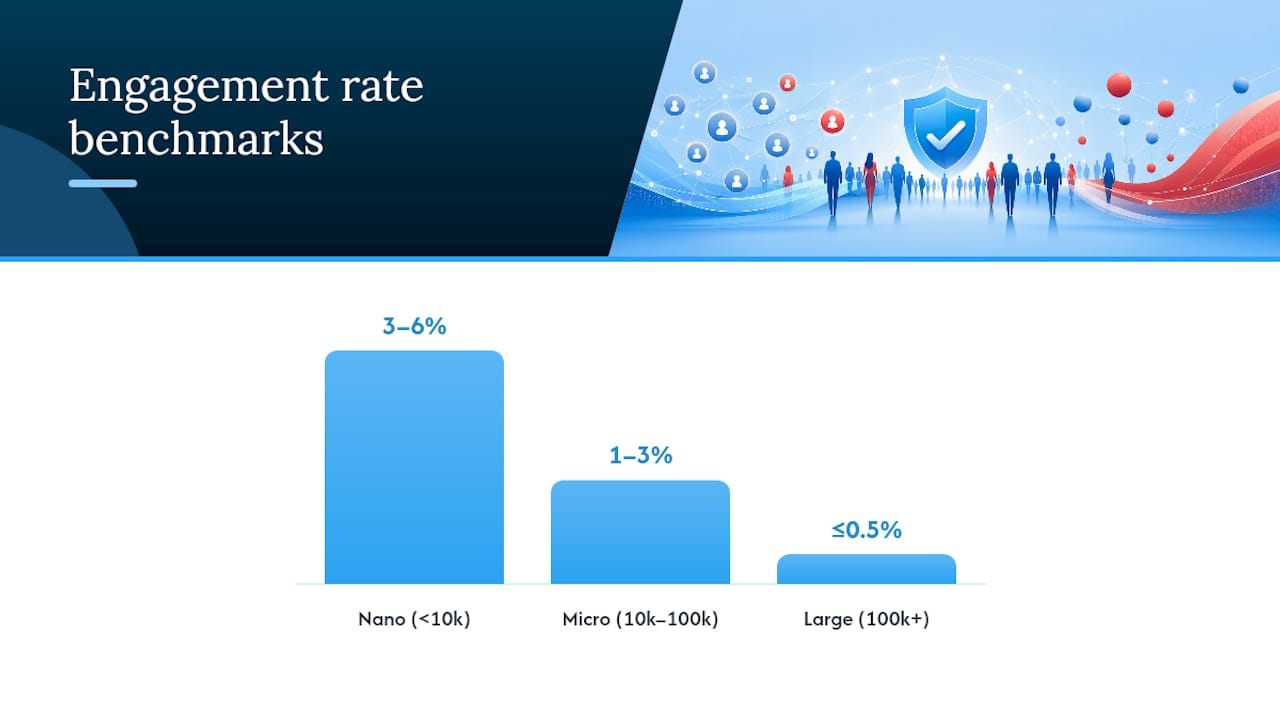
- Calculate the engagement rate. Add up likes and comments across the last nine posts, divide by nine, divide that by the follower count, then multiply by 100. Nano accounts under 10,000 followers typically sit at 3–6% engagement, and micro accounts between 10,000 and 100,000 usually land at 1–3%, according to Hootsuite’s breakdown of vanity metrics. A large account stuck consistently below 0.5% is a strong signal something’s wrong.
- Check the growth curve. Tools like Social Blade plot follower counts over time, and real growth is gradual with occasional bumps tied to viral moments. Bought growth shows up as a near-vertical spike with no matching surge in engagement, which is the giveaway a chart alone can reveal in seconds.
- Read the comments, not just the count. Pull up 10 to 15 recent comments and look for generic phrases repeated word for word (“Great post!”, “Amazing content!”) across multiple accounts, or replies that don’t relate to the actual post.
- Sample the followers themselves. Open 10 to 20 random profiles. Look for a language or location mismatch against the account’s stated audience, near-empty profiles, or a wildly lopsided following-to-follower ratio.
- Run a third-party audit if two or more signals look off. An audience-authenticity score below 70% warrants closer investigation, and for significant spend, insist on a high authenticity score or shift to performance-based payment terms, according to InfluencerFee’s vetting workflow.
Statistic to remember: engagement thresholds vary by tier, so compare a creator’s rate against their own follower bracket rather than a single universal benchmark. A micro account running 2% engagement is healthy; the same 2% on an account with two million followers deserves a second look.
One complication worth flagging for 2026: AI-generated profile photos and plausible filler posts have made the old “empty profile” test far less reliable. CreatiVault’s research on fake follower detection notes that fabricated accounts can now carry three to eight grid posts and a convincing bio. The fix is to stop hunting for a single tell and instead look for paired anomalies, growth spikes alongside duplicate comment phrasing, or a geography mismatch alongside a suspicious posting pattern.
Red flags before you pay, and safer ways to spend
If a seller does any of the following, stop the transaction immediately:
- Asks for your password or a 2FA code “to connect” or “activate” the service
- Guarantees a specific large number of followers within a fixed, very short window
- Only accepts gift cards, cryptocurrency, or untraceable payment methods
- Has no listed company name, address, or way to contact support before you buy
- Refuses to explain, even briefly, how the followers or engagement will be delivered
A legitimate provider will look almost the opposite. Expect named company details you can actually verify, standard card payment processing, a clear refund policy, some explanation of methodology, and zero requests for your login credentials.
If you decide paid growth is worth trying at all, several routes carry far less risk than a bulk follower package. Platform-native ads let you target real, interested users directly. Verified creator partnerships put your budget behind a person with a documented, checkable audience. And a small, performance-tested pilot order with a written quality clause lets you judge a provider before committing serious spend.
Pro Tip: Before placing a full order, write a one-line quality clause into your purchase notes or email confirmation: “Order valid only if delivered followers/engagement show normal profile activity within 14 days; unsatisfactory delivery is refundable in full.” Then test with the smallest available package size first, not the biggest discount tier.
If you’ve already paid or lost account access: what to do now
Acting fast limits the damage. Work through this in order:
- Cut off further loss. Cancel any pending payment or subscription immediately, and if you shared card details, contact your bank to flag the transaction.
- Revoke access. Go into your account’s connected apps and active sessions list and remove anything unfamiliar, then change your password and switch on two-factor authentication.
- Report credential theft through the platform. Use the official account-recovery process and keep every message, invoice, and screenshot from the transaction, since you’ll need this evidence.
- Pursue financial recourse. Dispute the charge with your card provider, and in the UK, report the incident to Action Fraud if money or personal data was stolen.
- Clean up and rebuild. Remove obvious bot followers where the platform allows it, pause any ad campaigns built on that audience, and shift focus back to genuinely active followers while you monitor engagement metrics for a few weeks.
Why you can trust this checklist
This guide is written by Irwin Lee for Greediersocialmedia, drawing on documented scam patterns and detection methods rather than guesswork.
The advice above holds up against how Greedier Social Media itself operates, and that consistency is worth spelling out:
- No password requests at any point in the ordering or delivery process
- UK-based customer support for questions before or after an order
- Packages spanning Instagram, TikTok, YouTube, and Facebook rather than a single platform
- Over one million customers served since 2013, according to the company’s own figures
Password-free delivery matters because it removes the exact vector that Bitdefender’s research flagged as the core mechanism behind most follower scams: fake dashboards asking you to log in to “activate” your order. A provider that never asks for your credentials in the first place can’t use them against you.
Does buying followers hurt your algorithm performance long-term?
Yes, and the damage compounds the longer bought followers stay in your audience. Algorithms on Instagram, TikTok, and Facebook weight reach based on how many people actually interact with a post relative to who sees it. A follower count padded with bots drags that ratio down permanently, because thousands of accounts that never like, comment, or watch anything are still counted in the denominator.
This creates a quiet, ongoing tax on every future post. Your organic reach per post shrinks, even for content that would otherwise perform well, because the platform reads a low engagement ratio as a signal that your content isn’t worth showing widely. Businesses running ads face an even sharper version of this problem: lookalike audiences built from a follower base contaminated by bots learn the wrong patterns entirely, and ad targeting effectiveness degrades as a direct result.
The fix isn’t fast. Removing bot followers helps stop further erosion, but it doesn’t retroactively repair the engagement history the algorithm has already logged. That’s the real cost of a bought follower package. It’s not the money spent buying it. It’s the months of suppressed reach that follow while the account slowly re-earns the algorithm’s trust with real interactions.
Is buying followers illegal, and what do platforms actually say?
Buying followers isn’t a criminal offence in the UK, but it does breach the terms of service on every major platform, and enforcement has real teeth. Instagram, TikTok, Facebook, and YouTube all explicitly prohibit “inauthentic engagement” in their community guidelines, and violations can lead to shadow-banning, reduced reach, follower count purges, or in repeat or severe cases, permanent account suspension.
The legal risk shifts if credentials are stolen during the process. Handing your password to a fake growth manager who then accesses your account without further authorisation crosses into unauthorised computer access territory, which is where UK law, specifically the Computer Misuse Act, can apply to whoever carried out the intrusion. That’s a matter for the scammer’s liability, not yours, but it’s precisely why avoiding password-sharing schemes matters beyond just protecting your follower count.
For businesses, there’s a second, quieter policy risk: advertising platforms increasingly cross-reference organic audience authenticity when approving ad accounts, and a history of purchased engagement can complicate ad approval or trigger manual review. None of this makes buying followers a criminal act for the buyer. It does mean the practical consequences, account suspension, reduced reach, ad account scrutiny, sit squarely inside platform enforcement, and those consequences are enforced far more consistently than most sellers admit.
Measured tests versus long-term shortcuts
A small, documented pilot order with a written refund clause is defensible when you’re testing a provider’s legitimacy, not chasing a vanity number. It’s a controlled experiment with a built-in exit.
What’s never defensible is a guarantee of huge, fast numbers or any request for your password. Both are tactical mistakes that backfire, one through platform enforcement, the other through outright theft. The influencer marketing research on brand ROI makes the same point from a different angle: audiences that don’t convert aren’t an asset, whatever the follower count says. Tie any growth spend to a measurable outcome, sales, sign-ups, real engagement, not a number on a profile page.
— Irwin Lee
A password-free way to test paid growth safely
Greedier Social Media’s stated model sidesteps the exact vector that causes most of the scams covered above: it delivers followers, likes, and views on Instagram, TikTok, YouTube, and Facebook without ever asking for your password. That single design choice removes the credential-theft risk that trips up buyers who deal with fake growth managers or phishing dashboards.
Because no login is ever requested, there’s no dashboard to “activate,” no session to hijack, and no account recovery scramble afterwards. That’s the practical difference between this and the scam patterns detailed earlier in this guide. If you want to test the approach, start small: place a modest order from the Instagram engagement packages or the auto Instagram followers service, watch how delivery behaves against the checks covered above, and judge the provider on that evidence rather than on promises. UK-based support is available if you have questions before you order.
Sources
For a growth-curve check, use a historical follower chart tool such as Social Blade to spot unnatural vertical spikes. For an engagement audit, calculate the rate manually using Hootsuite’s benchmark figures, then cross-check ambiguous cases against the third-party audit thresholds covered earlier. For scam mechanics and recovery steps, Bitdefender’s writeup remains the clearest reference.
- Why vanity metrics are misleading (Hootsuite)
- Instagram paid follower scam (Bitdefender)
- Fake follower detection and vetting workflow (InfluencerFee)
- How to check for fake Instagram followers (CreatiVault)
FAQ
How much does it cost to buy 1,000 followers?
Prices vary enormously depending on quality and platform, from a couple of pounds for likely-bot packages to considerably more for services claiming real, active accounts. On Greedier Social Media, Instagram follower packages range from £1.99 to £229.99 depending on package size, and other platform prices are listed on the respective product pages.
How can you tell if someone bought fake followers?
Check their engagement rate against their follower tier (nano accounts should see roughly 3–6%, micro accounts 1–3%, according to Hootsuite), then look at their growth chart for sudden vertical spikes. Reading 10 to 15 recent comments for generic or duplicated phrasing adds a third, reliable signal.
Will Instagram ban you for buying followers?
Instagram’s terms explicitly prohibit inauthentic engagement, and consequences range from reduced reach and follower purges to account suspension in repeat or severe cases. A password-free service that never triggers a credential-based red flag carries a different, lower risk profile than one that asks for your login.
Is buying TikTok followers a good idea?
It’s rarely a good idea if the goal is genuine reach, since bot followers drag down your engagement ratio and can suppress how the algorithm distributes your content. If you want to test paid growth on TikTok at all, a small order through a password-free provider with TikTok packages and clear refund terms is a far safer starting point than an unverified seller promising huge numbers overnight.