
Understanding what is audience targeting social media wise helps small businesses stop wasting ad spend.
TL;DR:
- Audience targeting segments audiences by demographics, interests, and behaviors to reach those most likely to engage. Small businesses benefit from using first-party data and iterative testing across platforms like Facebook, LinkedIn, and TikTok. Focusing on real engagement signals and avoiding over-niching improves targeting effectiveness and campaign results.
Audience targeting on social media is the practice of segmenting your broader audience by demographics, interests, and behaviours so your content reaches the people most likely to engage and convert. Platforms like Facebook, Instagram, and TikTok have built powerful targeting tools directly into their advertising systems, making this approach accessible to individuals and small businesses, not just large brands. The core principle is simple: stop broadcasting to everyone and start speaking directly to the people who actually care. When you understand what is audience targeting on social media, you stop wasting budget and start building real traction.
What is audience targeting social media wise, and why does it matter?
Audience targeting is the process of dividing a broad potential audience into smaller groups based on shared characteristics, then delivering content tailored to each group. The industry term for this practice is audience segmentation, and it sits at the heart of every effective social media campaign. Targeting improves return on ad spend by reducing wasted impressions and increasing the relevance of every post or paid promotion you run.

The importance of audience targeting becomes clear when you consider the alternative. Broad, untargeted campaigns reach people who have no interest in your product or service. Brands using targeting see measurably better engagement and conversion rates compared to those running generic campaigns. For a small business with a limited budget, that difference is the gap between growth and stagnation.
Social media audience segmentation also helps you understand your existing customers more deeply. When you analyse who responds to your content, you gather real data about what your audience values. That data feeds back into better content, sharper ads, and stronger relationships over time.
What are the main types of audience targeting data?
The four core pillars of social media audience segmentation are demographics, psychographics, behavioural data, and platform-specific usage. Each pillar answers a different question about your audience.
- Demographics answer who: age, gender, location, income, and education level.
- Psychographics answer why: values, lifestyle choices, opinions, and motivations.
- Behavioural data answers what: purchase history, content interactions, device usage, and browsing patterns.
- Platform-specific usage answers where: which networks your audience uses, when they are active, and how they engage.
Understanding these pillars helps you build a complete picture of your audience rather than relying on one dimension alone.
First-party data versus third-party data
First-party data such as customer email lists, website pixel data, and CRM records is more powerful than platform-provided demographics for precise targeting. This advantage is growing as third-party cookies decline across the web. Uploading a customer list to Facebook or Instagram to create a Custom Audience is a direct application of first-party data in action.
Social listening adds another layer. AI-powered social listening shifts focus from static demographics to dynamic audience interests and motivations. Instead of only knowing that your audience is aged 25–34, you learn what they are talking about, what problems they are trying to solve, and which trends they are following. Tools like Brandwatch and Emplifi specialise in this kind of analysis.
Pro Tip: Start building your first-party data list from day one. Even a small email list of 500 genuine customers will outperform a broad interest-based audience when used as a Custom Audience seed on Facebook or Instagram.
| Data type | What it tells you | Example source |
|---|---|---|
| Demographics | Age, gender, location | Facebook Ads Manager |
| Psychographics | Values, interests, lifestyle | Social listening tools |
| Behavioural data | Clicks, purchases, engagement | Website pixel, CRM |
| Platform usage | Active times, preferred formats | Instagram Insights |
How do social media platforms differ in their targeting tools?
Facebook and Instagram offer the most advanced targeting of any social platforms, covering demographics, interests, behaviours, Custom Audiences, and Lookalike Audiences. A Lookalike Audience takes your best existing customers and finds new people who share similar characteristics. This is one of the most cost-effective targeting methods available to small businesses.
LinkedIn excels at professional and B2B targeting. You can filter by job title, industry, company size, seniority level, and professional skills. For a business selling software to marketing managers at mid-sized UK firms, LinkedIn’s targeting is unmatched. The cost per click is higher than Facebook, but the audience quality for B2B purposes justifies it.
TikTok’s targeting is driven more by behavioural and interest signals than by detailed demographic filters. The platform’s algorithm is exceptionally good at finding the right audience for your content based on how people interact with similar videos. Twitter (now X) focuses on keyword and conversation-based targeting, letting you reach people actively discussing specific topics in real time.
| Platform | Targeting strength | Best use case |
|---|---|---|
| Facebook/Instagram | Demographics, Custom, Lookalike | B2C, local business, e-commerce |
| Job title, industry, seniority | B2B, professional services | |
| TikTok | Behavioural, interest-based | Brand awareness, younger audiences |
| Twitter/X | Keywords, conversations | News, events, real-time campaigns |
- Facebook’s Custom Audiences let you retarget website visitors with pinpoint accuracy.
- Instagram Stories ads perform best when targeting warm audiences who already follow you.
- LinkedIn’s Matched Audiences feature mirrors Facebook’s Custom Audience capability for professional contacts.
- TikTok’s Spark Ads let you boost organic posts, combining content performance with paid targeting.
How to implement audience targeting effectively: a step-by-step approach
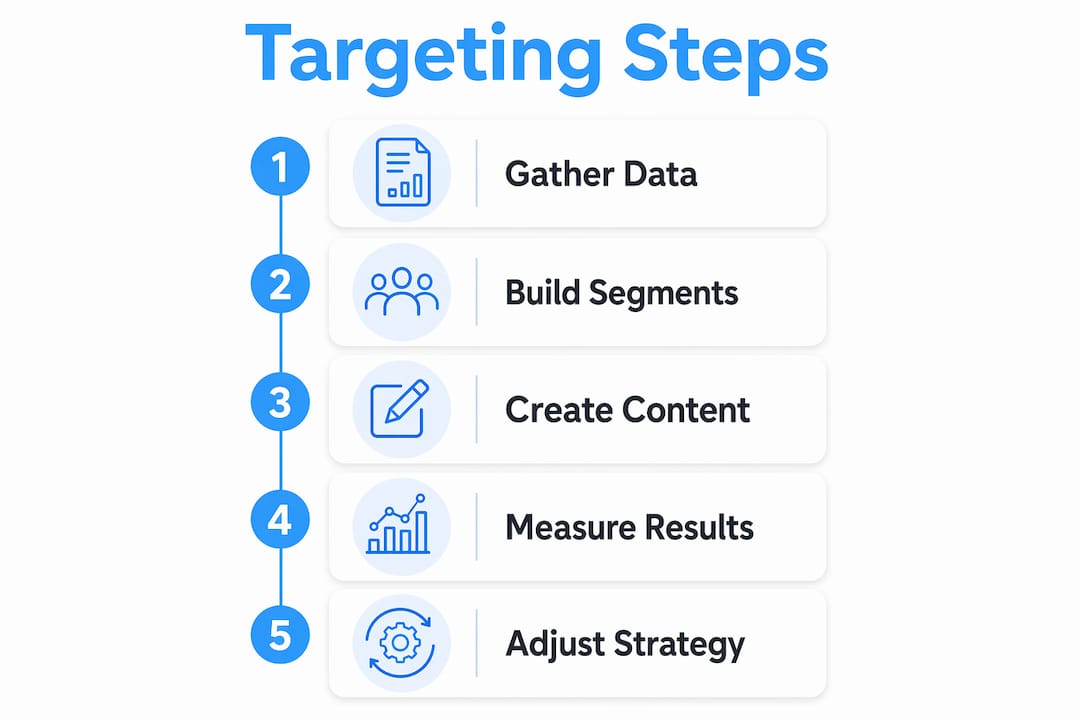
Effective targeting follows a four-step cycle: data gathering, segmentation, content creation, and measurement. Small businesses achieve better results by continuously adjusting their targeting based on analytics rather than setting campaigns once and leaving them to run.
Step 1: Gather your data. Pull together everything you already know about your customers. Check your website analytics in Google Analytics, review your social media insights on Instagram or Facebook, and export your CRM contacts. This existing data is your starting point.
Step 2: Build your segments. Group your audience by the characteristics most relevant to your product. A local bakery might segment by location and age. A freelance graphic designer might segment by industry and job title. Keep your initial segments broad enough for the platform’s algorithm to learn from them.
Step 3: Create content for each segment. A 55-year-old business owner and a 24-year-old freelancer may both need your service, but they respond to very different messaging. Write copy and choose visuals that speak directly to each group’s specific situation.
Step 4: Measure and adjust. Review your campaign results weekly. Look at click-through rates, cost per result, and engagement rates by segment. Iterative testing and refinement is what separates campaigns that grow from campaigns that plateau.
Experts recommend focusing on 1–3 platforms where your audience is most active rather than spreading effort thinly across every network. Depth on two platforms beats a shallow presence on six. You can always expand once your targeting is working well on your core channels.
Pro Tip: When launching a new campaign, resist the urge to narrow your audience immediately. A broader initial audience gives the platform’s algorithm enough data to optimise before you start tightening your targeting parameters.
What pitfalls should you avoid in social media audience targeting?
The most common mistake is confusing market segmentation with audience segmentation. Market segmentation is a strategic decision about which part of the market you serve. Audience segmentation is the tactical execution of reaching specific people within that market on a given platform. Mixing the two leads to campaigns that are neither strategic nor precise.
Over-niching too early is the second major pitfall. When you restrict your audience to a very small group before the algorithm has gathered enough data, you starve the platform’s machine learning of the signals it needs. The result is poor delivery and inflated costs. Start broader, then narrow down once you have performance data to guide you.
A third mistake is treating targeting as a one-time setup. Audiences shift. Trends change. What worked in january may not work in july. Audience targeting is an ongoing, iterative cycle that requires regular review and adjustment.
Social listening and AI move focus beyond ‘who’ your audience is to ‘what’ they care about, enabling far richer and more responsive targeting than demographics alone can provide.
Advanced practitioners use social listening to identify emerging micro-segments, sometimes called sub-tribes, within their broader audience. These are small but highly engaged groups united by a specific interest or behaviour. Reaching them with content that speaks directly to that shared interest produces engagement rates well above average. Tools like Brandwatch and Emplifi surface these groups through sentiment analysis and conversation tracking. You can also learn how to target a niche effectively once your broader targeting is established.
Social media algorithms prioritise behavioural engagement signals over demographics. A person who watches 80% of your video is a stronger signal than someone who matches your demographic profile but never interacts. Build your targeting strategy around engagement behaviour, not just who people are on paper.
Key takeaways
Audience targeting on social media works best when you combine first-party data, behavioural signals, and iterative testing across a focused set of platforms.
| Point | Details |
|---|---|
| Define your data pillars | Use demographics, psychographics, and behavioural data together for a complete audience picture. |
| Prioritise first-party data | Customer lists and website pixels outperform broad interest targeting, especially as cookies decline. |
| Match platform to purpose | Use Facebook and Instagram for B2C, LinkedIn for B2B, and TikTok for behavioural reach. |
| Avoid over-niching early | Start with a broader audience to give the algorithm enough data before narrowing segments. |
| Treat targeting as ongoing | Review and adjust your segments regularly based on real engagement and conversion data. |
Why I think most small businesses are targeting backwards
Most small businesses I speak with start by picking a demographic and building content around it. They decide their customer is a 35-year-old woman in Manchester who likes fitness, and then they write every post for that imaginary person. The problem is that person is a guess, not a finding.
The businesses that grow consistently do the opposite. They publish content, watch who actually engages, and let real behaviour tell them who their audience is. Then they build segments around observed patterns rather than assumptions. This shift from assumption-led to data-led targeting is the single biggest improvement most small accounts can make.
The other thing I have noticed is that people underestimate how much performance marketing on social media depends on patience. Targeting does not deliver results in 48 hours. It takes two to four weeks of consistent data collection before a campaign starts to find its rhythm. Small businesses often pull the plug too early, just before the algorithm would have started delivering efficiently.
The shift from static demographics to dynamic interest-based targeting is real and accelerating. Platforms are giving more weight to what people do than who they are. That is good news for small businesses, because behavioural data is available to everyone, regardless of budget. You do not need a large ad spend to gather meaningful signals. You need consistency, patience, and a willingness to let the data lead.
— Luna
How Greediersocialmedia supports your targeting and growth
Knowing the theory behind audience targeting is one thing. Putting it into practice on a live account, with real budget and real stakes, is another challenge entirely.
Greediersocialmedia has supported over a million UK users since 2013, helping individuals and small businesses build genuine visibility on platforms like Instagram and Facebook. Whether you are looking for social media growth tactics that complement your targeting strategy or a growth strategy built for small businesses, the team at Greediersocialmedia offers practical, secure solutions without requiring your passwords. Real engagement from real people gives your targeting efforts the social proof they need to convert.
FAQ
What is audience targeting on social media?
Audience targeting on social media is the practice of segmenting your potential audience by demographics, interests, and behaviours so your content reaches the people most likely to engage. Platforms like Facebook, Instagram, LinkedIn, and TikTok all offer built-in tools to apply this targeting to both organic and paid content.
What is the difference between audience segmentation and market segmentation?
Market segmentation is a strategic decision about which part of the overall market your business serves. Audience segmentation is the tactical process of identifying and reaching specific groups within that market on a social media platform.
How do I start targeting audiences on social media?
Start by gathering your existing customer data from your CRM, website analytics, and social media insights. Build two or three broad segments, create content tailored to each, and measure engagement weekly before narrowing your targeting further.
Which social media platform has the best audience targeting tools?
Facebook and Instagram offer the most advanced targeting options, including Custom Audiences and Lookalike Audiences built from your own customer data. LinkedIn is the strongest choice for B2B targeting based on professional attributes.
Why is first-party data better for audience targeting?
First-party data such as customer email lists and website pixel data reflects real behaviour from people who have already shown interest in your business. This makes it far more accurate than broad platform demographics, and its value increases as third-party cookies continue to decline across the web.