
Learning to align social media business objectives properly is what separates busy accounts from genuinely effective ones.
TL;DR:
- Most small businesses focus on activity rather than aligning their social media efforts with specific business goals.
- Connecting social media strategies to objectives like lead generation or revenue ensures that every post and campaign has a clear purpose.
- Regular quarterly reviews and SMART goals help measure meaningful KPIs, preventing vanity metrics from misleading progress.
Most small businesses are posting consistently, staying active on multiple platforms, and still wondering why social media never seems to move the needle. The problem is rarely effort. The problem is that their social media activities and their actual business goals have nothing to do with each other. When you properly align social media business objectives, every post, campaign, and platform choice has a purpose. This guide gives you a practical, step-by-step framework to connect your social media work to outcomes that genuinely matter, from generating leads and driving revenue to building lasting customer loyalty.
Table of Contents
- Key takeaways
- How to align social media business objectives
- Setting SMART goals that match your priorities
- Choosing platforms and creating aligned content
- Measuring performance and running quarterly reviews
- Common pitfalls and how to avoid them
- My take on alignment after years in social strategy
- Grow faster with Greediersocialmedia
- FAQ
Key takeaways
| Point | Details |
|---|---|
| Start with business outcomes | Define what success looks like for your business before choosing any social media tactic. |
| Use SMART goals | Specific, measurable goals tied to business priorities give you something to actually track and improve. |
| Pick platforms with purpose | Match each platform to one primary goal and the audience most likely to take action there. |
| Track meaningful KPIs | Focus on 2 to 3 metrics per goal that reflect real business impact, not just likes and shares. |
| Review quarterly, not annually | A structured quarterly audit prevents strategy drift and keeps your efforts pointed at the right outcomes. |
How to align social media business objectives
The first step is getting clear on what your business actually needs right now. Not what sounds good in a strategy document. Not what your competitors appear to be doing. What your business genuinely needs.
Start by listing two or three core business outcomes you want to influence this year. These might include:
- Revenue growth: More direct sales, leads, or product sign-ups from social channels
- Brand awareness: Reaching new audiences who have not heard of you yet
- Customer retention: Keeping existing customers engaged, informed, and loyal
- Website traffic: Driving qualified visitors who convert once they arrive
Once you have those outcomes written down, you can map social media’s role in each one. Social media’s strategic role in supporting business growth is often underestimated, yet it is one of the most cost-effective ways for small businesses to influence buying decisions at multiple stages of the customer journey.
The mistake most small businesses make is treating “grow followers” or “post more content” as a goal. Neither of those is a business outcome. They are activities. Focusing on business outcomes first, then selecting tactics and KPIs, is what separates busy social media work from social media that actually grows a business.

Pro Tip: Write your business objectives on a single page and keep them visible when planning social media content. If a post idea cannot be connected to at least one of those objectives, it probably does not belong in your calendar.
Setting SMART goals that match your priorities
Once you know your business objectives, you need to translate them into goals your social media activity can realistically deliver. This is where the SMART framework proves its worth. SMART stands for Specific, Measurable, Achievable, Relevant, and Time-bound. It sounds familiar because it works.
Here is what a poorly formed social media goal looks like: “Get more engagement on Instagram.” Here is a SMART version of the same idea: “Increase Instagram post engagement rate from 1.8% to 3% within 90 days by publishing three educational carousel posts per week targeted at UK small business owners.”
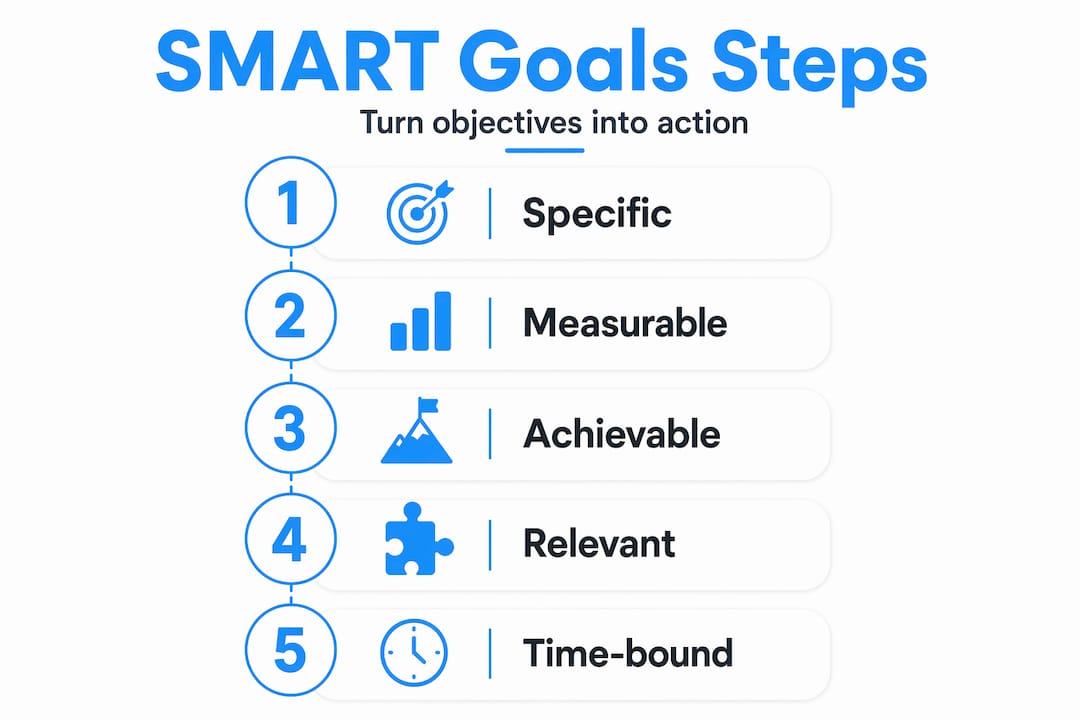
Notice the difference. The SMART version tells you exactly what to do, how to measure it, and when to evaluate it. That kind of specificity makes it far easier to report progress to stakeholders and to know when something is not working.
When mapping goals to your business objectives, a few examples help clarify the connection:
- Business objective: lead generation. Social media goal: drive 150 qualified website visits per month from LinkedIn posts by the end of Q2, tracked via UTM-tagged links in Google Analytics.
- Business objective: brand awareness. Social media goal: reach 20,000 unique accounts per month on Instagram within 60 days through consistent Reels publishing.
- Business objective: customer retention. Social media goal: respond to 90% of customer comments and messages within four hours across all platforms by end of Q1.
A useful rule of thumb is to focus on no more than two or three goals at once. Spreading your attention across too many objectives dilutes the results of all of them. Pick the goals that matter most right now and commit to them fully before adding more.
Choosing platforms and creating aligned content
Platform choice is not about where you feel most comfortable or which one has the most users globally. It is about where your specific audience spends time and which platforms suit the type of goals you have set. Platform selection should be audience-driven, matching your content type and goal to the platform’s strengths.
Here is a practical framework for matching platforms to goal types:
- Instagram and TikTok suit brand awareness and product discovery, particularly for B2C businesses with strong visual content
- LinkedIn works best for B2B lead generation, professional credibility, and reaching decision-makers
- Facebook remains effective for community-building, local businesses, and paid retargeting campaigns
- YouTube is valuable for long-form educational content that supports trust-building and customer retention
Once you have selected your platforms, build content themes that serve your business objectives directly. An independent accountancy firm with a lead generation goal, for instance, might create a LinkedIn content series answering common tax questions. Each post educates the audience while demonstrating expertise, and every post includes a clear next step such as booking a call or downloading a resource.
Pro Tip: Assign one primary goal to each platform rather than trying to achieve everything everywhere. Mixing multiple goals on a single platform can dilute your impact. LinkedIn for leads, Instagram for awareness, Facebook for community is a much cleaner structure than trying to make one channel do everything.
Plan your content calendar with your KPIs in mind. If your goal is website traffic, every piece of content should include a reason to click through. If your goal is brand awareness, your content needs to be shareable and visually distinctive. Strategy and execution need to move together, or the effort is wasted. Greediersocialmedia works with small businesses to choose the right social platform for their goals, which is often where the biggest gains are made.
Measuring performance and running quarterly reviews
Effective social media performance measurement means knowing which numbers actually tell you something useful. Key social media KPIs fall into six categories: engagement, awareness, conversions, ROI, customer care, and content performance. The goal is not to track all of them. It is to pick the two or three that prove progress toward each specific business objective.
Here is a simple KPI reference to get you started:
| Business objective | Relevant KPI | What it tells you |
|---|---|---|
| Brand awareness | Post reach, profile visits | How many new people are discovering you |
| Lead generation | Link clicks, form completions | How many people are taking the next step |
| Customer retention | Comment response rate, DM resolution rate | How well you are maintaining relationships |
| Revenue | Conversion rate from social traffic | How effectively social drives purchases |
The critical distinction is between vanity metrics and meaningful KPIs. Follower count and post likes feel rewarding, but tracking only easy-to-measure metrics leads to vanity metrics rather than genuine business insight. A post with 2,000 likes that generates no website traffic or enquiries has not contributed to your business objectives. A post with 80 likes that brings in 15 qualified leads has.
Quarterly reviews are where good strategies become great ones. A structured quarterly review involving roughly 90 minutes of structured analysis followed by fresh goal-setting helps distinguish proactive growth from busywork. Regular performance audits four times a year sustain alignment and prevent the strategy drift that quietly kills so many small business social media efforts.
Pro Tip: Set a recurring calendar reminder for the last week of each quarter. Use it to assess which KPIs moved, which did not, and what that tells you about the next 90 days. Monthly lighter check-ins can supplement the quarterly deep-dives for faster-moving teams.
Common pitfalls and how to avoid them
Even with a well-structured plan, small businesses run into predictable obstacles. Knowing what these are in advance means you can sidestep them rather than diagnose them after the fact.
The biggest trap is treating social metrics as objectives rather than measurement tools. A follower count going up is a signal. It is not a business result. Tie every metric back to its parent business objective, and this confusion disappears.
A few other pitfalls worth knowing:
- Mixing conflicting goals on one platform. Trying to build community, drive sales, and attract recruits all on the same Instagram account creates confusing content that serves none of those purposes well.
- Posting without a plan. Reactive social media with no content strategy leads to inconsistency, and inconsistency erodes trust and reach.
- Ignoring stakeholder communication. If business owners or clients cannot see the connection between social activity and results, budget and buy-in disappear fast.
On that last point, fast stakeholder buy-in is achieved by tying social goals to cost and revenue metrics with a consistent reporting cadence. Even a simple monthly summary showing KPI progress against business objectives keeps everyone aligned and confident in the work being done.
Consistency over perfection is the most underrated principle in social media. A business that posts three times a week with a clear purpose will always outperform one that posts daily with no strategy and goes quiet whenever things get busy.
My take on alignment after years in social strategy
I’ve seen hundreds of small businesses throw real money and time at social media and walk away frustrated. Almost every time, the core issue was not the content. It was not the posting frequency. It was that nobody had connected the social media activity to anything the business actually cared about.
In my experience, the businesses that get the most from social media share one habit: they start every planning conversation with the business goal, not the platform. They ask “what do we need to grow this quarter?” before they ask “what should we post?”
I’ll be honest about something that most social media guides skip over. Follower count obsession is genuinely holding small businesses back. I’ve watched companies celebrate reaching 10,000 followers while their enquiry rate sat flat for months. The follower number looked good in a board meeting but did nothing for the bottom line. When those same businesses shifted to tracking link clicks and conversion traffic, their results changed within a quarter.
The other thing I would stress is that maintaining alignment is not a set-and-forget activity. Quarterly review rhythms create the discipline needed to catch drift before it becomes a problem. Without that structured check-in, even well-built strategies slowly start chasing trends rather than objectives.
If you take one thing from this, let it be this: your social media strategy should be something you can explain in a single sentence that references your business goal. If you cannot do that, the alignment work is not done yet.
— Luna
Grow faster with Greediersocialmedia
If your strategy is sound but your reach is still too small to generate momentum, Greediersocialmedia can close that gap. Working with UK businesses since 2013, they have helped over a million users build genuine social media presence through real followers, likes, and views without requiring passwords or compromising account security.
When your follower base grows authentically, the KPIs that matter start to move. Engagement rates improve, reach expands, and the business outcomes you have mapped your strategy around become genuinely achievable. Whether you are starting from scratch or pushing past a growth plateau, Greediersocialmedia’s follower growth services give your aligned strategy the audience it needs to deliver real results. You can also explore options to increase social media followers across the platforms where your goals live.
FAQ
What does it mean to align social media business objectives?
It means connecting every social media activity, from content themes to platform selection, to a specific business outcome such as lead generation, revenue, or customer retention rather than chasing generic engagement metrics.
How do I set effective social media goals for my business?
Use the SMART framework to create goals that are Specific, Measurable, Achievable, Relevant, and Time-bound. Each goal should map directly to one of your core business objectives and include a clear KPI for tracking progress.
Which social media platforms are best for small businesses?
The best platform depends on your goal and audience. LinkedIn works well for B2B lead generation, Instagram and TikTok for brand awareness, and Facebook for community building and local reach.
How often should I review my social media performance?
A quarterly review is the recommended minimum, with lighter monthly check-ins for faster-moving businesses. Quarterly audits prevent strategy drift and give you a structured opportunity to reset goals based on real performance data.
What is the difference between a vanity metric and a meaningful KPI?
A vanity metric, such as likes or follower count, looks good but does not directly reflect business impact. A meaningful KPI, such as link clicks or conversion rate, ties directly to a business objective and tells you whether your social activity is generating real results.