
Understanding why retargeting improves campaign results explains why it’s rarely optional in a paid strategy.
Retargeting improves campaign results because it re-engages people who have already shown interest in your product, raising conversion probability while lowering the cost of each acquisition. Cold audiences convert at a fraction of the rate of warm ones. Retargeting fixes that gap by keeping your brand in front of users who visited your site, viewed a product, or abandoned a basket.
Three reasons it outperforms standard prospecting:
- Higher conversion rate: Retargeted visitors are roughly 70% more likely to convert than visitors who were never retargeted.
- Lower CPA: Campaigns targeting warm audiences routinely cut cost per acquisition substantially compared with cold prospecting campaigns.
- Improved ROAS: Industry reporting places retargeting ROAS in the 4.0–4.2× range, well above typical prospecting benchmarks.
Key takeaways
Retargeting improves campaign results by converting warm, high-intent audiences at lower cost than cold prospecting, with ROAS typically in the 4.0–4.2× range when campaigns are correctly structured and measured.
| Point | Details |
|---|---|
| Install dual tracking first | Deploy both the browser pixel and Conversions API before building any audience. |
| Segment by intent depth | Separate product viewers, cart abandoners, and past purchasers into distinct audiences with tailored creative. |
| Front-load bids in days 1–3 | Conversion probability decays steeply after 72 hours; concentrate spend in the early window. |
| Measure with holdout tests | Run quarterly holdout experiments to separate incremental lift from organic conversions. |
| Comply with UK GDPR | Obtain explicit consent before firing pixels and prioritise first-party CRM data for privacy resilience. |
Table of Contents
- Why retargeting improves campaign results: the core mechanics
- How does retargeting actually work technically?
- What types of retargeting should you use?
- Why does retargeting lift conversion rates and ROI?
- How do you measure the real impact of retargeting?
- Retargeting campaign best practices that actually move the needle
- What goes wrong and what UK privacy rules apply?
- Real-world retargeting scenarios and expected uplift
- What do retargeting campaigns cost and when do results appear?
- Which platforms and tools should UK marketers use?
- An editorial perspective on retargeting in a UK marketing mix
- Grow your social presence alongside your retargeting
- Sources
- FAQ
Why retargeting improves campaign results: the core mechanics
Retargeting is a paid advertising technique that serves ads specifically to users who have previously interacted with your brand. Those interactions can include visiting a product page, adding an item to a basket, watching a video, or opening an email. The ad platform recognises those users through a tracking signal and shows them relevant ads on other sites, apps, or social feeds.
Retargeting vs remarketing: Google’s own platform uses “remarketing” for the same concept, while Meta and most independent ad tech use “retargeting.” The terms describe the same practice. The only meaningful distinction is channel: Google Ads remarketing typically refers to display and search list-based campaigns, whereas Meta retargeting uses custom audiences built from pixel events or CRM uploads.
Where it sits in the funnel matters. Retargeting is a mid-to-lower funnel tactic. It does not create awareness; it converts it. Users already know who you are. The job of a retargeting ad is to remove the remaining friction between interest and purchase.
How does retargeting actually work technically?
Three tracking mechanisms underpin most retargeting campaigns.
- Browser pixel: A small JavaScript tag fires when a user loads your page, dropping a cookie that lets ad platforms identify and re-serve that user. This is the standard starting point for Google Ads and Meta Ads.
- Server-side Conversions API: After Apple’s ATT changes and tightening browser privacy settings, the pixel alone misses a significant share of events. Two-layer tracking, combining the browser pixel with a server-side Conversions API connection, recovers conversions the pixel alone would lose. For any UK campaign running on Meta, this is now a baseline requirement, not an optional extra.
- List-based and CRM uploads: You upload a hashed email list directly to Google Ads or Meta Ads. The platform matches it to logged-in accounts. This works well for high-value customer segments and SaaS trial lists where behavioural data is limited.
SDK events handle in-app retargeting for mobile, firing audience signals from within your app rather than a browser.
Quick four-step setup checklist:
- Install your pixel (Google Ads global site tag or Meta Pixel) and verify it fires on key pages (product views, add-to-basket, checkout).
- Set up a Conversions API connection alongside the pixel to recover signal lost to browser restrictions.
- Define audience rules: separate product viewers, cart abandoners, and past purchasers into distinct segments with appropriate lookback windows (7, 14, or 30 days depending on purchase cycle).
- Configure frequency caps and exclusion lists before launch. Exclude recent converters from day one.
Pro Tip: Cross-device tracking is imperfect. A user who browses on mobile and converts on desktop can appear as two separate users without a logged-in identity layer. Google’s and Meta’s people-based matching partially solves this, but for UK campaigns where consent rates are lower post-GDPR, expect some cross-device signal loss. Server-side events and CRM matching reduce that gap.
What types of retargeting should you use?
The right type depends on where your customers spend time and what action you want them to take.
Site retargeting with dynamic product ads is the workhorse for e-commerce. When a user views a product, a dynamic product ad (DPA) automatically pulls that exact item, its price, and current stock status from your product feed and serves it back to the user on Google Display, Meta, or both. Dynamic product ads routinely outperform static retargeting creative for e-commerce, often by a significant margin, because the ad matches precisely what the user looked at.

Search retargeting (RLSA) lets you adjust bids on Google Search for users already on your remarketing lists. Someone who visited your pricing page and then searches a competitor term is worth bidding more aggressively on. RLSA does not change your ad; it changes how much you pay to show it to a warmer audience.
Social retargeting on Meta Ads uses custom audiences built from pixel events or video engagement. It is particularly effective for brands with strong visual creative and for sequenced messaging, where you show a product ad first, then a testimonial, then an offer.
Email and CRM-based retargeting uses list uploads. Upload a hashed CSV of trial users or lapsed customers to Google Customer Match or Meta Custom Audiences and serve them specific messaging. This is the most privacy-resilient method because it relies on first-party data rather than third-party cookies.
All four types are available to UK marketers through Google Ads and Meta Ads.
Why does retargeting lift conversion rates and ROI?
Three forces explain the performance gap between retargeting and cold prospecting, and they compound each other.
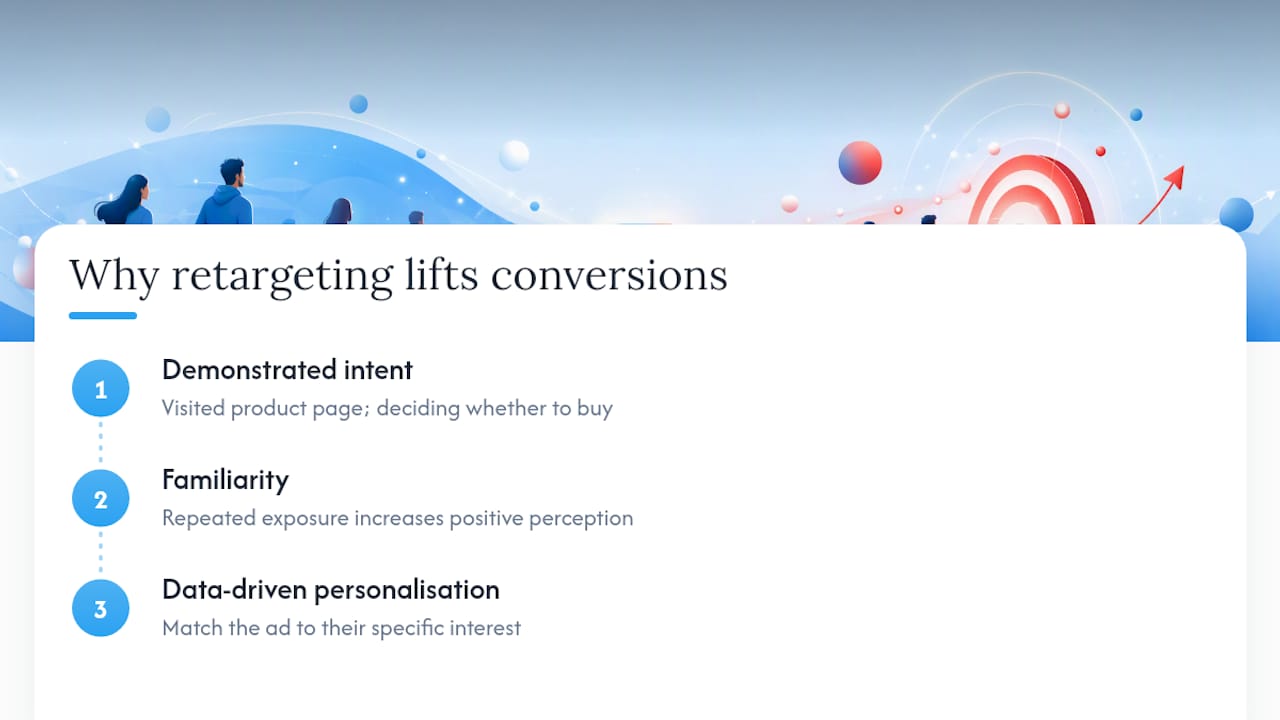
Demonstrated intent. A user who visited your product page has already done the research. They are not discovering your brand; they are deciding whether to buy. Ads shown to this group address a real, active consideration rather than interrupting someone with no relevant need.
Familiarity. Repeated exposure to a brand increases positive perception, a well-documented psychological effect. Behavioural research points to the mere-exposure effect and the Zeigarnik effect (the tendency to remember incomplete tasks) as two reasons retargeted users respond at higher rates. The user started a purchase journey and did not finish it. The retargeting ad is a prompt to close that loop.
Data-driven personalisation. Because you know what the user viewed, you can match the ad to their specific interest. A user who looked at running shoes sees running shoes, not a generic brand ad.
Around three-quarters of marketers use retargeting, and many report it outperforms other digital channels on a cost-per-conversion basis. The numbers support that view.
A simple illustration: if your site attracts 10,000 visitors per month and 2% convert on the first visit, you have 9,800 non-converting visitors. Retargeting even 5% of those at a 10% conversion rate adds 49 incremental conversions. At a £30 average order value, that is £1,470 in recovered revenue from an audience you had already paid to acquire.
Global cart abandonment sits at approximately 70%, which means the majority of e-commerce visitors who show genuine purchase intent leave without buying. Retargeting is the primary mechanism for recovering that revenue.
How do you measure the real impact of retargeting?
Last-click attribution over-credits retargeting almost every time. A user who was going to convert anyway sees a retargeting ad in the final hour and the platform claims the conversion. Without a measurement plan, you will pay for conversions you would have received regardless.
Incrementality testing (holdout tests) is the correct method. Search Engine Land recommends holding back a random slice of your retargeting audience, serving them no ads, and comparing their conversion rate to the exposed group. The difference is your true incremental lift. Run holdout tests quarterly; results shift as audience composition and creative fatigue change.
A simple holdout example: expose 90% of your retargeting audience and hold back 10%. That is the number to report to stakeholders, not the platform’s claimed conversion count.
Attribution model caveats:
- Post-click attribution counts a conversion only when the user clicked the ad. More conservative and usually more accurate.
- Post-view (view-through) attribution counts a conversion when the user saw the ad but did not click. Platforms default to this and it inflates reported results significantly.
- Assisted conversions in GA4 show retargeting’s role in multi-touch paths without over-crediting it.
GA4 and data-driven attribution (DDA) distributes credit across all touchpoints using machine learning. It requires a minimum data threshold (roughly 300–3,000 conversions per month depending on the model) to function reliably. Below that threshold, use last-click with a holdout test to validate. Track incremental conversions, CPA, and ROAS as your three primary metrics, and keep an eye on social media KPIs that signal audience health.
Measurement tool checklist: GA4 (DDA, assisted conversions, audience reports), Google Ads Experiments (holdout tests for Search/Display), Meta Conversion Lift (holdout tests for Meta campaigns), and a tag manager (Google Tag Manager or a server-side equivalent) to manage pixel and Conversions API firing.
Retargeting campaign best practices that actually move the needle
Segmentation is where most campaigns either win or waste budget. Do not lump all site visitors into one audience.
- Segment by intent depth. Product viewers, cart abandoners, and checkout abandoners have different levels of intent and need different messages. Cart abandoners are the highest-value segment; they have committed to a product and stopped just before payment.
- Set lookback windows by purchase cycle. A fashion retailer might use a 7-day window for cart abandoners and a 30-day window for product viewers. A B2B SaaS company might extend to 90 days for trial users.
- Sequence your creative. A three-phase structure works well: remind (days 1–3, show the product), persuade (days 4–10, add social proof or a review), incentivise (days 11–21, introduce a limited offer if needed). Stanford research confirms that conversion probability decays steeply after the first three days, so front-load your highest bids and most personalised creative in that early window.
- Cap frequency. Three to five impressions per user per week is a reasonable starting point for most campaigns. Above that, ad fatigue sets in and sentiment turns negative.
- Exclude converters immediately. A user who purchased yesterday should not see an acquisition ad today. Failing to exclude recent buyers is one of the most common and most damaging retargeting errors.
- Run A/B tests on creative variants, frequency caps, and incentive vs no-incentive messaging. Test one variable at a time and give each test at least two weeks of data before drawing conclusions.
Pro Tip: Product feed hygiene multiplies dynamic ad results. If your feed has missing images, incorrect prices, or out-of-stock items, your dynamic product ads will serve irrelevant or broken creative. Audit your feed weekly. A clean feed is the single highest-leverage maintenance task for e-commerce retargeting.
For broader audience targeting on social platforms, the same segmentation logic applies: the tighter the audience definition, the more relevant the creative can be.
What goes wrong and what UK privacy rules apply?
Common mistakes that kill performance:
- Targeting “all visitors” as a single undifferentiated audience. This wastes budget on users who bounced in two seconds.
- Failing to exclude converters, leading to ads that annoy existing customers.
- Stale creative. Running the same ad for six weeks produces fatigue and declining CTR. Refresh creative every three to four weeks.
- Overexposure. High frequency without a cap burns through budget and damages brand perception.
UK GDPR and ePrivacy compliance checklist:
- Obtain explicit, informed consent before firing tracking pixels. A pre-ticked cookie banner does not meet UK GDPR standards.
- Document your lawful basis for processing retargeting data. Legitimate interests can apply in some cases, but consent is the safer basis for behavioural advertising.
- Maintain an up-to-date vendor list (your Consent Management Platform should handle this) and apply data minimisation: collect only the signals you actually use.
- Use server-side Conversions API with hashed, pseudonymised data where possible to reduce the volume of raw personal data sent to ad platforms.
- First-party data methods (CRM uploads, logged-in targeting) are more privacy-resilient than cookie-based pixel tracking and should be prioritised as third-party cookies continue to phase out.
For a broader view of overcoming privacy-aware measurement challenges, the shift to first-party data is the defining trend for UK digital marketers right now.
Real-world retargeting scenarios and expected uplift
E-commerce cart recovery. A user adds trainers to their basket and leaves. Within the first 24 hours, serve a dynamic product ad showing those exact trainers with free delivery highlighted. The first 24 hours are the highest-converting window; after 72 hours, recovery rates drop sharply.

SaaS trial-to-paid conversion. A user signs up for a 14-day free trial and goes quiet after day three. A sequenced retargeting campaign works well here: remind them of a feature they have not used (days 1–3), show a customer case study (days 4–10), then introduce a limited upgrade offer (days 11–21). Expected uplift over no retargeting: a meaningful increase in trial-to-paid conversion, particularly for users who engaged with at least one product feature during the trial.
B2B lead nurture. A prospect visits your pricing page twice but does not request a demo. Sync your retargeting audience with your SDR outreach: the prospect sees a LinkedIn or display ad reinforcing your value proposition at the same time your SDR sends a follow-up email. Segment by page intent (pricing page visitors vs blog readers) and measure meetings booked as the primary KPI, not clicks.
Each scenario benefits from the same underlying principle: the closer the ad message is to the specific action the user took, the higher the response rate.
What do retargeting campaigns cost and when do results appear?
Retargeting generally costs less per click than prospecting because the audience is smaller and more qualified. Typical benchmarks vary by platform and sector, but the directional picture is consistent.
Timeline expectations:
- Days 1–7: Early signal. You will see click and impression data quickly, but conversion volumes are often too low to draw conclusions.
- Weeks 2–8: Stabilisation. Enough conversion data accumulates to optimise bids, pause underperforming creative, and adjust frequency caps.
- Week 4 onwards: Run your first holdout test if conversion volumes allow. This is when you can start separating incremental lift from organic conversions.
Front-load your budget in the first three days of any new retargeting audience, when conversion probability is highest. After that window, reduce bids for users who have not engaged and reallocate to fresh entrants into the audience.
Which platforms and tools should UK marketers use?
Google Ads covers search (RLSA), display, and Shopping retargeting. It is the strongest option for capturing users with active search intent and for e-commerce product retargeting via Google Shopping campaigns. Google’s audience lists integrate directly with GA4, making measurement cleaner.
Meta Ads (Facebook and Instagram) excels at social retargeting with rich visual creative. Custom audiences built from pixel events or CRM uploads, combined with dynamic product ads, make it the default choice for e-commerce brands with strong creative assets. The Conversions API is mandatory for reliable signal recovery on Meta post-ATT.
GA4 is your measurement hub. Use it for data-driven attribution, assisted conversion reports, and audience exports to Google Ads. Set up conversion events properly before launching any retargeting campaign.
Tag managers (Google Tag Manager or a server-side equivalent) manage pixel and Conversions API firing without requiring developer involvement for every change.
Feed management tools (such as DataFeedWatch or Feedonomics) keep product feeds clean and up to date for dynamic ads across Google and Meta.
All of these tools are available to UK marketers and comply with UK GDPR when configured correctly with a Consent Management Platform and server-side data handling.
For a fuller picture of how social campaigns are optimised, the platform selection decision sits inside a broader optimisation framework that covers creative, bidding, and audience strategy together.
An editorial perspective on retargeting in a UK marketing mix
Most marketers treat retargeting as a finishing move: something you bolt on after the prospecting campaign is running. That framing is backwards. Retargeting should be the first paid channel you get right, not the last.
The reason is straightforward. You have already paid to bring those users to your site through SEO, social, or paid search. Retargeting is the mechanism that extracts value from that existing spend. Running prospecting without retargeting is like filling a bucket with a hole in it.
For UK brands specifically, the privacy constraints are real but manageable. The shift to server-side tracking and first-party data is not a compliance burden; it is a competitive advantage for anyone who moves early. Brands that build clean CRM lists and implement Conversions API now will have more reliable audience data than competitors still relying on third-party cookies.
If you are starting from scratch, week one should look like this: install the pixel and Conversions API together, create three audiences (product viewers, cart abandoners, past purchasers), set frequency caps, exclude converters, and launch with dynamic product ads. Do not wait for perfect creative. A clean feed and correct tracking will outperform beautiful static ads with broken measurement every time.
Retargeting also pairs naturally with performance marketing on social media, where the same audience segmentation logic applies across paid and organic channels. Greediersocialmedia works with UK brands to build the social presence that makes retargeting audiences larger and warmer from the outset. A brand with genuine engagement and visibility on Instagram or Facebook generates more retargetable users per pound of media spend than one starting from a cold base.
Grow your social presence alongside your retargeting
Retargeting works best when your brand already has traction. Greediersocialmedia has supported over a million users since 2013, helping UK businesses and creators build real, engaged audiences on Instagram, Facebook, TikTok, YouTube, and Threads. Larger, warmer audiences mean more users entering your retargeting funnel from day one.
Explore social media growth tactics that complement your paid retargeting strategy.
Sources
- Retargeting Ad Performance Statistics 2026: ROI Data Now
- The Complete Retargeting Guide (2026) | FYI Digital
- Retargeted advertising: sooner better than later — Stanford GSB
FAQ
What are the main benefits of retargeting campaigns?
Retargeting delivers higher conversion rates, lower CPA, and improved ROAS by focusing ad spend on users who have already shown purchase intent.
How does retargeting work in display advertising?
A tracking pixel or Conversions API fires when a user visits your site, adding them to an audience list. Ad platforms then serve that user relevant display ads across other websites and apps, keeping your brand visible after they leave.
How should you measure retargeting performance?
Use holdout (incrementality) tests to isolate the true lift retargeting delivers, rather than relying on last-click attribution. Track three primary KPIs: incremental conversions from the holdout, CPA, and ROAS. Run tests quarterly because results shift as audiences and creative age.
What are the main disadvantages of retargeting ads?
Ad fatigue from overexposure, privacy and consent requirements under UK GDPR, and the risk of over-crediting retargeting through last-click attribution are the three most common problems. Frequency caps, exclusion lists, and holdout testing address all three.