
What does social media KPI mean, exactly?
A social media KPI (key performance indicator) is a specific, measurable metric tied directly to a business objective. Not every number you can pull from a dashboard qualifies. A metric is any data point you can measure; a KPI is the metric you have chosen to track progress toward a defined goal, complete with a target, a timeframe, and a benchmark to judge it against.
The distinction matters more than most marketers realise. Follower count is a metric. Conversion rate is a KPI. If you only watch follower count, you will optimise for follower growth, which can have zero correlation with revenue.
KPIs vs metrics at a glance:
- KPIs are business-linked, goal-specific, and carry a target and timeframe
- Metrics are raw data points useful for diagnostics but not strategy
- Vanity metrics (likes, impressions) feel good but rarely connect to commercial outcomes
- Value metrics (cost per lead, conversion rate, customer acquisition cost) affect your bank account directly
Table of Contents
Common social media KPIs and how to measure them
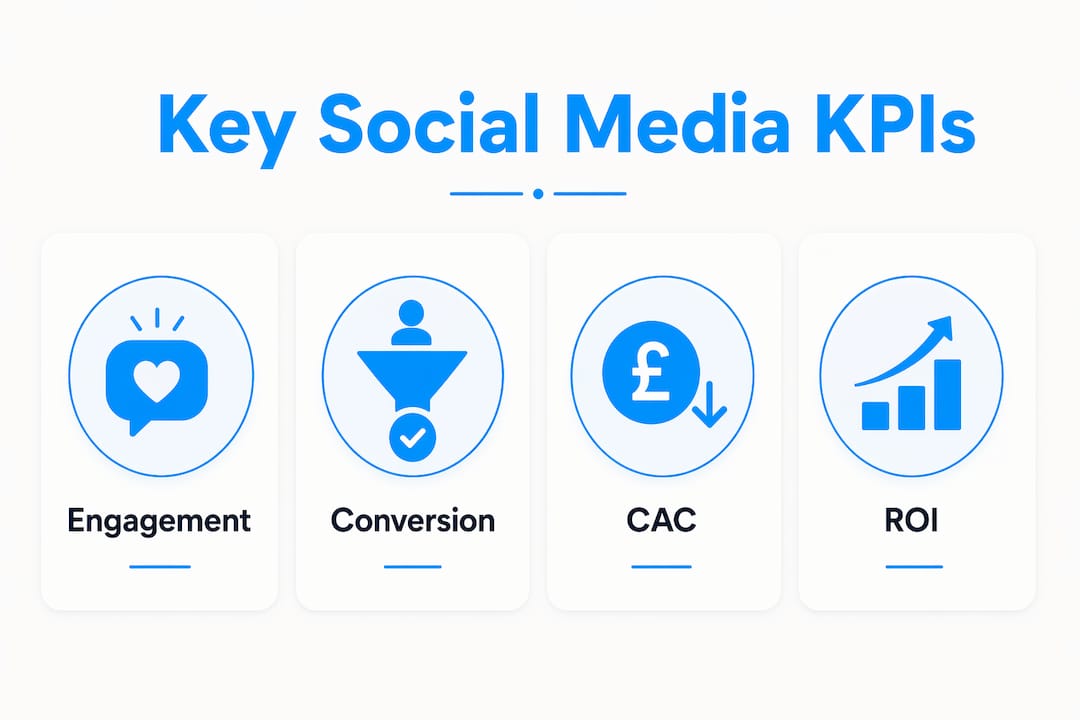
The most widely tracked KPIs for UK businesses include engagement rate, conversion rate, customer acquisition cost (CAC), return on ad spend (ROAS), cost per lead (CPL), and click-through rate (CTR). Each maps to a distinct stage of the customer journey, so selecting the wrong one for your current stage wastes both time and budget.

UK benchmarks give you a useful starting point: engagement rate sits at roughly 1.6% on Instagram and 4.5% on TikTok. If you are consistently below those figures, the content itself is the problem, not the posting frequency.
Measurement in practice:
- Connect Meta Business Suite native insights with Google Analytics 4 (GA4) for a complete picture
- Add UTM parameters to every link so GA4 can attribute traffic and conversions back to specific posts and campaigns, turning social activity into a measurable revenue stream
- Track social media KPIs monthly and compare against your own baseline before chasing industry averages
KPI selection should also reflect where your business sits right now. As analyst Ciaran Connolly notes, early-stage businesses should align KPIs to business objectives around CPL and conversion rates, growth-stage companies on ROAS and CAC, and established brands on customer lifetime value. A one-size-fits-all approach produces one-size-fits-nobody results.
ROI calculation: the part most UK marketers get wrong. Hootsuite’s guidance is clear: KPIs give leadership a consistent business language to justify budgets and pivot strategy. But the ROI formula only works when you include all costs: staff time, content production, agency fees, and tool subscriptions, not just ad spend. Expert Esraa Mahmoud advises factoring in long-term influenced conversions too, since last-click attribution misses assisted sales that social media initiated weeks earlier. A strong return ratio of around five times your investment is often cited as a useful UK benchmark, though high-ticket service businesses may find profitability at lower ratios.
Greediersocialmedia works with UK businesses to build the kind of authentic engagement that makes these KPIs move. If your numbers are stalling, their social media growth tactics are worth exploring.
FAQ
What is the difference between a KPI and a metric?
A metric is any measurable data point; a KPI is a metric linked to a specific business goal with a defined target and timeframe. Likes are a metric; cost per lead is a KPI.
Which social media KPIs matter most for small UK businesses?
Start with conversion rate, cost per lead, and engagement rate. These connect directly to revenue and are measurable with free tools like GA4 and Meta Business Suite.
How do you calculate social media ROI accurately?
Use the formula: (Earnings minus Costs) divided by Costs. Include all costs — staff time, agency fees, and subscriptions — not just ad spend, and account for long-term conversions influenced by social activity.
What is a good engagement rate on social media in the UK?
Roughly 1.6% on Instagram and 4.5% on TikTok are useful UK benchmarks. Consistently falling below these figures points to a content quality issue rather than a distribution problem.