
You can verify followers, yours or anyone else’s, by combining three checks: a sample review of the profiles themselves, the account’s growth history, and engagement measured against audience size. No tool can prove that every single follower is a real person. What you can do is build a body of evidence that is strong enough to trust, and that works whether you are auditing a creator you want to hire or testing a provider you have paid.
This guide shows the checks in the order we would run them, what a trustworthy provider should be able to show you, and where the limits of every checker lie.
TL;DR
- No checker proves each follower is genuine. Treat any authenticity percentage as an estimate, and look at the signals behind it.
- One warning sign proves nothing. Several together (no photo, empty bio, few posts, very high following, generic comments) are what count.
- Real followers and useful followers are different things. Check whether the audience fits your market, not just whether the profiles look human.
- Test any provider with a small order first, record the numbers before and after, and keep the evidence.
- If you pay creators or are paid to promote, UK rules on labelling and contract terms on artificial engagement apply.
Table of Contents
- What verifying followers can and cannot tell you
- A 10-minute manual check you can do today
- Warning signs that matter, and how much weight to give them
- Engagement rate and ghost followers
- Real is not the same as right for you
- How to verify a follower provider before and after you buy
- Our view: how we would want to be tested
- If you are vetting a creator, not a provider
- UK rules and contracts worth knowing
- Where to start with us
- Quick checklist
- FAQ
- Sources
What verifying followers can and cannot tell you
Instagram does not hand a third party the complete follower list of another account. That is why every outside checker works from public or sampled data: follower count, following count, average likes and comments, and a sample of profiles. One published checker explains that its authenticity read is built from a profile’s public numbers, and it argues that a tool which shows its inputs is more defensible than one claiming exact certainty.
So be suspicious of any score presented as a verdict. A sensible way to read a result:
- Under a rough threshold of concern: the sample shows no strong pattern. This is not a clean bill of health.
- A high fake percentage: a prompt to investigate, not proof of purchase. Larger accounts attract more bot activity whether or not the creator bought followers, and inactive real users can look like bots.
- Any score at all: an estimate, not an audit-grade fact.
The practical consequence is that verification is about weight of evidence. You collect several independent signals, and you only act when they point the same way.
A 10-minute manual check you can do today
Before opening any tool, do this by hand. It costs nothing and often tells you more than a percentage.
- Record the baseline. Note follower count, following count, and the likes and comments on the last 10 posts. Write down the date. A live count is a changing snapshot, so a timestamp matters.
- Scroll the growth history. Look at when posts were published against when the audience seemed to jump. A flat account that gains thousands overnight, with no post, mention or campaign to explain it, deserves a question.
- Sample the followers. Open 20 to 30 profiles from different points in the list, not only the top. Look at profile photos, bios, post history, username patterns (strings of random digits are common) and how many accounts each follows.
- Read the comments. Generic phrases, emoji-only replies, and the same comment repeated across posts suggest low-quality engagement. Compare what people say with what the post is about.
- Compare audience to content. A practical manual review is to inspect ten random recent posts and ask whether the roles, interests and locations of commenters match the creator’s subject.
We also keep a longer list of common fake follower warning signs if you want to calibrate your eye.
Warning signs that matter, and how much weight to give them
The same published guidance makes a point worth repeating: a bot warning becomes credible when several indicators occur together. One indicator alone is not conclusive, because real people can be private, inactive or simply lazy about their profile.
| Signal | What it can mean | Weight on its own |
|---|---|---|
| No profile photo | Bot, or a private real user | Low |
| Empty or copied bio | Bot, or minimal real profile | Low |
| Very few posts | New account, lurker, or bot | Low |
| Following thousands, followed by few | Mass-follow pattern | Medium |
| New account age | Throwaway account, or a new user | Low to medium |
| Generic or repeated comments | Engagement pods or automation | Medium |
| Engagement far below follower count | Inactive or inflated audience | Medium |
| Sudden unexplained spike | Purchase, giveaway or viral post | Medium, needs context |
When three or four of these line up across your sample, the risk is real. When one appears in isolation, move on.
Engagement rate and ghost followers
An audience can be made of real people and still be worthless to you if none of them interact. This is the so-called ghost-follower problem, and checkers approach it through ratios: likes and comments against follower count, and repeated comments or mass-follow patterns.
Rather than quote a universal benchmark, which varies enormously by niche and account size, compare the account with itself and with similar accounts in its own field. Ask:
- Do engagement levels move with follower count, or did followers triple while likes stayed flat?
- Do comments reference the post, or could they sit under any photo?
- Are saves and shares visible in the creator’s own insights? These are harder to fake than likes.
If you are the account owner, your own Instagram insights show more than any outside tool can, including audience location and age ranges. For follower retention over time, our piece on real follower retention and cohorts explains why tracking who stays matters more than the headline count.
Real is not the same as right for you
A provider saying its followers are real is a starting claim, not a result. For a UK business there are three separate questions:
- Do the accounts look like human beings? This is the profile check above.
- Are they active, and in your target market? A real person in another country, on a dormant account, does nothing for a Manchester café.
- Do they resemble your customers? Age, interests and location should plausibly overlap with who buys from you.
This is why inspecting whether the remaining audience matches the intended UK location, age and interests matters more than whether a headline score is low. If you plan to use paid growth alongside advertising, read what buying followers can do to your ads before you commit.
How to verify a follower provider before and after you buy
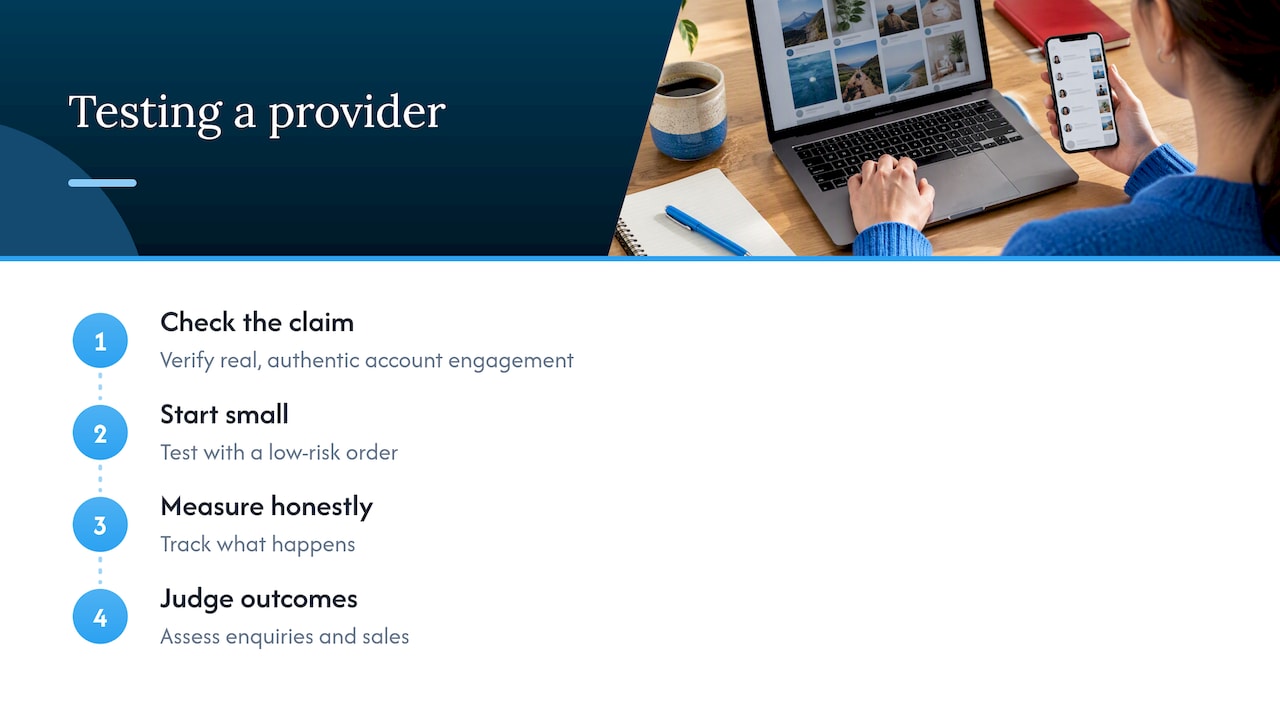
This is the part most guides skip. Whether you are considering us or anyone else, treat the first order as a test.
Before you order
- Check what is promised. Is the service described as followers, likes or views, and does it say where the audience is targeted? For UK businesses, UK targeting is the detail that matters.
- Look for password requests. A legitimate delivery needs your public username only. Never hand over a login.
- Find the support route. Can you reach a human before you pay, and does the site say how quickly they reply?
- Read the delivery terms. Is delivery instant, staged, or unspecified? Gradual delivery can look less abrupt on a growth chart, but ask what the provider actually does.
- Start small. Our Instagram followers range from £1.99 to £229.99 as a one-off, so a low-priced first package costs little and still lets you inspect the result.
During the first 14 days
Run a simple pilot. Record on day 0, day 1, day 7 and day 14:
- Follower count and following count
- Likes, comments and saves on your latest three posts
- Audience location split from your insights
- Number of followers lost since delivery (drop-off)
Then sample 30 new followers using the manual check above. If most have photos, some posts and a believable following ratio, that is encouraging. If most are empty shells, you have your answer, and you should contact support with screenshots.
What good evidence looks like
| Evidence | Why it helps |
|---|---|
| Dated before and after screenshots | Shows exactly what changed |
| Saved sample list of 30 profiles | Lets you judge quality consistently |
| Insights export of audience location | Tests the targeting claim |
| Order confirmation and support emails | Supports any refund or replacement conversation |
Keep all of it. If you later work with brands, you may be asked about audience quality.
Our view: how we would want to be tested
We have served over a million customers since 2013, and the one thing that has stayed constant is that customers who test us properly are the ones who stay. So here is how we think about it.
We sell followers, likes and views with UK and USA targeting, instant delivery and no password required, and our position is that the engagement should come from real, authentic accounts rather than bots. We would rather you check that claim than take our word for it. A provider that discourages inspection is telling you something.
Where we think the industry is often too glib is in treating the follower number as the product. It is not. The product is credibility at the moment a stranger lands on your profile: does it look established enough that they will follow, click or buy? Followers are one input, and the content, the engagement and the consistency behind them are the others. We would always pair a purchase with a plan to publish, reply and earn real interaction on top. Our guide to authentic engagement versus fake followers sets out how we separate the two.
We also think small businesses deserve straight answers on risk. No checker is perfect, no growth is risk-free, and a number on its own never makes a brand. Test small, measure honestly, and judge on what happens to your enquiries and sales.
— Irwin Lee
If you are vetting a creator, not a provider
Marketers face the reverse problem: someone else’s audience. A few principles:
- Ask for access. Request screenshots of audience insights (location, age, gender) taken within the last 30 days, and compare them with your target market.
- Do your own sample. Use the manual check above on the creator’s followers and on the accounts commenting.
- Judge outcomes. Past campaigns with trackable links or codes tell you more than any score. Our article on how brand partnerships evaluate influencers goes through the criteria, and spotting fake engagement in influencer marketing covers comment and like patterns.
- Link checks to results. Follower checks are one part of a wider plan; these influencer marketing strategies that tie authenticity checks to campaign outcomes show how to fit them in.
UK rules and contracts worth knowing
If money or free products change hands for a post, the content must be labelled. The Competition and Markets Authority has said that users who receive payment or another incentive to promote a product must disclose that clearly, and Instagram’s UK commitments included prompts, a paid-partnership tool and technology to spot unclear disclosures. The requirement covers UK users and people directing posts at UK Instagram users. If you are unsure whether a particular arrangement counts, check the CMA’s published guidance or take advice from a solicitor who works in advertising law.
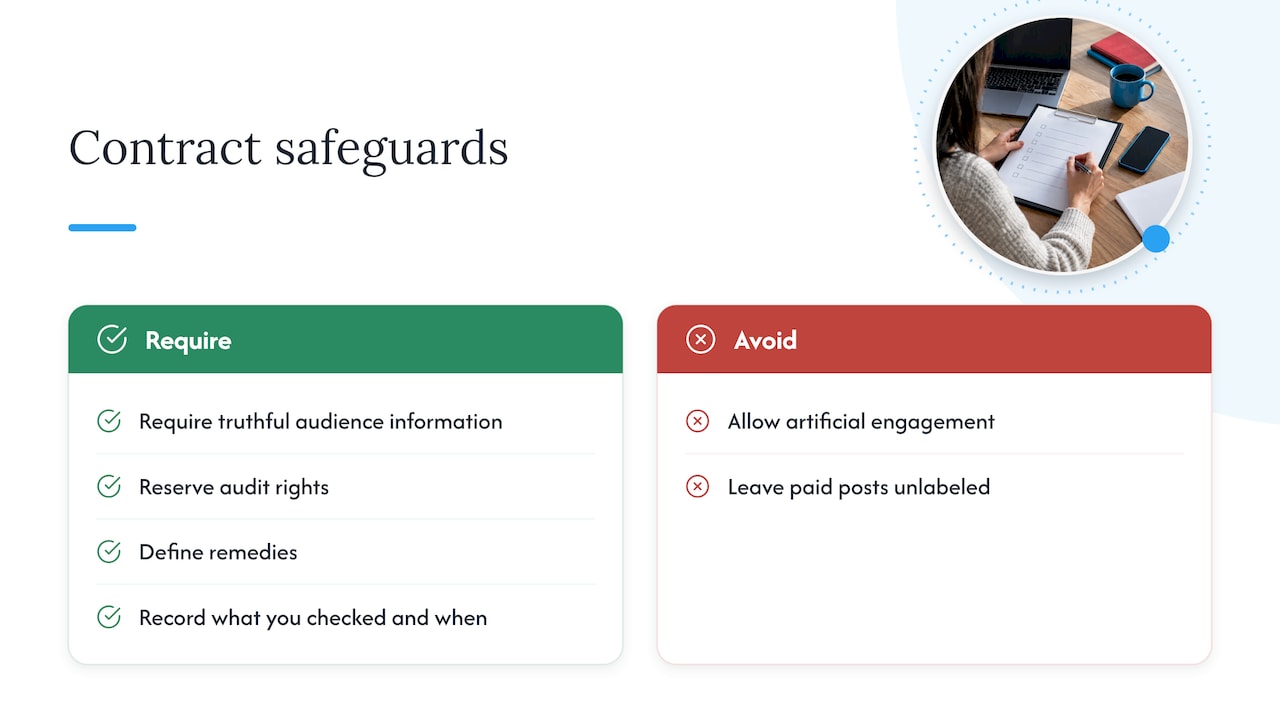
On the contract side, ISBA, the UK advertiser body, has published influencer agreements, and its work specifically addresses fake followers, bots and artificial engagement. Brands can protect themselves by requiring truthful audience information, prohibiting artificial engagement, reserving audit rights and defining remedies. Keep a record of what you checked and when.
If you are a UK creator buying followers as a business expense, tax treatment is its own question; our piece on VAT when buying followers is a starting point, but confirm your position with an accountant or HMRC.
Where to start with us
If you want to run the test above with a low-risk first order, our Instagram packages cover followers (£1.99 to £229.99), likes (£0.99 to £189.95) and video views (£0.59 to £54.99), all one-off and delivered without a password. For steady growth, auto followers run from £15.00 to £100.00 per month. We also cover TikTok, YouTube and Facebook. If you are unsure what to buy first, what happens when you buy Instagram followers walks through the process.
Quick checklist
- Baseline numbers recorded with a date
- 30 followers sampled by hand, not only the first page
- Several warning signs weighed together, not one in isolation
- Audience location compared with your target market
- Engagement checked against follower growth
- Evidence saved: screenshots, sample list, order emails
- Any paid promotion labelled clearly
FAQ
How do I check if followers are real?
Record the follower and following counts, then sample 20 to 30 profiles and read recent comments. Look for several warning signs together rather than one. Outside tools can add an estimate, but they work from sampled public data.
Can I buy legit followers on Instagram?
Providers exist that say they deliver real accounts, but the claim needs testing. Order a small package, sample the new followers, check audience location in your insights, and watch drop-off over two weeks. Judge the provider on that evidence.
How can I tell if a follower is a bot?
No single trait settles it. A missing photo, empty bio, few posts, very high following and generic comments together make a bot likely. Private or inactive real users can show one or two of those signs.
Does a high fake follower score mean someone bought followers?
Not necessarily. Bigger accounts attract spam and bots whatever the owner did, and inactive real users can look like fakes. Use the score as a reason to look closer, then check growth history and engagement.
Sources
- Instagram Fake Follower Checker methodology, HowSociable
- Free Instagram Fake Follower Checker, Modash
- How to check if an influencer’s followers are real, Revealed
- Instagram to tackle hidden advertising after CMA action, GOV.UK
- ISBA launch contracts to improve influencer marketing effectiveness