
Understanding TikTok views retention explains why some videos keep getting pushed further.
Retention means how much of your video people actually watch, measured through average watch time and completion rate, and it decides whether TikTok pushes your content past its first test audience. The single most impactful fix for most creators is the opening three seconds: tighten that hook and average watch time rises across the board.
TL;DR:
- Improving the first three seconds of your video significantly boosts average watch time and retention metrics essential for TikTok’s algorithm.
- Target benchmarks suggest aiming for over 60% completion on videos under 15 seconds and adjusting expectations downward as video length increases.
- Early distribution relies heavily on metrics like completion rate, rewatch rate, and engagement signals such as saves and shares, which influence video spread.
- Analyzing the retention graph for specific drop points identifies critical editing fixes, especially in the hook or mid-section, to maintain viewer interest.
- Increasing initial views with honest promotion strategies helps your videos gather enough data for the algorithm to recognize their value and promote them further.
Table of Contents
- What is TikTok views retention, exactly?
- What retention rate should you be aiming for by video length?
- How does TikTok’s algorithm use retention to decide distribution?
- How do you read your TikTok retention graph?
- What editing tactics actually improve retention?
- How do you test and measure retention improvements?
- What we’ve learned watching thousands of TikTok videos
- How Greedier Social Media supports your retention strategy
- Sources
- FAQ
What is TikTok views retention, exactly?
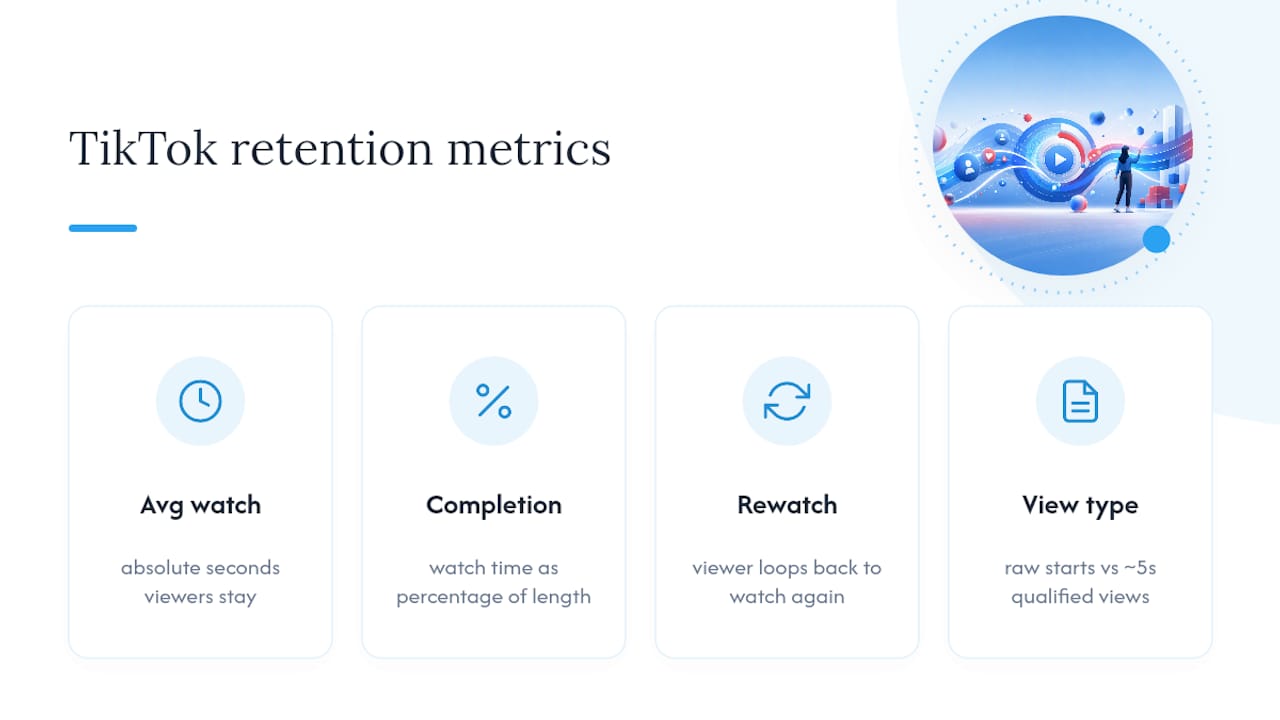
Retention isn’t one number. It’s a cluster of metrics that together describe what viewers do once your video starts playing, and each one tells you something slightly different.
Average watch time is the absolute number of seconds people stick around for, not a percentage. This matters because two videos can share the same completion rate and still perform completely differently in the algorithm if one holds attention for 45 seconds and the other for 4. A 90 second video with 20 seconds average watch time and a 15 second video with 12 seconds average watch time both look mediocre on paper, but the first one is losing viewers far faster relative to its length.
Completion rate expresses that watch time as a percentage of total video length, and it’s the figure most creators fixate on.
Rewatch rate tracks how often people loop back to the start rather than swiping away. A spike here is one of the strongest signals you can send TikTok, since it shows a viewer chose to watch again rather than being served the video twice by accident.
Then there’s the distinction between a raw view and a qualified view. TikTok counts a view the instant playback starts, but for things like Creator Rewards, a qualified view generally needs a watch of around five seconds or longer, with repeat plays counted as a strong signal on top. Knowing this gap matters because a video can rack up thousands of raw views while only converting a fraction into anything the algorithm or your monetisation eligibility actually values, as Shopify’s breakdown of TikTok view mechanics explains.
What retention rate should you be aiming for by video length?
There’s no single “good” retention number, because the same percentage means something completely different depending on how long your video runs.
Retensis’s 2026 benchmarking data gives a workable set of targets by duration:
- Under 15 seconds: aim above roughly 60% completion. Anything less suggests your hook or pacing is losing people almost immediately.
- 15 to 30 seconds: around 50% is a solid target. This is the zone where most trend-driven and comedic content lives.
- 30 to 60 seconds: closer to 40% completion is respectable, since you’re asking for more sustained attention.
- 60 seconds to 3 minutes: roughly 30% completion is the realistic bar. Longer-form content trades completion rate for absolute watch time.
- Beyond 3 minutes: completion rate becomes almost meaningless as a comparison point. Average watch time in seconds or minutes is the more honest metric here.
These figures come from Retensis’s TikTok retention benchmarks for 2026, and they’re worth checking against your own analytics rather than treating as gospel. Context by length is the whole game.
How does TikTok’s algorithm use retention to decide distribution?
TikTok tests every video against a small initial audience before deciding whether to expand its reach, and how that test group behaves in the first minutes after posting largely determines what happens next. Completion and watch time sit at the top of the signal hierarchy, above almost everything else creators typically chase.
The rough order of importance, based on Sprout Social’s analysis of TikTok’s ranking behaviour, looks like this:
- Completion rate and average watch time
- Rewatches
- Saves and shares
- Comments, particularly longer or reply-generating ones
- Likes
Statistic to remember: industry guides tracking 2026 performance put roughly 70% completion as the threshold many creators treat as a strong viral test result, though that figure assumes a short-form video and drops as duration increases, per Socialync’s retention data.
That ordering has a direct practical consequence. Likes are easy to get and cheap as a ranking signal; rewatches and saves cost the viewer more effort, so the platform weights them accordingly. Designing a single video to trigger several of these signals at once, a strong hook that earns watch time, a punchline that earns a rewatch, a useful detail that earns a save, beats optimising for any one metric in isolation.
How do you read your TikTok retention graph?
Every video you post has a retention graph sitting inside TikTok Studio, and it’s the single most useful diagnostic tool you have. Most creators check their view count and move on, ignoring the graph that actually explains why that view count looks the way it does.
Here’s how to use it properly:
- Open TikTok Studio (or Creator Analytics) and select the video. The audience retention graph plots the percentage of viewers still watching against elapsed time, second by second.
- Look for an initial cliff. If the line drops sharply in the first one to three seconds, your hook isn’t earning the watch. This is the most common and most fixable problem.
- Look for a mid-video cliff. A steep drop somewhere in the middle usually means dead air, a slow transition, or the payoff taking too long to arrive.
- Look for a spike above 100% at the very start. This indicates rewatches, people looping back to watch again, and it’s one of the clearest positive signals a video can produce.
- Note the exact timestamp of every drop. This is the part creators skip. A vague sense that “people leave partway through” is useless; the timestamp is what tells you what to cut.
Once you have a timestamp, convert it into an edit decision. A drop at second 2 means rework the hook. A drop at second 8 in a 15 second video usually means the setup runs too long before the payoff. A drop right after a caption appears might mean the text itself is confusing or poorly timed. Socialk treats the retention graph as the primary editing tool rather than a vanity metric, and that’s the right instinct.
Pro Tip: Screenshot the retention graph for your five best-performing videos and your five worst. Lay them side by side. The pattern in where the lines diverge will usually tell you more about your audience than any single piece of advice in this article.
What editing tactics actually improve retention?
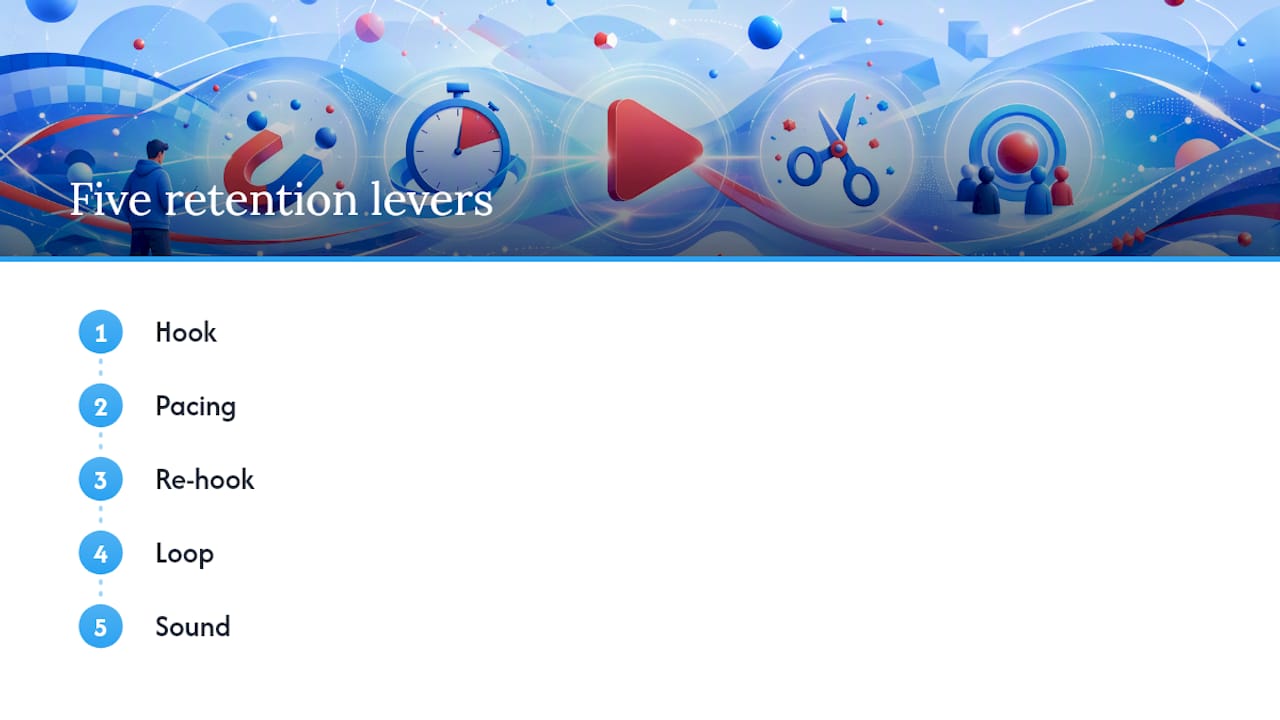
This is where most of the actual work happens, and it breaks down into five areas: the hook, the pacing, the re-hook, the loop, and the sound.
The three-second hook
You have roughly three seconds before a viewer decides whether to stay, and that decision is emotional, not rational. Three formulas work consistently well:
- Curiosity gap: start mid-action or mid-sentence so the viewer needs to watch on to understand what’s happening.
- Payoff promise: state clearly what they’ll get by the end (“here’s the exact edit that fixed this”) so leaving feels like missing out.
- Pattern interrupt: open with something visually or audibly unexpected, a jump cut, an unusual angle, a loud sound, that breaks the scroll habit.
Pacing that holds attention
Dead air is the single most common cause of a mid-video cliff. Aim for a visual change, a cut, a zoom, a text overlay, roughly every three to five seconds. This doesn’t mean frantic editing; it means never letting a single static shot run long enough for a thumb to start moving toward the swipe gesture. On-screen text matters here too, since a large proportion of viewers watch with sound off, and captions that summarise the key line keep muted viewers engaged rather than lost.
Re-hooks and payoff placement
A second hook placed roughly at the halfway point re-engages anyone whose attention has started to drift, a line like “but here’s what actually happened” or a sudden visual shift works well. Place your most satisfying payoff in the final third rather than right at the end; if the best moment lands in the last half second, a chunk of your audience will have already left before they see it.
Loops versus longer narratives
For videos under 20 seconds, engineer the ending to flow naturally back into the beginning, a visual or audio match cut that makes a second watch feel almost automatic. Retensis’s benchmarking work flags rewatches as one of the strongest single signals TikTok measures, so a well-built loop can outperform a video that simply holds attention once. For longer content, past 60 seconds, chasing a loop stops making sense; structure it instead as a narrative with escalating stakes, using re-hooks at intervals to prevent drop-off rather than relying on a single replay trick.
Sound strategy
Trending sounds can help discovery in the early testing window, but they’re not always the right call. A clear voiceover with keyworded speech, saying the actual topic and key terms out loud, helps TikTok’s search and recommendation systems understand and surface your content, which matters more for evergreen or tutorial-style videos than for pure trend content. Save trending audio for entertainment clips where the sound itself is part of the joke or the format, and read a piece on storytelling techniques that boost engagement if you want the narrative side of this to go deeper than editing tricks alone.
Pro Tip: If you only have time to fix one thing this week, fix the gap between your hook and your first payoff. Most retention loss happens because the promise made in second one doesn’t pay off quickly enough to justify sticking around.
How do you test and measure retention improvements?
Running a proper experiment doesn’t require anything complicated, just discipline about changing one thing at a time.
- Pick a single variable per test. Change only the opening line, or only the video length, or only the ending, never all three in the same comparison.
- Watch the first 30 to 60 minutes closely. This is TikTok’s initial test window, and early completion rate here largely predicts whether the video gets pushed further.
- Check again at 24 and 72 hours. A video that starts slowly but keeps a steady completion rate can still gain distribution later; one that spikes and dies within hours usually won’t.
- Prioritise completion rate and rewatch rate over raw view count when judging whether a variant “won.” A smaller view count with stronger retention numbers is the better result to build on.
- Scale the winning variant by applying the same hook or pacing choice to your next few videos rather than treating one good result as a one-off.
Reply to comments in the first fifteen minutes after posting. Early engagement in that window compounds the platform’s testing process, and Adobe’s guide to TikTok engagement notes that this initial burst of activity carries disproportionate weight in how far a video gets pushed.
What we’ve learned watching thousands of TikTok videos
Most advice about TikTok retention treats it as a purely creative problem, hooks, pacing, editing flair, and ignores the fact that early distribution is also a numbers game. A brilliant edit with a weak first test audience can still underperform simply because the algorithm never gave it enough eyes to prove itself. We’ve seen accounts fix their hooks, tighten their pacing, and still plateau because the initial push was too small to generate a meaningful signal either way.
That’s the gap conventional advice skips. Retention tactics and early visibility aren’t competing strategies, they work together, and treating them as separate problems is why some creators do everything right on paper and still stall at 200 views.
— Luna
How Greedier Social Media supports your retention strategy
A perfect hook and airtight pacing won’t matter if your video never gets enough initial views to prove its retention to TikTok’s algorithm in the first place. That’s the practical gap Greedier Social Media fills: password-free, UK-targeted views delivered fast enough to give your test window a real sample size while you’re still refining the edit.

Think of it as giving your creative work a fair shot at being judged, rather than dying in a test pool too small to register a strong completion rate. This works best as a complement to the editing tactics covered above, not a replacement for them; buying engagement to mask a weak hook won’t fix the underlying retention problem, and Shopify’s guidance is clear that any tactic simulating fake activity risks platform penalties. Used honestly, alongside genuine retention work, an early boost from Greedier Social Media’s TikTok views service gives your best edits room to prove themselves before the algorithm moves on to the next video in the queue. Check current packages and get your next upload seen by more than just the first test group.
Sources
- How to get more views on TikTok (Sprout Social)
- TikTok retention benchmarks 2026 (Retensis)
- Socialk
- Guide to TikTok engagement (Adobe Express)
FAQ
Is 50% retention good on TikTok?
It depends on length. For a video between 15 and 30 seconds, 50% completion sits right at the benchmark for solid performance; for a 90 second video, 50% would be excellent, well above the roughly 30% benchmark for that duration.
Is 10,000 views a lot on TikTok?
View counts alone don’t tell you much without retention data alongside them. Views with strong completion and rewatch rates signals a video the algorithm is actively pushing, while the same number with a steep early drop-off suggests the content reached people but failed to hold them.
How long do views stay on TikTok?
Views and their associated analytics remain attached to a video for as long as it stays live on the platform, and TikTok continues factoring historical performance into how it treats a creator’s future uploads.
Why are my TikToks staying at 200 views?
This usually means the video failed its initial test audience, most commonly because of a weak first three seconds causing an early cliff on the retention graph. Check the graph for the exact drop-off point; if it happens in the opening seconds, the hook is the place to fix first.