

A high follower count can attract attention, but it can’t show whether customers are satisfied. For a newer or lesser-known business, that distinction matters. People often look for reassurance before enquiring or buying, and visible signals can shape their first impression. Understanding the value of social proof for small business means looking beyond likes and numbers to the evidence that helps potential customers assess your offer.
Reviews, customer stories, user-generated content, case studies and social engagement can all play a role, but they don’t prove the same things. A review describes a customer’s experience; likes and followers show visible activity, not purchase intent or service quality. This guide explains how social proof can influence decisions, where its limits lie and how to choose credible evidence for your business and customer journey. You’ll also learn how to use social metrics as supporting signals without overstating what they mean. Start with the proof that best answers the questions customers have before taking their next step.
Key Takeaways
- See how the value of social proof for small business depends on the reassurance it provides, not simply how visible it is.
- Match each type of evidence, from reviews to case studies, to the customer questions it can answer.
- Use relevance, recency and clear context to make proof more credible and useful.
- Build a practical approach by identifying a concern, choosing suitable evidence and requesting permission to share it.
- Use followers, likes and views as supporting profile signals, not as proof of customer satisfaction or business results.
What is social proof, and why does it matter to a small business?
A first-time customer has little experience to rely on. Before booking an unfamiliar service, buying from a new shop or trying an independent café, they may look for signs that other people have chosen it and had a worthwhile experience. That’s where the value of social proof for small business begins: it can help make an unfamiliar choice easier to assess.
Social proof is evidence that other people have chosen, used or endorsed a business, helping prospective customers decide whether it merits consideration. The idea draws on how people use others’ behaviour to inform their own decisions. The Social proof overview explains this psychological concept. In business, however, different signals convey different things, and none guarantees a sale.
Which signals count as social proof for a small business?
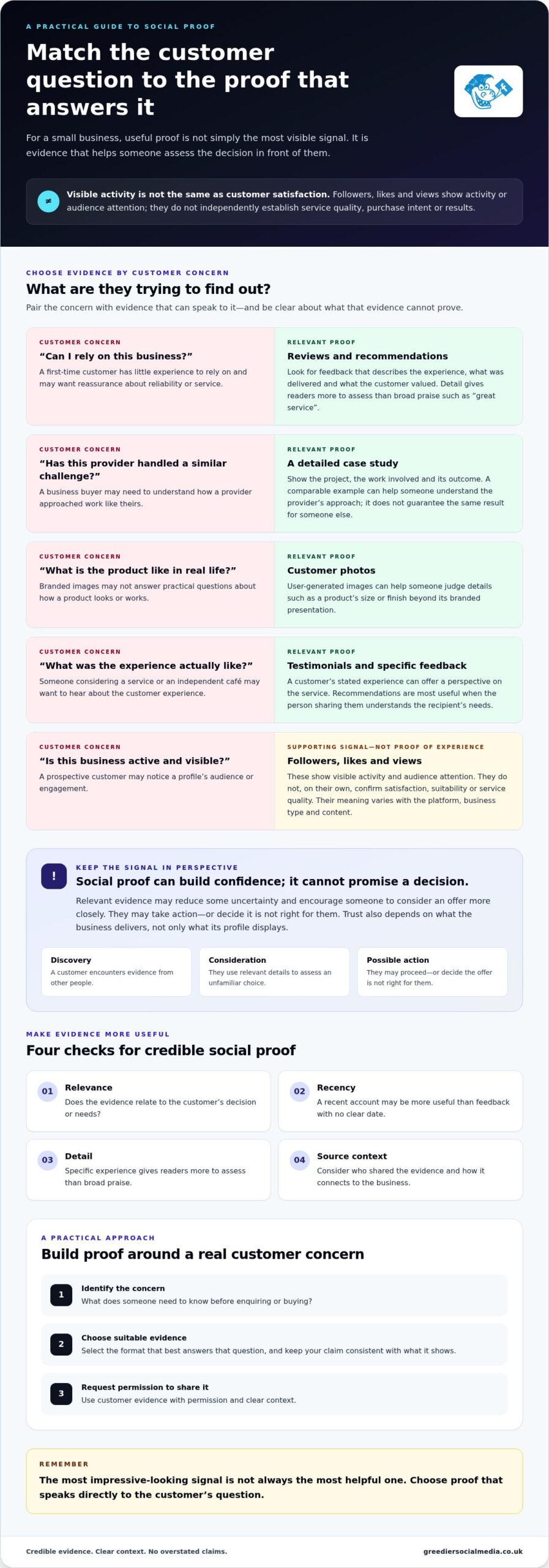
Different formats address different concerns. Reviews and recommendations can offer a view of reliability or service. Testimonials share a customer’s stated experience, while case studies can describe a project, the work involved and its outcome. Customer photos may help someone judge how a product looks or works in real life. Visible engagement, such as followers, likes or views, signals activity and audience attention, but doesn’t independently establish satisfaction or quality.
Start with the question a customer needs answered. A homeowner comparing tradespeople may want feedback about communication and completed work. A shopper may look for customer photos that show a product’s size or finish. Someone considering an independent café may value recommendations about the overall experience. The useful signal is the one that relates to the decision, not simply the one that looks most impressive.
How does social proof shape a customer’s first impression?
When a business is unfamiliar, a prospective customer has limited information. Relevant evidence from other people can reduce some of that uncertainty and encourage them to take a closer look. A review describing a service experience may prompt further consideration; a detailed case study may help a business buyer understand how a provider approached a similar challenge. A customer photo can show a product beyond its branded images.
This influence can support a journey from discovery to consideration and, sometimes, action. But the evidence needs context. A large follower count may suggest visibility, while a specific, recent account of a customer experience can speak more directly to what working with the business is like. The value of social proof for small business comes from choosing signals that fit the question a customer is asking, then backing them with a clear offer and a consistent experience. Trust still depends on what the business delivers, not just what its profile displays.
How social proof works: from visible signals to customer confidence
Social proof can influence a decision gradually. Someone encounters evidence from other people, uses it to make an unfamiliar choice feel less uncertain, then considers the offer more closely. They may take action, but they may also decide it isn’t right for them. The psychological principle describes a possible influence, not a guaranteed behaviour or conversion.
Relevant customer evidence can reduce perceived risk by helping a prospective buyer judge whether a business has met needs similar to their own. Its persuasive value depends on how well it answers that person’s questions. Relevance, recency, detail and source context all matter. A recent account of a comparable customer experience may be more useful than broad praise with no explanation.
Why do reviews and recommendations influence decisions?
Reviews and recommendations give prospective customers another person’s perspective on an offer. A detailed review that describes what was purchased, how the service was delivered and what the customer valued gives readers more to assess than “great service”. Recommendations can also offer useful context, especially when the person sharing them understands the recipient’s needs.
Google Business Profile and Trustpilot are examples of places where people may encounter customer feedback. The platform itself doesn’t make every comment equally relevant: readers still need to consider its detail, date and connection to the business.
What can follower counts and likes communicate?
Follower counts, likes and views make activity and audience attention visible. Their meaning is less direct than a customer’s account of an experience. A high count may catch someone’s eye, but it doesn’t confirm that customers are satisfied, that an offer suits them or that the business delivers a particular result. Counts can also be interpreted differently depending on the platform, business type and content.
For instance, a useful post with a modest response may still answer a customer’s question, while a popular post may say little about service quality. Read social media authority and social proof for broader platform context.
For a small business, the value of social proof depends on matching each signal to the decision it can help inform. Treat customer feedback as evidence of experience and engagement as a sign of visible activity. Keep claims consistent with what the evidence actually shows. If you’re considering visible Instagram activity as one supporting signal, explore Instagram engagement metrics alongside proof that speaks directly to customer experience.
Customer reviews, case studies and social metrics: what proves what?
Different forms of social proof answer different questions. A customer review can describe an experience; a case study can explain a process and its reported outcome. Follower counts and likes show visible activity, not verified satisfaction. These signals aren’t interchangeable. Large numbers alone don’t establish trust or prove results, so choose evidence for what it can genuinely show.
| Source | What it can show | Best use | Key limitation |
|---|---|---|---|
| Reviews | A customer’s account of an experience | Addressing questions about service or reliability | May lack detail or reflect only one experience |
| Testimonials | A customer’s stated perspective | Sharing a concise account relevant to a prospect’s concern | Brief praise may not explain the context |
| Case studies | The process, challenge and reported outcome | Showing how work unfolded in a comparable situation | One example doesn’t establish what every customer will achieve |
| User-generated content | A customer’s photo or video of real-world use | Helping people picture a product or experience | Needs clear context and permission to share |
| Recommendations | An endorsement from someone the prospect knows or respects | Introducing a business through a trusted connection | May not address the prospect’s specific needs |
| Social engagement | Visible activity, such as followers, likes or views | Adding an activity signal to a social profile | Doesn’t independently prove customer satisfaction or results |
Which type of proof fits each customer question?
Match the evidence to the concern. Use reviews to show what customers say about an experience, case studies to describe the work and its reported outcome, and testimonials to present a customer’s own perspective. Customer-created photos or videos can illustrate real-world use when permission and context are clear. Engagement metrics can indicate visible activity, but shouldn’t be used to claim product performance or customer satisfaction.
How can a small business spot weak or misleading proof?
Generic praise, undated comments and claims without context give prospects little to assess. Add relevant details where you can, and avoid implying that one customer’s experience represents everyone. Purchased engagement is also distinct from customer endorsement. Don’t present bought followers, likes or views as independent evidence that customers chose, used or recommend the business. For a separate look at account visibility, see Instagram growth for new accounts.
The value of social proof for small business lies in using each signal honestly and for the right purpose. If visible activity is one part of your profile approach, explore social engagement metrics from Greedier Social Media as a supporting signal, alongside evidence that speaks directly to customer experience.
How to build and measure credible social proof on a small-business budget
Credible evidence doesn’t need a complicated collection system. Start with the questions customers ask, gather proof that answers them, and keep track of where and how you use it. This makes the value of social proof for small business easier to assess without confusing visible activity with customer confidence.
How should a small business collect customer evidence?
Use this simple workflow:
- Identify a customer concern. Note the questions people ask before they book, enquire or buy. These point to the reassurance they need.
- Choose suitable evidence. A review may help explain a service experience; a customer photo may show a product in use. Match the format to the concern.
- Ask at a natural moment. After a genuine customer interaction, invite honest feedback. Don’t script praise or suggest that a positive response is expected.
- Get permission and record context. Note the date, what the evidence relates to and how you’re authorised to use a testimonial, image or case-study detail. Publish it accurately.
Keep a simple evidence log in a spreadsheet or shared document. Record where each item appears and review it periodically. This makes it easier to refresh outdated examples, correct inaccuracies and avoid using a comment outside its original context.
Credible proof is relevant, clearly attributed and proportionate to the claim it supports.
How can you tell whether social proof is helping?
Set a clear goal before publishing. If you add a customer review to a service page, track visits to that page, enquiries and the questions customers raise. If you share a recommendation on social media, note referral mentions and the quality of enquiries, alongside reach and engagement. These measures help show what is happening, but a change after publication doesn’t prove the proof caused it.
Where practical, compare formats against the same audience and goal. Keep the measurement period and other changes in view, such as a new offer or seasonal demand. Look for useful patterns, not a guaranteed result from a single post or testimonial.
For platform-specific context, read about Facebook Page growth trends. If visible Facebook activity is one supporting part of your profile, explore Facebook Page Likes alongside customer evidence that speaks to real experiences.
Turn social proof into a trustworthy presence for your small business
A credible online presence is built on more than one signal. Start with the customer experience you deliver, gather evidence that accurately reflects it, then make that evidence easy to understand. Reviews, testimonials and customer-created content can speak to what people experienced. Social metrics can add a visible activity signal. Each has a different role.
How can social engagement support, rather than replace, trust?
Followers, likes and views may contribute to how active a profile appears on Instagram, YouTube, TikTok, Facebook or Threads. They can support profile presentation, but they don’t independently verify a customer’s experience, endorse your business or prove its performance. Keep that distinction clear. A like is not a review, and a view is not evidence that someone bought or used what you offer.
Greedier Social Media provides engagement metrics across these platforms. For a business considering visible activity, they can be one part of a wider presence, alongside relevant customer evidence and a consistent experience. The value of social proof for small business comes from bringing these elements together honestly, not asking one metric to stand in for everything else.
What should a small business do next?
Keep the next step simple. Choose one concern a prospective customer has, then add the most relevant evidence where they’re likely to look for reassurance. If they need to understand how a service works, a detailed customer account may help more than a follower count. If they want to see a product in use, a customer photo with clear context may be more useful.
Review your proof regularly. Check that it’s still accurate and relevant, that any permissions remain clear, and that the claims match the experience your business delivers. Remove or update examples that no longer represent your offer. Consistency matters: the reassurance on your profile should reflect what customers encounter after they get in touch.
Build the foundation with customer experience and credible evidence. Add visible platform activity only where it supports your wider approach. To consider that supporting role, explore social engagement services as part of your visibility strategy.
Build trust with proof that fits your business
The value of social proof for small business lies in choosing evidence that answers real customer questions. Reviews, testimonials and case studies can give insight into customer experience, while followers, likes and views show visible social activity. Keep each signal in its proper role: popularity alone doesn’t prove satisfaction, quality or results.
Start with one concern your customers have. Add relevant, clearly attributed evidence, then review it for accuracy and recency. Pair a positive customer experience with proof that reflects it. That steady approach can make your business easier for new customers to assess.
Greedier Social Media has operated since 2013, with engagement metrics available across Instagram, YouTube, TikTok, Facebook and Threads. These metrics can support profile visibility as one part of a broader trust-building approach, not replace customer evidence. Explore social engagement services to add visible platform activity to your business’s wider presence. Build credibility one clear, honest signal at a time.
Frequently Asked Questions
What is social proof for a small business?
Social proof for a small business is evidence of other people’s experiences or choices that helps prospective customers assess an unfamiliar company. Examples include reviews, recommendations, case studies, testimonials, customer photos and social engagement. Each form shows something different: reviews can describe experiences, while case studies explain processes or outcomes. Likes and followers indicate visible activity. Popularity metrics alone don’t prove customer satisfaction or guarantee a sale.
Why is social proof important for small businesses?
Relevant social proof can help an unfamiliar small business address uncertainty by showing how other people experienced its offer. A detailed review, for example, can make a service claim easier to assess, while a case study may explain how a project was handled. This can support a prospect’s consideration, but it can’t replace a strong offer, clear information or a reliable customer experience. The value of social proof for small business rests on credible evidence, not volume alone.
What is the most effective type of social proof for a small business?
There isn’t one best format for every business. Match the evidence to the question a prospective customer needs answered. Reviews can describe a customer experience; case studies can explain a process or reported outcome; visible engagement can show activity on a platform. Choose evidence that’s current, relevant to the prospect’s needs and presented accurately. A specific, well-contextualised example is often more useful than broad praise without supporting details.
Can social media followers and likes help a small business build trust?
Followers and likes may contribute to a profile’s first impression, depending on the platform, content and type of business. They show visible engagement, but don’t independently prove customer satisfaction, endorsement or sales performance. Use social metrics as supporting signals rather than customer evidence. Pair them with reviews, detailed customer stories and a consistent experience, so prospects can see both that a profile is active and what customers say about working with the business.
How can a small business collect customer testimonials ethically?
Ask for honest feedback after a genuine customer interaction, and make clear that a positive response isn’t expected. Get permission before publishing a customer’s name, image or identifiable details. Keep the testimonial’s intended meaning intact, avoid edits that add unsupported claims, and include enough context for readers to understand what the feedback relates to. Transparent, specific comments give prospective customers more to consider than praise scripted by the business.
How do you measure the value of social proof?
Track outcomes that relate to your goal, such as enquiry quality, referral mentions and the questions customers ask, alongside page visits or social engagement. Where practical, compare different proof formats with the same audience and objective. Note other changes that may affect results, such as seasonal demand or a new offer. If enquiries rise after you publish a testimonial, that timing alone doesn’t prove the testimonial caused the change.
Does social proof guarantee more sales for a small business?
No. Social proof can help prospective customers evaluate a business, but it can’t guarantee a purchase. Sales also depend on factors such as the offer, price, customer need, timing and the experience the business delivers. Use evidence to support specific, accurate claims, not to promise outcomes it can’t establish. Treat social proof as one part of the customer journey, alongside clear information and a good experience from first enquiry to delivery.