

A bigger follower count can look like progress, but it doesn’t show whether people trust your brand or take action. That’s why choosing a social media growth service uk calls for more than comparing headline figures. Some services deliver specific metrics, such as followers, likes or views. Broader agencies may plan content, manage accounts and support wider marketing goals. These offers aren’t interchangeable.
Before deciding, identify exactly what a service delivers and what you want the metric to help you assess. Purchased engagement can carry platform-policy risks, so read the relevant terms and understand the limits of the figures. A change in followers, likes or views isn’t proof of audience fit, enquiries or sales.
This guide explains how focused metric services differ from social media management, and how to match support to your platform and current priorities. You’ll find practical ways to compare offers, record progress and interpret results alongside your content and business objectives.
Key Takeaways
- Identify whether a service provides strategic and creative support or a specific engagement metric before comparing offers.
- Start with your platform and immediate objective, then choose one priority metric to assess.
- Compare the deliverable, service format and terms, and decide how you’ll review progress.
- A social media growth service uk may focus on followers, likes or views, so match the metric to your account’s current priorities.
- Greedier Social Media provides engagement options across Instagram, YouTube, TikTok, Facebook and Threads.
What does a UK social media growth service actually do?
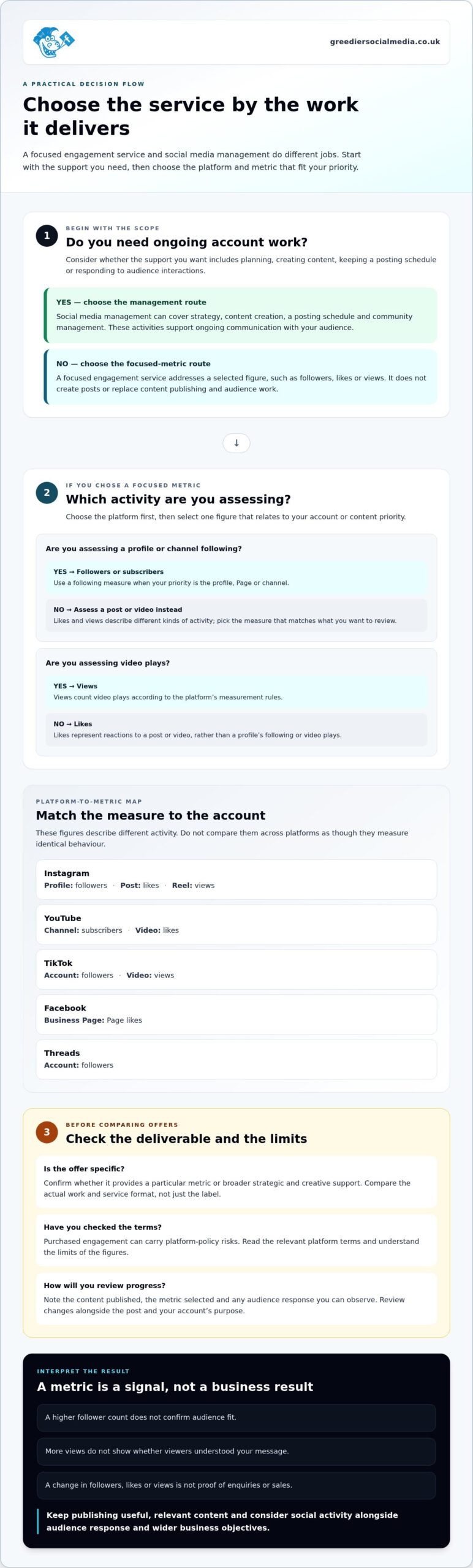
A social media growth service can support selected account metrics, such as follower counts, likes or video views. The term covers different types of work. A full-service agency may combine strategy, content creation and community management. A focused engagement service delivers a particular metric on a chosen platform. Compare the actual work and deliverables, rather than assuming the same label means the same service.
Each figure describes something different. Followers indicate how many accounts follow a profile or page. Likes are reactions to a post or video. Views count video plays according to the platform’s measurement rules. Facebook Page likes relate to a Page, whilst YouTube subscribers follow a channel. None of these figures, on its own, tells you whether an audience is relevant to your business.
Engagement metrics show activity on an account or piece of content; they don’t, by themselves, demonstrate business results such as enquiries or sales. Use each measure to assess the specific activity it represents, not as a substitute for commercial outcomes. For a broader overview of the discipline, Social Media Marketing covers how social platforms can form part of marketing activity.
Which social media metrics can a growth service address?
The right measure depends on the platform and your immediate aim. Instagram offers profile followers, post likes and Reel views. YouTube uses subscribers and video likes. TikTok followers indicate an account’s following, while video views track plays. Facebook Page likes relate to a business Page, and Threads followers measure an account’s following there.
Choose the platform first, then select the metric that fits your priority. If you’re focusing on a video, views and likes represent different kinds of activity. If you want to focus on a profile or channel, followers or subscribers are more directly relevant. Be specific about the figure you intend to review, rather than setting a vague goal such as “more engagement”.
How is metric delivery different from social media management?
Focused metric delivery addresses a selected figure, such as followers, likes or views. Social media management has a broader scope. It can involve planning what to publish, creating content, maintaining a posting schedule and responding to audience interactions. Those activities support an account’s ongoing communication; a metric-focused service doesn’t replace them.
A larger figure alone can’t establish audience fit, content quality or commercial impact. Keep publishing useful material, make your messaging relevant and consider how social activity fits into your wider marketing. Platform rules also matter: review the relevant terms before using a service, and don’t mistake a change in a visible metric for proof of reach, customer response or sales.
How social media growth services work alongside content and platform activity
Account activity has several connected parts. A brand publishes content, people may watch or interact with it, and the account displays metrics such as views, likes or followers. A focused growth service addresses selected figures. It doesn’t create the post, explain the offer or respond to comments. Those tasks remain part of your publishing and audience work.
Engagement figures are signals to interpret, not proof of business performance. A rise in views doesn’t tell you whether viewers understood the message. A higher follower count doesn’t confirm that the followers match your intended audience. Read each measure alongside the content, observable audience response and the account’s purpose.
How should businesses connect metrics with content?
Set the content or account objective first. Decide whether a post is intended to introduce a product, explain a service or maintain an active profile. Then select a metric that relates to that aim. Sprout Social’s guide to building a social media marketing strategy also treats goals and content planning as connected decisions, rather than isolated numbers.
Consistent, relevant publishing gives people context for account activity. A like is easier to interpret when you know which post received it and what the post set out to do. Keep publishing useful material and managing audience conversations; engagement delivery doesn’t supply either.
Which platforms and metrics suit different priorities?
Choose a measure that matches the account and the activity you want to assess. Instagram followers relate to the profile, likes to individual posts, and Reel views to video plays. On YouTube, subscribers describe the channel’s following, whilst likes relate to particular videos. These measures provide different kinds of context and answer different questions.
TikTok followers indicate the size of an account’s following; Facebook Page likes relate to a Page; Threads followers relate to a Threads profile. There’s no single platform or metric that suits every business. Start with where you publish and what you want the account to do. Don’t compare figures across platforms as though they measure identical behaviour.
To review progress, note the content published, the metric selected and any audience response you can observe. If a figure changes, examine it alongside the post and relevant customer feedback. This gives you a clearer basis for deciding what to publish next, without treating one number as a verdict on the whole account.
If a particular engagement figure is your priority, explore platform-specific engagement options and consider how they fit alongside your content and wider activity.
How to compare social media growth services without confusing the offer
The label alone won’t tell you what you’re buying. A social media growth service uk could mean strategic agency support, a defined engagement metric or a combination of activities. Compare the scope and deliverable, not just the provider’s description or a headline figure. A larger number doesn’t make two offers equivalent.
Use this framework to separate the service model from the metric and decide how you’ll assess progress:
| Service model | Platform | Metric | Deliverable | How to assess progress |
|---|---|---|---|---|
| Agency support | Agreed social channels | May cover several account or campaign measures | Could include strategy, creative work and community activity | Review agreed work and relevant account or campaign measures |
| Focused engagement service | Selected platform | One defined measure, such as likes or views | A specific engagement metric | Track that measure against its starting point and account objective |
The table is a comparison tool, not a promise that every agency includes the same work. Strategy, content creation, community management and advertising are separate scopes. A focused metric purchase shouldn’t be assumed to include them. For a closer look at how visible engagement relates to social media authority and social proof, consider how a number appears alongside the account’s wider content.
Which questions clarify a service’s scope?
Pin down the basics before comparing offers: which platform does the service apply to, and what specific metric does it address? Then establish whether the arrangement is a one-off purchase or an automated subscription. These are different service formats, so don’t assume that a single purchase and an ongoing arrangement are interchangeable.
Separate engagement metrics from work such as planning posts, creating content, managing conversations or running advertising. Those activities need their own deliverables and assessment criteria. A clear scope shows what is included and what you’ll still manage through your own marketing activity.
How can businesses assess whether the metric is useful?
Start with a specific account objective and audience context. If you’re assessing likes, note which content received them. If you’re tracking views, consider the video and its purpose. Record the selected metric alongside relevant content and business indicators, such as audience responses or enquiries, where those are part of your measurement plan.
Followers and views can describe visible account activity, but they don’t establish conversion, loyalty or audience fit on their own. Compare like with like, review changes in context and avoid treating a single figure as proof of business performance.
A practical checklist for choosing a UK social media growth service
Make your decision from a short, specific brief rather than a headline promise. Assess a social media growth service uk against the platform, the metric you want to address and the role that metric plays in your plans. Work through this checklist before choosing support.
- Name the platform and immediate objective. Start with the account you want to focus on and what you want it to support, such as building a profile or assessing engagement on a particular post.
- Choose one priority metric. Select followers, likes, views, Page likes or subscribers according to the platform and objective. Avoid combining several measures into one vague goal.
- Record your starting point. Note the current figure and the date. This gives you a clear basis for reviewing the metric later.
- Define how you’ll assess it. Decide what change you’re tracking and what other context matters, such as the content published or audience responses.
- Confirm the scope. Understand what the service delivers and whether it is a one-off engagement purchase or an automated subscription. Don’t assume it includes content creation, community management or advertising.
- Review access requirements and terms. Understand what account information or permissions are requested, how the arrangement works and what conditions apply before you proceed.
How should a business define its brief?
Keep the brief practical: name the platform, the metric and why it’s the priority now. Include the account’s current stage, too. A newly established Instagram profile may need a different approach from an established account reviewing engagement on individual posts. If Instagram is your focus, this guide to Instagram growth for new accounts offers further context for planning your next steps.
What expectations should the checklist set?
Treat the selected figure as one input alongside your content and audience response. Don’t assume that a service guarantees reach, sales, virality or long-term retention. Keep the starting figure and the metric under review together, then interpret any change in context. This makes the assessment clearer and separates a visible metric from broader business performance.
Once your platform, priority metric and scope are clear, you can make a more informed comparison. Explore Greedier Social Media’s platform engagement options to see how focused metric support can fit alongside your own content and marketing activity.
Greedier Social Media growth services: match the platform to the metric
Greedier Social Media provides direct engagement metrics across Instagram, YouTube, TikTok, Facebook and Threads. Its options are organised by platform and metric, helping businesses focus on a particular account figure. Start by identifying the platform you use, then choose the metric that relates to your current priority.
This is different from strategy or content management. A social media growth service uk can address selected visible metrics, but those figures still need to sit alongside relevant publishing and wider marketing decisions. Choose an option for the measure it relates to, rather than expecting one metric to cover every account goal.
Which engagement options does Greedier Social Media provide?
Greedier Social Media offers the following platform-specific engagement options:
- Instagram: followers, likes, auto-followers, auto-likes and Reel views.
- YouTube: subscribers and likes.
- TikTok: followers.
- Facebook: Page likes.
- Threads: followers.
These categories address different account measures. Instagram Reel views relate to video content, whilst followers and likes refer to other types of account or post activity. YouTube subscribers relate to a channel; likes apply to videos. Pair the platform and metric when deciding what fits your objective.
If you’re weighing automated Instagram likes against a one-time purchase, the guide to Instagram auto-likes and one-time purchases can help you understand the difference between those formats.
What is a sensible next step?
Use the brief you’ve developed to narrow your choice: select the platform, name one priority metric and note how you’ll assess it. For example, if your priority is activity on Instagram Reels, views are a more direct match than YouTube subscribers or Facebook Page likes. Keep your own content and audience communication active, too. Engagement support focuses on selected metrics, not a substitute for a content plan or broader social strategy.
Before proceeding, make sure the option you select matches the account and measure you intend to address. Record the starting figure and review it in context with the content you publish. This helps distinguish a change in a metric from wider outcomes, which depend on more than one account figure.
Ready to match your platform and priority metric to a relevant category? Explore Greedier Social Media’s growth services.
Make your next growth decision with purpose
Decide what you’ll do with the information you collect. Agree who will review the account and how the team will use that review. A clear owner helps turn observations into decisions, rather than letting a changing figure become a goal in itself.
Keep the review focused. Ask whether the activity you chose still fits your priorities, whether your content gives people a reason to engage and what you want to learn before making another change. This keeps a social media growth service uk in its proper role: focused support for a selected metric, alongside the work that gives your account its purpose.
When you’re ready to explore a metric-led option, match the platform and engagement category to your current objective. Explore Greedier Social Media’s growth services and choose a category that fits your priority. A considered decision gives your social activity a clearer direction.
Frequently Asked Questions
What is a social media growth service in the UK?
A social media growth service in the UK may focus on a selected account measure or cover broader marketing work. A business launching a product might prioritise engagement on a particular post, whilst another may focus on its channel following. The service label alone won’t tell you which applies. Look at the deliverable and consider whether it fits the account’s current purpose and the work you’re already doing.
Is a social media growth service the same as social media management?
No, the scope can be quite different. Management might involve deciding what to publish, scheduling posts and responding to comments. A focused engagement service addresses a specified account metric instead. If your team already plans and publishes content but wants to focus on a particular visible figure, the narrower service may be relevant. If you need someone to run the account day to day, assess that requirement separately.
Can social media growth services guarantee more sales?
No. Sales depend on more than social account metrics, including whether the offer suits the audience and whether the customer journey makes it easy to act. A video view, for instance, doesn’t show whether someone visited your website or made an enquiry. Set a business measure, such as qualified enquiries, alongside the platform figure you’re reviewing. This helps you assess commercial impact without treating engagement as a sales promise.
How do I choose the right social media growth service?
Choose by matching the deliverable to a defined account need. If a campaign centres on a particular video, decide whether you’re assessing views or reactions, and keep that measure consistent during your review. Read the terms and understand any account access requested before proceeding. A focused brief makes it easier to judge whether a social media growth service uk fits your plan or whether you need wider support.
Are social media growth services useful for a new account?
They can be considered if you’ve identified a specific metric that matters at the account’s current stage. First make sure the profile explains what the business offers and gives visitors useful information; a metric can’t do that work for you. For Instagram, the new Instagram account growth guide provides further ideas for establishing a profile and planning its activity.
Should I choose a social media agency or a focused engagement service?
Choose according to the work you need covered. If you need help planning campaigns, producing posts and managing audience conversations, an agency with that scope may be a better fit. If those activities are already handled and your priority is a particular account metric, a focused service may be more relevant. Write down the tasks you expect to be completed, then compare them with each offer’s stated deliverables.