

What if a subscriber is a real person but never watches your videos? That distinction matters when you’re assessing real youtube subs. A visible count can look impressive, but it doesn’t show whether people are interested, watching or returning.
It’s reasonable to want clear evidence that an audience is genuine. Yet a human-operated account and an engaged viewer aren’t the same thing, and claims of “real” or “high-quality” subscribers don’t prove either. YouTube’s fake engagement policy also makes it important to understand how growth is achieved before choosing an option.
This guide explains what genuine subscribers mean, which channel signals can help you assess engagement, and why subscriber totals tell only part of the story. You’ll learn how to review views, audience patterns and growth claims with care, without treating any single metric as proof. The aim is to help you understand your channel’s audience and make informed decisions about growth.
Key Takeaways
- Assess real youtube subs by distinguishing human-operated accounts from viewers who choose to watch and engage.
- Look beyond the headline subscriber count. Compare views, watch time and retention over time.
- Understand how opted-in viewers differ from inactive accounts and automated or deceptive activity, without assuming a quiet subscriber is fake.
- Use YouTube Studio to review audience patterns and investigate changes that need a closer look.
- Before considering growth support, check how the service works and whether its methods align with YouTube’s fake engagement policy.
What are real YouTube subs, and what does “real” actually mean?
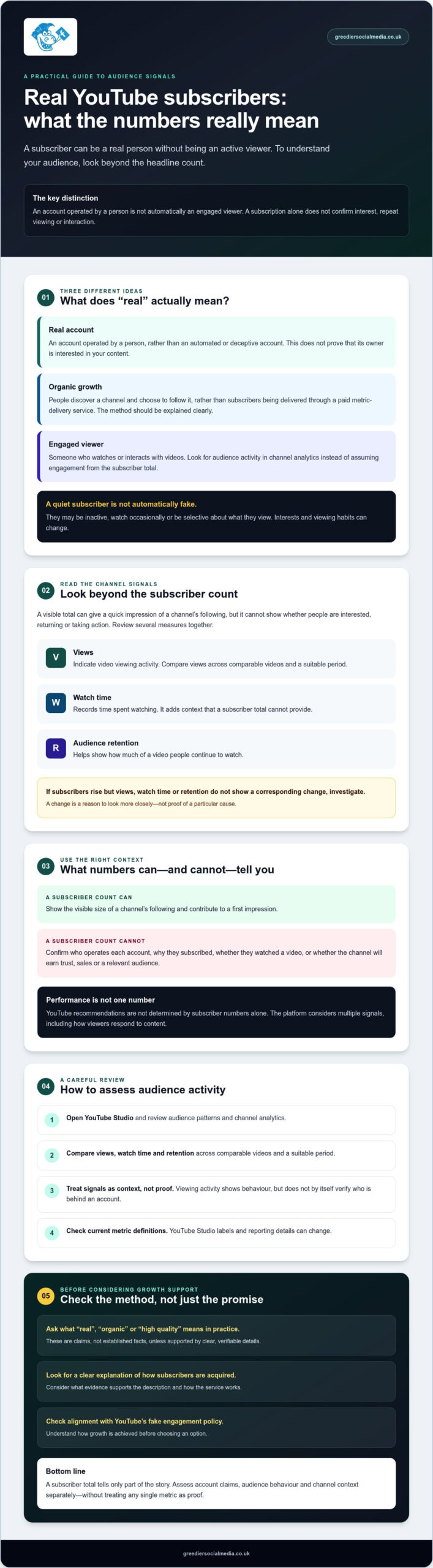
A real YouTube subscriber is an account operated by a person; an engaged subscriber is someone who chooses to watch or interact with a channel’s content. The distinction matters because real youtube subs can include people who rarely watch as well as regular viewers. A subscriber count alone can’t confirm who operates each account, why they subscribed or whether they’ve watched a video.
“Real” is often used as a marketing label, but it isn’t proof of interest or activity. To assess a claim, look for a clear explanation of how subscribers are acquired and what evidence supports the description. Without transparent, verifiable details, treat claims such as “organic” or “high quality” as claims, not established facts.
Does a real subscriber always watch your videos?
No. Someone may subscribe after enjoying one video, then watch occasionally or stop following new uploads. Interests and viewing habits change, and subscribers won’t necessarily see or choose every video you publish.
A subscription records a connection to the channel. It doesn’t demonstrate repeat viewing, watch time or meaningful interaction. Assess those behaviours separately as evidence of audience interest. A quiet subscriber isn’t automatically fake; they may simply be inactive or selective about what they watch.
Real accounts, organic growth and engaged viewers explained
These terms describe different things:
- Real account: An account operated by a person rather than an automated or deceptive account. This alone doesn’t show that its owner is interested in your content.
- Organic growth: Subscribers gained through people discovering and choosing to follow a channel, rather than through a paid metric-delivery service. The label should be supported by a clear explanation of the method.
- Engaged viewer: Someone who watches or interacts with videos. Look for audience activity in channel analytics rather than assuming engagement from the subscriber total.
Account authenticity and genuine interest require different evidence. A person may operate an account without watching your channel, while viewing activity shows behaviour but doesn’t, by itself, verify who is behind an account. For context, influencer marketing often relies on a creator’s expert level of knowledge or social influence; a subscriber count alone doesn’t establish that credibility or influence.
Keep the distinction in mind when reviewing growth claims. Ask what “real” means in practice, how the method works and whether evidence is available. A number on a channel page can’t answer those questions on its own.
Do real YouTube subs improve channel performance or business credibility?
Subscriber count alone can’t establish how well a video performs. A high total may create a positive first impression, but it doesn’t prove that viewers are interested, that your content meets a business need or that people will take action. Social proof isn’t the same as evidence of demand.
YouTube recommendations aren’t determined by subscriber numbers alone. The platform considers multiple signals, including how viewers respond to content. Real subscribers may form part of a channel’s audience, but the number itself can’t show whether videos reach the right people or hold their attention.
What subscriber numbers can and cannot tell a business
A visible count gives visitors a quick indication of a channel’s following. It can contribute to a first impression, but it can’t guarantee trust, sales or a relevant audience. A smaller channel with clear expertise and useful videos may appear more credible to a prospective customer than a larger channel with unrelated or inconsistent content.
Build credibility through the full channel experience: publish relevant content, make the channel’s purpose clear and give viewers a consistent reason to return. For a UK business, useful context comes from your intended audience. Consider whether your videos address their needs and whether viewers continue to engage, rather than relying on a broad platform statistic.
Why views and audience retention add important context
YouTube Studio reports measures such as views, watch time and audience retention. Views indicate video viewing activity; watch time records time spent watching; retention helps show how much of a video people continue to watch. Check Studio’s current definitions for each metric, as labels and reporting details can change.
Review these measures across comparable videos and a suitable period. If subscriber numbers rise but views, watch time or retention don’t show a corresponding change, investigate rather than treating it as proof of a problem. Returning viewers and consistent interest in relevant topics add context, though no single metric explains every result.
If you’re reviewing paid subscriber options, treat them as metric delivery, not a promise of active viewers or organic channel growth. Check the provider’s method and its fit with YouTube’s fake engagement policy before deciding. You can review YouTube subscriber options with those distinctions in mind.
Real YouTube subscribers vs bots and low-quality accounts: what is the difference?
Subscriber behaviour can offer clues, but it can’t reliably identify the person or method behind every account. A quiet viewer isn’t automatically fake. Compare patterns over time and ask how growth was generated before drawing conclusions about real youtube subs.
| Subscriber type | Possible observable behaviour | What it can tell you |
|---|---|---|
| Opted-in viewer | May watch, return or interact with videos that interest them. Activity can vary between uploads. | Repeat viewing or interaction suggests interest, but doesn’t verify account ownership on its own. |
| Inactive account | May show little recent viewing or interaction. | Could reflect changed interests or viewing habits. Silence alone isn’t evidence of automation. |
| Automated or deceptive activity | May be linked to artificial or coordinated attempts to inflate subscriber or engagement figures. | Public behaviour may not reveal the account’s origin. Ask about the acquisition method rather than relying on appearances. |
How can you assess claims that subscribers are genuine?
Ask a provider to explain in plain terms how subscribers are acquired, what “real” or “organic” means in its description, and what evidence supports those claims. Paid delivery of a metric alone doesn’t establish whether accounts are operated by interested viewers or how they were obtained. Treat broad labels as claims, not guarantees, unless transparent evidence supports them.
Protect your channel access. A provider shouldn’t need your Google password to add subscribers. Don’t share passwords or verification codes, or grant channel permissions, unless you understand why they’re needed and have independently confirmed the request is legitimate.
Could artificial engagement create channel or reputation risks?
YouTube’s fake engagement policy prohibits artificially increasing metrics, including subscribers. Its guidance also addresses third-party services that inflate engagement and “sub4sub” schemes. Review the current wording before choosing a growth method, as policies can change.
Artificial or poorly matched activity can make your metrics harder to interpret: a rising count may not be accompanied by meaningful viewing or interaction. It can also weaken trust if customers or collaborators see a gap between the displayed audience and the channel’s visible activity. These are reasons to assess methods carefully, not predictions of a specific enforcement outcome. Avoid supposed workarounds and assess the method against YouTube’s policy directly.
How can you tell whether YouTube subscribers are genuinely engaged?
Use YouTube Studio to check whether subscriber changes coincide with viewing behaviour. Assess engagement through multiple metrics, including views, watch time, audience retention and returning viewers, rather than inferring it from the subscriber total alone.
Review patterns across comparable videos and suitable time periods. A single upload can be affected by its topic, format or publishing schedule, so treat unexpected changes as a prompt to investigate, not proof that subscribers are genuine or fake.
Which YouTube Studio metrics should you review?
In Studio Analytics, check channel and video performance over a consistent period. Interface labels can change, so use YouTube’s current Studio guidance if you’re unsure where a report appears or how a metric is defined.
- Views: Show viewing activity, but not whether viewers are subscribers or who operates their accounts.
- Watch time: Shows how long people spend watching. Compare it across similar videos to see whether viewing is sustained.
- Audience retention: Shows how viewing changes through a video. A drop-off can point to sections that lose attention, but it doesn’t identify viewers.
- Subscribers gained or lost: Compare changes with the videos published during the same period.
- Returning viewers: Helps indicate whether people come back to watch more of your content.
Compare like with like. For example, review similar topics or formats over matching periods rather than comparing a short video with a long one. That gives you more useful context than treating one unusually strong or weak upload as a verdict on your audience.
How do you interpret subscriber growth without overreading it?
Start with the timing. Note when subscriber numbers change, then check which topics or formats you published around those dates. See whether viewing activity continues on later videos. A rise after one popular upload may reflect interest in that subject, but it doesn’t prove those subscribers will watch every new video.
Keep the limitations in view. Small samples can fluctuate, and a change in publishing frequency can affect comparisons. Look for patterns across several videos, not a single spike or dip. For broader context on building a consistent social presence, consult the Social Media Authority UK guide and check its advice against your channel’s own analytics.
Use these checks to understand your audience before making decisions about paid metric delivery. If you’re considering that option, review YouTube subscriber options and assess the service method separately from evidence of viewer engagement.
How to choose YouTube growth support without mistaking metrics for an audience
Start by deciding what you need. A subscriber metric and an organic audience strategy are different things. Purchasing a metric doesn’t provide content planning, audience research or organic channel management, and it doesn’t establish that the accounts will watch your videos.
Check any service against YouTube’s current rules before you proceed. YouTube’s fake engagement policy prohibits artificially increasing metrics, including through third-party services that sell subscribers. A provider’s description of a service doesn’t determine whether its methods comply.
Questions to ask before choosing a subscriber service
Ask clear questions and look for specific answers. If the method is vague, or the provider relies on broad labels rather than explaining its service, don’t treat those claims as proof.
- How does it work? Ask how subscribers are acquired and compare the answer with YouTube’s current policy.
- What exactly is included? Confirm that the service description matches what is delivered. Don’t assume it includes active viewers, ongoing audience development or any particular outcome.
- What evidence supports its claims? Treat words such as “real” and “organic” as claims that need substantiation, not guarantees.
- What access does it request? Be wary of requests for your Google password or unnecessary channel permissions. Never share passwords or verification codes.
- Does it promise performance? Be cautious of unsupported claims about views, recommendations, sales or channel growth.
A transparent description can help you understand what you’re considering. It can’t, by itself, establish policy compliance or prove that subscribers will become interested viewers.
What a subscriber metric can and cannot do for your channel
A paid subscriber service concerns a metric. Building an organic audience involves separate work, such as understanding what viewers want, planning relevant content and learning from audience response. Don’t treat one as a substitute for the other.
Judge business value against your channel’s goals. If you want to reach potential customers, relevant viewing and sustained interest matter more than a larger total on its own. Review your analytics and consider whether a service’s methods align with platform rules before making a decision.
Greedier Social Media offers YouTube subscribers as paid metric delivery, not organic channel management. If you’re considering that offering, review the service details and assess them against YouTube’s current policy before proceeding.
Build a clearer picture of your YouTube audience
The key distinction is simple: a real account isn’t necessarily an engaged viewer. Subscriber totals can contribute to social proof, but they can’t confirm audience interest, video performance or business value on their own. Review views, watch time and retention across comparable videos to understand how people respond to your content.
Before choosing growth support, ask how it works and check its methods against YouTube’s current rules. Treat claims about “real” or “organic” subscribers as claims to assess, not evidence of active viewers. Keep your channel goals and audience behaviour at the centre of the decision.
Greedier Social Media has operated since 2013 and offers YouTube subscribers as paid metric delivery. This is distinct from organic channel management and doesn’t establish that subscribers will watch your videos.
With a measured approach to real youtube subs, you can make informed choices and keep building a channel around the viewers you want to reach.
Frequently Asked Questions
What are real YouTube subs?
Real YouTube subscribers are accounts operated by people who chose to follow a channel, rather than automated or deceptive accounts. The phrase real youtube subs doesn’t prove that those people watch your videos, return to your channel or are interested in your content. Check YouTube Studio for viewing behaviour, including views, watch time and retention. A high subscriber count alone isn’t evidence of an active audience.
Can you buy real YouTube subscribers?
A seller may describe subscribers as real, but that label doesn’t show how they were acquired or whether anyone will watch. YouTube’s fake engagement policy prohibits artificially inflating metrics, including buying subscribers from third-party services. Review the current rules before choosing a service and ask how it works. A paid increase doesn’t guarantee engagement, recommendations or eligibility for monetisation.
Do YouTube subscribers affect recommendations?
Subscriber count doesn’t guarantee that YouTube will recommend a video. Recommendations involve multiple signals, including how viewers respond to content, and each video’s relevance to its audience matters. Avoid claims that one number determines reach or ranking. YouTube’s systems can change, so check its current official guidance and use YouTube Studio to understand how people respond to your videos.
How can I tell if my YouTube subscribers are engaged?
Review several measures in YouTube Studio, including views, watch time, audience retention and returning viewers. Compare similar videos over suitable time periods, then check whether viewers return for related topics or formats. These metrics show viewing behaviour, not the identity of each account. Don’t draw conclusions from one upload or a short-term subscriber change; look for patterns across your channel’s content.
Why did my YouTube subscriber count go down?
Your count may fall because viewers unsubscribed or YouTube adjusted accounts or metrics. A decrease alone doesn’t reveal which explanation applies, so don’t assume every removed subscriber was fake. Check the timing against your channel analytics and consult YouTube’s current guidance. If the change is substantial or unexpected, use official YouTube support resources to check for relevant explanations or account notifications.
Are real YouTube subscribers enough to join the YouTube Partner Programme?
No. Subscriber numbers alone don’t establish YouTube Partner Programme eligibility. As of September 2026, the full ad-revenue threshold is 1,000 subscribers plus either 4,000 valid public watch hours in the past 12 months or 10 million valid public Shorts views in the past 90 days. Channels must also meet applicable programme and policy requirements. Check YouTube’s current official eligibility guidance before making plans, as criteria can change.