

A larger follower count can make a profile look established, but it doesn’t show whether the audience is relevant or engaged. That’s the central trade-off in organic growth vs buying followers: organic activity can build relationships over time, whilst purchased metrics change a visible number without creating genuine interest by themselves.
If growing organically feels slow, you’re not alone. But speed isn’t the only factor to weigh. Platform rules can change, and a mismatch between follower numbers and real engagement may affect how people view your brand. Greedier Social Media provides direct social metrics across platforms, including Instagram followers, likes and Reel views. These are specific profile metrics, not a replacement for useful content or audience relationships.
This article compares what each approach can and can’t do, the practical trade-offs and the risks to consider. You’ll also learn how to track progress through relevant signals such as engagement and audience response, rather than relying on follower count alone, so you can make a considered decision that protects your brand’s credibility.
Key Takeaways
- See how organic growth, purchased followers and paid advertising serve different purposes, and why one shouldn’t be mistaken for another.
- Use the organic growth vs buying followers comparison to weigh audience relationships against the narrower aim of changing a visible profile metric.
- Choose measures of progress that reflect your goals, such as audience relevance and interaction, rather than follower count alone.
- Start with the business outcome you want, then decide whether discovery, community, profile presentation or a visible metric is the priority.
- Understand where direct followers, likes and views fit, and what they can’t replace in a broader social media approach.
Organic growth vs buying followers: what is the real difference?
The difference is what you’re building. Organic growth develops an audience through content, interaction and opportunities for people to discover a profile. Buying followers is a transaction for a visible follower metric. The number beside an account can change, but that alone doesn’t tell you who those followers are, whether they interact or whether they’re interested in the brand.
Organic growth builds relationships over time; buying followers purchases a visible metric. That distinction is central to organic growth vs buying followers. A larger count is not the same as a relevant audience, an active community or commercial intent. Buying followers is also different from paying a platform to show an advert or paying a team to manage social media activity. Each has a different purpose.
Social media marketing covers a broad range of ways to use social platforms. For this comparison, keep the terms precise: organic growth comes from audience development, whilst a follower purchase changes a profile’s follower metric. Neither figure on its own confirms whether social activity is contributing to wider business aims.
What organic social media growth involves
Organic growth is built through repeated activity. A brand publishes content designed for its audience, responds to comments and conversations, and uses platform features that help people find posts. For example, it could share a short video in a format suited to the platform, join a relevant discussion or make the profile information clear so visitors understand what the account offers.
These actions create opportunities for discovery and interaction, not guaranteed results. More followers are only one possible outcome. Enquiries, sales and customer loyalty are separate business outcomes, and a growing account doesn’t prove they have followed. Pace and results vary with the content, audience, platform and how consistently and effectively the account is run. Assess growth over time rather than treating each post as a promised return.
What buying followers does and does not represent
Buying followers means paying for a follower metric to be added to a social profile. The transaction is about that visible count. It is distinct from advertising, where a brand pays for promotional placement, and from management, where someone plans or carries out ongoing account activity.
A purchased follower count doesn’t establish that the people represented are customers, active fans or genuinely interested prospects. It also doesn’t demonstrate, by itself, that posts are being seen or that the account is building a relationship with an audience. Keep the claim narrow: the metric may change, but the number cannot tell you what each follower thinks, does or intends to do.
That clarity helps set realistic expectations. If your aim is to learn what content resonates, look beyond the count to actual responses and conversations. If you’re considering a direct metric purchase, assess it as a profile metric, not as evidence of customer demand or a replacement for audience development. The next comparison can help you decide which approach fits the result you want to measure.
How organic growth, purchased followers and paid advertising differ
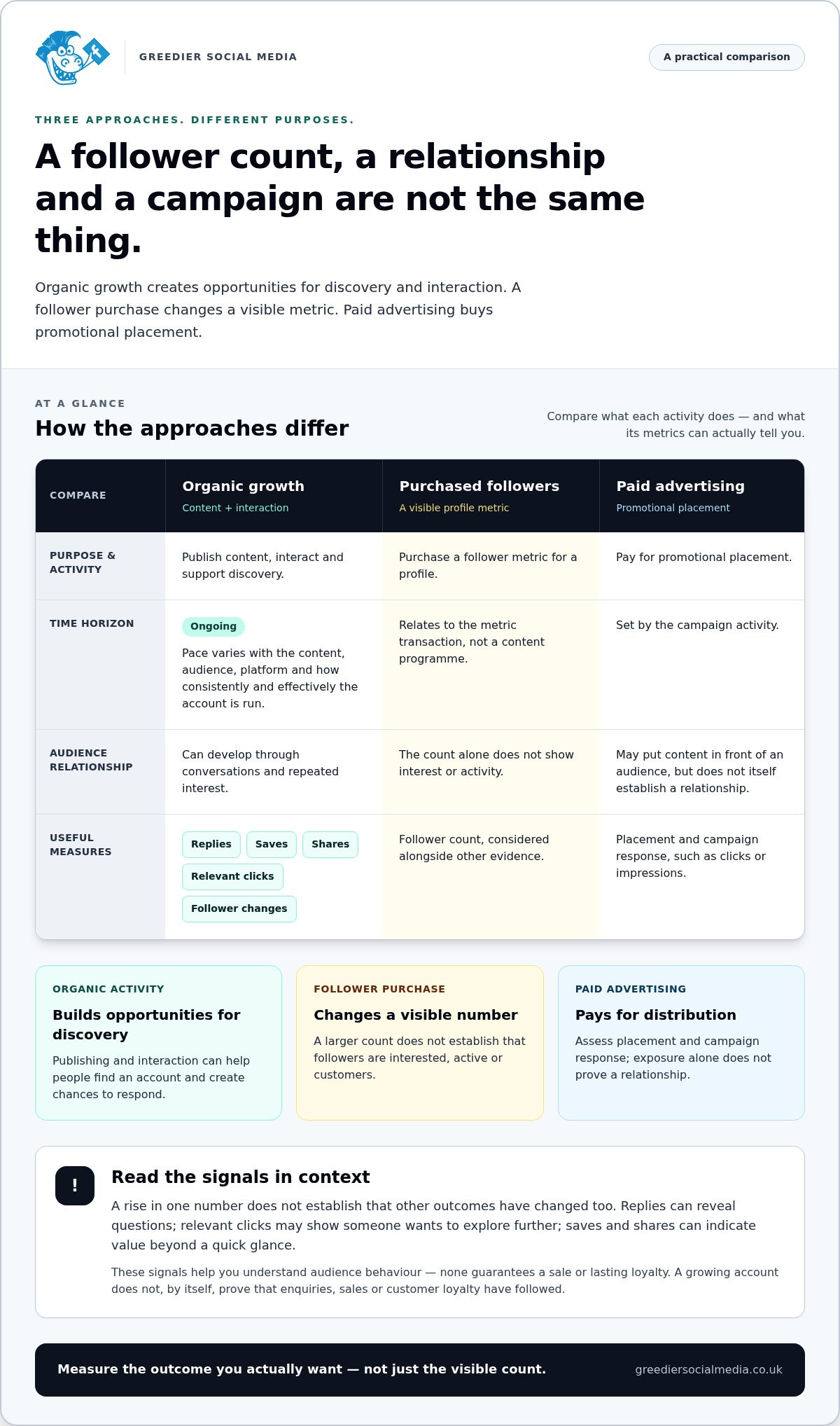
These three approaches can all affect how a brand appears on social media, but they involve different activities. Organic growth is ongoing publishing and interaction that may help an audience discover and follow an account. A follower purchase changes a visible profile metric. Paid advertising pays for promotional placement, with performance assessed through the results the campaign records.
Advertising purchases distribution; follower purchases purchase a metric. Organic activity sits apart from both: it creates opportunities for discovery, but can’t guarantee reach, follower growth, engagement or revenue. A rise in one number doesn’t establish that other outcomes have changed too.
| Approach | Purpose and activity | Likely time horizon | Audience relationship | Useful measures |
|---|---|---|---|---|
| Organic growth | Publish content, interact and support discovery | Ongoing; pace varies | Can develop through conversations and repeated interest | Replies, saves, shares, relevant clicks and follower changes |
| Purchased followers | Purchase a follower metric for a profile | Relates to the metric transaction, not a content programme | The count alone doesn’t show interest or activity | Follower count, considered alongside other evidence |
| Paid advertising | Pay for promotional placement | Set by the campaign activity | May put content in front of an audience, but doesn’t itself establish a relationship | Placement and campaign response, such as clicks or impressions |
What organic growth can support over time
Consistent publishing gives a brand chances to learn which topics, formats and messages prompt a response. Conversations add context: a reply can reveal a question, whilst a relevant click may show that someone wants to explore further. Saves and shares can indicate that a post has value beyond a quick glance, though none of these signals guarantees a sale or lasting loyalty.
Use these measures to understand audience behaviour, not as a promise of future performance. An account could gain followers without generating many replies, or receive useful questions without a major change in follower count. Compare signals that match your goal and review them over time.
What purchased metrics can and cannot tell you
A change in follower count tells you that the displayed metric has changed. On its own, it doesn’t establish who is represented, whether they see the content or whether they take meaningful action. Don’t assume a particular level of audience behaviour without looking at relevant evidence. For more context on how visible signals shape perceptions, see this social proof guide for UK brands.
That distinction is useful when weighing organic growth vs buying followers. If you’re considering direct metric delivery, explore social media engagement metrics as one specific option, and judge it against the outcome you actually need.
Organic growth vs buying followers: compare the trade-offs
Each approach calls for a different kind of judgement. Organic growth takes ongoing creative work and consistency, but that effort can help you understand which topics attract the right audience and prompt worthwhile conversations. Buying followers has a narrower purpose: changing a visible profile metric. It doesn’t provide the audience insight that comes from observing how people respond to content.
Neither route is a shortcut to business success. A rising follower count doesn’t prove that people will enquire or buy. A strong engagement rate on one post doesn’t prove lasting interest either. Assess several signals together and weigh them against the outcome your brand needs.
When organic growth is the stronger fit
Choose organic activity as the main route when progress depends on trust, conversation, audience insight or repeat engagement. This takes sustained work: plan and publish content, respond to people and review which themes attract useful reactions. The pace is difficult to predict, and results depend on the audience, platform and execution.
Look for signs of fit, not just volume. If a specialist business wants to reach people with a particular need, relevant questions, thoughtful replies and clicks to useful information may say more than a jump in followers. Track these alongside follower growth. Over time, the pattern can guide content decisions, although it still can’t guarantee enquiries, loyalty or sales.
When a purchased metric may fit a narrower objective
A purchased follower metric may be relevant if your immediate objective is specifically to change the number displayed on a profile. Keep the purpose narrow. It isn’t evidence of customer acquisition, and it doesn’t replace content, community activity or a wider marketing plan. If a profile’s visible count and its other signs of activity appear out of step, some visitors may question what the figures represent. Reactions can vary, so don’t assume every purchase has the same effect.
Consider the trade-off before acting. Ask whether changing the visible number answers a real business need, and decide what evidence would tell you whether your wider social activity is working. For a broader look at how social signals can shape perception, explore this UK social media authority guide.
- For learning: prioritise content responses, relevant clicks and audience fit.
- For profile presentation: treat follower count as one visible signal, not proof of trust or demand.
- For business performance: connect social measures to the outcome you want, rather than relying on one metric.
That’s the practical distinction in organic growth vs buying followers: one centres on sustained audience development, whilst the other changes a profile metric. If direct social metrics match a specific objective, explore social media metric options with that limitation in mind.
How to choose a follower-growth approach for your goals
Start with the business outcome, not a number you’d like to see beside your profile. Do you need more people to discover your brand, stronger community interaction, a more established-looking profile or a specific change to a visible metric? The answer helps you choose an approach and avoid treating follower growth as proof of business impact.
Use this decision process to set a clear direction:
- Name the outcome. Be specific. For example, you might want more relevant people to find your content, more conversations with existing followers or a change to your displayed follower count.
- Identify the main need. Discovery and audience fit call for content that helps the right people find you. Community goals centre on replies and ongoing conversation. Profile presentation or a visible metric is a narrower objective.
- Choose measures that match. Track relevant interactions or enquiries for relationship and business goals. If the aim is a follower-count change, treat the count as the measure of that objective, not as evidence of sales or trust.
- Review platform rules. Before choosing any purchased engagement service, read the current rules for the platform and consider how your decision could affect audience perceptions and brand credibility.
Match the approach to the outcome you need
For awareness, focus on publishing content that suits the platform and audience, then look for signs that relevant people are finding and responding to it. For relationships, pay attention to replies, useful conversations and repeat engagement. These goals rely on ongoing activity, and neither content nor interaction guarantees a particular result.
If your objective is simply a different follower total, be clear that it’s a metric objective. Don’t use that change to claim stronger audience relevance or business performance unless other evidence supports the claim. In the organic growth vs buying followers decision, the right fit depends on what you need to achieve, not which option changes a number fastest.
Set a realistic measurement plan
Before changing your approach, record a starting point. Choose a small set of indicators you can review consistently, such as relevant comments, replies, profile visits, useful clicks or enquiries. Include follower totals for context, but assess them alongside the quality of interaction and whether the audience fits your brand.
Set a review point that gives you enough time to observe a pattern, rather than reacting to one post or a brief change. If your content attracts views but few relevant actions, consider whether the topic, format or audience fit needs attention. For practical ideas on building an account through content and discovery, use this Instagram growth guide for new accounts.
Once your goal is clear, assess direct metrics against that specific objective. Explore direct social media metrics as a visible-count option, while keeping your wider success measures grounded in audience relevance and meaningful business outcomes.
Where Greedier Social Media fits in the comparison
Greedier Social Media sits on the direct-metric side of the organic growth vs buying followers comparison. The business sells followers, likes and views across Instagram, YouTube, TikTok, Facebook and Threads. Its Instagram options include followers, likes and Reel views. These services address specific social metrics, not the wider work of building a content plan or developing ongoing audience relationships.
The practical question is whether a direct metric fits your objective. If you need meaningful conversations, relevant discovery or sustained community activity, a change to a displayed count isn’t a substitute for that work. If your goal is specifically a direct metric, distinguish that aim from broader marketing outcomes.
What a direct social metric service is designed to provide
A direct metric service provides a specified social metric, such as Instagram followers, likes or Reel views. YouTube subscribers and likes, TikTok followers, Facebook Page likes and Threads followers are also available through Greedier Social Media. The service is focused on metric delivery, so assess it against that specific aim.
Keep the scope clear. A purchased metric by itself doesn’t establish audience interest, reach, engagement, enquiries or sales. Assess those outcomes separately, using evidence that matches your business goal.
Make an informed next step
Before choosing, revisit the objective and measurement plan you set earlier. Ask what the service is meant to change, how you’ll assess that change and which outcomes need a different approach. If your priority is discovery or community, focus on the work and measures that relate to those aims. If the goal is a visible metric, treat it as exactly that, rather than as proof of commercial impact.
- For audience learning: prioritise content response and relevance.
- For community: look at conversations and repeat interaction.
- For a direct metric: assess the relevant follower, like or view category against that specific objective.
Make the decision with clear expectations. A direct metric service may fit a narrow profile-metric goal, but it doesn’t replace content or audience relationships. Explore Greedier Social Media if direct followers, likes or views align with what you’re looking to measure.
Choose the next step that fits your brand
Make your decision against a clear objective, not pressure to make a profile look bigger. If you want to build familiarity and learn what resonates, commit to useful content and genuine audience interaction. If you’re weighing a direct metric, decide what that number is meant to achieve and how you’ll judge its value without treating it as proof of customer interest.
The best choice in the organic growth vs buying followers debate is the one that supports your real priorities and protects the credibility you’re building. You don’t have to make every social metric serve the same purpose. Set a sensible measure for each goal, review the evidence and adjust your approach as your needs change.
If a direct social metric is the right fit for your current objective, explore Greedier Social Media’s social engagement services. Choose a clear aim and realistic expectations. A considered approach gives your brand a stronger foundation for moving forward.
Frequently Asked Questions
Is organic growth better than buying followers?
Usually, organic growth is the better fit when success depends on people recognising your brand, asking questions or returning to your content. In the organic growth vs buying followers decision, a retailer hoping to build repeat customer conversations needs different evidence from a profile seeking a particular displayed count. Define the outcome first, then judge the route by whether it supports that outcome, not by the size of the number alone.
Can buying followers help a business grow?
A purchased follower metric may alter profile presentation, but it doesn’t by itself show that a business has grown. For example, a new visitor may see a larger count yet still need clear product information, useful posts and a reason to enquire. Treat follower count as a profile indicator. To assess business growth, look for evidence tied to your sales process, such as relevant enquiries or completed actions.
How long does organic follower growth take?
There isn’t a reliable universal timetable. The starting audience, publishing consistency, content choices and platform all affect the pace, so another account’s results aren’t a dependable forecast for yours. Keep a simple record of what you publish and how the account changes. Compare like with like, such as similar content formats and posting patterns, so you can make a more informed decision about what to continue or adjust.
What happens if followers don’t engage with my content?
Low interaction is a reason to investigate, not proof of one particular problem. First check whether posts are being seen, then consider whether their subject and format suit the audience you want to reach. For instance, a post may attract views but prompt few meaningful responses. Review several posts and patterns before changing direction. A single quiet post or engagement-rate snapshot may not give enough context to diagnose the issue.
Can I combine organic growth with buying followers?
Yes, but keep the activities and their purposes distinct. You could maintain a content schedule to develop audience interest whilst treating any purchased follower metric as a separate profile objective. Don’t count purchased followers as evidence that your content has attracted active prospects. Keep separate records of the activity and review the platform’s current rules before choosing a purchased engagement service, since requirements can differ between platforms.
Does buying followers guarantee more reach or sales?
No. A follower purchase can’t be presented as a guarantee of reach, engagement or sales. A higher displayed count doesn’t confirm that posts will be shown to more people or that visitors will become customers. To understand commercial results, connect social activity to your customer journey. For example, record which enquiries mention a social post and whether those conversations lead to a business outcome.