

A large follower count can make a profile look established, but it can’t prove that people trust it. So, how many followers do you need to be credible? There’s no magic threshold. The answer depends on whether your audience, activity and profile tell a consistent, believable story.
It’s understandable to worry that a smaller number will make your brand look unestablished. Follower count is visible social proof, but it’s only one signal. A sizeable audience beside quiet posts or generic comments may raise more questions than a smaller, active community.
This practical guide will help you assess credibility without chasing an arbitrary target. You’ll learn how to weigh follower numbers against engagement, content quality and the details people see when they visit your profile. We’ll also look at proportionate ways to strengthen social proof, including the limits of paid engagement metrics. The goal is a profile that feels relevant, active and trustworthy, not simply larger.
Key Takeaways
- There’s no universal answer to how many followers you need to be credible. Judge the number in the context of your account.
- Use a quick profile check to spot gaps in completeness, content relevance, audience response and consistent identity.
- Compare your account with others at a similar stage and in a similar niche, rather than chasing a fixed follower target.
- Audit your profile and choose one measurable improvement before focusing on growth.
- Assess paid follower metrics by what they can change and what they cannot prove about trust.
How many followers do you need to be credible? No universal threshold
There’s no single follower-count threshold that makes every account credible. The number that feels persuasive depends on what the account does, who it serves and how established it is. If you’re asking how many followers do you need to be credible, start by comparing the audience with the rest of the profile, not with an arbitrary milestone.
Follower count is a visible cue. Visitors may use it as a quick shortcut when deciding whether an account seems established. That reaction reflects the psychological concept of social proof: people can take others’ apparent interest as a sign of value. But it’s only a first impression, not proof that an account is knowledgeable, dependable or delivering a good customer experience.
Social credibility is the combined impression created by relevant, consistent trust signals across an account. A modest audience that matches a specialist’s subject, sees useful posts and receives thoughtful replies may look more convincing than a much larger audience paired with dated content and little visible interaction.
Why follower counts create a first impression
Audience size is easy to spot, so it can shape a visitor’s initial judgement before they read a caption or explore a service. Context matters. A new creator may reasonably have a small following; a publisher may be judged by the regularity and usefulness of its work; an established brand may be expected to show a fuller record of audience activity. These are different expectations, not fixed rules. Don’t treat a follower milestone as a universal test of credibility.
What a follower number cannot prove
A count alone cannot confirm expertise, authenticity, customer satisfaction or business results. It also doesn’t tell visitors who the followers are, whether they’re relevant to the account, or why they chose to follow it. Consider two profiles: one has a smaller audience closely aligned with its specialist content; the other has a bigger but poorly matched audience and little apparent activity. The second number is higher, but it offers less context for judging trust.
Look beyond the total. Check whether recent posts support the account’s claims, whether the subject is consistent and whether audience responses are relevant to the discussion. Raw likes or comments need context too. A total by itself can’t show whether people found the content useful or had a genuine exchange with the account.
Visible metrics and platform rules can change, so check the relevant platform’s current guidance before making decisions based on a particular metric or engagement tactic. Use follower count as one piece of context, then assess whether the rest of the profile backs up the impression it creates.
What makes a social media profile credible beyond its follower count?
A credible profile makes it easy for a visitor to understand who’s behind the account, what it offers and why its content is worth attention. Check whether those elements fit together. A polished biography means little if the posts cover unrelated topics or the stated offer is hard to find.
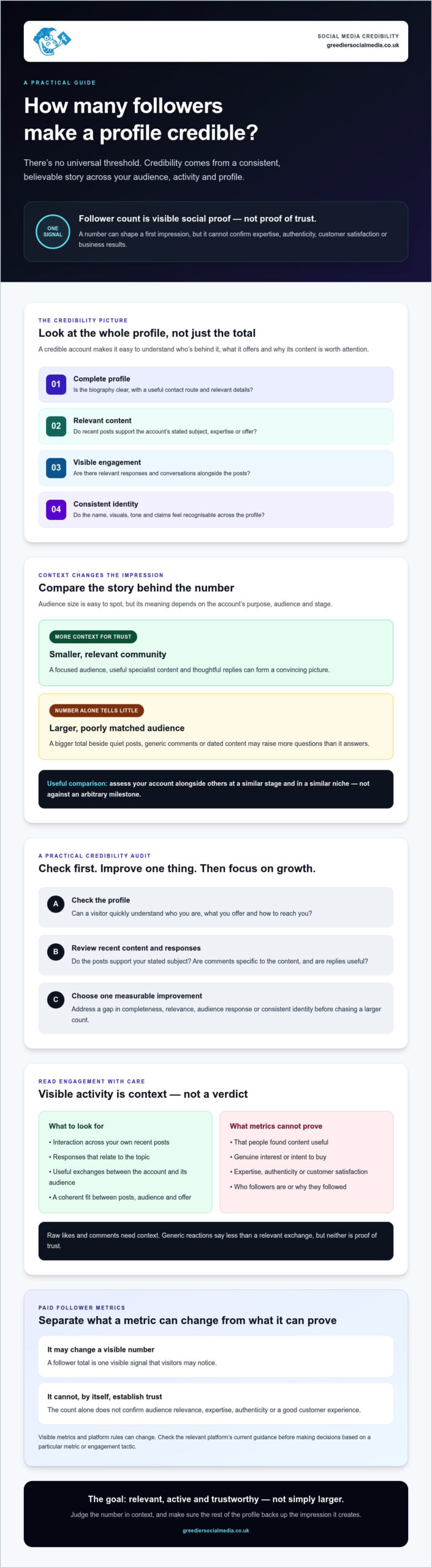
- Complete profile: Is the biography clear, with a useful contact route and any relevant details?
- Relevant content: Do recent posts support the account’s stated subject, expertise or offer?
- Visible engagement: Are there responses and conversations that make sense alongside the posts?
- Consistent identity: Do the name, visuals, tone and claims feel recognisable across the profile?
Testimonials and credentials can add useful context when they’re accurate, relevant and presented clearly. The Institute for Public Relations discusses ways to build credibility in the eyes of key stakeholders, including through expertise, open conversation and trustworthy interaction. Treat those signals as supporting evidence, not decoration.
Engagement and audience relevance
Look at interaction across the account’s own recent posts rather than comparing it with an assumed industry benchmark. Do people respond to the topic? Are comments specific to the content, and does the account reply in a useful way? A string of generic reactions tells you less than a relevant exchange, but neither comments nor likes prove genuine interest or intent to buy.
Consider audience fit, too. A specialist account may have a focused following that makes sense for its subject, while a broad audience may be less informative. Visible activity is context for your judgement, not a definitive measure of trust. Check whether the posts, apparent audience and stated offer form a coherent picture for a prospective visitor.
Profile, content and consistency signals
Scan the profile as a new visitor would. Can you quickly tell what the account does, who it’s for and how to make contact? Check that its visual identity is recognisable and its posts follow a discernible pattern. Regularity doesn’t require identical posts; it means the content continues to support the account’s stated focus.
For broader context on how these elements contribute to perceived trust, read this Social Media Authority UK guide. If you’re also weighing visible follower or engagement metrics, you can review available social media metrics as one part of that assessment. No single number replaces a complete, relevant and consistent profile.
How to judge whether your follower count looks credible for your account
The same follower total can create different impressions on different profiles. A newer account with a clearly defined subject may look promising, while an established brand with a long history may be expected to show a more developed audience. To answer how many followers do you need to be credible, compare your account with others that serve a similar purpose, not with whichever profile has the biggest number.
Follower totals are most informative when interpreted against an account’s age, niche, audience and purpose. Use this table to assess the context, not to set a minimum.
| Account type | What to consider | Useful credibility cues |
|---|---|---|
| New profile | It may not have had much time to attract an audience. | Clear profile details, a defined topic and useful recent posts. |
| Specialist creator | A focused subject may suit a smaller, relevant audience. | Evidence of knowledge, specific content and thoughtful audience discussion. |
| Established brand | Visitors may expect a visible history that fits the brand’s wider presence. | Consistent identity, current information and content that reflects its stated offer. |
New account, specialist creator or established brand?
An early-stage account can still make a sound impression. Make the purpose obvious, publish material that helps the intended audience and keep key details up to date. For a specialist creator, depth and relevance may carry more weight than broad reach: a focused discussion around specialist work can be more meaningful than a large but loosely connected audience. Established brands face different expectations, but those depend on their history and audience, not a universal follower target.
Use a context-first comparison, not a magic number
Choose a few genuine peers and ask:
- Do they cover a similar subject and serve a similar audience?
- Are their accounts at a comparable stage, with a similar purpose?
- How often do they post, and what kind of responses do their recent posts receive?
- Does their follower total make sense alongside their visible activity and profile information?
Keep follower count separate from engagement rate. The first is an audience total; the second describes interactions in relation to an audience or content measure. If you calculate a rate, state the method. For example, you might divide interactions on a post by the follower count, then multiply by 100. Specify which interactions and posts you included, and remember that different formulas can produce different results.
Use comparisons to spot useful questions, not to copy a peer’s numbers. A count can’t explain why people followed, and visible engagement alone can’t confirm genuine interest. Assess the whole profile before deciding whether growth is the right next step.
A practical credibility audit: what to improve before chasing more followers
Before asking how many followers do you need to be credible, check whether your profile is ready to make a clear, consistent impression. Fix unclear claims, missing details and conflicting presentation first. More visibility won’t resolve confusion about what you do or who your account is for.
If you’re building an early-stage Instagram profile, this Instagram growth guide for new accounts offers further reading. Use the audit below to decide what to improve before choosing a growth tactic.
A four-step profile and proof review
- Clarify the profile. Ask someone unfamiliar with the account to identify its purpose and intended audience from the biography and recent posts. If they can’t, make the description and offer more direct.
- Review your content. Check whether recent posts consistently support the expertise, subject or offer in your profile. Correct claims that are vague or difficult to substantiate, and address gaps in useful information.
- Inspect audience fit and visible proof. Look at interactions and profile details together. Are responses relevant to the post? Do the audience and content appear aligned with the account’s purpose? Treat visible metrics as clues, not confirmation of genuine interest.
- Choose one improvement. Set a clear review period, make one change and compare the relevant measure before and after. For example, update an unclear biography and check whether profile visits lead to more link clicks, if that information is available.
Keeping the test focused makes it easier to learn what helped. Changing the profile, content and posting approach all at once makes the result harder to interpret.
Choose growth measures that fit your objective
Pick a measure that matches your aim. For awareness, you might track reach or views. For community participation, look at relevant replies and conversations. If you want enquiries, monitor appropriate link clicks or messages where platform analytics make them available. Each metric has limits: a view doesn’t prove attention, and a click doesn’t confirm a sale.
Likes are one visible engagement measure, but they don’t establish trust by themselves. This Instagram likes guide provides further context on how to assess them. Make sure any growth tactic suits your account’s purpose and resources, and check the platform’s current rules before using it.
If you’ve reviewed your profile and want to consider a visible engagement metric, explore Instagram likes as one possible input, not a substitute for relevant content and audience response.
Can paid followers make an account credible? A balanced way to assess the option
Paid follower metrics can change the number visitors see, but that number alone can’t establish trust. It doesn’t show whether an audience is relevant, whether customers are satisfied or whether people are genuinely interested in the account. So, if you’re still asking how many followers do you need to be credible, treat paid metrics as one possible social-proof input, not a substitute for a credible profile.
Potential uses and limitations of paid engagement metrics
Greedier Social Media sells followers, likes and views for platforms including Instagram, YouTube, TikTok, Facebook and Threads. These are direct engagement metrics. They may affect visible totals, but they don’t independently demonstrate expertise, audience fit, customer experience or genuine interest.
Content-led growth works differently. It focuses on publishing relevant material and building an audience through its response over time. That can provide context about which topics attract attention and conversation, but it takes ongoing effort, and visible responses still don’t prove purchase intent. Neither approach guarantees credibility or business results. Consider what evidence each metric would actually give you, rather than assuming a higher total means greater trust.
Platform rules can change, and requirements differ between platforms. Check the current official guidance for the platform you use before purchasing any engagement service. Don’t assume a provider’s claims mean a platform will approve a tactic or that an account is protected from consequences.
Questions to ask before choosing a growth option
Pause before acting and make the decision specific:
- Which platform and metric? Identify whether you’re considering followers, likes or views, and why that measure fits the account.
- What’s the objective? Decide whether you want to improve a visible audience number, encourage interaction or measure another outcome. Don’t treat these goals as interchangeable.
- What will the metric prove? Be realistic about its limits. A follower total doesn’t show who follows or why; a like doesn’t confirm trust or customer satisfaction.
- Have you checked the details? Review the platform’s current official policies and the provider’s terms before purchasing. Keep your profile accurate, and keep audience fit, content and truthful presentation central to the choice.
Start with the profile’s actual need. If its details are unclear or its content doesn’t match its stated offer, address that first. If you’re assessing whether a visible metric has a role, explore these social proof options as one part of a wider credibility review.
Build credibility with signals that fit your account
There’s no universal answer to how many followers do you need to be credible. The number only makes sense alongside your account’s purpose, audience and stage of growth. A complete profile, relevant content and genuine, meaningful interaction help visitors understand what you offer and why it matters.
Before chasing a bigger total, fix unclear details and choose one measurable goal that fits your priorities. Paid metrics can change visible numbers, but they can’t establish audience relevance or customer trust on their own. Assess them as one possible input, not a substitute for a credible profile.
Greedier Social Media provides followers, likes and views across major social platforms. These services are direct engagement metrics, so assess them in the context of your goals and the rest of your profile.
Frequently Asked Questions
How many followers do you need to be credible?
There’s no universal minimum. The answer to “how many followers do you need to be credible” depends on your account’s purpose, niche, age and intended audience. Visitors may notice the total, but they’ll also look for signs that the profile is complete, current and consistent. Treat the number as one part of the first impression, then check whether your content and account details support the trust you want to build.
Can a small account still look credible?
Yes. A smaller account can make a credible impression if visitors can quickly understand its purpose and find useful, relevant information. Keep the profile accurate, make the offer clear and include suitable contact details or credentials. Compare your account with others at a similar stage and serving a similar audience, rather than a much larger profile with a different purpose. Focus on helping the right people assess your account.
Do followers matter more than engagement?
No single metric matters more in every situation. Follower totals show the size of an account’s stated audience, while likes and comments show visible responses to content. Neither confirms trust, genuine interest or business results. Review both alongside the relevance of your audience and the quality of your content. Look at patterns across several posts over time, rather than drawing conclusions from one unusually active post or a single headline number.
What makes an Instagram account look trustworthy?
A clear biography, recognisable identity, relevant posts and accurate contact information help visitors understand the account. Consistent presentation can make its purpose easier to follow, whilst accurate testimonials or verifiable credentials may offer useful supporting context. Follower counts and engagement can contribute to an initial impression, but they don’t prove reliability. Keep claims truthful, and check Instagram’s current official guidance before using any growth service or engagement tactic.
Can buying followers make a business look more credible?
Buying followers can change a profile’s visible audience total, but that alone doesn’t establish trust, customer satisfaction or audience relevance. Before considering a service, decide what you want the metric to represent and whether it fits your business objective. Review the platform’s current policies and the provider’s terms. Don’t present a larger number as proof of customer demand, and don’t assume purchased metrics will bring customers or improve other results.
How can I tell whether my follower count is low for my niche?
There’s no dependable universal threshold for a niche. Compare your profile with accounts that cover a similar subject, serve a similar audience and have a comparable purpose. Consider how long each account has been active and how consistently it publishes. Use the comparison to identify questions or profile improvements, not to copy another account’s total. If you consult benchmark data, check its source, publication date, sample and relevance before relying on it.
Should a new business wait until it has more followers before selling?
No. A new business can explain its offer before building a large following. Make the profile clear, provide accurate ways to get in touch and publish content that answers likely customer questions. Then assess whether people understand the offer through relevant feedback and enquiries. A follower total can’t prove demand, so avoid using it as a substitute for customer evidence. Make the next decision based on your business objective, not a target number.
To explore followers, likes and views for your social media accounts, visit Greedier Social Media.