

What does a higher Page-like count prove if those people never see or respond to your posts? A new or quiet Page can look less established, so it’s understandable to consider whether to buy facebook page likes uk as a way to build social proof. But the number alone can’t show whether people are interested in what you share.
This guide explains what purchased Page likes can and can’t do, how they differ from followers and meaningful engagement, and what to consider before choosing this option. Meta prohibits the artificial collection of likes, while its advertising tools offer a separate route to paid distribution.
You’ll learn how to compare purchased likes with organic activity and advertising, assess the limits of the metric, and review your Page before making a decision. Treat likes as a possible credibility signal, not a substitute for genuine audience interest.
Key Takeaways
- Learn how a Page like differs from a follow or a meaningful interaction, so you can choose the metric that fits your goal.
- See why a higher like count can offer social proof but can’t demonstrate sales, loyalty or audience engagement.
- Compare buying likes, organic publishing and Meta advertising to understand what each route measures and what it cannot promise.
- Use a practical readiness checklist to review your Page details and recent posts before deciding whether to buy facebook page likes uk.
- Understand what Greedier Social Media’s Facebook Page likes service covers and how it differs from organic management or ad campaign management.
What does it mean to buy Facebook Page likes in the UK?
To buy Facebook Page likes in the UK is to pay for a service intended to increase the like count displayed on a Facebook Page. This changes a visible metric; it doesn’t show by itself that people have read your posts, want your services or intend to become customers. Meta’s policies prohibit artificially collecting likes, so buying likes is distinct from promotion through Meta’s advertising tools.
A Page like is a visible signal that someone has liked a Page, not proof of their attention, approval or purchasing intent. That distinction matters. The Facebook Like Button is a familiar way for people to express interest, but a count can’t explain what each person thinks or does next.
Facebook distinguishes Page likes from Page follows. A like records that someone has liked the Page; a follow is a choice to receive its updates in Feed, subject to the person’s settings and Facebook’s systems. A meaningful interaction goes further: it might be a relevant comment, a question about an offer or a share accompanied by a recommendation. These actions are not interchangeable, even if marketing offers sometimes use the terms loosely.
How are Facebook Page likes different from followers?
Think of a like as an expressed connection and a follow as an update preference. Neither guarantees that someone will see a particular post or interact with it. For example, a Page might show a substantial like count while its latest posts have few comments or replies. That gap doesn’t explain why engagement is limited, but it does show why the headline figure isn’t a reliable measure of current audience activity.
What can a visible like count tell a visitor?
A count can shape a first impression. On a new or quiet Page, a visitor may read it as a sign that other people have noticed the business. That is social proof, not evidence that customers trust the business, found it relevant or had a positive experience. Perceived popularity and verified customer satisfaction are different things.
Use the number as context, not a verdict. Visitors can also assess whether the Page’s details are clear, whether its posts are current and whether real conversations appear beneath them. A like total alone can’t answer those questions. Nor does a higher number automatically mean Facebook will distribute posts more widely or rank the Page more favourably. Reach and response depend on factors beyond a displayed count.
If you’re considering paid likes, decide what you want the number to represent and compare it with observable signs of interest, such as relevant comments and enquiries. The count may contribute to a first impression, but the Page’s content and audience behaviour give visitors more useful context.
What bought Facebook Page likes can, and cannot, do
A higher Page-like count changes a visible number. It doesn’t establish that people have bought from you, intend to return or interact with your posts. This distinction is central to deciding whether to buy facebook page likes uk: the metric may contribute to social proof, but it isn’t evidence of business performance.
A like count is a social proof signal; comments, clicks, enquiries and purchases are measurable audience responses. Treating these as separate outcomes helps you set realistic expectations and judge activity against what matters to your Page.
Engagement quality and relevance matter because an interaction is useful only in context. A comment from someone asking a genuine question about your service gives a different signal from a number on a profile. HubSpot’s guide to Understanding Facebook Engagement explains the broader range of actions that can indicate audience response. A like count alone can’t show whether the people behind it are interested in your posts or offerings.
Do Page likes guarantee more reach or sales?
No. Purchased likes don’t guarantee wider reach, leads or sales. They are separate from people viewing a post, clicking through, sending an enquiry or completing a purchase. Keep those outcomes distinct in your reporting. For example, note whether a post prompted relevant comments or enquiries rather than treating a rise in Page likes as proof that marketing is working. A visible metric can be recorded, but it can’t stand in for results further along the customer journey. For organisations seeking authentic commercial momentum, collaborating with an evidence-led marketing agency such as Fresh Faced can help ensure your wider strategy focuses on measurable returns rather than vanity metrics.
How should buyers assess claims about likes?
Read promotional promises carefully. Claims such as “instant”, “authentic”, “completely safe” or “guaranteed results” need evidence to establish what a service will deliver. Ask what is being measured and what supports the claim. Don’t assume a phrase like “real users” means those people will see your posts, respond to them or become customers.
There is also a platform-policy consideration. Meta’s current guidance prohibits the artificial collection of likes, followers or shares; buying likes is not a promotion method endorsed by Meta. Meta’s advertising tools are a separate route for paid distribution. Artificial activity may create a credibility problem if the Page’s count appears out of step with its visible conversations, or if likes are later removed during integrity enforcement.
Set a clear purpose before spending, then decide how you’ll evaluate the Page beyond its headline count. Track relevant activity over time, such as comments related to your content, clicks, enquiries and completed sales. If those measures remain unchanged, the like count hasn’t demonstrated commercial value. A delivered metric and genuine audience interest are different outcomes.
If you’re weighing up a metric purchase, explore Facebook Page likes from Greedier Social Media with the limits of the metric and Meta’s policy in mind.
Bought likes, organic growth or Meta ads: which route fits your goal?
Choose the route by the result you want, not by the size of the number it might produce. Buying Page likes is a paid metric purchase. Organic publishing builds relevance through content and conversation. Meta advertising pays for distribution using Meta’s own tools. These approaches serve different purposes, so compare what each measures before deciding where to focus.
Route | Main purpose | What it measures | What it can’t guarantee
Purchased likes | Increase the visible Page-like count as a social proof signal. | The displayed number of likes. | Audience interest, post views, comments, enquiries or sales.
Organic publishing | Share useful, relevant content and encourage ongoing interaction. | Responses such as comments, shares and other engagement with posts. | A specific audience size, consistent reach or commercial results.
Meta advertising | Pay for distribution and pursue campaign objectives through Meta’s advertising tools. | Results associated with the campaign objective and its reporting. | A particular outcome, such as a sale, simply because an advert runs.
This comparison also clarifies what a service to buy facebook page likes uk covers: a visible metric, not organic publishing or paid advertising campaign management. For wider context on changes in the platform and Page growth, explore this Facebook Page growth trends guide.
When might a page owner consider buying likes?
The narrow use case is a business seeking a stronger visible social proof signal when visitors first land on its Page. That number is only one part of the impression. Make sure the Page has accurate business information, a clear description and useful, current content, so visitors can understand what you offer. Purchased likes don’t build relationships or replace answering questions and engaging with people.
When are content or advertising the better focus?
Choose organic publishing when your priority is sustained relevance and two-way interaction. Useful posts give people a reason to respond, ask questions or share their experience. Advertising is a separate paid-distribution route when you have a defined campaign objective and want to use Meta’s ad tools. Neither route is the same as buying a Page metric. For more on credibility beyond a single count, see this UK social media authority guide.
Set a practical measure for your goal before choosing. If you want a visible count, assess that metric on its own. If you want more conversation, look at relevant comments and replies. If you want enquiries, track them separately. For businesses seeking to combine these promotional channels into an effective overall strategy, consulting specialists such as Fireheart Digital can help define clear targets and ensure campaigns deliver lasting value. This keeps expectations grounded and helps you judge whether the route fits the outcome you actually need.
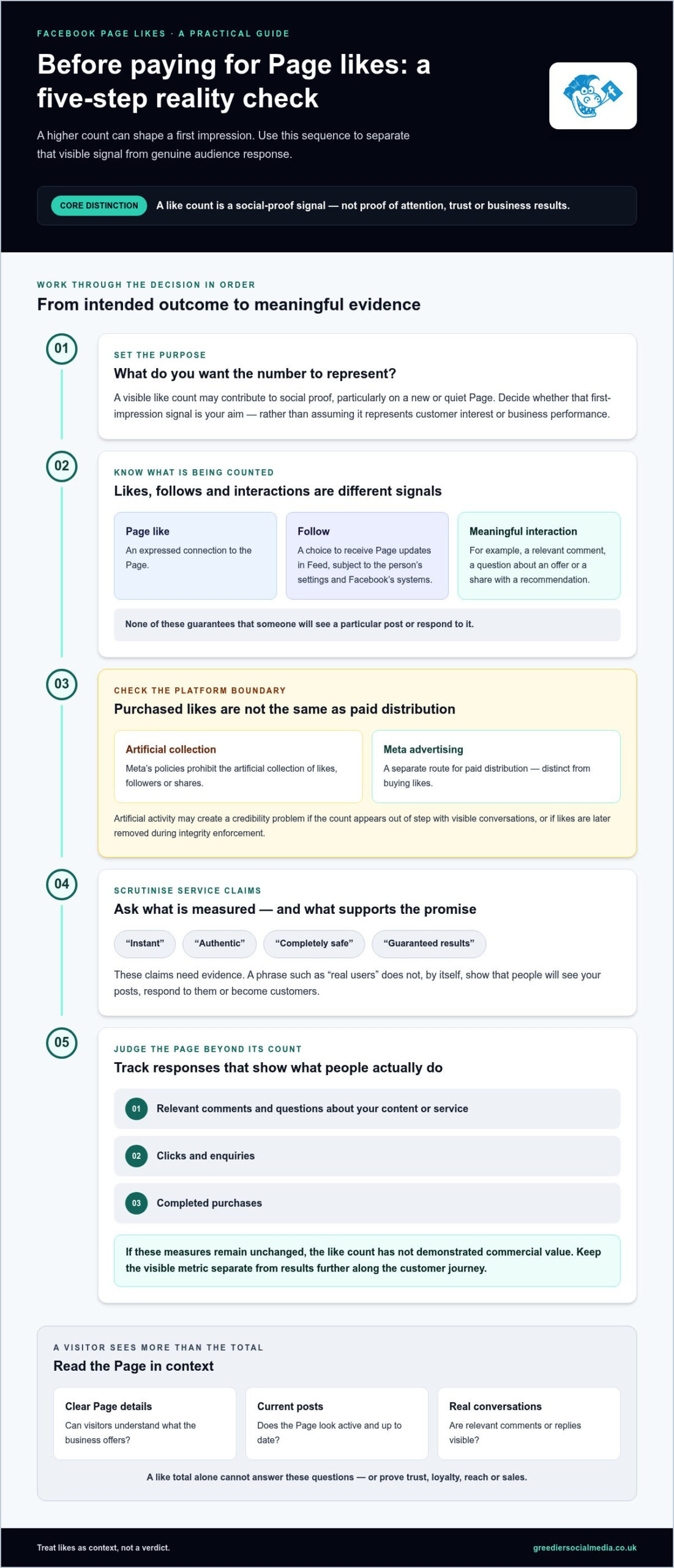
A practical checklist before buying Facebook Page likes
Pause before choosing a target count. A sound decision starts with a ready Page, a clear purpose and an honest way to judge whether the metric matters. If you’re considering whether to buy facebook page likes uk, work through this checklist first. It helps prevent a visible number from becoming a substitute for a meaningful business objective.
- Review the Page itself. Check the Page name, description and profile image. Make sure they accurately represent your business and current offer. Read recent posts as a first-time visitor would: do they explain what you do and give people a reason to stay?
- Set a specific goal. Decide whether you want to change the first impression the Page makes or pursue another defined objective. If the aim is enquiries, identify enquiries as the outcome to track. Don’t choose a target count without a reason tied to your Page’s context.
- Keep expectations realistic. A higher visible count won’t establish that people know, trust or intend to buy from your business. Consider whether the Page has enough useful, current information to give visitors a fuller picture than the number alone.
- Check Meta’s current rules. Platform guidance can change. Read Meta’s latest terms and guidance on inauthentic engagement before making a decision. Meta prohibits artificially collecting likes, followers or shares, so don’t treat a purchased metric as an approved method of promotion.
- Decide how you’ll measure the result. Record the Page’s starting position and choose measures that match your goal. That gives you a fairer basis for review than relying on the like count by itself.
Set a clear goal and prepare the Page
Preparation makes the Page more coherent for visitors, whatever you decide about a metric purchase. Keep the description, image and recent posts aligned with the business you operate now. A Page promoting an outdated offer or showing little recent activity can create confusion. Define why a stronger first impression matters to your Page, and avoid picking a number simply because it looks impressive.
Measure beyond the like count
Choose measures that fit the objective. Relevant reactions and comments can help you assess response to posts; link clicks or enquiries may be more useful if you want people to take a next step. Compare activity over a consistent period, and avoid attributing every change to one action. Content, timing and other factors can also affect results.
If the count changes but relevant engagement does not, review whether your content is useful to the audience you want to reach. For a direct metric option, you can explore Facebook Page likes, keeping Meta’s rules and your chosen outcome in view.
Buying Facebook Page likes from Greedier Social Media
Greedier Social Media provides Facebook Page likes as a direct purchase of a Page metric. The service focuses on paid delivery of likes, not organic social media management or advertising campaign management. Greedier Social Media has operated since 2013, and its Facebook Page likes service is for Page owners considering a change to the visible count as one part of their social proof.
Keep the distinction clear before deciding. A paid metric service doesn’t create a content plan, manage conversations with your audience or run an advertising campaign. It also doesn’t establish that people behind the likes are interested in your offer, will see your posts or will become customers. Meta prohibits the artificial collection of likes, so consider its current guidance as part of your decision. Meta’s advertising tools are a separate route for paid distribution.
What the Facebook Page likes service is for
The service is for a Page owner who has considered the limits and wants to purchase Facebook Page likes as a visible social proof metric. It isn’t a substitute for useful posts, accurate Page information or genuine audience relationships. Before acting, decide why the count matters to your Page and whether it supports a clear goal. Don’t treat a change to that number as evidence of reach, engagement or commercial performance.
Choose your next step with clear expectations
Review your Page’s current content and purpose first. If visitors can quickly understand what your business offers and find recent, relevant posts, you can assess the metric in that context. If the Page needs clearer information or stronger content, address those basics before focusing on its like count. Set expectations around the metric itself, not guaranteed reach, enquiries or conversions.
Then weigh the service against your objective. If your priority is meaningful audience interaction, focus on content and direct engagement. If you need paid distribution for a campaign objective, use Meta’s advertising tools. If you’re considering buy facebook page likes uk, remember that the service is limited to the metric and sits within Meta’s policy context. A measured decision starts with knowing what the count can represent, and what it cannot.
If that service scope fits your decision, explore Facebook Page likes from Greedier Social Media.
Make your next Page decision with purpose
Before acting, decide what role a like count should play in your wider plans. A metric is most useful when it has a clear place in your thinking, rather than becoming a target that drives every decision. Keep your focus on the reputation you want to build and the experience you want people to have when they visit your Page.
If you’re considering whether to buy facebook page likes uk, approach it as a considered choice, not a shortcut to lasting customer relationships. Revisit the decision as your Page develops, and keep your standards for credibility consistent.
Greedier Social Media offers Facebook Page likes for businesses choosing to purchase this specific metric. If that fits your next step, explore Facebook Page likes and decide whether it suits your Page’s aims.
Build your presence thoughtfully, one well-judged decision at a time.
Frequently Asked Questions
Is buying Facebook Page likes allowed under Meta’s rules?
No. Meta prohibits the artificial collection of likes, followers or shares, so buying Page likes isn’t a promotion method it endorses. If you’re considering whether to buy facebook page likes uk, review Meta’s current rules first, as platform guidance can change. For paid distribution through an approved route, Meta provides advertising tools such as boosting posts and Ads Manager. Keep metric purchases distinct from running an advert.
Can purchased Facebook Page likes increase post engagement?
They might not lead to more engagement. A like purchase changes the Page’s like count, but it doesn’t ensure that those accounts will comment on, share or click a post. For example, a Page could gain likes without receiving more questions about a new offer. Track the response you want, such as comments or link clicks, rather than assuming that a higher count will trigger activity.
What happens if Facebook removes likes from a Page?
The displayed count can fall if Facebook removes likes it identifies as inauthentic. That change may make the Page’s public metric look different, but a drop alone doesn’t tell you exactly why it happened. Check for relevant Page notifications and note when the count changed. Avoid treating removed likes as a reason to repeat the purchase; reassess your goal and focus on activity you can observe.
Do Facebook Page likes and followers mean the same thing?
No. Facebook treats Page likes and follows as separate metrics. A person may follow a Page to receive its updates without liking it, so the two totals can differ. For instance, someone might follow a business to keep up with opening hours but never select Like. Check each metric separately in Page information or reporting, and don’t use one as a substitute for the other.
Can a business build credibility with Facebook Page likes alone?
No. A count can contribute to a first impression, but credibility also depends on whether visitors can understand the business and find reasons to trust what it says. Make the Page’s contact information and offer clear, and keep its posts consistent with the service customers will actually receive. Genuine customer feedback and helpful responses can give visitors more context than a like total on its own.
Should I buy Facebook Page likes before publishing content?
It’s usually more sensible to publish useful content first. A visitor who sees a like count but no recent posts has little information about what the Page offers or whether it’s active. Start with an accurate description and posts that reflect your current services. Then decide whether a visible metric still supports your goal, rather than making the number the Page’s only point of interest.
Are Facebook Page likes the same as Facebook ad results?
No. Page likes are a social metric; ad results relate to paid distribution and the objective selected for an advert. A Page-like total doesn’t report how many people saw an advert, clicked through or completed another campaign action. If you advertise through Meta, assess the campaign using its relevant reporting measures. Don’t combine purchased likes and advert performance into one figure or assume one caused the other.