
Finding the best tools rapid brand awareness campaigns need starts with knowing what to actually measure.
The fastest stack for measurable brand awareness in the UK combines paid social engagement, social listening, branded-search tracking, and short survey waves. Set up your listening queries and baseline survey in the first 48 hours, launch a paid-engagement burst on your highest-traffic platform by day three, and activate branded keyword monitoring in Google Search Console or a dedicated SEO tool the same week. This stack outpaces organic-only approaches because it creates immediate social proof, triggers algorithmic amplification, and generates measurable signal within days rather than months.
Three actions for the first 72 hours:
- Configure a social listening tool to track your brand name, key product terms, and two or three competitor-adjacent keywords.
- Field a five-question baseline brand-awareness survey to a sample of UK respondents.
- Purchase a targeted paid-engagement package on your primary social platform to seed visible traction before your campaign content goes live.
Table of Contents
- What are the best tools for rapid brand awareness?
- Which KPIs actually matter for rapid brand-awareness gains?
- How do you choose the right brand-awareness tools quickly?
- Your 30–90 day playbook for fast brand awareness
- Where does paid engagement fit in the rapid stack?
- Copyable measurement templates for your brand-awareness dashboard
- Best Tools Rapid Brand Awareness: Key Takeaways
- Why fast tactics are not always the right call
- Greediersocialmedia: rapid UK-targeted engagement, no passwords required
- Further reading and authoritative sources
- FAQ
What are the best tools for rapid brand awareness?
Seven tool categories make up a complete rapid-awareness stack. Each serves a different function, and the trade-off between speed, depth, and cost varies sharply across them.
- Social listening and monitoring (e.g. Brand24, which tracks over 25 million online sources): surfaces mentions, sentiment, and share of voice in near real time. Trade-off: broad and fast, but behavioural data alone does not confirm recall.
- Survey-based brand tracking (e.g. SurveyMonkey, Pollfish): measures aided and unaided recall directly. Trade-off: gold-standard perception data, but requires a panel and a few days to field.
- Social publishing and AI content assistants (e.g. Hootsuite, Emplifi): combine scheduling, listening, and AI-assisted content creation in one workflow. Trade-off: speeds the insight-to-action cycle but carries a subscription cost.
- Digital-asset management and brand guidelines (e.g. Lingo): centralises brand assets and live guidelines so teams publish on-brand content faster. Trade-off: reduces execution errors but adds set-up time upfront.
Prioritise first for rapid gains: paid engagement + social listening. Add survey tracking by week two and branded-search monitoring from day one. PR monitoring and DAM tools are month-two additions once the baseline is moving.
Which KPIs actually matter for rapid brand-awareness gains?
Tracking the wrong metrics in a 30–90 day window wastes budget and misleads stakeholders. Focus on six KPIs that move quickly enough to be actionable.
- Unaided recall: the percentage of respondents who name your brand without prompting. Measured via short survey waves. A meaningful lift in a 30-day window is typically a small percentage increase from a low baseline. SurveyMonkey recommends unaided questions specifically to avoid the vanity trap of aided-only scores.
- Share of voice (SOV) and mentions: your brand’s mention volume as a proportion of total category conversation, tracked via listening tools. Brand24 surfaces this across 25 million+ sources, giving a fast read on whether your campaign is generating conversation.
Vanity metric swap: raw follower count tells you almost nothing about awareness. Replace it with active engagement rate and unaided recall as your primary health indicators. Large follower numbers with low engagement are a signal of audience mismatch, not brand strength.
Combining social listening with survey research gives you the fullest picture: listening spots emerging conversations in real time, while surveys confirm whether those conversations are translating into actual recall. Use UK-specific social media analytics to ground your dashboard in local benchmarks rather than global averages.
For a complete list of social media KPIs to track in 2026, cross-reference your dashboard fields against platform-native reporting to avoid gaps.
How do you choose the right brand-awareness tools quickly?
Speed of selection matters as much as speed of insight. Use this framework before committing budget.
Decision criteria (score each vendor against these):
- Speed of insight: how quickly does the tool return usable data after set-up?
- UK respondent coverage: does the survey panel or listening index have verified UK depth? SurveyMonkey’s guidance specifically flags local panel depth as a critical check before purchase.
- Panel transparency: can the vendor show you sample demographics and historical UK response rates?
- Integration: does the tool connect to your ad platform, Google Analytics 4, or CRM via API?
- Cost shape: pay-per-response suits short campaigns; subscriptions suit ongoing tracking.
- SLA and support: for a 30-day sprint, a 48-hour support response is too slow.
Three vendor questions to ask before buying:
- “What is your UK-specific panel size, and what is the average field time for a 200-respondent consumer study?”
- “Does your API connect to Google Analytics 4 and Meta Ads Manager out of the box, or does it require a third-party connector?”
- “How do you handle bot-generated mentions in your listening data, and what is your false-positive rate?”
Red flags to walk away from:
- No API or data export (you cannot own your data)
- Opaque panel sourcing with no demographic breakdown
- Listening tools that cannot distinguish genuine mentions from spam or bot activity
- Survey platforms with no UK-specific targeting options
Quick decision framework:
| Need | Recommended category |
|---|---|
| Speed above all else | Paid engagement + social listening |
| Depth and statistical validity | Survey tracking + brand-lift tests |
| Low cost, always-on | Branded-search monitoring (Google Search Console) |
| Full-funnel attribution | Integrated platform (Hootsuite or Emplifi) |
For affordable social media services that fit a sprint budget, prioritise tools with transparent pricing and no long minimum-term contracts.
Your 30–90 day playbook for fast brand awareness
This plan assumes a UK brand starting from a low or unmeasured awareness baseline.
Weeks 1–2: set-up and baseline
- Configure social listening queries (brand name, product terms, two category keywords).
- Field a five-question baseline survey to a sample of UK respondents via platforms like Pollfish or SurveyMonkey. Pollfish can return broad-audience results within hours, niche segments within a few days.
- Set up Google Search Console branded keyword tracking and note week-one volume.
- Centralise brand assets in a lightweight DAM (Lingo or equivalent) so all team members publish from the same approved files.
- Brief paid-engagement packages on your primary platform (Instagram, Facebook, or TikTok).
Weeks 3–4: momentum launch
- Activate paid-engagement burst: followers, likes, and views on your highest-priority content.
- Launch paid social ads (Meta or TikTok) targeting UK audiences with a brand-awareness objective.
- Begin AI-assisted content cadence: three to five posts per week using tools such as Hootsuite’s OwlyWriter or Buffer AI, informed by listening data. AI content tools accelerate production but require a clear brand position to avoid generating generic output.
- Run first weekly report: mentions, reach, engagement rate, branded search trend.
Month 2: scale and refine
- Analyse week-three and week-four listening data; adjust content angles toward topics generating the most organic conversation.
- Add influencer micro-boosts with UK creators having a modest follower count in your category.
- Field a second survey wave (same questions, same panel spec) to measure recall movement.
- Integrate web analytics with your social dashboard. Combining web analytics with social media closes the loop between traffic behaviour and campaign exposure.
Month 3: validate lift and hand over
- Run a brand-lift test via your ad platform if spend thresholds are met.
- Field a third survey wave and compare against baseline.
- Produce a 90-day summary report: recall delta, SOV movement, branded search growth, engagement rate trend.
- Decide which tools to retain on subscription versus which to drop after the sprint.
| Checkpoint | Deliverable | Owner | Success signal |
|---|---|---|---|
| Week 2 | Baseline survey results + listening dashboard live | Marketing lead | Baseline recall % confirmed |
| Week 4 | First weekly report pack | Analytics owner | Mentions up, engagement rate ≥ 3% |
| Month 2, week 1 | Second survey wave | Research lead | Recall movement ≥ 2 percentage points |
| Month 3 | 90-day lift report | Marketing lead | Unaided recall up, branded search trending |
For social media testing frameworks that support lift-test design, use A/B audience splits from week three onwards so month-three results are statistically defensible.
Where does paid engagement fit in the rapid stack?
Paid engagement is not a vanity play. It solves a specific problem: new or low-awareness brands face a cold-start problem on social platforms, where low engagement signals suppress algorithmic reach before organic audiences have a chance to discover the content. A targeted engagement burst breaks that loop.
Integration steps with listening and analytics:
- Run your paid-engagement package on the same content you are tracking in your listening tool, so you can separate organic conversation from seeded activity.
- Tag paid-engagement campaigns with UTM parameters so Google Analytics 4 can attribute any downstream web traffic.
- Monitor sentiment in your listening dashboard during and after the engagement burst to confirm the activity is generating positive or neutral conversation, not flagging as inauthentic.
- Cross-reference follower growth against engagement rate weekly. A Facebook post engagement service that delivers real interactions will show a stable or rising engagement rate; a low-quality service will inflate follower counts while engagement rate drops.
Anonymised UK case example:
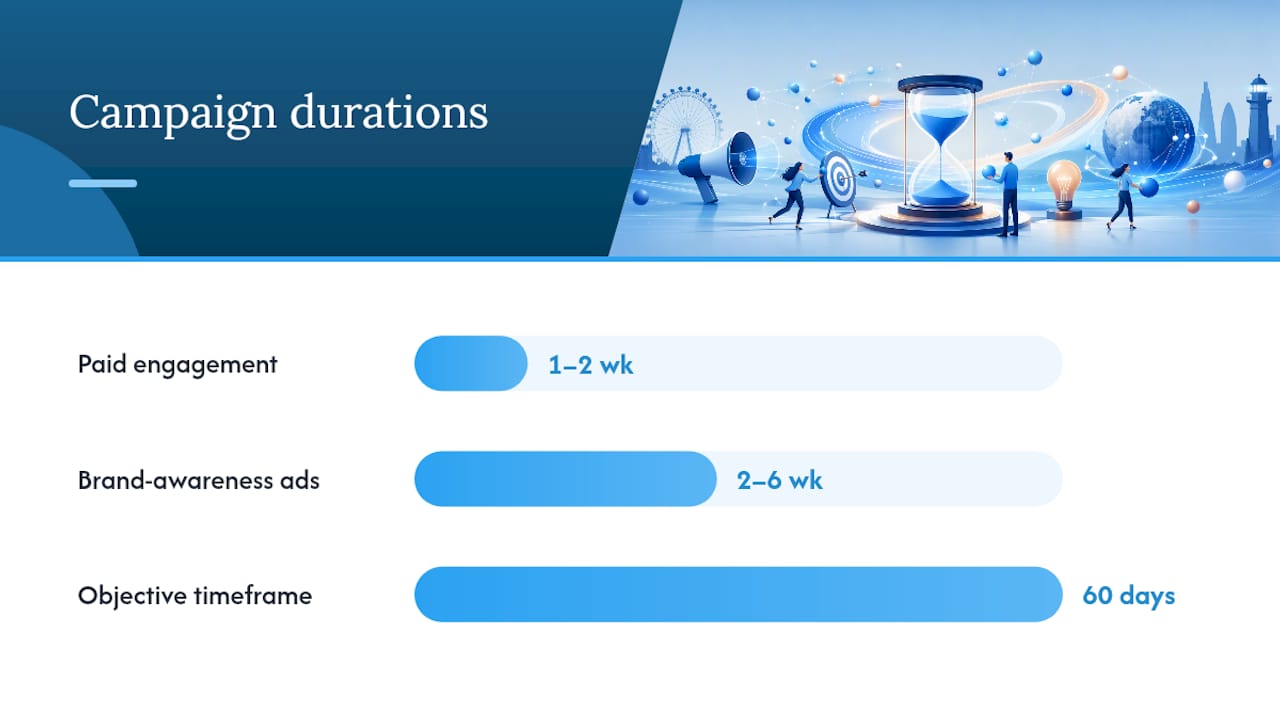
A UK-based direct-to-consumer food brand launched with zero social presence. Objective: reach 5% unaided recall among 25–44-year-old UK consumers within 60 days. Tactics: paid Instagram followers and likes via Greediersocialmedia (weeks 1–2), Meta brand-awareness ads (weeks 2–6), weekly AI-assisted content, Brand24 listening. KPIs tracked: unaided recall (survey), branded search volume, Instagram engagement rate. Result: unaided recall moved from below measurable threshold to a visible positive reading at the 60-day survey wave; branded search volume showed a consistent upward trend from week four.
Pro Tip: Always match your paid-engagement package to your target audience’s geography. Greediersocialmedia delivers UK-targeted engagement without requiring account passwords, which protects brand security and keeps platform compliance risk low.
Greediersocialmedia has supported over a million users since 2013, with services covering Instagram, Facebook, TikTok, YouTube, and Threads. For a direct comparison of paid engagement versus organic growth, the key finding is consistent: paid engagement accelerates the cold-start phase, while organic content sustains momentum once algorithmic reach is established.
Copyable measurement templates for your brand-awareness dashboard
Brand-awareness survey skeleton
Five questions cover the essentials for a rapid tracking wave:
- “When you think of [category], which brands come to mind?” (unaided recall, open text)
- “Have you heard of [Brand Name]?” (aided recall, yes/no)
- “How would you describe your overall impression of [Brand Name]?” (sentiment, 5-point Likert: very negative to very positive)
- “How likely are you to consider [Brand Name] the next time you need [category]?” (consideration, 5-point Likert)
- “Where have you seen or heard about [Brand Name] in the past 30 days?” (channel attribution, multi-select)
Field this to a minimum of 200 UK respondents per wave. SurveyMonkey recommends consistent question wording across waves so trend data is comparable.
Dashboard fields
| KPI | Data source | Refresh cadence | Owner |
|---|---|---|---|
| Unaided recall % | Survey (Pollfish / SurveyMonkey) | Monthly (wave-based) | Research lead |
| Aided recall % | Survey | Monthly | Research lead |
| Branded search volume | Google Search Console | Weekly | SEO lead |
| Share of voice | Social listening (Brand24) | Weekly | Social lead |
| Total mentions | Social listening | Daily | Social lead |
| Reach and impressions | Platform analytics | Weekly | Paid media lead |
| Engagement rate | Platform analytics | Weekly | Content lead |
| Sentiment score | Social listening | Weekly | Social lead |
| Campaign lift | Ad platform lift test | Per campaign | Paid media lead |
For a deeper view of how to measure social media growth progress, map each dashboard field to a business objective so stakeholders understand why each metric is being tracked, not just what it shows.
Best Tools Rapid Brand Awareness: Key Takeaways
The fastest path to measurable brand awareness in the UK combines paid engagement, social listening, branded-search tracking, and short survey waves run across a 30–90 day sprint.
| Point | Details |
|---|---|
| Start with listening and a baseline survey | Set up social listening queries and field a 200-respondent UK survey within the first 48–72 hours. |
| Use paid engagement to break the cold-start loop | A targeted engagement burst on your primary platform seeds social proof and triggers algorithmic reach before organic audiences arrive. |
| Track six KPIs, not twenty | Unaided recall, branded search volume, SOV, reach, engagement rate, and campaign lift cover the full awareness picture without noise. |
| Run three survey waves in 90 days | Baseline at week two, mid-point at month two, and final at month three gives statistically comparable recall data. |
| Greediersocialmedia for UK-targeted engagement | Greediersocialmedia delivers real followers, likes, and views to UK audiences instantly, without requiring account passwords, making it a practical first step in the rapid stack. |
Why fast tactics are not always the right call
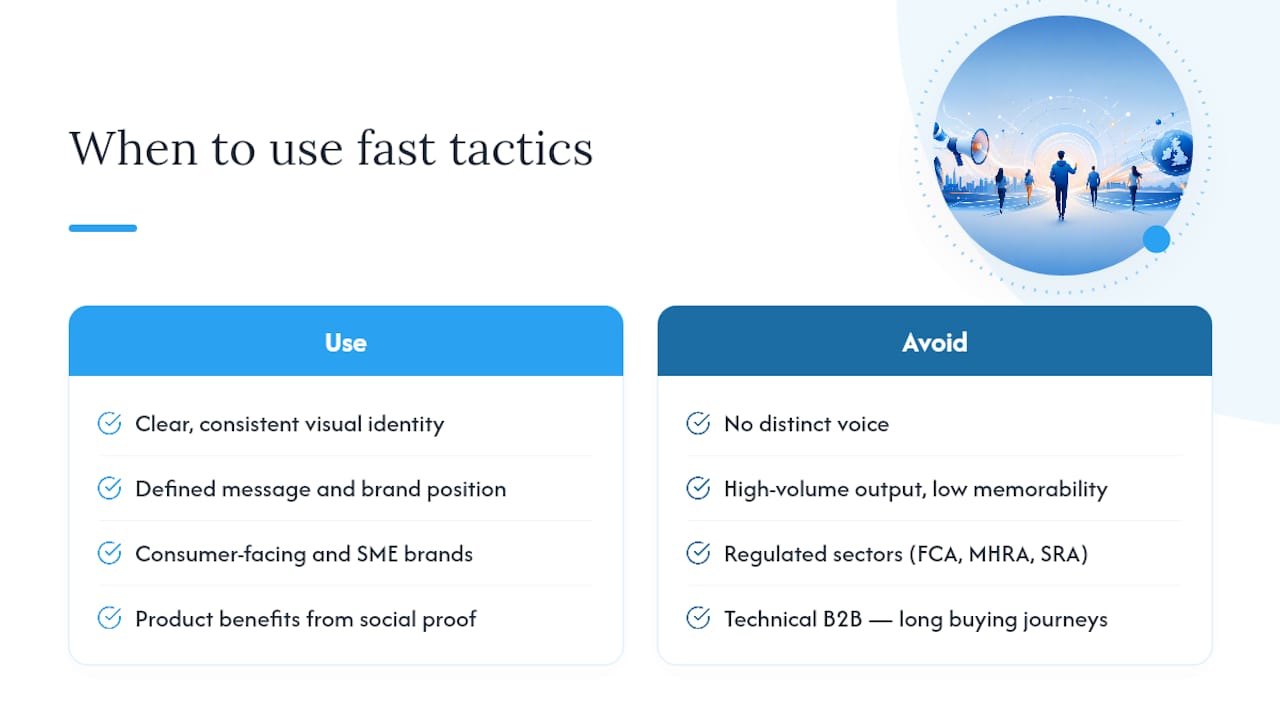
The case for speed is real, but it is not universal. Fast engagement tactics work best when a brand has a clear, consistent visual identity and a defined message. Without those foundations, paid engagement amplifies noise rather than recognition. An AI tool that generates fifty posts a week for a brand with no distinct voice produces volume, not memorability. The WeAreTenet research on AI tools for brand visibility makes this point directly: AI speeds production, but visibility requires a clear brand position first.
There are also sectors where rapid engagement tactics carry genuine risk. Regulated verticals such as financial services, healthcare, and legal services in the UK operate under strict FCA, MHRA, and SRA advertising rules respectively. A fast engagement burst that draws attention to non-compliant content accelerates the wrong kind of visibility. Highly technical B2B brands face a different problem: their buyers conduct long, research-heavy purchasing journeys, and a spike in Instagram followers does not move a procurement committee. In those contexts, the right investment is in thought-leadership content, PR, and branded-search capture, not social engagement volume.
The 30–90 day playbook in this article is designed for consumer-facing and SME brands with a defined UK audience and a product or service that benefits from social proof. If that describes your situation, the stack works. If it does not, slow down and invest in the measurement infrastructure first: get your baseline survey right, build your listening queries carefully, and let the data tell you where awareness is actually weak before spending on amplification.
Greediersocialmedia: rapid UK-targeted engagement, no passwords required
Most brand-awareness campaigns stall in the first two weeks because new content gets no traction and the algorithm deprioritises it. Greediersocialmedia solves that specific problem: real followers, likes, and views delivered to UK audiences instantly, with no account password required and a customer support team that responds fast.
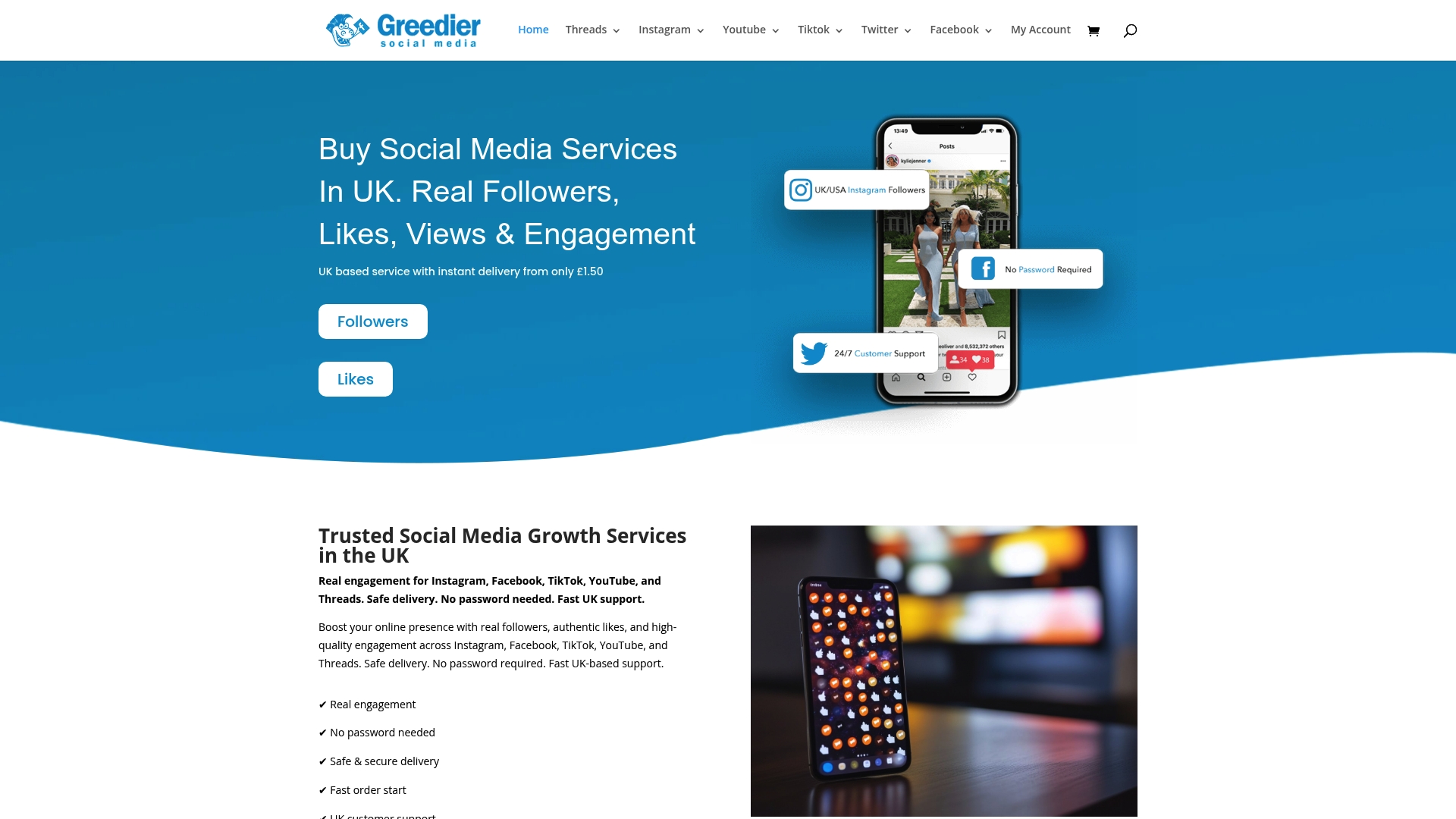
The service covers Instagram, Facebook, TikTok, YouTube, and Threads, so your engagement burst can run across every platform in your stack simultaneously. Over a million users have used Greediersocialmedia since 2013, and the approach is built around authentic engagement rather than bot-generated noise. For a practical breakdown of social media growth tactics that complement paid engagement with content strategy, the resource library covers the full picture.
Browse the packages at greediersocialmedia.co.uk and select the platform and volume that fits your 30-day sprint budget.
Further reading and authoritative sources
These sources underpin the frameworks, templates, and tool recommendations in this article. Each is worth bookmarking for deeper study.
- Brand24
- Brand awareness: How to measure and improve it | SurveyMonkey
- AI-Powered Social Media Marketing Platform | Emplifi
- Hootsuite platform
- 12 best AI tools for brand visibility (WeAreTenet)
- Brand tracking software | Pollfish
- 6 brand awareness measurement tools for B2B | Column Five
- The brand management tools every marketing leader needs in 2025 | Lingo
Use these sources to pressure-test vendor claims, cross-reference KPI benchmarks, and build the business case for measurement investment with stakeholders.
FAQ
What tool is used to measure brand awareness?
No single tool covers everything. The most complete approach combines a survey platform (SurveyMonkey or Pollfish) for recall data, a social listening tool (Brand24) for mentions and share of voice, and Google Search Console for branded search volume trends.
What is the 3-7-27 rule of branding?
The 3-exposure heuristic suggests a prospect needs multiple exposures to notice a brand, begin associating it with a category, and develop genuine trust. Definitions vary across sources, and it is a practitioner heuristic rather than a peer-reviewed finding, but it supports the case for sustained, multi-channel exposure over a 30–90 day period.
How can you spread brand awareness quickly in the UK?
The fastest approach is a combined paid-engagement burst on your primary social platform, supported by Meta or TikTok brand-awareness ads targeting UK audiences, and a social listening tool to track the resulting conversation. Greediersocialmedia delivers UK-targeted followers, likes, and views instantly, making it a practical first step for brands starting from a low visibility baseline.
What are the 5 C’s of branding?
Definitions of the 5 C’s vary widely across marketing frameworks and no single canonical version exists. A common practitioner version covers clarity, consistency, content, connection, and credibility, but you should verify which version your specific framework or course material uses before applying it.
How do surveys and listening tools differ for brand tracking?
Surveys measure what people consciously recall and how they feel about a brand; listening tools capture what people say unprompted in public online spaces. Using both together, as Column Five recommends, gives you the most complete picture of awareness and perception across a campaign window.