
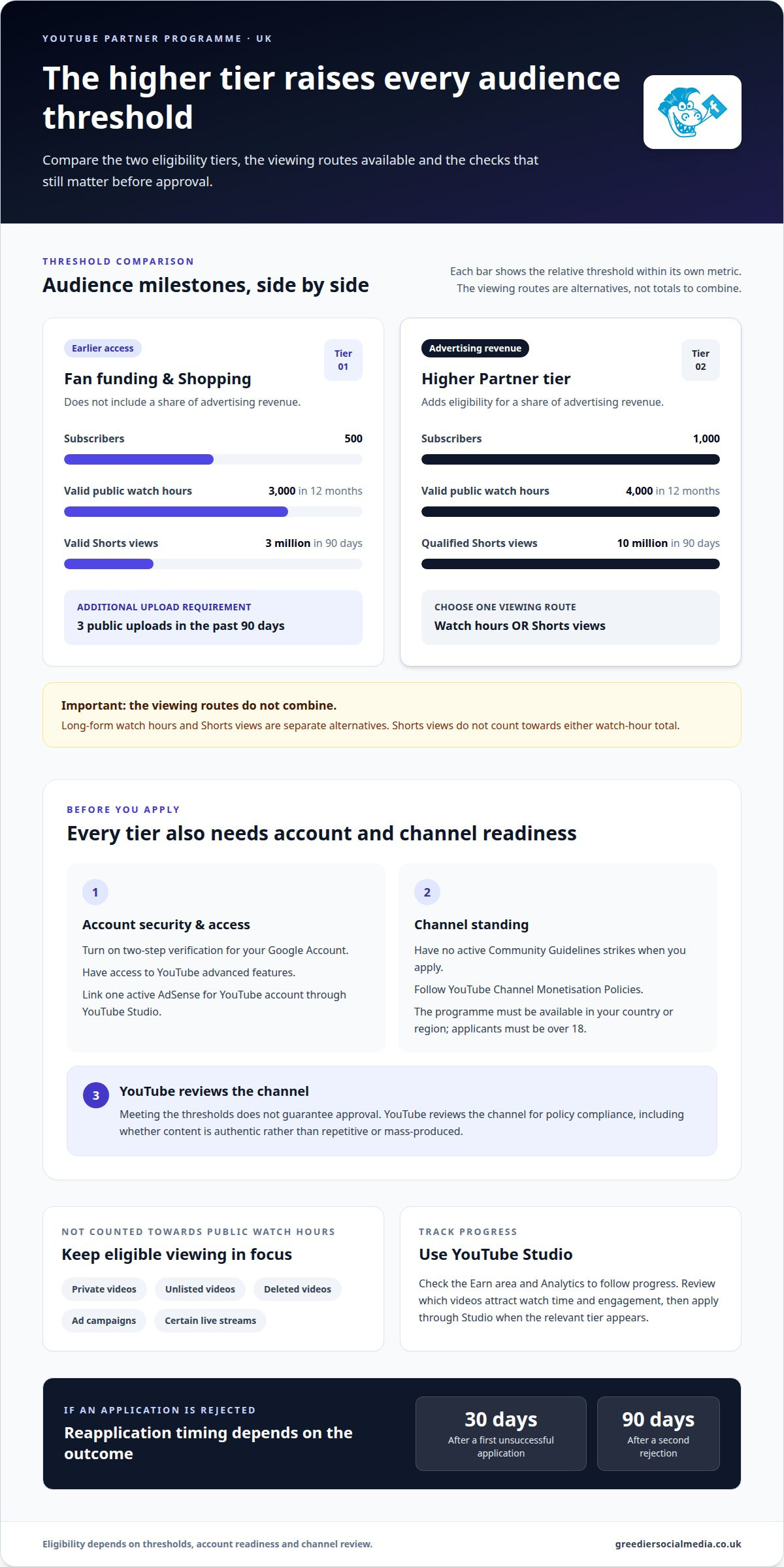
There are two YouTube Partner Programme eligibility tiers in the UK. The YouTube monetisation requirements in the UK start with 500 subscribers, three public uploads in the past 90 days, and either 3,000 valid public watch hours in the past 12 months or 3 million valid Shorts views in the past 90 days. For a share of advertising revenue, the threshold rises to 1,000 subscribers and either 4,000 valid public watch hours in the past 12 months or 10 million qualified Shorts views in the past 90 days.
Meeting the numbers is only part of the process. You also need no active Community Guidelines strikes, two-step verification, access to advanced features and a linked AdSense for YouTube account. It’s understandable to want a clear route from building an audience to earning from your videos. This guide explains the eligibility tiers, how strikes can affect approval, how to link AdSense and practical ways to work towards the requirements in 2026. You’ll also learn what YouTube reviews before approving a channel, so you can plan your next steps with confidence.
Key Takeaways
- Understand how active Community Guidelines strikes and YouTube’s channel review can affect an application.
- Choose a viewing route that fits your content, and learn which views and watch time don’t count towards eligibility.
- Prepare to link one active AdSense for YouTube account through YouTube Studio as part of setup.
- Build towards eligibility with consistent public uploads and a clear focus on original, policy-compliant content.
YouTube Partner Program eligibility tiers
The YouTube Partner Programme has an earlier-access tier and a higher tier for advertising revenue. In the UK, eligibility depends on meeting the relevant audience and viewing thresholds, satisfying account requirements and passing YouTube’s channel review.
The earlier-access tier can unlock fan-funding and Shopping features, but it does not qualify a channel for a share of advertising revenue. You need 500 subscribers, three public uploads in the past 90 days, and either 3,000 valid public watch hours in the past 12 months or 3 million valid Shorts views in the past 90 days.
The higher YouTube Partner tier adds advertising revenue sharing. It requires 1,000 subscribers and either 4,000 valid public watch hours in the past 12 months or 10 million qualified Shorts views in the past 90 days. These are alternative viewing routes: long-form watch hours and Shorts views aren’t combined to reach one threshold.
- Account readiness: Turn on two-step verification for your Google Account and gain access to YouTube advanced features.
- Channel standing: Have no active Community Guidelines strikes when you apply, and follow YouTube Channel Monetisation Policies.
- Location and age: The programme must be available in your country or region, and applicants must be over 18 years old.
Meeting a threshold does not guarantee approval. YouTube reviews each channel for policy compliance, including whether its content is authentic rather than repetitive or mass-produced. Track your progress in YouTube Studio’s Earn area and Analytics, then apply through Studio when the relevant tier appears.
Suspension from the YouTube Partner Programme means losing monetisation access after failing to meet programme conditions. An active Community Guidelines strike prevents an application from meeting the stated eligibility requirements. YouTube can also remove monetisation from a channel that has not uploaded or posted for six months or more. If an application is rejected, the reapplication wait depends on the circumstances: after a first unsuccessful application, creators can reapply after 30 days; after a second rejection, the wait is 90 days.
Linking an AdSense account
An AdSense for YouTube account is the payment account linked to your channel. Set one up or link an active account through YouTube Studio as part of the monetisation process.
AdSense account requirements
Eligible creators use an AdSense for YouTube account to receive earnings. Your channel needs one active linked account, or you must be ready to create one. The linked account must be approved before you can receive payments. Keep its details accurate and follow AdSense policies, since approval and payment depend on meeting the relevant requirements.
AdSense account setup
AdSense account setup is the process of creating or linking the account through YouTube Studio. Open Studio and follow the monetisation application steps to connect an existing account or set up a new one for YouTube. YouTube advises using Studio for this process, rather than creating an account separately through the AdSense homepage. Creating and linking an account should take about 10 minutes.
Use one active AdSense for YouTube account for your channel. If you already have one, select it during the Studio process instead of creating another. If you need a new account, follow the prompts in Studio to complete setup. Linking an account is separate from YouTube Partner Programme approval, so this step alone does not activate ad revenue.
AdSense payment schedule and threshold
The AdSense payment schedule is the monthly timing for finalising earnings and issuing payments. YouTube earnings are finalised and posted to AdSense for YouTube between the 7th and 12th of the following month. For example, earnings from one month are posted during the stated window in the next month.
Payments are issued between the 21st and 26th of the month when the payment threshold is met. The payment threshold determines whether earnings are issued in that cycle. If it hasn’t been reached, the balance carries forward until it is met. Check AdSense for YouTube to follow posted earnings and payment status; video ad revenue and the payment schedule are separate from the 12 months used to assess watch-hour eligibility.
How do I reach YouTube monetisation requirements in 2026?
Work towards the tier that fits your content and track progress in YouTube Studio. A practical plan for meeting YouTube monetisation requirements in the UK starts with choosing a viewing route and publishing consistently.
Subscriber thresholds
Subscriber thresholds are the audience milestones required for YouTube Partner Programme access. The earlier-access tier starts at 500 subscribers, while the advertising-revenue tier requires 1,000. Treat each milestone as a result of consistent, relevant content, not a standalone target. Give viewers a clear reason to subscribe, such as a recurring format or useful follow-up videos.
Public watch-hour thresholds
Public watch-hour thresholds measure eligible viewing time over a set period. The earlier-access route requires 3,000 valid public watch hours in the past 12 months; the advertising route requires 4,000. Shorts views don’t count towards either watch-hour total. Private, unlisted or deleted videos, ad campaigns, and certain live streams also don’t contribute.
Build a loyal subscriber audience by making your videos recognisable and worth returning to. Choose a clear topic, publish related videos and guide viewers to a relevant next upload; for creators exploring popular culture or biographical niches, platforms like Star World demonstrate how engaging stories and facts can capture audience interest. Use YouTube Analytics to see which videos attract watch time and engagement, then shape future content around those patterns. Make each subscription prompt relevant to the video’s value.
Use a simple review cycle: plan a topic, publish a public video, then review its performance in YouTube Studio. Compare audience retention and watch hours across related uploads rather than relying on one video’s views. If viewers leave early, refine the opening or pacing. Keep content authentic and aligned with YouTube’s guidelines. Understanding UK YouTube monetisation requirements helps you focus on eligible progress, not just headline view counts.
For a long-form channel, prioritise public videos that encourage sustained viewing across the past 12 months. If Shorts are your strength, work towards the separate qualified-views route instead of counting Shorts-feed views as watch hours. Check Studio’s Earn area to see which route your channel is progressing towards and what remains before applying.
Ad revenue sharing eligibility
Ad revenue sharing eligibility is the higher YouTube Partner Programme tier that allows qualifying channels to earn from advertising. For UK creators, this route requires 1,000 subscribers and either 4,000 valid public watch hours in the past 12 months or 10 million qualified Shorts views in the past 90 days.
For long-form videos, creators receive 55% of eligible advertising revenue. Reaching the viewing threshold is only one part of approval: YouTube also reviews the channel against its Channel Monetisation Policies. Repetitive or mass-produced material can be classed as inauthentic content, so a high view count alone doesn’t make a channel eligible.
YouTube Shopping eligibility is access to Shopping features through the earlier-access Partner Programme tier. That route requires 500 subscribers, three public uploads in the past 90 days, and either 3,000 valid public watch hours in the past 12 months or 3 million valid Shorts views in the past 90 days. This tier may unlock Shopping and fan-funding features, but it doesn’t qualify a channel for advertising revenue sharing.
Shorts views eligibility is the viewing route based on qualified views in the Shorts feed. For the earlier-access tier, the threshold is 3 million valid Shorts views in the past 90 days; for ad revenue sharing, it is 10 million qualified Shorts views in the same period. These routes are alternatives to the applicable long-form watch-hour threshold, not additions to it.
Not every view contributes. Private, unlisted or deleted Shorts, ad campaigns, and image posts in the Shorts feed don’t count towards the Shorts-view threshold. Likewise, Shorts-feed viewing doesn’t add to the 4,000 public watch-hour requirement. Use YouTube Studio to monitor the relevant progress, then apply when the correct tier appears. YouTube reviews the channel, so keep content authentic and policy-compliant throughout.
Greedier Social Media
Greedier Social Media offers paid engagement options for creators building a presence across social platforms. YouTube monetisation still depends on YouTube’s eligibility thresholds, channel policies and review, so Instagram engagement cannot replace qualified YouTube subscribers or views.
If you’re developing an Instagram profile alongside your YouTube channel, Greedier Social Media offers Instagram Followers, Instagram Likes, Auto Instagram Followers and Auto Instagram Likes. These paid services can support visibility and social proof on Instagram, while your YouTube monetisation work remains focused on eligible content and audience engagement.
Choose support that fits the platform and goal you’re working on. For a straightforward next step, contact Greedier Social Media.
Make your next step a consistent one
Turn your monetisation goal into a practical publishing routine. Choose a clear promise for your channel, then plan videos that deliver on it and give viewers a reason to return. Use the YouTube monetisation requirements in the UK to track progress, not as a substitute for content that serves your audience. Build trust with useful, authentic videos; a consistent direction can make your next decisions clearer.
If you’re also growing an Instagram presence, Greedier Social Media offers Instagram Followers, Instagram Likes and Auto Instagram Followers. These paid options support Instagram visibility, not YouTube eligibility, so keep each platform’s goals distinct.
Contact Greedier Social Media to discuss support for your Instagram presence. Keep your YouTube plan focused, make each upload count and take the next step with confidence.
Frequently Asked Questions
How many views do you need on YouTube to make money?
There’s no single view count that guarantees earnings; YouTube uses eligibility thresholds and a channel review. For advertising revenue, you need 1,000 subscribers and either 4,000 valid public watch hours in the past 12 months or 10 million qualified Shorts views in the past 90 days. A video’s view total alone doesn’t determine whether your channel can earn.
What do ‘qualified watch hours’ and ‘qualified Shorts views’ mean?
These are viewing totals YouTube counts towards the relevant Partner Programme threshold. Public watch hours come from eligible public long-form videos, not Shorts, private or unlisted videos, deleted videos, ad campaigns or certain live streams. Qualified Shorts views exclude views from private, unlisted or deleted Shorts, ad campaigns and image posts in the Shorts feed. Check your channel’s progress in the Earn area of YouTube Studio.
What happens if my counts drop below the threshold after I have applied?
A lower count after you apply does not, by itself, determine whether YouTube will approve your channel. YouTube reviews applications against its Channel Monetisation Policies, and meeting the threshold does not guarantee acceptance. Keep publishing eligible content and monitor your application in YouTube Studio. If YouTube rejects it, the decision and available next steps will appear there.
What if I don’t meet the programme threshold?
You can keep working towards the tier that fits your content and apply when YouTube Studio shows you’re eligible. The earlier-access tier has lower audience and viewing thresholds than the advertising-revenue tier. YouTube may still show ads on videos from channels that do not meet its higher criteria, but those channels do not receive a share of that ad revenue through the programme.
What kind of videos or topics can’t be monetised on YouTube?
YouTube can refuse monetisation for content that does not comply with its Channel Monetisation Policies. Repetitive or mass-produced videos may be classed as inauthentic content, making a channel ineligible. A topic alone does not determine approval: YouTube reviews the channel and its content against its policies. Make each upload original and avoid repeating formats with little meaningful variation.
Why was my YouTube monetisation application rejected?
Applications can be rejected when a channel doesn’t meet eligibility requirements or fails YouTube’s review against its Channel Monetisation Policies. An active Community Guidelines strike, reused or mass-produced content, or a channel that doesn’t meet its tier’s criteria can affect the decision. Read the reason shown in YouTube Studio, address the relevant issue, then appeal within 21 days or reapply after the applicable waiting period.