
Views matter more for what a channel earns and how far it reaches today. Subscribers matter more for what a channel can unlock and how reliably it can launch a video. They are not two scales of the same thing: a view tells you a video was played, a subscriber tells you a person once chose to follow you. Most channel decisions go wrong when one is used to answer the other’s question.
This guide explains what each number actually measures, how YouTube’s 2026 change to view counting affects the picture, which thresholds depend on subscribers, and how to read the two together. We also say plainly where bought engagement fits and where it does not.
TL;DR
- Subscribers are a historical total. Views, especially recent ones, show your current reach and drive most of your earnings.
- Monetisation needs both: 1,000 subscribers plus either 4,000 public watch hours or 10 million Shorts views for ad revenue.
- The ratio of views to subscribers over a recent period tells you more than either raw number.
- From 24 August 2026 a view is counted when a video starts to play, so engaged views and watch time are the figures to trust.
- Bought numbers never replace retention. Use them, if at all, as a modest starting signal for a channel that already makes good videos.
Table of Contents
- What each metric actually measures
- How YouTube counts a view in 2026
- Where subscribers still matter
- Where views matter more
- Read them together: the views-to-subscribers ratio
- Why the audience you have is smaller than your count
- Which one should you chase?
- Our perspective
- What bought engagement can and cannot do
- Our YouTube packages
- A simple 30-day routine
- FAQ
- Sources
What each metric actually measures
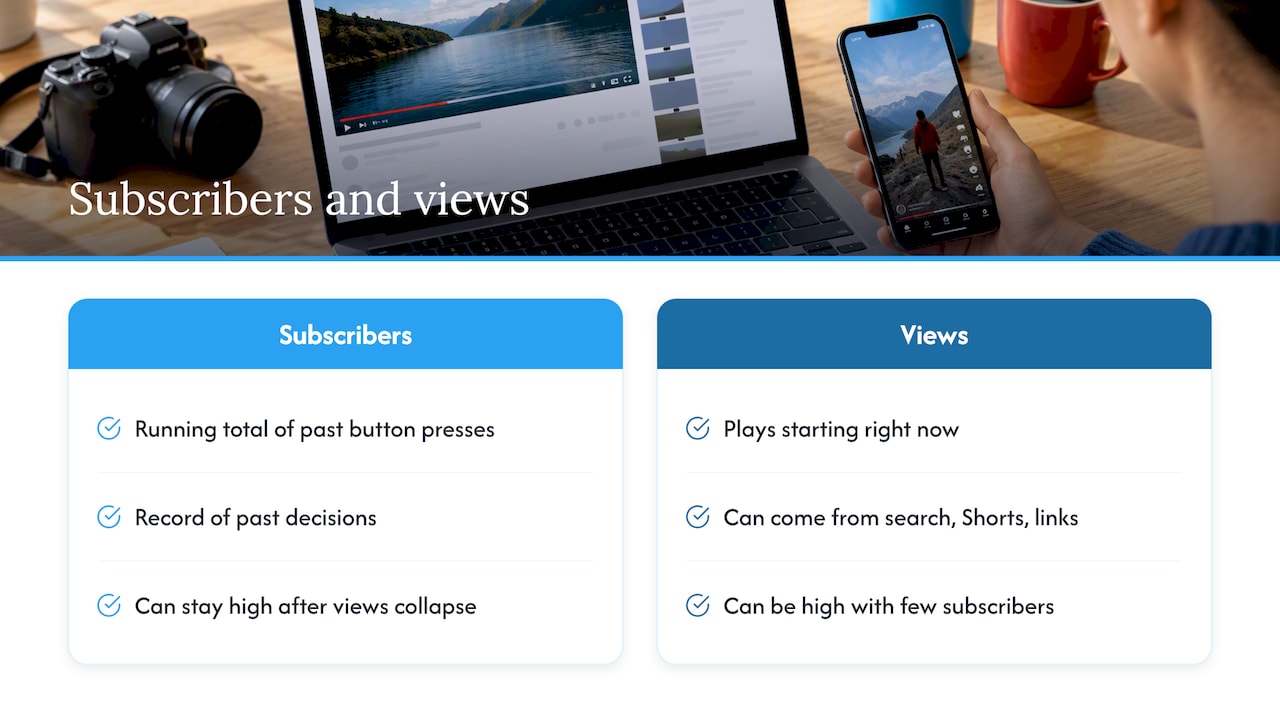
Subscribers are a running total of people who pressed the button at some point. The count only goes up unless people leave or YouTube removes accounts. That makes it a record of past decisions, not a measure of who is watching this week. A channel three years past its peak can keep a large subscriber count while its daily views have collapsed.
Views are plays. They answer a different question: how many times is your content being started right now? Views can come from subscribers, but also from search, suggested videos, the Shorts feed and external links. A channel with few subscribers and a big video is perfectly normal.
TubeLeader’s analysis of the two metrics makes the same point: they answer different questions, and a channel can be strong on one and weak on the other. Neither is inherently the better one. A high views-to-subscribers ratio signals wide reach beyond your followers, while a low one signals a contained, loyal audience. These are different business models, not good and bad.
How YouTube counts a view in 2026
This has changed recently, and it affects how you read your public numbers. According to YouTube Help, from 24 August 2026 views are counted the moment a video starts to play, across Shorts, long-form videos and live streams. YouTube states the update does not change Partner Programme earnings or eligibility, which still rest on engaged views and qualified watch hours.
Shorts moved first. YouTube’s own Shorts guidance says that from 31 March 2025 a Short’s view counts each time it starts to play or replay, with no minimum watch time.
In practice, the public view count is now a measure of starts, not of attention. A sharp thumbnail that earns clicks but loses people in ten seconds will look healthy on the public count and poor in your analytics. YouTube describes engaged views as the more reliable guide, and you can only see them privately in YouTube Studio.
If you want the longer comparison of plays against time spent, our piece on watch time vs views goes deeper.
Where subscribers still matter
Subscribers have not become irrelevant. They matter in three concrete ways.
- Thresholds. Ad revenue through the YouTube Partner Programme requires 1,000 subscribers. YouTube’s eligibility page pairs that with either 4,000 valid public watch hours in the last 12 months or 10 million valid public Shorts views in the last 90 days. No amount of views gets you in without the subscriber count.
- Launch momentum. A video that opens to an existing audience gets early plays and likes, which give the recommendation system something to test. Subscribers are your first audience, not your only one.
- Social proof. A new visitor deciding whether to trust a channel glances at the count. It is a weak signal, but it is a signal, particularly for local businesses and new creators without other credentials.
There is also a long-run link. A study of the first 1,700 YouTube channels found a strong correlation of 0.920 between subscriber count and total views, but only 0.095 between the number of uploads and views. Large channels tend to have both, and posting more alone did not explain the views. That is historical and cumulative, so it does not tell you that adding subscribers will create views tomorrow.
Where views matter more
If your goal is income, reach or sales enquiries, recent views carry the weight. Research in the International Journal of Web-Based Communities found that new daily views and their growth rate drove daily revenue, while total subscriber counts did not directly contribute to daily earnings. For a creator, that means consistent recent viewership beats a large, dormant subscriber base.
This is why a small channel with a video ranking in search can out-earn a bigger one that posts to an inactive audience. It is also why a UK tradesperson with 800 subscribers and a how-to video that people keep finding may get more enquiries than a lifestyle channel with 20,000 followers and little search traffic.
Read them together: the views-to-subscribers ratio
The most useful single figure is the ratio of views to subscribers over a recent window, such as the last 28 or 90 days. Divide recent views by your current subscriber count.
| Pattern | What it usually means | What to do |
|---|---|---|
| Low ratio (views well below subscribers) | Audience is dormant, or subscribers were gained from one-off spikes | Revisit topics your core viewers actually watch; improve thumbnails and titles |
| Mid ratio | Healthy mix of followers and outside discovery | Keep a consistent format; test new topics in small batches |
| High ratio (views far above subscribers) | Videos travel through search or recommendations; viewers are not converting | Add a clear reason to subscribe, end screens and a series structure |
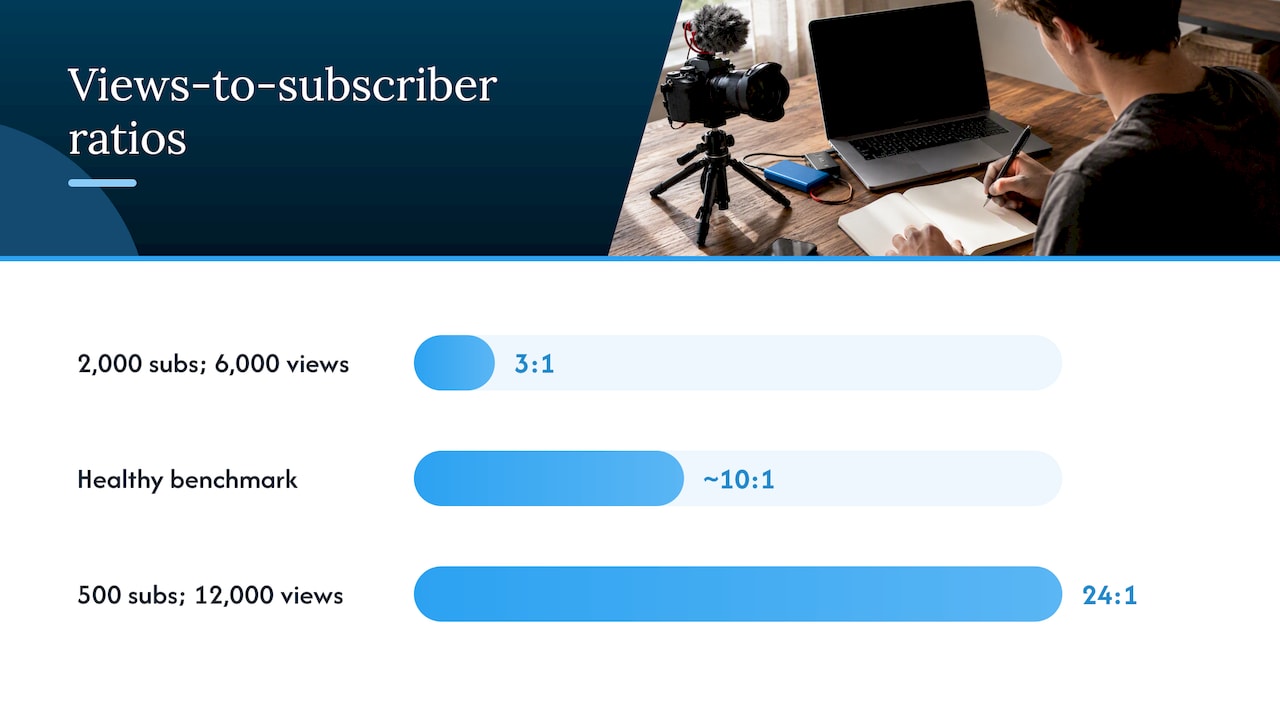
One published benchmark puts a healthy figure at roughly 10 views for every subscriber, but treat that as a rule of thumb, not a standard. Niche matters: a news or entertainment channel will behave differently from a B2B explainer channel.
A worked example. A channel has 2,000 subscribers and 6,000 views in the last 28 days. The ratio is 3:1. That is not alarming if the channel serves a tight community, but if you want to reach new customers, it suggests your videos are mostly watched by people who already know you. A second channel with 500 subscribers and 12,000 views in 28 days has a ratio of 24:1: it is being found, but not convincing people to follow. Each needs a different fix.
Why the audience you have is smaller than your count
New creators are often discouraged by how few subscribers actually watch. YouTube explains that regular viewers, those watching consistently for six months or more, are often below 1% for new channels. It describes this as normal and not harmful to reach or monetisation. The lesson is to concentrate on retention rather than panic about the size of your core community.
Your monthly audience, the unique viewers over 28 days, is a better picture of your real size than your subscriber total. If you have not looked at it before, open the Audience tab in YouTube Studio and compare it with your subscriber count.
Which one should you chase?
The answer depends on the stage you are at.
Under 1,000 subscribers
Your constraint is the Partner Programme threshold, so subscribers matter, but only if they come with watch time. Make videos that answer one specific question well, ask for the subscription at the moment the viewer has just got value, and publish consistently enough that new subscribers see activity. Our guide to growing YouTube subscribers covers the practical steps.
Past the threshold
Shift attention to views per video, retention and click-through rate. Subscriber count is now a by-product. Look at which videos pulled in non-subscribers and make more of what worked. For approaches to lifting plays, see how to boost YouTube video views.
Running a brand or local business channel
Views from the right people count for more than raw volume. A plumber in Leeds does not need a million plays from abroad. Watch whether viewers click through to your website, call, or ask for quotes, and use the subscriber count mainly as a credibility cue on your channel page.
Supporting your videos with wider promotion helps too. Practical audience engagement strategies lean on retention and repeat interaction rather than uploads or follower totals alone, which fits what the data above suggests.
Our perspective
We have worked with small businesses, creators and marketers across the UK since 2013, and the same misunderstanding comes up repeatedly: people treat subscribers as the prize and views as noise, or the other way round. Both are inputs to the same system.
Our view is that the first impression matters. A new channel with 40 subscribers and a handful of plays looks unproven to a stranger, and many viewers will click away before judging the content. For a channel that already publishes good videos, a measured amount of added engagement can make the page look established while the real work, retention and consistent publishing, builds momentum. We would never present it as a replacement for that work.
The point we stress most is pacing. Numbers that arrive in a believable pattern, alongside genuine viewing, sit better with a channel’s history than abrupt jumps. And we always suggest checking your analytics afterwards: if subscribers rise and engaged views do not, the content, not the count, is the next thing to fix. We also stay open about the limits: YouTube says purchased views and views from ad campaigns do not count towards the Partner Programme, so do not buy views expecting to reach monetisation. Our own explainer on why engaged views now rule goes through the 2026 changes.
— Irwin Lee
What bought engagement can and cannot do
It helps to be exact here, because this is the area where creators lose most money and trust.
- It can add social proof to a channel page, help a new video look less empty at launch, and give a business a more established first impression.
- It cannot create watch hours that YouTube will count. YouTube says purchased views, views from ad campaigns and automated or non-original content are excluded from Partner Programme eligibility, and that using services to inflate metrics can put your standing at risk.
- It cannot fix a low ratio caused by weak videos. If viewers do not watch, extra numbers just sit beside poor retention.
If you are promoting products on YouTube in the UK, remember the disclosure rules as well. GOV.UK guidance for content creators says content you were incentivised to make must be clearly identifiable as advertising, and the guidance for brands says promotional content, including your own, must be labelled as an ad. Put the label up front, not buried in hashtags or behind a “more” click.
If you want to understand what makes added subscribers worthwhile, read our notes on what makes YouTube subscribers genuine, and on drip-feeding views to protect retention.
Our YouTube packages
If you have decided that a measured boost suits your channel, we offer real YouTube subscribers from £11.99 to £259.99 (one-off), views from £4.99 to £269.99 and likes from £2.99 to £85.99, with UK support and no password needed. You can see every package on our YouTube services page, or read the details of buying YouTube subscribers in the UK first. Pick the smallest package that fits your goal, then check your analytics before ordering more.
A simple 30-day routine
- Day 1. Note your subscriber count, the last 28 days of views, engaged views and monthly audience.
- Days 2 to 10. Find your three best videos by engaged views. Write down what they share: topic, length, opening, thumbnail style.
- Days 10 to 25. Publish two or three videos built on that pattern, each with a clear subscribe prompt after the most useful moment.
- Day 30. Recalculate the ratio. If views rose but subscribers did not, strengthen your calls to action and playlists. If subscribers rose but views did not, your titles and thumbnails need work.
The point is to act on the gap between the two numbers rather than to chase either.
FAQ
Do subscribers or views earn more money on YouTube?
Views do the earning, while subscribers help you qualify. Ad revenue comes from plays of your videos, and research found daily revenue follows new daily views rather than total subscribers. You still need 1,000 subscribers to join the Partner Programme for ads.
Is a high views-to-subscribers ratio good?
Usually it means your videos are reaching beyond your followers, which is good for discovery. But it can also mean viewers are not converting into subscribers, so check whether your videos give people a reason to follow. Niche and format change what counts as normal.
Can a channel make money with 500 subscribers?
YouTube’s tier for fan funding starts lower than the ad tier, and which features you can access depends on your country and eligibility. Check the criteria on YouTube’s eligibility page and in YouTube Studio’s Earn area for your channel’s current status.
Do views from my own subscribers count the same as other views?
Public counting treats a play as a play. For monetisation, YouTube looks at engaged views and qualified watch hours, so what matters is that people actually watch, whoever they are.
Sources
- How engagement metrics are counted, YouTube Help
- Get started creating YouTube Shorts, YouTube Help
- Understand your YouTube content performance, YouTube Help
- YouTube Partner Programme overview and eligibility, YouTube Help
- Understand new, casual and regular viewers, YouTube Help
- Subscribers vs Views, TubeLeader
- YouTube Channels, Subscribers, Uploads and Views: A Multidimensional Analysis, MDPI
- Research on daily views and revenue, International Journal of Web-Based Communities
- Social media endorsements: guidance for content creators, GOV.UK
- Social media endorsements: guidance for brands, GOV.UK