
A refill guarantee is a provider’s promise to replace followers, likes or views that drop after delivery, usually within a set warranty window. It’s only worth anything alongside specific terms: a clear threshold, a defined claim process and a support channel that actually responds. Before relying on one, read the fine print and check how a claim gets filed.
TL;DR:
- Refills only cover drops caused by platform purges or account inactivity, which can happen weeks or months after delivery, regardless of vendor fraud.
- The effectiveness of a refill guarantee depends on clear terms, including a well-defined threshold, support responsiveness, and transparent delivery methods like drip feed.
- Vague exclusions, such as “reasonable efforts” or unlisted platform risks, often weaken a guarantee, making many policies effectively unenforceable.
- Longer warranty windows are not inherently more reliable; they must be accompanied by explicit thresholds and prompt, transparent support to be meaningful.
- Buyers should document their drop evidence, understand the specific conditions voiding guarantees, and avoid providers with hidden or ambiguous terms.
Table of Contents
- Why purchased followers, likes and views drop
- How a legitimate refill guarantee actually works
- Reading the fine print: exclusions and red flags
- Why warranty windows differ between providers
- How to claim a refill: evidence, contact and timing
- Refill, refund or reorder: which one to ask for
- How to reduce drops and spot a guarantee with no real value
- Where Greedier Social Media fits into this
- The conventional advice gets the emphasis wrong
- Get engagement with a refill policy you can actually check
- Sources
- FAQ
Why purchased followers, likes and views drop
Drops happen for reasons that have nothing to do with vendor fraud. Platforms regularly purge accounts they judge fake, inactive or spam-linked, and that removal can happen weeks or months after delivery.
Meta’s spam policy prohibits buying or exchanging engagement outright, which means any engagement tied to a flagged account or deceptive tactic is liable to be stripped at any point. YouTube applies a similar standard: its fake engagement policy states that artificial views, likes or subscribers gained through third-party services simply will not count, and repeated violations can bring strikes or termination.
- Platform purges remove accounts that trip spam or policy detection, sometimes long after the original order.
- Low-quality or inactive accounts get cleaned out of the ecosystem over time, taking their follows and likes with them.
- Delivery pacing affects how visible a drop looks: a slow trickle is less noticeable than a sudden drip-feed collapse.
- Platforms don’t distinguish gently between vendors; artificial engagement that gets flagged is removed regardless of who sold it.
How a legitimate refill guarantee actually works
A refill guarantee only functions as a genuine safeguard when its mechanics are spelled out, not implied.
- The warranty window is the period, commonly somewhere between 30 days and a year, during which a drop is eligible for replacement; shorter windows are typical for one-off engagement packages, longer ones for premium or retention-focused tiers.
- The drop threshold sets how much loss triggers a refill, often a percentage of the original order rather than every single unit lost.
- Automatic versus manual replacement matters because an automatic system tops up numbers without you lifting a finger, while a manual one requires you to submit a claim and wait for review.
- Evidence requirements usually mean an order ID, the date of purchase and a screenshot showing the current count versus the delivered count.
- Delivery method affects reliability itself: providers using slower, drip-based delivery and better account vetting tend to see fewer drops in the first place, which is partly why their warranty windows can afford to be longer.
Reading the fine print: exclusions and red flags
The exclusions are where most refill guarantees quietly lose their teeth. Before trusting a warranty window, find the terms page and look for these patterns.
- Organic or self-acquired followers are typically excluded, since the guarantee only covers what the provider delivered.
- Deliberate policy breaches on your part, like running competing growth tools simultaneously, often void the warranty outright.
- Rate-limit violations or sudden account changes (switching to private, deleting content) are common voiding conditions.
- Vague phrasing such as “reasonable efforts” or “subject to review” signals a guarantee with no enforceable commitment behind it.
- Missing contact details or a support form that never confirms receipt is itself a red flag, regardless of what the warranty text says.
Pro Tip: Search the provider’s site for “refill policy” or “guarantee” before buying, then message support with one direct question: “What exactly voids this guarantee?” A vague or delayed answer tells you more than the terms page does.
Why warranty windows differ between providers
Warranty windows may vary notably in length. Shorter windows often reflect cheaper, faster-delivered packages where the provider accepts higher churn as a cost of doing business. Longer windows tend to appear on services that invest in drip-feed delivery and account vetting, which lowers the drop rate they have to cover in the first place.
A long window attached to vague exclusion language is no stronger than a short one with clear terms. Judge window length alongside support responsiveness and how openly the provider describes its delivery method, not as a standalone promise.
How to claim a refill: evidence, contact and timing
Treat a refill claim like any other service complaint: document it before contacting anyone.
- Capture your order ID, the original delivery screenshot and a current screenshot showing the drop, all timestamped.
- Contact support through the channel stated in the terms (live chat, ticket form or email), referencing the order ID in the first line.
- Expect an initial response within a few business days; providers with clear processes usually confirm receipt quickly even if the fix takes longer.
- If a claim is rejected without explanation, ask for the specific clause it falls under, and escalate through a second support contact or, where applicable, your payment provider’s dispute process.
Refill, refund or reorder: which one to ask for
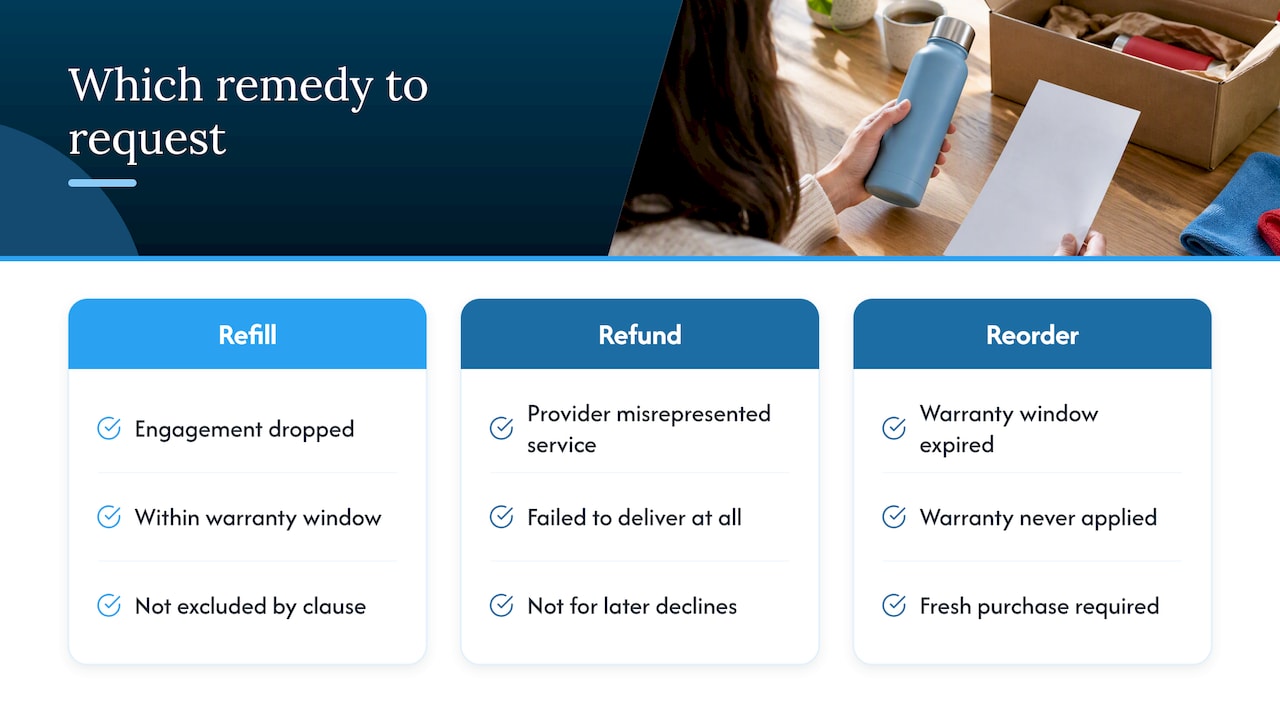
A refill is the standard remedy when delivered engagement drops within the warranty window and the drop isn’t excluded. A refund is reasonable when the provider misrepresented the service or failed to deliver at all, not simply when numbers later declined. A reorder (a fresh purchase) is the only route left once the warranty window has expired or never applied. Match your request to the actual clause in the terms rather than asking generically for “compensation”.
How to reduce drops and spot a guarantee with no real value
Buyers aren’t powerless here. Choosing moderate delivery pacing over instant, bulk drops reduces the chance of platform detection, and avoiding simultaneous use of other growth tools on the same account lowers your own policy risk under rules like Meta’s spam policy.
- Favour providers whose terms name a specific percentage threshold and timeframe rather than general language.
- Check that support replies with specifics, not templated reassurance, when you ask about exclusions.
- Track your counts weekly after delivery so you notice a drop while you’re still inside the warranty window.
- Treat a guarantee with no written threshold, no contact method and no mention of platform risk as effectively meaningless.
Pro Tip: A provider that openly explains how drip feed delivery reduces drops is usually more trustworthy than one that only advertises the word “guaranteed”.
Where Greedier Social Media fits into this
A certain social media service has supported a large number of customers since 2013, delivering followers, likes and views without requiring account passwords, alongside UK-based support. That combination matters directly against the risks above: password-free delivery removes a common cause of account-security disputes, and a support team that responds quickly shortens the gap between spotting a drop and getting it resolved. Readers checking any provider’s refill terms can use the same checklist here against Greedier Social Media’s own published terms before ordering.
The conventional advice gets the emphasis wrong
Most guides treat “guaranteed refill” as a feature to tick off, the same way shoppers treat a warranty sticker on a kettle. That misses the point. The warranty window length is the least informative number in the whole arrangement. A 90 day window with ambiguous exclusions protects you less than a 30 day window with a plainly stated threshold and a support team that answers in hours.
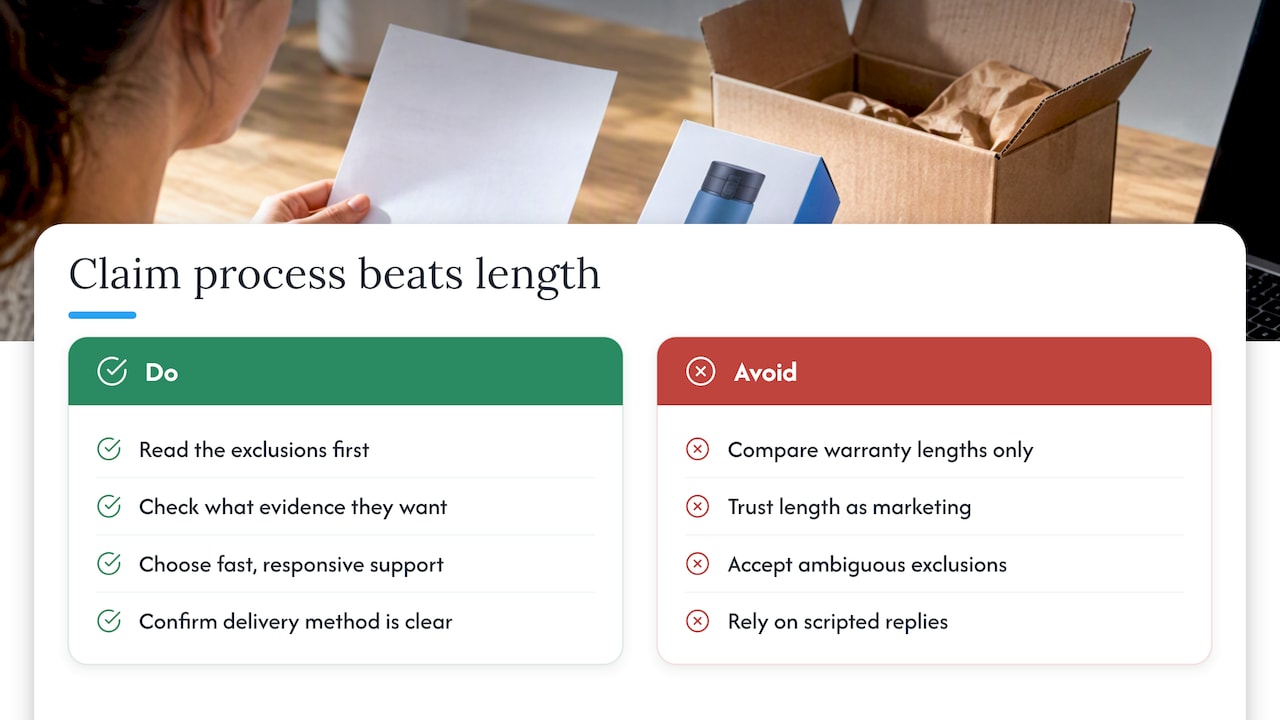
What the evidence here actually supports is this: the claim process predicts outcomes better than the promise itself. A provider that documents exactly what evidence it wants, replies to tickets without a script, and explains its delivery method openly will honour a short guarantee more reliably than a vague one will honour a long guarantee.
If you take one thing from this, prioritise reading the exclusions before you compare warranty lengths. The length is marketing. The exclusions are the contract.
— Irwin Lee
Get engagement with a refill policy you can actually check
Greedier Social Media sells real followers, likes and views across Instagram, Facebook, TikTok, YouTube and Threads, including auto-delivery plans for ongoing growth rather than one-off top-ups.
- Browse the Instagram product range for followers, likes and video views priced from £0.59.
- Check the Auto Instagram Followers plan if you want recurring delivery rather than a single order.
- Explore YouTube subscribers, likes and views or TikTok followers, likes and views for other platforms.
Every order ships without needing your password, and the UK-based support team handles replacement queries directly, so you can apply the same checklist from this article against the terms before you buy.
Sources
For platform rules behind the drops described above, see Meta’s spam policy and YouTube’s fake engagement policy. For a broader framework on vetting paid-engagement vendors, see this social advertising strategy guide.
FAQ
What is the meaning of 30 days refill?
A 30-day refill means the provider will replace any followers, likes or views that drop within 30 days of delivery, provided the drop isn’t covered by an exclusion. After that window closes, any further loss is no longer eligible for a free replacement.
What is meant by refill?
A refill is the act of topping up an order back to its originally delivered count after some of it has dropped off, rather than issuing money back or starting a new order. It’s the standard remedy named in most engagement providers’ guarantee terms.
Is it refill or refill?
Both spellings refer to the same action: replacing lost followers, likes or views to restore an order to its original count. There’s no meaningful difference in usage; the word is simply written as one unhyphenated term, “refill”.