
Your local business online presence explained: it is the sum of every digital spot where customers find, judge, and contact you: your website, your Google Business Profile and map listings, your social profiles, and your reviews. Get three things done today and you’ll already be ahead of most competitors on your high street.
- Claim and complete your Google Business Profile — takes about 20 minutes and puts you on Google Maps and Google Search instantly.
- Add clickable contact details to your website — a phone number and address that work on mobile, not buried in a footer.
- Ask one recent happy customer for a review — a single fresh review can lift your ranking in the local map pack.
These three moves matter because they hit visibility, trust, and contactability all at once. Nearly all consumers now use the internet to find local businesses before they call or walk in, so if you’re invisible online, you’re invisible full stop.
Local Business Online Presence Explained: Key Takeaways
Building a local business online presence works best when Google Business Profile, a mobile-friendly website, and genuine reviews are treated as the three non-negotiable foundations before any paid spend begins.
| Point | Details |
|---|---|
| Start with three quick wins | Claim your Google Business Profile, add contact details to your site, and request one review today. |
| Sequence, don’t scatter | Follow the eight-step checklist over 30 to 90 days rather than tackling every channel at once. |
| Fix NAP everywhere | Match your business name, address, and phone number across Google, Facebook, and directories. |
| Measure from day one | Track calls, cost per lead, and close rate using GA4, Search Console, and GBP insights. |
| Speed up trust signals | Greediersocialmedia adds real, password-free followers and engagement on Instagram and Facebook while your organic work builds. |
Table of Contents
- What counts as your online presence?
- Why does an online presence actually matter?
- Which channels should you build first?
- What’s the first eight steps to take, in order?
- How do you get the local SEO basics right?
- What should you measure, and which tools are free?
- What mistakes cost businesses the most?
- Should you use paid ads or focus on organic growth?
- How can Greediersocialmedia help you move faster?
- Sources
- FAQ
What counts as your online presence?
Your online presence splits into three types of touchpoint: owned, earned, and paid. Owned channels are the ones you fully control, like your website and email list. Earned channels are what other people say about you, like reviews and local mentions. Paid channels are the ones you buy visibility on, like local ads and sponsored posts.
In practice, for a local business, that means:
- Owned: your website, your email newsletter, your own social media posts.
- Earned: Google and Facebook reviews, customer photos and tags, local press mentions or backlinks.
- Paid: Google local ads, boosted Facebook or Instagram posts, sponsored listings.
The touchpoints customers actually bump into are specific: your Google Business Profile, Google Maps, Apple Maps, your Facebook page, your Instagram profile, your own website, and third-party review sites. These aren’t separate silos. A good website page becomes the source for a social post, and that same content often feeds the snippet Google shows on your map listing.
Why does an online presence actually matter?
A weak or missing presence costs you customers before you ever meet them. Someone searches “plumber near me,” can’t find your hours or a phone number that works, and calls the next name down the list instead.
The upside works the same way in reverse:
- More people discover you through local search and maps.
- Search visitors convert into calls and visits more readily than passers by, because they’ve already decided they need what you offer.
- Customers can reach you faster, which reduces missed enquiries.
- A visible, well-reviewed profile builds reputation before anyone speaks to you directly.
Experian’s guidance on this is blunt: local SEO and content that reflects what your customers actually care about are what convert searches into trust. And trust converts offline. A completed Google Business Profile with recent reviews doesn’t just look better. It turns into booked jobs, footfall, and repeat business, because it removes every reason a customer had to hesitate.
Which channels should you build first?
Not every channel deserves equal effort. Some produce local return almost immediately; others are worth doing properly but won’t move the needle in week one.
Priority tiers:
- Essential — Google Business Profile. This is the single highest-return asset most local businesses have, according to analysis from ClicksGeek, because completeness, photos, and review activity feed directly into map pack visibility.
- Essential — your website. Even a five-page site works if it loads fast on mobile, states what you do, and makes contacting you obvious.
- Essential — reviews. Genuine reviews on Google and Facebook build trust faster than almost anything else you can do for free.
- High priority — local SEO basics. NAP consistency (name, address, phone number matching everywhere) and a handful of local keywords on your site.
- High priority — core listings. Google Maps and Apple Maps, plus any directory relevant to your trade.
- Medium priority — social profiles. Instagram and Facebook, chosen by where your actual customers spend time, not by trend.
- Medium priority — email. A simple list for repeat customers and offers.
- Medium priority — paid local ads. Useful once the essentials are solid, not before.
For each, aim for “good enough, done properly” in your first working session rather than perfection. A Google Business Profile with hours, photos, and a category filled in beats a half-empty listing you’ll “finish later.” A website with one clear contact page beats five pages that never quite got written.
Priorities shift slightly by business type. A retailer benefits most from strong product photos and local stock information on Google Business Profile. A tradesperson benefits most from service-area settings and before/after photos. A professional services firm benefits most from clear credentials and case studies on the website itself, since trust is the entire sale. Whatever the trade, mobile optimisation isn’t optional: most local searches happen on a phone, so a site that’s slow or fiddly to navigate on mobile loses customers before they even see what you offer.

What’s the first eight steps to take, in order?
Follow this sequence over your first 30 to 90 days rather than trying everything in one weekend.
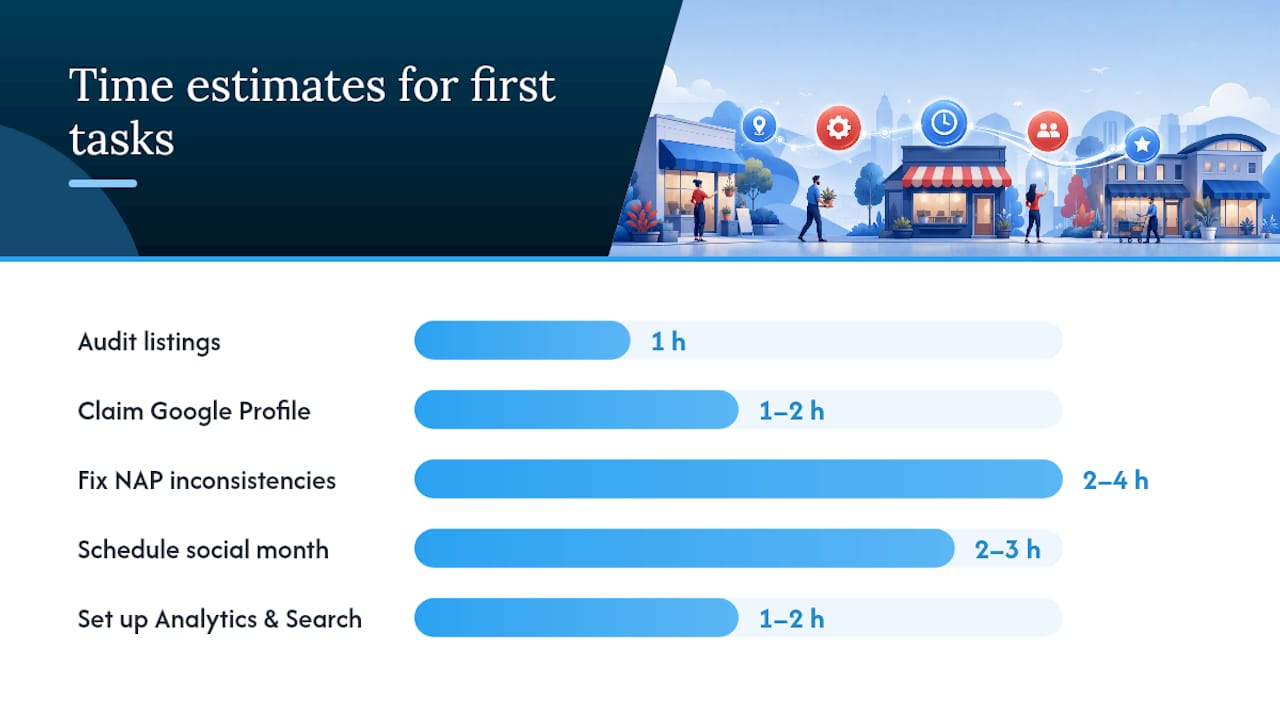
- Audit current listings (1 hour, easy). Search your business name and check what’s already out there, correct or not.
- Claim and complete your Google Business Profile (1 to 2 hours, easy). Add hours, photos, category, and services.
- Fix NAP inconsistencies (2 to 4 hours, medium). Match your name, address, and phone number across every listing you find.
- Add clear contact and conversion points to your website (half a day, medium). Click-to-call buttons, a contact form, visible address.
- Ask for reviews from recent customers (ongoing, easy). Send a direct link the moment a job finishes or a sale closes.
- Schedule a month of simple social content (2 to 3 hours, easy). Photos of real work, not stock images.
- Set up Google Analytics and Google Search Console (1 to 2 hours, medium). This is where measurement starts.
- Run one small paid test (a day to set up, medium). A modest local ad budget to see what converts.
After each step, check for an expected effect. Google Business Profile changes usually show in map pack impressions within a week or two. NAP fixes take longer to show, sometimes a month, because directories reindex slowly.
Pro Tip: Do steps 1 to 5 before you spend a single pound on ads. Paid traffic to a business with no reviews and a broken listing just wastes the budget.
How do you get the local SEO basics right?
Local SEO is mostly housekeeping, not mystery. Get these right and the map pack takes care of itself over time.
- Audit your NAP across Google, Facebook, and any trade directories, and correct every mismatch you find.
- Fill in every field Google Business Profile offers: service area, opening hours, attributes, and a proper business description.
- Write one page per service or location if you cover more than one area, using language your customers actually type into search.
- Ask a developer to add basic local business schema markup if your site doesn’t have it. It’s a small technical addition that helps search engines understand your address and hours.
Relevance, distance, and prominence are the three factors that decide who ranks locally, and on-page optimisation plus NAP consistency and local backlinks all feed prominence.
Pro Tip: Reply to every review, good or bad, within a couple of days. Recency and response rate both influence how Google and customers judge your listing.
What should you measure, and which tools are free?
Track three numbers from day one: bookings or calls by channel, cost per lead by channel, and your close rate. Everything else is noise until those three are under control.
- Google Analytics (GA4) tracks website visits and where they came from.
- Google Search Console shows which searches actually bring people to your site.
- Google Business Profile insights shows calls, direction requests, and website clicks from your listing.
- A simple call-tracking number on ads or your listing tells you which channel actually rang the phone.
Attaching a unique tracking code or number to every channel before spending more on any one of them stops you guessing where your budget is working.
What mistakes cost businesses the most?
A handful of errors show up constantly, and each has a quick fix.
- Incomplete Google Business Profile: fill every field, add photos weekly.
- Inconsistent NAP: audit and correct every listing you find.
- Slow mobile site: compress images and remove anything that isn’t loading fast.
- Ignoring reviews: reply to all of them, not just the positive ones.
- Broad ad targeting: narrow to your actual service area before spending more.
Pro Tip: Fix Google Business Profile completeness and review response first. Both take under an hour and produce the fastest visible change.
Never buy fake reviews or fake engagement to shortcut this. It damages trust the moment a customer notices, and platforms increasingly penalise accounts caught doing it.
Should you use paid ads or focus on organic growth?
Paid and organic solve different problems, and most local businesses need both eventually, just not on day one.
| Factor | Paid local ads | Organic (SEO, GBP, reviews) |
|---|---|---|
| Speed of results | Fast, often within days | Slower, builds over weeks to months |
| Cost pattern | Ongoing spend required | Mostly time, low ongoing cost |
| Best used for | Seasonal peaks, proving a new channel | Long-term visibility and trust |
| Measurement | Landing pages plus call tracking | GA4, Search Console, GBP insights |
Consider paid when demand is immediate, when a season is short, or when you want to test a new service before committing organic effort to it. Whichever you choose, keep geographic and keyword targeting tight and send traffic to a page built for that exact search, not your homepage.
Why this sequence works
Get the free foundations solid first: profile, listings, reviews. Only then does paid spend actually convert, because you’re sending clicks to a business that already looks trustworthy.
How can Greediersocialmedia help you move faster?
Building the organic foundations above takes weeks of consistent effort, and social proof is often the slowest part to build from scratch. Greediersocialmedia exists for exactly that gap: while you’re fixing your Google Business Profile and chasing reviews, real followers, likes, and views on Instagram and Facebook give new visitors a reason to trust you the moment they land on your profile, without you waiting months for organic growth to catch up.
Delivery is instant, UK-targeted, and never asks for your password, which is worth checking against any vendor you consider. Before you commit to any provider, ask three things: can they show evidence of results for businesses like yours, do they have a clear measurement plan, and how quickly is delivery actually completed? If you want a straightforward next step, look at the social media growth strategy built for small businesses and request a quote for the package that matches where you are right now.
Sources
- Online presence: build your digital footprint (Shopify)
- Business online presence (Experian)
- From zero to one million: the omnichannel marketing system for a local business (Frontend Horizon)
- Digital marketing strategy for local business (ClicksGeek)
- How to build an online presence for local business (TheStacc)
FAQ
What does “online presence” mean for a local business?
It means every place customers can find, read about, or contact your business online, including your website, Google Business Profile, social profiles, and reviews.
What is the 5-3-2 rule on social media?
It’s a posting mix guideline: for every ten posts, five share other people’s or industry content, three share your own original content, and two are personal or fun posts, used to keep a profile from feeling like constant self-promotion.
What is the 5-5-5 rule for social media?
Definitions vary by source, but a common version suggests spending five minutes engaging with others’ content, five minutes checking your own analytics, and five minutes planning content, as a simple daily habit rather than a strict content formula.
How long does it take to build a decent online presence?
The essentials, Google Business Profile, a basic website, and your first few reviews, can be in place within a couple of weeks; consistent local SEO and review growth then compound over several months.
Can buying followers or likes damage my local reputation?
Genuine, real engagement from services like Greediersocialmedia supports trust signals without risking your account, whereas fake or bot-generated engagement can get profiles penalised and should always be avoided.