
If your Instagram likes have suddenly fallen, the cause is almost always one of three things: fewer people are being shown your posts, your account has a recommendation restriction, or the content itself has stopped landing. You can tell which in about ten minutes by checking Account Status, then comparing follower and non-follower reach in Insights. Fix the cause you find, not the one the internet guesses at.
This guide walks through that check in order, explains what each result means, and sets out a two-week plan to recover. We also cover the question readers ask next: how many likes is “normal”, and when a post with only 20 likes is a problem and when it isn’t.
TL;DR
- Open Account Status first (Profile, menu, Settings, Account Status). If it is clear, the drop is most likely normal fluctuation or a content issue, not a penalty.
- In Insights, compare reach from followers and non-followers. A fall in non-followers only points to stopped recommendations; a fall in both points to posting habits, format or seasonality.
- Do not assume a “shadowban” and do not rebuild your whole strategy after one weak post. Compare like with like over the same time window and post type.
- Fix what is flagged, post consistently in your best-performing format, and give it two weeks before judging.
- Never pay anyone to “unban” an account, and be careful with anything that adds engagement without addressing the cause.
Table of Contents
- Why your Instagram likes suddenly drop
- The 10-minute diagnosis
- If Account Status shows a problem
- If Account Status is clear
- A two-week plan to recover your likes
- Why am I only getting 20 likes?
- Our perspective: what a like drop really tells you
- When extra engagement can help
- Mistakes that make a drop worse
- FAQ
- Sources
Why your Instagram likes suddenly drop
Likes are the last step in a chain. Instagram has to show your post to someone, that person has to stop on it, and then they have to care enough to tap. A drop can start at any of those links, which is why generic advice (“use more hashtags”) so often misses.
The three most common causes look like this:
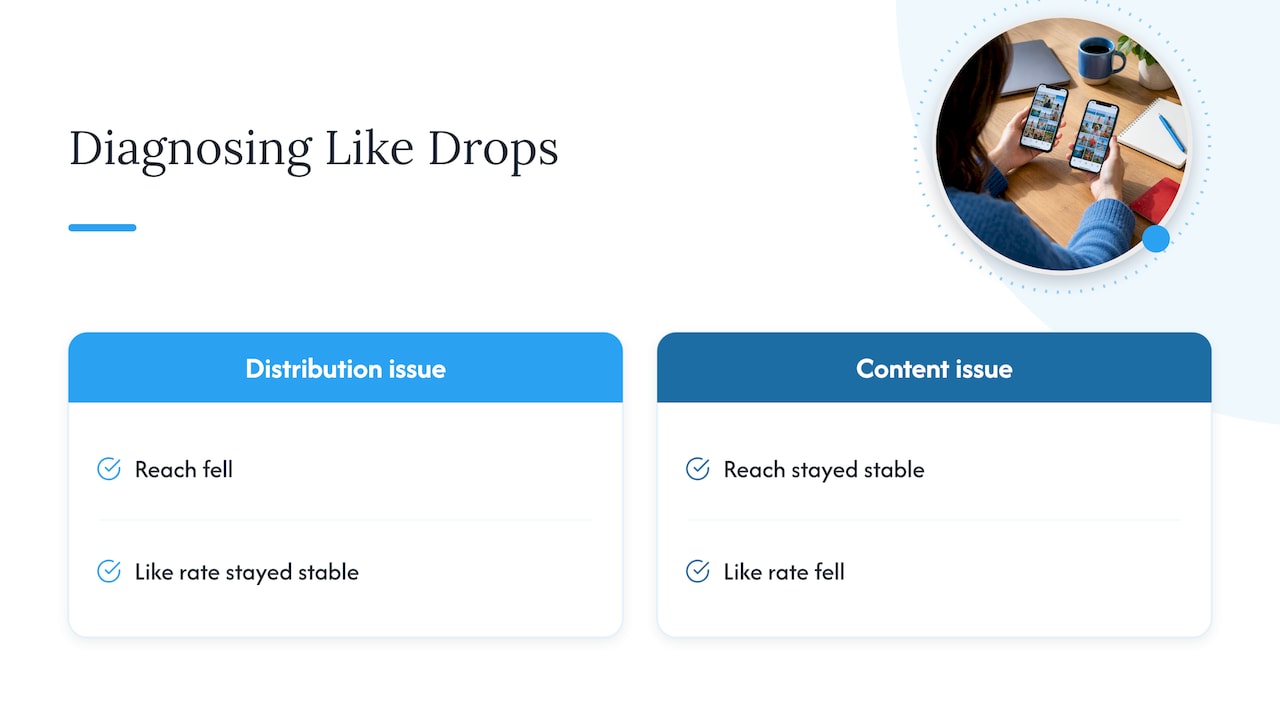
- Reach fell. Fewer people saw the post, so fewer liked it. Your like rate (likes divided by reach) may be unchanged.
- A recommendation limit applies. Instagram ranks what it shows to people who don’t follow you using relevance, interest and integrity filters, as its own explanation of Instagram Search ranking sets out. If your content or account fails those filters, your followers can still see posts but strangers are shown them far less.
- The content changed. A new format, a gap in posting, a topic your audience doesn’t care about, or a seasonal lull. Reach is fine, but the like rate fell.
Notice what is not on the list: a mystery penalty that nobody can see. Instagram does not use the word “shadowban” itself, and one analyst’s warning against assuming a shadowban without stronger evidence is worth taking seriously. A single weak result is not a pattern.
The 10-minute diagnosis
Work through these steps in order. Stop when you find something.
Step 1: Check Account Status
On the mobile app, open your profile, tap the menu, go to Settings, then Account, then Account Status. Account Status can show removed content, features you are blocked from using and, for business and creator accounts, whether your account can be recommended to people who don’t follow it.
If Instagram has found a recommendation problem, the screen may point to sample posts or profile elements that conflict with its Recommendations Guidelines. You can edit or delete the item and, where an appeal is offered, ask for another review.
Two cautions. First, Account Status is not perfect: The Markup found that some restrictions and removed content did not appear there, and suggests checking Help, then Support Requests, then Violations if removed content is missing. Second, if you use a personal account, you will see less detail than on a professional one. Switching to a professional account is free and unlocks Insights too.
Step 2: Split reach into followers and non-followers
In Insights, reach is broken down by followed and non-followed accounts, a split Brandwatch describes. Use reach rather than impressions for diagnosis: reach counts unique viewers, so repeat views don’t muddy the picture.
Then read the pattern:
| What you see | Most likely meaning | Next move |
|---|---|---|
| Non-follower reach down, follower reach steady | Recommendations may have stopped | Recheck Account Status, review recent posts |
| Both follower and non-follower reach down | Fewer posts, weaker format or seasonality | Review posting rhythm and format mix |
| Reach steady, likes down | Content isn’t resonating | Test hooks, topics and formats |
| Everything down after a long break | Audience cooled off | Post consistently for two weeks |
The reading of this table follows the logic in this agency’s breakdown: drops in non-follower views can indicate stopped recommendations, while drops in both groups often point to fewer posts, a weaker format or seasonality.
Step 3: Compare like with like
This is where most people go wrong. A Reel from last month and a carousel from this week are not comparable. Use consistent time windows and post types, and look at follower and non-follower reach separately, to tell a technical restriction from a normal dip.
A practical way to do it: pick your last five posts of one format and the five before them. Write down reach and likes for each. If the like rate (likes divided by reach) is roughly stable but reach fell, your problem is distribution. If reach is stable and the rate fell, the problem is content.
Step 4: Be wary of shadowban tests
There is no foolproof test. HubSpot notes that tools advertising shadowban tests are not reliable, and that a sudden, sustained drop in engagement, especially in non-follower reach, may suggest one. “Sudden” and “sustained” are the key words: one quiet Tuesday doesn’t count.
If Account Status shows a problem
Recommendation limits usually come from content that breaks Instagram’s Recommendations Guidelines. These set quality rules for what is shown to non-followers, and one practitioner guide lists engagement bait and unoriginal reposts among common limiters.
Here is what to do:
- Open the flagged post or profile component.
- Decide honestly whether it fits: reposted memes with a watermark, “like if you agree” captions and recycled clips are typical culprits.
- Edit or delete it. If you think the decision is wrong, use the option to disagree and request another review.
- Post original content for the next couple of weeks and check Account Status again.
Some content is limited by design. For example, Meta announced that political content from accounts not eligible for recommendation would still reach existing followers through Feed and Stories, but wouldn’t be proactively recommended to others. If you post on those topics, expect smaller reach beyond your own audience.
Recommendation eligibility also affects how your wider content system should work. If you run a brand account, it is worth thinking about social content production as a process rather than a string of one-off posts, so every piece is built to be original and recommendable from the start.
If Account Status is clear
This is the more common outcome, and good news: nothing is wrong with your account. Your task is to work out what changed in the content or the rhythm.
Posting rhythm
Gaps matter. If you posted daily for a month, then twice in three weeks, a fall in reach and likes is normal. Pick a rhythm you can keep, even three solid posts a week, and hold it.
Format mix
Check which format used to carry your numbers. Many accounts find that Reels bring reach from non-followers while carousels and photos earn likes from followers. If you swapped one for the other, the drop may just be that. Our guide on Reels views versus likes shows how to read the two numbers together before deciding what to change.
Audience quality
A follower base padded with inactive or mismatched accounts will always like less than its size suggests. That is why the follower-to-engagement ratio matters more than the follower count. We cover typical ranges and how to improve them in our follower to engagement ratio benchmarks article.
Seasonality and life
Summer holidays, bank holiday weekends and the run-up to Christmas all change when UK audiences scroll and what they respond to. A dip that lines up with a calendar event often fixes itself.
A two-week plan to recover your likes
Don’t change everything at once, or you will never know what worked. This plan changes one variable at a time.
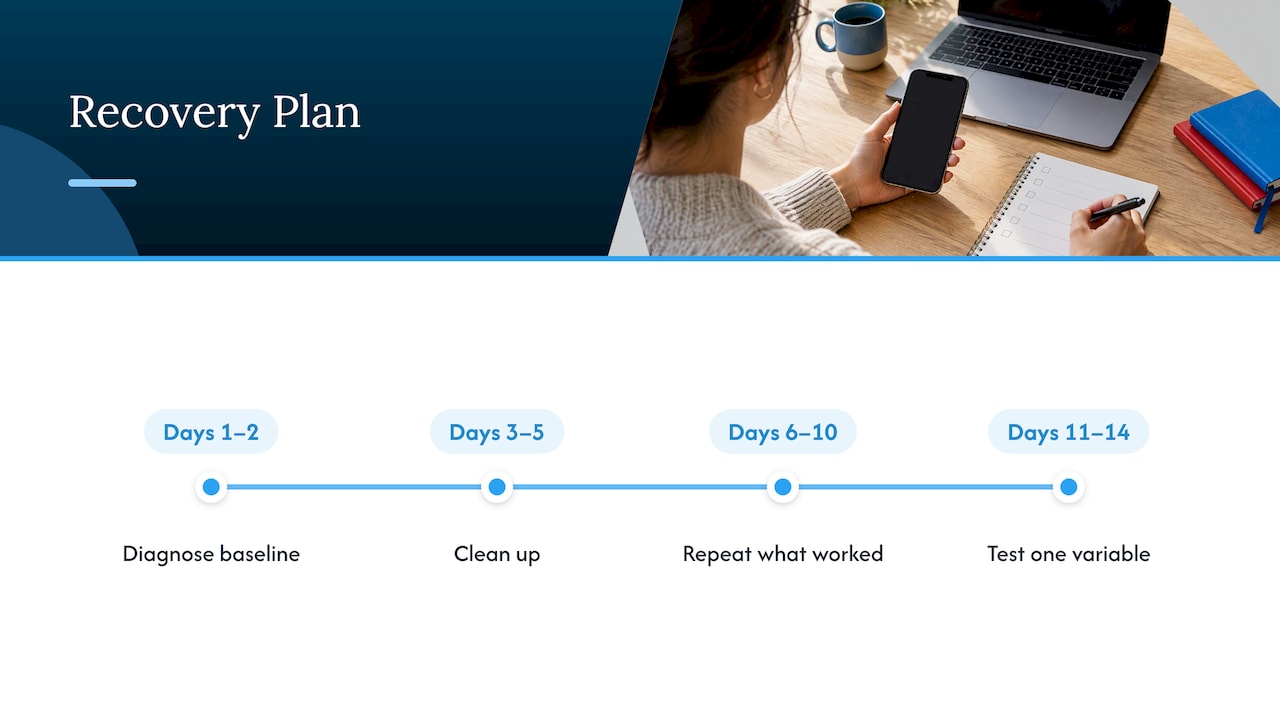
Days 1 to 2: diagnose. Complete the 10-minute check above and note your baseline: average reach and likes on your last five posts.
Days 3 to 5: clean up. Remove or edit anything flagged. Archive posts that are off-brand or low quality. Check that your bio, profile photo and recent content still tell a clear story about who you are.
Days 6 to 10: repeat what worked. Go back to your best-performing post types. Post at least every other day, in the format that historically earned your best like rate. Write a hook in the first line and ask a question that people can answer without being begged to like.
Days 11 to 14: test one thing. Change one variable, such as posting time, caption length or cover image, and compare against the baseline.
Compare numbers at day 14, not day 3. Recovery timing varies by cause, and no reliable published figure promises a fixed number of days, so judge by trend: is reach by non-followers climbing, and is the like rate steady or rising?
For a deeper look at building the habit of recovery, our 30-day follower recovery plan uses the same principles, with a focus on saves. You can also read our guide to increasing Instagram likes organically for content ideas that earn likes without gimmicks.
Why am I only getting 20 likes?
A number like 20 means nothing without context. Ask three questions:
- How many people saw it? Twenty likes on 200 reach is a 10% like rate, which is healthy. Twenty likes on 5,000 reach is a content problem.
- Who saw it? If most reach was from followers and your following is small, 20 may be most of your audience.
- Is the like count visible? Instagram lets people hide like counts on their own posts, and some viewers hide them in their feed, so what you see may not be what others see. Our piece on Instagram getting rid of the likes count explains how that affects your reading of the numbers.
If your account is small, the realistic aim is to grow reach among non-followers first. Likes follow reach, not the other way round.
Our perspective: what a like drop really tells you
We have worked with UK creators and small businesses on social growth since 2013, and the same mistake comes up again and again: treating a likes drop as a verdict. It is a symptom. The people who recover fastest are the ones who diagnose before they act, and who keep the changes small enough to measure.
We also hold a clear view on paid engagement. Likes and views can help a post look established when it first goes live, and they can give a new account some social proof. But they cannot repair a recommendation limit, and they cannot replace content people want to react to. If Account Status shows a problem, fix that first. If you buy anything, buy it to support content that is already working, not to cover for content that isn’t. Our article on whether paid likes affect reach lays out what to expect, and our note on shadowban risks when buying followers is honest about where the risks lie.
— Irwin Lee
When extra engagement can help
Once the cause is fixed and your content is solid, a modest boost can help a good post get noticed. We offer UK-targeted Instagram likes from £0.99 up to £189.95 as one-off packages, delivered without needing your password, plus auto likes from £9.99 per month for accounts that post often. Instagram video views start at £0.59 and go up to £54.99.
Start small, on a post that already has a strong hook, and check the effect on your reach before spending more. You can see the options on our Instagram services page.
If you are unsure whether you need likes, followers or views, our comparison of followers versus likes helps you match the product to the problem.
Mistakes that make a drop worse
- Deleting lots of posts in a panic. Remove only what is flagged or clearly off-brand.
- Posting several times a day to “reset” the algorithm. Quantity without originality can hurt more than a quiet week.
- Paying for an unban. Nobody outside Instagram can lift a restriction. Use Account Status and the appeal route instead.
- Switching niche overnight. Your audience followed you for something specific.
- Judging by one post. Compare averages over several posts of the same type.
FAQ
Why are my Instagram likes suddenly dropping?
Usually because fewer people are seeing your posts, your content isn’t resonating, or a recommendation limit applies. Check Account Status, then compare follower and non-follower reach in Insights. The pattern tells you which of the three it is.
How do I check whether my account can be recommended?
Open your profile, tap the menu, go to Settings, then Account, then Account Status. On professional accounts it shows whether your content may be recommended to people who don’t follow you, and flags posts or profile elements that conflict with the guidelines.
How long do likes take to recover?
There is no reliable fixed timeline, because it depends on the cause. A seasonal or rhythm dip often turns within a couple of weeks of consistent posting. If you have fixed a flagged item, watch non-follower reach over the following weeks rather than checking daily.
Is it a shadowban if my likes halve overnight?
Not necessarily. There is no foolproof shadowban test, and a one-off drop is often a weak post, a format change or a quiet period. A sudden and sustained fall in non-follower reach is the stronger signal, and Account Status is the place to confirm it.
Sources
- Instagram Search ranking explained (Meta Transparency Centre)
- What to do if you think you’ve been shadowbanned on Instagram (The Markup)
- Instagram’s new transparency tools (TechCrunch)
- Instagram and Threads will no longer proactively recommend political content (TechCrunch)
- Instagram Analytics Explained: 5 Key Metrics (Brandwatch)
- Instagram Reach Dropped Suddenly? Restriction or Normal Dip
- Instagram Shadowban Is Real: How to Test for and Prevent It (HubSpot)
- How to investigate a social media reach drop (Worthe)
- Account Status and Recommendation Guidelines (UGC Content)