

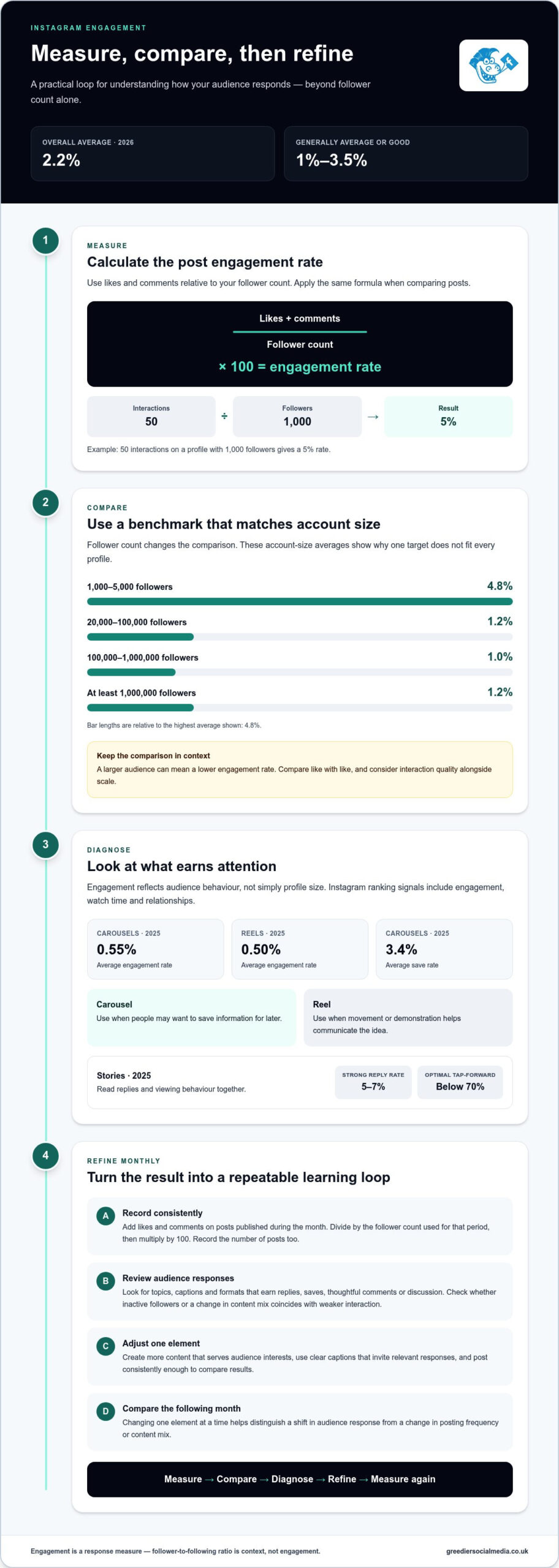
A high follower count doesn’t automatically mean strong engagement. The follower-to-engagement ratio on Instagram is best assessed through engagement rate: add a post’s likes and comments, divide by the follower count, then multiply by 100. A rate between 1% and 3.5% is generally average or good, with 2.2% the overall average for 2026.
It’s understandable to look for one benchmark to show whether an account is performing well. But the right comparison depends on your account’s size and type, and the follower-to-following ratio measures something different from engagement.
This guide explains how to calculate engagement, compare results with benchmarks for different account types, and understand what shapes interactions. You’ll also find practical ways to improve engagement by giving people a reason to watch, respond and return.
Key Takeaways
- Compare your follower-to-following ratio with accounts of a similar size and type; treat it as context, not a measure of engagement.
- Assess likes and comments alongside your follower count, then use the result to spot changes in how audiences respond.
- Focus on content that earns attention and interaction, since watch time and relationships influence what people engage with.
- Use reach-based and follower-based engagement measures for different insights: one reflects who saw a post, the other compares interactions with your audience size.
Ratio benchmarks for personal accounts, creators and businesses
Your follower-to-following ratio compares followers with accounts you follow. Treat it as context, not a standalone measure of account quality.
Suggested Ratios by Account Size and Stage
A benchmark is a comparison between your follower count and following count, interpreted against your account’s size and purpose. A new account can sit near 1:1, while a growing business might aim for 1.5:1 to 3:1. Established business accounts often sit between 2:1 and 10:1. For accounts below 1,000 followers, 3:1 or higher is considered excellent; from 1,000 to 10,000, the guide’s excellent benchmark is 10:1 or higher. Community accounts may reasonably aim lower.
Engagement Rates for Micro and Macro Influencers
Engagement rate measures audience interactions relative to followers, making it useful for comparing creators of different sizes. In 2025, Instagram micro-influencers with 10,000-50,000 followers averaged 3.12%, compared with 2.37% for macro-influencers with 100,000-500,000 followers. A larger audience can mean a lower rate, so brands should consider interaction quality alongside scale.
To spot potentially fake followers or inflated engagement, look for mismatches: a large audience but consistently sparse, generic or unrelated comments. Compare several posts, not one unusually popular result. A 50,000-follower account following 40,000 accounts may also look like it grew through follow-for-follow activity, rather than attracting an audience organically.
Prune your following list gradually. Prioritise accounts that have been inactive for at least six months, especially those that haven’t posted for a year. Unfollow in small batches over a week or two rather than making a sudden sweep. This keeps your list relevant without treating every account you follow as a problem.
Brands and visitors may read a high ratio as a sign that an audience chooses to follow the account. A 50,000-follower profile following 200 accounts can create that impression; the ratio alone doesn’t prove trust or influence. Instagram’s ranking signals focus on engagement, watch time and relationships, not the follower-to-following ratio.
An engaged audience gives creators and businesses more opportunities to build relationships through meaningful interactions. Keep your content consistent and relevant, then assess whether comments and likes show genuine interest. A healthy ratio can support a strong first impression, but ongoing audience response is a more useful sign of connection.
How does one increase the Instagram engagement rate for their account?
Start by measuring engagement consistently, then adjust content based on how your audience responds. Instagram’s overall average engagement rate is 2.2% for 2026. A rate between 1% and 3.5% is generally considered average or good, but account size changes the comparison. The Instagram follower-to-engagement ratio can help you assess interaction alongside audience size.
For an individual post, add its likes and comments, divide by your follower count, then multiply by 100. For example, 50 interactions on a profile with 1,000 followers gives a 5% rate. Use the same formula across posts so the metric remains comparable. The follower-to-engagement ratio on Instagram is a useful way to frame that comparison, but it doesn’t explain which content prompted the response.
Account size shapes benchmarks. Instagram accounts with 1,000 to 5,000 followers average 4.8%, while accounts with 20,000 to 100,000 followers average 1.2%. Accounts with 100,000 to 1,000,000 followers average 1.0%; accounts with at least 1,000,000 average 1.2%. Compare like with like, rather than treating one average as a target for every profile.
How to track a monthly engagement rate
Choose a consistent monthly method. Add the likes and comments on posts published during the month, then divide by the follower count used for that period and multiply by 100. If you compare monthly totals, record the number of posts too. This helps distinguish a change in audience response from a change in posting frequency.
To improve engagement, review which topics earn replies, saves or discussion, then create more content that serves those interests. Use clear captions that invite relevant responses, and post consistently enough to compare results. Check whether inactive followers or a change in content mix coincides with weaker interaction. Change one element at a time, then compare the results the following month.
If you want to consider post-level interaction as part of a wider growth approach, explore Instagram Likes.
Factors that influence social media engagement
Instagram engagement reflects audience behaviour, not simply profile size. Ranking signals include engagement, watch time and relationships. Someone might watch a Reel, reply to Stories or regularly interact with an account. These actions show different forms of attention. Compare similar posts and formats to see which responses your audience gives most often.
Format can shape the interactions a post receives. In 2025, carousels had an average engagement rate of 0.55%, while Reels averaged 0.50%. Carousels also recorded an average save rate of 3.4%. Use a carousel when people may want to save information for later. Use a Reel when movement or demonstration helps communicate the idea.
Stories offer another way to build direct audience relationships. A reply rate of 5-7% indicated strong engagement in 2025. A tap-forward rate below 70% was considered optimal. Review replies and viewing behaviour together: replies can signal interest, whilst quick taps can show viewers are moving on. Use questions or useful updates to encourage a meaningful action.
Content relevance matters because people respond to posts that match their interests. Compare topics, captions and formats across your recent posts, then identify what prompts thoughtful comments or shares. For example, a local café could test a menu carousel against a behind-the-scenes Reel. Keep the subject clear, and make each caption’s invitation specific rather than asking for generic engagement.
Relationships also influence how audiences respond. Creators can encourage conversation by replying to comments and acknowledging useful contributions from their audience. Partners can introduce complementary perspectives, giving followers a reason to join the discussion. Keep collaborations relevant to both audiences; an unrelated mention may attract attention without creating lasting interest. Measure responses alongside watch time, saves and replies instead of judging performance by likes alone.
Overall Instagram engagement rates fell by 28% year over year as of 2025. That makes comparisons most useful when they account for format, audience and purpose. Review your own posts consistently, note which interactions each format encourages, and adapt future content to those patterns.
Instagram engagement rate per follower vs reach
Follower-based and reach-based engagement rates answer different questions. The follower-based measure compares interactions with your account’s follower count. The reach-based measure compares interactions with the people who saw a post. The first helps assess audience response across your profile; the second shows how viewers who encountered a particular post reacted.
Use the follower denominator to compare posts with your wider audience, especially when reviewing account performance over time. Reach is more useful for assessing an individual post’s response among viewers. A post can reach people beyond your followers, so the rates may differ. Neither measure alone explains why a post performed as it did.
Keep the denominator consistent when comparing results. For follower-based analysis, use the follower count associated with the post or reporting period. For reach-based analysis, use the post’s reach, not the profile’s follower total. Compare posts in similar formats and note meaningful differences in topic, timing and audience.
Impressions can add another layer, but they aren’t interchangeable with reach. An impression counts a view, while reach counts accounts reached. In 2025, accounts with 1,000-5,000 followers averaged 590 impressions per Reel. Accounts with 5,000-10,000 averaged 1,078, and those with 10,000-50,000 averaged 2,424. Treat these as impressions benchmarks, not engagement rates.
For a practical review, record each post’s interactions, follower count and reach together. Then compare its follower-based rate with its reach-based rate. Stronger reach-based engagement can suggest that a post resonated with viewers beyond your existing audience. A stronger follower-based result can show that current followers responded well, even if distribution was narrower.
If increasing Reel exposure is part of your wider measurement plan, explore Instagram Reel Views.
Greedier Social Media: Instagram Followers
Greedier Social Media offers Instagram Followers and Instagram Likes for people looking to grow their profile’s visible audience and post interactions. These options may suit accounts seeking support with presentation, alongside relevant content and consistent audience engagement.
For a more ongoing approach, Auto Instagram Followers and Auto Instagram Likes are also available. Keep your measures clear: follower numbers and likes are separate from meaningful replies, saves and watch time. Treat them as distinct metrics when reviewing account performance, not substitutes for content that connects with your audience.
Consider these options when they fit your account goals and wider growth approach. To discuss Instagram Followers or Instagram Likes, contact Greedier Social Media.
Turn your Instagram metrics into your next move
Choose one audience action to focus on next, such as starting a conversation, saving a useful post or viewing more of your content. Make that intention clear in your next posts, then assess whether the response supports your goal. This gives the follower-to-engagement ratio on Instagram a practical role: it becomes one part of your decision-making, not the only measure of progress.
If you want to grow your profile’s visible audience or post interactions, Greedier Social Media offers Instagram Followers, Instagram Likes and Auto Instagram Followers. These options can complement the content and audience approach you’re building as you continue to assess performance using the measures that matter to your account.
Take the next step at a pace that suits your plans. Contact Greedier Social Media to discuss your Instagram goals, and keep moving towards a clearer, more considered growth approach.
Frequently Asked Questions
How do I calculate my Instagram follower ratio?
Divide your follower count by the number of accounts you follow to calculate your follower-to-following ratio. For example, 5,000 followers divided by 4,000 accounts followed gives a 1.25:1 ratio. Use the same order each time: followers first, following second. This figure describes the balance between those counts, not how actively followers interact with your posts.
Should I unfollow people to improve my ratio?
Unfollowing accounts can change the ratio mathematically, but it doesn’t create more audience engagement by itself. Review your following list for inactive accounts or profiles unrelated to your interests, and make changes gradually. Instagram’s published ranking signals don’t include this ratio. Avoid mass-following for follow-backs and then unfollowing, as Instagram’s policies consider that behaviour spam.
What’s a good ratio in 2026?
A useful ratio depends on account purpose and growth stage, so there isn’t one target for every profile. A new account can have roughly equal follower and following counts. A growing business might aim for 1.5:1 to 3:1, whilst an established business can sit between 2:1 and 10:1. Treat these as comparison points, not a measure of engagement quality.
How do I calculate Instagram engagement rate by followers?
Add the likes and comments on an individual post, divide that total by your follower count, then multiply by 100. For instance, 40 likes and 10 comments on a post are 50 interactions; divide 50 by the account’s follower count before converting to a percentage. Apply the same interaction types and calculation to each post you compare.
What is a good Instagram follower-to-engagement ratio in 2026?
There’s no single standard called a follower-to-engagement ratio, because follower balance and engagement rate are different measures. For engagement, the stated overall average for 2026 is 2.2%; a rate above that is considered good against this benchmark. Compare similar account sizes and post formats too. A strong result for one profile may not represent the same performance elsewhere.
What is the average Instagram engagement rate by follower count?
Average rates vary by audience size. Instagram accounts with 1,000-5,000 followers average 4.8%; those with 20,000-100,000 average 1.2%. Accounts with 100,000-1,000,000 followers average 1.0%, whilst accounts with at least 1,000,000 average 1.2%. Use these figures as broad comparisons, then assess your own posts using a consistent calculation method.