
Instagram does not publish a daily like limit. The figures you see quoted, from 300 to 1,000 likes a day, are community estimates, not Meta rules. What Meta does document is that it restricts activity that looks automated, spammy or inauthentic, and that is a different thing from a counter you can stay under.
That gap explains why every guide gives a different number, and why some people are blocked after a few dozen likes while others scroll for hours without trouble. This article sets out what is known, what is folklore, what to do if you see a “Try again later” message, and what it means for a UK business that cares about its reputation on the platform.
TL;DR
- There is no official daily like limit. Meta describes behaviour-based enforcement, not a fixed quota.
- Commonly quoted numbers (around 20 to 60 likes an hour, 300 to 1,000 a day) are third-party estimates and vary wildly between sources.
- Staying under a number does not make activity safe: Meta says it can restrict accounts at lower frequencies when other spam signals are present.
- If you are blocked, stop, avoid automation tools and wait. Most blocks are reported to lift within a day or two.
- Meta’s UK policy does not allow buying, selling or exchanging engagement, so weigh that before paying for likes.
Table of Contents
- Is there an official Instagram like limit?
- The numbers people quote, and why they disagree
- Why staying under a number is not a safety guarantee
- What to do if Instagram blocks your likes
- Likes are not the only limit
- Perspective: what we tell small businesses about likes
- What the policy means for UK businesses
- Safe habits for everyday liking
- Getting more likes on your own posts
- Where our Instagram services fit
- FAQ
- Sources
Is there an official Instagram like limit?
No. Meta’s Community Standards on spam do not set a number of likes per day. They describe content and behaviour designed to deceive, mislead or overwhelm people in order to artificially increase viewership, and they say this detracts from authentic engagement.
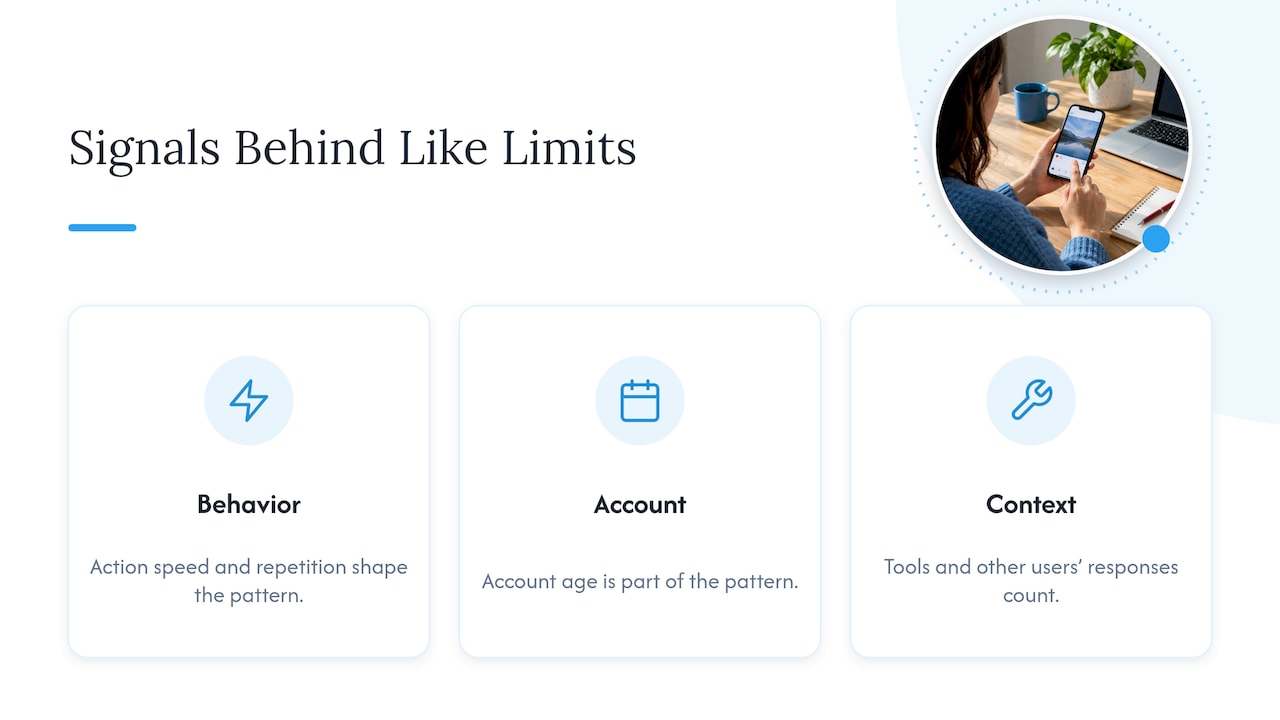
So the system works on signals. Think of it less as a turnstile that clicks shut at likes number 1,001 and more as a fraud check that looks at the whole pattern: how fast you act, how repetitive the actions are, how old the account is, whether tools are involved, and how other users respond to you.
One independent write-up on the subject makes the same distinction: Instagram has two kinds of limits, and only one of them is written down. Media and publishing limits, such as caption length or Reels duration, are documented. Action limits, such as likes per hour, are not.
The numbers people quote, and why they disagree
Search for this topic and you will find a spread of figures. Here is how the main ones compare.
| Claim | Where it appears | How to treat it |
|---|---|---|
| Up to 1,000 likes a day, some accounts blocked from 700 | Taplink’s limits guide, published in 2020 | Dated, labelled an average |
| Up to 1,000 likes a day | Metricool’s 2026 limits article | Third-party estimate |
| No official limit; a commonly recommended range of about 20 an hour and 300 to 500 a day | Tagembed’s 2026 restrictions guide | Explicitly unofficial |
| 100 a day for new accounts, 300 to 500 for established ones | Frequently repeated, no Meta source | Community observation |
The pattern is clear. The higher figure (1,000) is described as a ceiling that some accounts never reach, while the lower figures (300 to 500) are described as a safe working range. None comes from Meta. If you need a planning number, treat the lower range as a cautious habit, not as a guarantee, and read on to see why even that can mislead.
Why staying under a number is not a safety guarantee
Meta’s spam policy says restrictions may apply even at lower frequencies when other spam or inauthenticity indicators are present, such as repetitive content. That is the line most guides skip.
In practice it means two accounts can each like 200 posts in a day and get different outcomes:
- Account A is two years old, likes posts from accounts it already follows, spreads activity through the day and also comments, posts and watches Reels.
- Account B is three days old, likes 200 posts under the same hashtag in 20 minutes, using an app that logs in on its behalf.
The first looks like a person. The second looks like a script. A fixed number cannot tell them apart, which is why Meta does not rely on one.
What tends to raise the risk
Third-party troubleshooting guides, such as this action-blocked walkthrough, list the same triggers again and again. They are reports, not Meta policy, but they match the logic of the spam rules:
- Bursts of identical actions in a short window, for example fifty likes in a few minutes.
- A new or recently reactivated account suddenly doing a lot.
- Third-party apps or bots that automate liking, following or commenting.
- Repeating the same comment or message across many accounts.
- Logging in from several devices or locations in a short time.
What to do if Instagram blocks your likes
You usually see a message saying that an action was blocked or to try again later. Meta does not publish a countdown, but the sensible response follows from how its policy works.
- Stop trying. Repeated attempts while blocked look like more of the same behaviour.
- Switch off anything automated. Disconnect third-party apps, schedulers that like on your behalf and auto-engagement tools. Change your password if you gave it to any of them.
- Review recent activity. Ask whether you did a burst of likes, follows or identical comments in the hours before the block.
- Use the app normally. Browse, watch, post, reply to people who comment. Ordinary use rebuilds a normal pattern.
- Wait. Troubleshooting guides report that most action blocks lift on their own within 24 to 48 hours. That is an observation, not a promise, and repeated blocks can last longer.
- Come back slowly. Resume at a clearly lower pace than before and spread it across the day.
If the block does not lift after several days, or you lose access to the account, use the in-app help and report-a-problem route rather than creating new accounts, which tends to look worse.
Likes are not the only limit
People searching for the like limit often mean the broader set of action caps. The best-known one you can verify is the following cap: Instagram does not allow anyone to follow more than 7,500 accounts, which Taplink notes as a total, not a daily figure. Hourly and daily follow, comment and DM numbers are again community estimates.
A few related questions come up constantly:
- The 3-2-1 and 4-1-1 rules. These are content-planning heuristics from marketers, not like quotas and not Meta rules. Do not use them to work out how many posts you may like.
- Setting your own daily limit. That is a wellbeing feature in the app’s time-management settings, separate from like limits.
- Hiding like counts. You can hide like and share counts on your posts and reels from the privacy settings. It changes what people see, not what you are allowed to do.
Perspective: what we tell small businesses about likes
We have supplied engagement packages to UK clients since 2013, and the question we hear most is how much is too much. Our honest answer starts with the account’s behaviour, not a number.
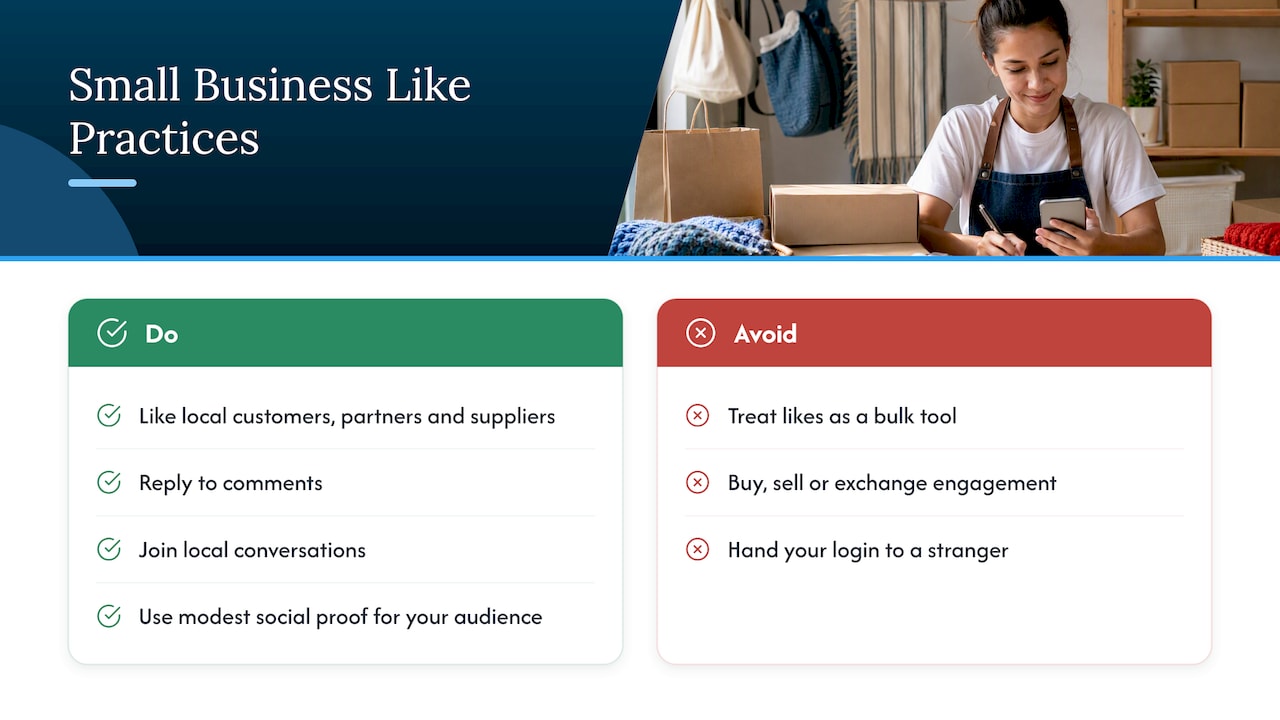
A business account that likes a hundred posts from local customers, partners and suppliers over a day is doing something useful: it is being visible in its own community. A business that treats the like button as a bulk tool is working against the platform’s own detection, however neat the arithmetic looks.
The same applies to paid engagement. Meta’s UK policy says it does not allow buying, selling or exchanging engagement, and we think customers should read that wording before they order from anyone, including us. Our services are built around real-looking, UK-targeted delivery with no password required, which removes one common risk, handing your login to a stranger. It does not remove the policy question, and we would rather you made the decision knowing that.
What we have seen work for small businesses is a mix: genuine customer content, replies to comments, local conversations, and if you do decide to add visible social proof, a modest amount that fits the size of your audience. A post with 4,000 likes on an account with 90 followers convinces nobody.
— Irwin Lee
What the policy means for UK businesses
The daily-limit question hides the more important one. Meta’s UK Community Standards state that it does not allow attempting to buy, sell or exchange engagement, including likes, shares, views, follows and clicks. The same policy covers like and share gating and artificial viewership.
That has three practical consequences for a business:
- Pacing does not neutralise the policy. You can stay far below any rumoured number and still be on the wrong side of the rule if activity is judged inauthentic.
- The risk is to credibility as well as to the account. The point of social proof is trust. Visible engagement that customers or the platform see as manufactured can erode exactly that.
- Safer routes exist. Genuine comments, customer photos, creator collaborations, local partnerships and Meta’s own advertising tools do not carry the same policy exposure. Our guide to increasing post visibility without paid ads covers the organic side in detail.
If you want to understand the trade-offs before deciding, we have written about when buying Facebook likes can mislead customers and about what happens when you buy Instagram followers.
Safe habits for everyday liking
These habits fit how the platform’s rules work, whatever the real thresholds turn out to be.
For personal and brand accounts
- Like posts because you have read them, not to reach a count.
- Spread activity across the day instead of clearing it in one session.
- Mix actions: comment, save, share to Stories, reply to DMs.
- Avoid following and unfollowing in bulk on the same day as heavy liking.
- Keep to the official app, and do not give your password to tools.
For newer accounts
New accounts tend to be treated more cautiously, according to the troubleshooting guides above. Build up over the first weeks: post, follow people you know, and increase activity gradually. Our small business Instagram presence guide walks through a sensible setup.
For social media managers
If you manage several client accounts from one device or network, keep logins tidy and avoid mass actions across accounts at the same moment. Scheduling posts through approved tools is different from automating likes, and the latter is the pattern spam systems look for.
Getting more likes on your own posts
Most businesses worry about the like limit when the real goal is receiving more likes. That is a content problem first. A few things that consistently help:
- Post when your actual customers are online, and check Insights for your own pattern.
- Lead with a clear image or the first second of a Reel, since that decides whether people stop.
- Ask a specific question in the caption, so likes turn into comments.
- Reply to every comment quickly, which keeps the conversation moving.
- Feature customers and local places, which gives people a reason to engage and share.
We have detailed walk-throughs on how to generate more likes on Instagram and increasing your Instagram likes organically.
Where our Instagram services fit
Some businesses and creators want an initial layer of visible engagement alongside organic work, for instance on a launch post that would otherwise look empty. For those readers, we offer Instagram likes from £0.99 up to £189.95 as a one-off purchase, with UK-targeted delivery and no password needed. You can see the options on our Instagram services page or read the details on our Instagram likes page.
Because of what Meta’s policy says, we would suggest starting small, keeping it in proportion to your real audience, and treating it as a supplement to genuine engagement, not a replacement for it.
FAQ
What is the limit of likes on Instagram per day?
Meta has not published one. Third-party sources suggest anything from a few hundred to around 1,000 a day, but these are estimates and differ between accounts. Behaviour, account age and use of automation matter more than the raw count.
How many likes per hour is safe?
There is no verified safe figure. Some guides recommend about 20 an hour as a cautious pace, but Meta says it can restrict accounts even at lower frequencies when other spam signals are present. Natural, varied use is the safest approach.
How long does an Instagram like block last?
Meta does not state a duration. Troubleshooting guides report that many blocks clear within 24 to 48 hours if you stop the behaviour that triggered it. Repeated blocks, or use of automation tools, can lead to longer restrictions.
Does buying likes count towards a daily limit?
There is no public counter that works that way. The bigger issue is policy: Meta’s UK Community Standards do not allow buying, selling or exchanging engagement. Anyone considering paid likes should weigh that risk before ordering.
Are the 3-2-1 and 4-1-1 rules official?
No. They are content-mix suggestions from marketers, not Instagram rules and not like quotas. They have no bearing on how many posts you can like.
Sources
- Spam | Transparency Centre (UK Community Standards)
- Spam | Transparency Center (Meta)
- Instagram Limits 2026: Posting, Media and Action Caps
- Instagram Limits in 2026 (Metricool)
- Instagram New Rules and Limits on Follow, Likes & Comments (Tagembed)
- Instagram limits guide: activity & time (Taplink)
- Instagram Action Blocked: How to Fix It (2026)