
The number that works is a modest one: enough likes to take a post a step above your usual result, not a figure that looks nothing like your account. For most UK businesses and creators that means ordering somewhere between your typical organic likes and about double that, then judging the result before you order again. Below, you will find how to calculate that number for your own account, how it changes by platform, and how to stay on the right side of platform and UK rules.
TL;DR
- Start from your baseline: the average likes on your last 10 to 20 posts. Buy to sit slightly above it, not far above.
- A small order that looks natural beats a large one that looks out of place next to your comments, shares and views.
- There is no fixed like count that makes a post viral. Speed, shares, watch time and reach relative to your normal matter more.
- Meta’s rules prohibit artificially inflating engagement, and UK advertising and consumer rules apply to commercial content, so keep orders measured and disclose paid relationships.
- Likes work best alongside content people want to engage with, so pair any order with organic effort.
Table of Contents
- The short answer: match your baseline
- How to work out your number in four steps
- Does 1,000 likes mean a post has gone viral?
- Likes, views and reach: keep the proportions realistic
- How the number changes by platform
- Our perspective
- Staying within platform and UK rules
- What a bought lift does and does not do
- Pair likes with organic engagement
- Choosing a package with us
- FAQ
- Sources
The short answer: match your baseline
Nobody can give you a universal number, and that includes the platforms. Meta’s spam policy says nothing about a safe quantity of purchased likes. It prohibits content designed to artificially increase viewership and lists buying or exchanging platform assets among the conduct it does not allow. So the sensible approach is to treat your own account history as the guide and keep any order proportionate.
Our working rule at Greedier Social Media is simple. Take your average organic likes, then choose a package that lifts a new post to roughly one to two times that average. A post that normally gets 40 likes and lands on 60 to 80 looks like a good day. A post that normally gets 40 and lands on 2,000 looks like something else, and readers notice.
That is our guidance, not a platform rule. It rests on one idea: likes are social proof, and social proof only persuades when it is believable.
How to work out your number in four steps
- Find your baseline. Open your last 10 to 20 posts and note the likes on each. Drop the best and worst, then average the rest. That is your normal.
- Identify your best recent result. This is your realistic ceiling. A post that sits at or slightly above it will not look strange.
- Set your target. Aim between your average and your ceiling for ordinary posts, and a little past the ceiling for an important launch post.
- Subtract what you expect organically. If you want 150 likes and you usually earn 60, you are looking at an order of about 90. Start there, or a little lower, and see how it feels.
Here is how that looks with examples. These are illustrations of the method, not results we are promising.
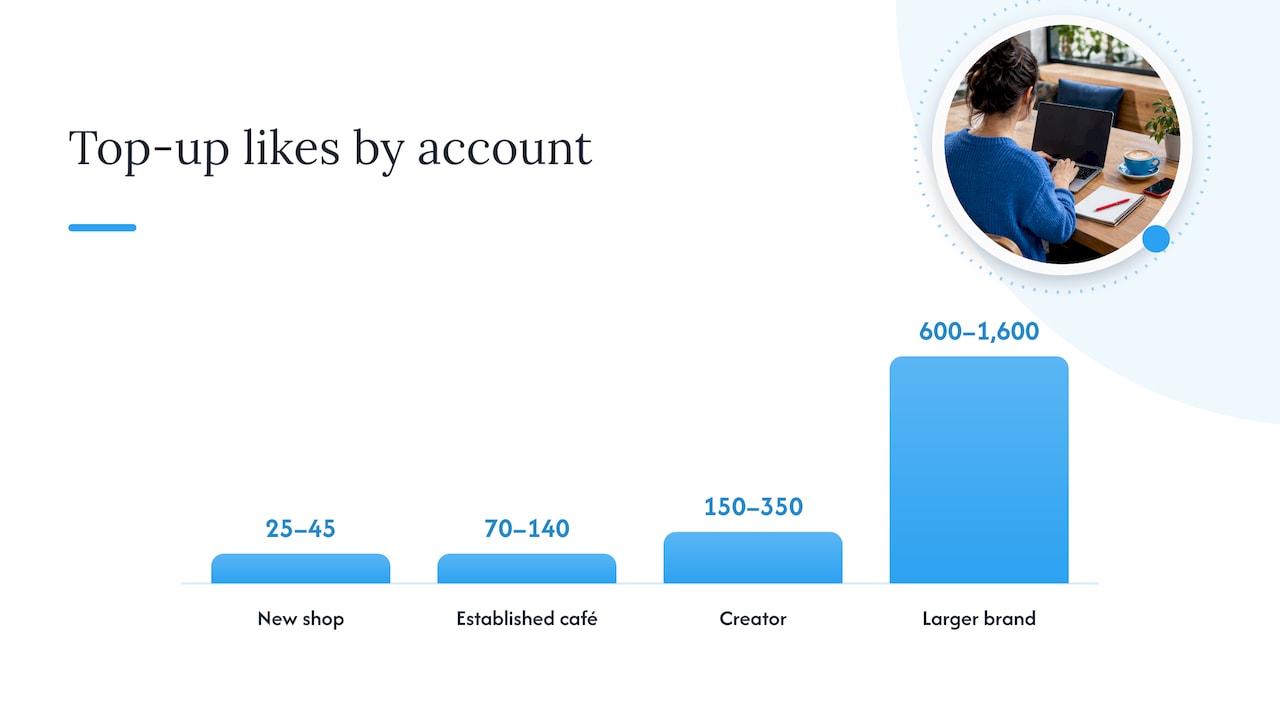
| Account type | Typical organic likes | Best recent post | Sensible target for a key post | Approximate top-up |
|---|---|---|---|---|
| New local shop, 300 followers | 15 | 30 | 40 to 60 | 25 to 45 |
| Established café, 3,000 followers | 80 | 140 | 150 to 220 | 70 to 140 |
| Creator, 10,000 followers | 250 | 450 | 400 to 600 | 150 to 350 |
| Larger brand, 50,000 followers | 900 | 1,800 | 1,500 to 2,500 | 600 to 1,600 |
Notice that the target is never a multiple of ten above the baseline. The aim is a believable lift.
Our Instagram follower to engagement ratio guide goes deeper on how many likes an account of a given size usually collects, which helps you set the baseline above if you are starting a new account with little history.
Does 1,000 likes mean a post has gone viral?
Not by itself. Laser Magazine describes 1,000 likes as an initial milestone rather than a fixed viral threshold, and says momentum matters: 1,000 likes in an hour can signal more than 5,000 gathered over three days.
Other analysts agree that virality is relative. Noise says there is no fixed like count that makes a post viral, with watch time, shares, comments, saves and early engagement weighing more than likes alone. SociaVault frames it comparatively: on Instagram, reaching Explore and roughly five to ten times your normal reach says more than an absolute total, and 5,000 likes might count as viral only where 1,000 is your usual result. Shopify UK makes the same point for TikTok, noting that 10,000 views may be a success for a new account but average for a larger one.
What does this mean for your order? Buying 1,000 likes is not a shortcut to going viral, and you should not size an order around that aim. Size it around what makes your post look established when a new visitor lands on it.
Likes, views and reach: keep the proportions realistic
A like count looks right only next to the other numbers on the post. A video with 50,000 views and 12 likes looks odd. A video with 800 views and 4,000 likes looks odder.
For YouTube, TrendReport’s data gives a useful yardstick: a median like-to-view rate of 2.4% on long videos, about 2,400 likes per 100,000 views, and 2.2% on Shorts, based on the preceding 52 weeks at the time of writing. So the answer to “how many likes for 100K views?” is roughly 2,200 to 2,400 on YouTube if you want to sit at the middle of the pack.
For TikTok, Social Champ offers an unofficial benchmark of 5 to 10% of followers per video as healthy engagement, while stressing that no like count defines virality. On an account with 4,000 followers, that is roughly 200 to 400 likes.
A practical way to use these figures:
- If you order likes, consider ordering views alongside them so the ratio stays believable. Our Instagram video views service exists for exactly this pairing.
- On YouTube, let views lead and likes follow at around two to three per hundred views.
- On TikTok, think in terms of your followers: a like total in the single-digit to low double-digit percentage range of your audience is easy to believe.
How the number changes by platform
Instagram posts are judged quickly. Most visitors glance at the like count, the comment count and the post’s age. Match your order to your usual range. For a feed post where you normally get 100 likes, an order of 50 to 100 is a natural lift. Reels tend to have a wider spread, so base your number on your recent Reels rather than your photos. If you post often, a monthly plan of automatic likes spreads the lift across posts so no single one stands out.
TikTok
TikTok results swing more widely from video to video, so your baseline is less stable. Use the median of your last 15 videos rather than the mean, which a single hit can distort. Our comparison of TikTok likes versus shares explains why shares often tell the platform more than likes do.
For pages, post likes and page likes do different jobs. Post likes support one piece of content, while page likes shape the first impression of the business. Local UK firms usually do better thinking small and steady. Our note on followers versus page likes helps you choose which to order.
YouTube
Stick to the ratio above. A channel’s likes make sense only relative to its views, so decide your views first.
Our perspective
We have served more than a million customers since 2013, and the question we hear most is “how many?” Our answer has hardly changed: fewer than you think, and matched to the post.
The orders that work best for our UK customers are the ones that make a good post look as well supported as it deserves to. A bakery with a strong launch photo, a freelancer announcing a new service, a creator releasing a video they are proud of: each needs the first impression to say “people are interested in this”. That is what likes give a visitor.
We built our service around that idea. Delivery is designed to be real-looking and arrives without asking for your password, and our UK-based support can help you pick a quantity that suits your account. If you are unsure, start at the lower end of a range and add later. It is far easier to top up than to undo an order that was too large.
Irwin Lee
Staying within platform and UK rules
Buying engagement is something to do carefully, and a few facts help you keep orders measured.
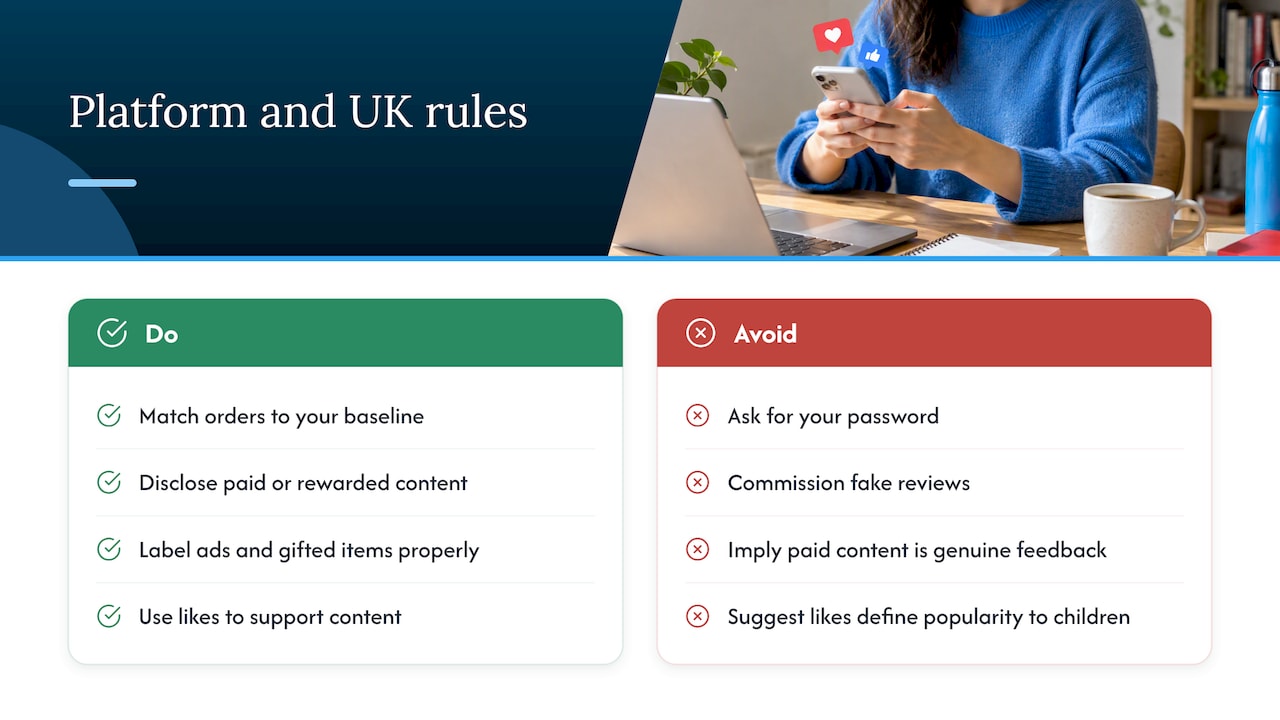
Platform rules. Meta’s policy prohibits content designed to deceive or overwhelm users to artificially increase viewership. That is the main reason we suggest modest, baseline-matched orders rather than dramatic spikes, and why we never ask for your password.
Disclosure when you are paid or rewarded. The Competition and Markets Authority (CMA) says its creator guidance applies regardless of follower count and covers free products, discounts, payments and commissions linked to your content. UK influencers must make commercial relationships clear, prominent and upfront, and must not give the impression of being genuine customers when they are not. If you are a creator, that means labelling ads and gifted items properly whatever your like count is.
Reviews and customer claims. The CMA has warned that commissioning fake reviews breaches consumer protection law and can lead to civil or criminal action. The practical takeaway: use likes to support content, and never to stand in for customer reviews or testimonials. Our article on buying Facebook likes and misleading customers covers where that line sits for UK businesses.
Content aimed at children. The Advertising Standards Authority has ruled that marketers must not suggest that gaining likes and followers is desirable in its own right where it could encourage an unhealthy view of popularity, particularly among children. If your audience is young, keep promotional messaging well away from the idea of collecting likes.
What a bought lift does and does not do
Likes arriving on a post raise its visible social proof within hours. Our own analysis suggests the effect on algorithmic discovery is short-lived, which is covered in our pieces on bought likes and algorithm impact and the 0 to 6 hour lift. That is useful to know when you plan: a purchase makes a post look credible to the people who find it, and the content and your wider activity decide what happens next.
So the best-timed orders are for posts you will push anyway: a launch, an offer, a profile link in an advert, a post you will pin. A good order does three things:
- Gives a first-time visitor a reason to stay and look.
- Sits comfortably beside your comments and shares.
- Leaves room for real engagement to build on top.
Pair likes with organic engagement
The strongest accounts treat bought likes as one input among several. Hootsuite suggests that to earn more likes, you share posts to Stories, work with creators, use Collab posts and track what performs, then repeat what works.
For UK small businesses, the British Business Bank’s Start Up Loans toolkit, published in January 2024, recommends promotions, competitions, direct replies, sharing customer content with permission and user-generated content. PayPal UK’s small-business guide advises defining a specific audience, using polls or direct-message surveys, and making content relevant, authentic, actionable and shareable rather than chasing likes alone.
We have written up our own tips too: creative ways to increase your Instagram likes and how to increase likes organically. If you want your order to blend into your feed, read how to make purchased engagement look natural.
A routine that works for many small teams:
- Post consistently, at the times your audience is active.
- Reply to every comment in the first hour.
- Order a modest like package for your most important post each month.
- Review the results against your baseline and adjust.
Choosing a package with us
Our UK-targeted likes are delivered without needing your password, and our support team can help you size an order. Instagram likes start from £0.99 and go up to £189.95 as a one-off purchase, so you can begin small. If you post regularly and want steady support, auto likes on Instagram start from £9.99 per month. On other platforms, you will find TikTok likes from £2.99 to £119.99, YouTube likes from £2.99 to £85.99, and Facebook post likes from £3.99 to £79.99.
Pick the platform, take the number from the four steps above, and choose the nearest package below it.
Ready to order? Browse Instagram likes and views, or see our TikTok, YouTube and Facebook ranges. If you want a walkthrough first, our guide to buying real Instagram likes explains the process.
FAQ
How many Instagram likes should I buy for one post?
Start with your average organic likes and aim for roughly one to two times that figure. If you usually get 100, an order of 50 to 100 is a believable lift. Begin at the lower end and top up if you want more.
Is 1,000 likes a lot, and is it viral?
It depends on your account. Laser Magazine treats 1,000 likes as a milestone rather than a viral line, and it says the speed of arrival matters. For an account that normally gets 50, 1,000 is exceptional. For one that normally gets 900, it is ordinary.
How many likes should a video have per 100,000 views?
On YouTube, TrendReport’s data points to a median of about 2,400 likes per 100,000 views for long videos and about 2,200 for Shorts. Other platforms differ, so compare against your own previous videos too.
Should I buy likes every time I post?
Not necessarily. Many customers choose key posts such as launches and offers, while others prefer a monthly auto likes plan that spreads smaller amounts across posts. Either way, keep the totals consistent with your normal range.
Do I need to disclose anything if I buy likes?
Buying likes does not itself create a disclosure duty, but UK rules on advertising and endorsements apply to the content. The CMA says creators must make payments, gifts and other incentives clear, so label ads and gifted products properly.
Sources
- Spam | Transparency Centre (Meta)
- The Magic Number: How Many Likes Does It Really Take to Go Viral (Laser Magazine)
- How Many Likes to Go Viral (Noise)
- Reverse-Engineer Viral Content (SociaVault)
- How To Go Viral on TikTok (Shopify UK)
- What is a good like-to-view ratio on YouTube? (TrendReport)
- Do TikTok Likes Still Matter? (Social Champ)
- Social media endorsements: guidance for content creators (GOV.UK)
- Influencer marketing: what you need to know (CMA)
- CMA open letter on online reviews and endorsements
- ASA Ruling on SuperAwesome Trading Ltd t/a PopJam
- Instagram likes: Why they matter, and how to get more (Hootsuite)
- Start Up Loans Social Media Toolkit (British Business Bank)
- Instagram Marketing Strategy for Small Businesses (PayPal UK)