

A sudden drop in reach after buying followers doesn’t prove you’re getting shadowbanned for buying followers. If new followers rarely watch, like or share your content, your audience size may grow without a similar rise in engagement. That gap can affect how your account appears to visitors, but it isn’t proof that Instagram has restricted your posts.
It’s understandable to worry when fewer people see your content, especially when claims about shadowbans and detection conflict. “Shadowban” isn’t an official Instagram label, so check the account-status information Instagram provides before drawing conclusions. A decline can also reflect normal performance changes, differences in content or shifts in who engages.
This guide explains what people mean by a shadowban, how purchased followers may affect engagement signals and how to assess a reach drop using consistent metrics. You’ll learn what to check in Account Status, how to compare reach from followers and non-followers, and why one underperforming post isn’t enough to diagnose a restriction. You’ll also be better placed to weigh follower growth and engagement services against your account goals and Instagram’s rules.
Key Takeaways
- Getting shadowbanned for buying followers is a concern, but the term isn’t an official diagnosis. Check your account for more useful signals.
- A mismatch between follower numbers and engagement may affect how your account appears, but it doesn’t prove restricted reach.
- Compare reach across several posts, formats and publishing times to distinguish a possible restriction from ordinary performance variation.
- Document changes, review Account Status and assess recent content before deciding what to do next.
- Weigh purchased metrics against your account goals, engagement quality and Instagram’s rules before choosing a growth approach.
Getting shadowbanned for buying followers: what the term really means
A sudden fall in reach can feel like a hidden penalty, especially if it follows a change in your follower count. But a dip alone doesn’t show that Instagram has restricted your account or explain why fewer people saw a post. The phrase getting shadowbanned for buying followers describes a worry, not a diagnosis.
A suspected shadowban is an informal description of reduced visibility without a clear notice. A measured performance decline is a change in your Insights data that, by itself, doesn’t identify its cause. Keeping these ideas separate helps you assess the evidence without treating every disappointing post as proof of enforcement.
Is a shadowban an official Instagram account status?
“Shadowban” is creator shorthand, not a named account status that confirms a restriction. Meta’s Account Status tools provide information about account or content issues and recommendation eligibility. If content isn’t eligible for recommendations, it may be less likely to reach people who don’t follow you. Eligibility doesn’t guarantee that content will be recommended or receive a particular level of reach.
Check the current Account Status information in Instagram and Meta’s official guidance. These tools can offer useful signals, but they don’t explain every suspected visibility change. Treat the label and the account information available to you as separate things.
What can a reach drop tell you?
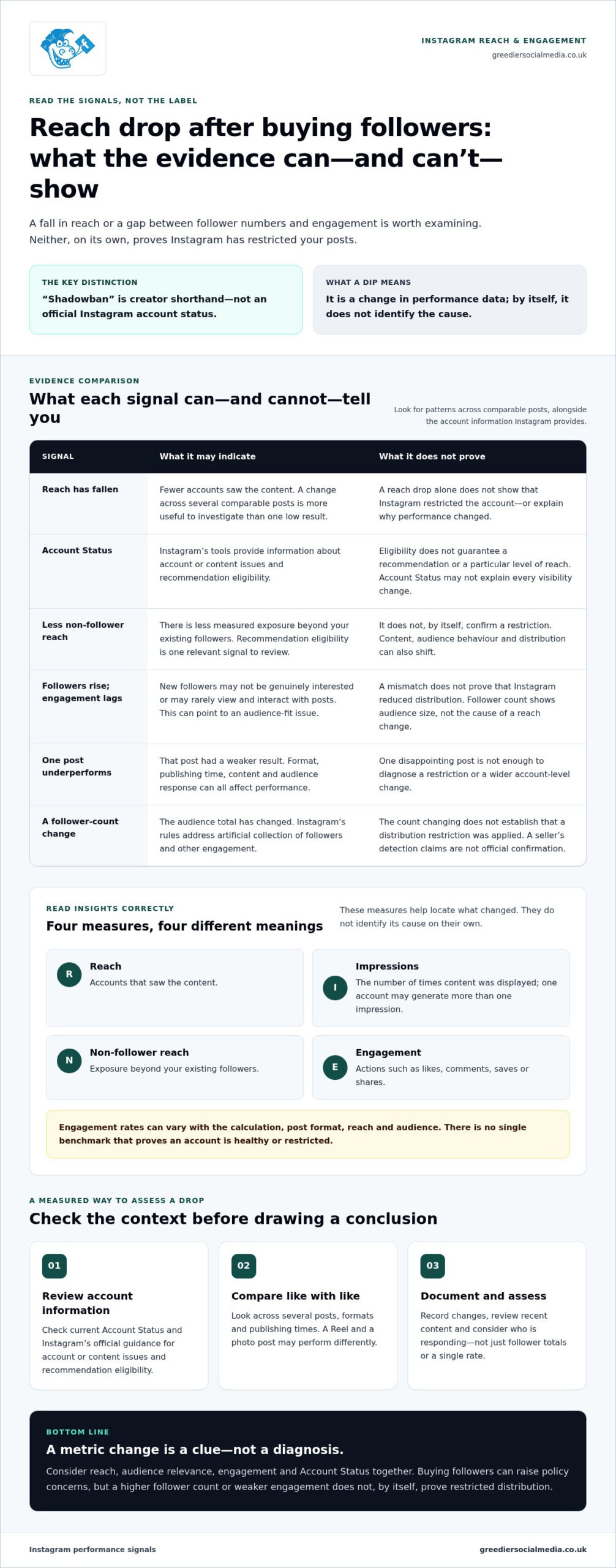
Reach is an outcome, not proof of a specific enforcement action. In Insights, reach refers to the accounts that saw content; impressions count displays, and one account may generate more than one impression. Non-follower reach shows exposure beyond your existing audience, while engagement records actions such as likes, comments, saves or shares. These figures describe different parts of performance.
Compare like with like before deciding what changed. For example, a Reel’s non-follower reach may differ from a photo post’s, and a post published at a different time may get a different response. Content, audience behaviour and distribution can all shift. A change across several comparable posts is more useful to investigate than one low result, but it still needs to be considered alongside Account Status and other evidence.
- Reach: accounts exposed to the content.
- Impressions: the number of times it was displayed.
- Non-follower reach: exposure beyond current followers.
- Engagement: actions people took after seeing it.
These measures help locate the change, not identify its cause. A follower-count increase followed by weaker engagement may be a reason to look more closely at audience response, but it doesn’t, on its own, prove a distribution restriction.
How buying followers could affect Instagram account signals
A follower purchase can increase an audience count without changing who is genuinely interested in the account. If new followers rarely view or interact with posts, there may be a weaker relationship between follower count and engagement. That points to a possible audience-fit issue, not proof that Instagram has reduced distribution.
Follower count alone can’t diagnose reach suppression: it shows audience size, not whether Instagram has restricted your content or why its performance changed. A higher count alongside a drop in engagement rate may prompt closer analysis, but rates vary depending on the calculation, post format, reach and audience. There’s no single benchmark that proves an account is healthy or restricted.
Why follower quality and audience fit matter
Consider a local bakery whose posts are aimed at potential customers nearby. Followers who have no interest in the business, or rarely use their accounts, may be unlikely to save a menu post, share a Reel or ask about opening times. The account’s follower total has risen, but its relevant audience may not have grown.
Read engagement alongside reach and audience relevance. Compare similar posts and look at who is responding, not just the percentage produced by a formula. A low rate can have several explanations, while a strong rate on one post doesn’t show that the wider audience is a good fit.
What platform rules say about inauthentic activity
Instagram’s rules address artificial collection of followers, likes and other engagement. Buying followers can therefore raise a policy concern, but claims about exactly how Instagram detects purchases or what action it will take aren’t the same as Meta’s published rules. Don’t treat a seller’s detection claims or a sudden metric change as official confirmation of enforcement.
Instagram may remove inauthentic activity or take other action under its policies. The outcome depends on the activity and the platform’s enforcement; a follower-count change doesn’t establish that a distribution restriction has been applied. Review the current Instagram Terms of Use and Community Guidelines for the relevant wording, and don’t try to disguise activity or bypass enforcement.
If you’re weighing purchased metrics for social proof, consider that purpose separately from reach growth. Greedier Social Media offers Instagram follower and engagement metrics, including followers, likes and Reel views. A metric purchase can’t guarantee audience interest, recommendation eligibility or reach. Compare the option with your account goals, audience relevance and Instagram’s rules before deciding.
Shadowban or ordinary reach fluctuation? Compare the evidence
Buying followers doesn’t, by itself, prove you’re getting shadowbanned for buying followers. Look for a pattern across comparable posts, then check whether account-status information supports a restriction. A reach change is a reason to investigate, not a verdict.
Which Instagram Insights should you review?
Choose a consistent reporting period and compare like with like: Reels against Reels, and photo posts against similar photo posts. Record reach, impressions, interactions and the split between followers and non-followers. Note the format, topic and publishing context, including timing. This helps you identify whether the shift affects discovery, response from existing followers or both.
| Observation | What it may indicate | What it cannot prove |
|---|---|---|
| Non-follower reach falls across several comparable posts, while follower reach is steadier | Less exposure beyond the existing audience, or weaker performance with new viewers | A specific restriction or its cause |
| One format, such as Reels, changes whilst other formats remain similar | A format-specific difference in content response or distribution | An account-wide visibility limit |
| Posts published at a different time receive less reach | Audience activity or publishing context may have affected results | That timing, or a follower purchase, caused the change |
| Reach and interactions shift across different formats over several posts | A broader change worth checking alongside Account Status and content history | That Instagram has imposed a penalty |
What other explanations should you consider?
Check whether the content remained relevant to its intended audience and whether your posting pattern changed. Audience activity and normal performance variation can also affect results. A single post may simply have connected with fewer people. A format-specific dip differs from a consistent change across the account, so avoid drawing a conclusion from one metric or post.
Keep a simple record of comparable posts and review the pattern alongside Account Status. If non-follower reach falls repeatedly, note whether the change is limited to one format or appears more widely. This gives you a clearer basis for investigation, although it still doesn’t establish the cause.
Social proof and reach are related considerations, but they are not interchangeable measures. For a wider look at the role of social proof, read this Social Media Authority UK guide.
What to do if restricted after buying followers
If you suspect a restriction, pause before making sweeping changes. A measured review can help you separate an account notice from a performance concern and decide what to do next. Getting shadowbanned for buying followers is a fear, but the useful next step is to check the evidence available in your account.
A measured account review checklist
Save results for comparable posts, review Account Status, check recent content and notifications, then use Instagram’s in-app reporting option if the issue continues. This creates a clear record without assuming that a follower purchase caused the change.
- Document the change: Capture Insights for comparable posts and Reels. Note reach, impressions, interactions, follower and non-follower distribution, format and publishing context. Compare a consistent period rather than relying on one result.
- Review Account Status: Look for notices or recommendation-eligibility information currently displayed in the app. Read any explanation provided and follow the relevant prompts.
- Inspect recent activity: Record content or posting changes and any account notifications. Check Instagram’s current official guidance for relevant explanations and steps.
- Report a continuing issue: If the app provides an in-app reporting route relevant to your situation, use it to describe the problem clearly and include the account evidence you’ve recorded.
Avoid repeated speculative edits, sudden shifts in posting or supposed “shadowban fixes” that promise to restore reach. These actions don’t establish the cause and can make it harder to understand what changed. Use current in-app guidance rather than tactics that claim to evade enforcement.
How to make a more informed growth decision
Next, be clear about your goal. Is visible social proof the priority, or are you aiming for more interaction from people who are genuinely interested in your content? Those aims aren’t interchangeable. A follower count may serve the first purpose, but it can’t guarantee engagement, recommendation eligibility or reach.
If you’re building an account from the start, this Instagram growth guide for new accounts offers a broader early-stage perspective. Consider your account goals, audience relevance and Instagram’s current rules before choosing a growth approach. No provider or tactic can promise immunity from enforcement or a particular reach outcome.
If visible social proof is part of your decision, explore Instagram follower options with those limits in mind. Treat a purchase as a deliberate metric choice, not a fix for a suspected restriction.
Choosing a follower-growth approach with clear expectations
Choose an approach by starting with the result you want, not the number you hope to display. More visible followers may support a social-proof goal, but that figure alone doesn’t show whether people are interested, likely to start a conversation or ready to buy. If your priority is qualified traffic or sales, consider how you’ll measure those outcomes separately.
Match the approach to the result you want
Each route has a different purpose and trade-off:
- Purchased metrics: Instagram followers, likes or Reel views can change visible engagement figures. They don’t establish audience relevance, commercial intent or future reach.
- Audience-building activity: Publishing relevant posts and interacting with people in your intended audience takes ongoing effort. The aim is to encourage genuine interest, but results aren’t guaranteed.
- Content investment: Planning and producing useful, original content can give people a reason to watch, save or share. It requires time and resources, and performance can vary.
These approaches aren’t interchangeable. A visible follower count can contribute to first impressions, while conversations, qualified visits and sales depend on other signals and actions. Set a clear measure for your goal before choosing. For a social-proof objective, decide which visible metric matters. For an audience or business objective, identify the interactions or outcomes you want to assess.
Set realistic expectations before choosing
Before taking action, review Instagram’s current rules and your account evidence. If you’re concerned about getting shadowbanned for buying followers, don’t use a purchase as a presumed fix for reduced reach. Follower, like and view counts are metrics, not assurances of distribution or protection from enforcement.
Greedier Social Media sells Instagram followers, likes, automated follower and like services, and Reel views. These are direct engagement metrics, not account-management services. Consider your account’s aims, the likely value of the metric to those aims, audience relevance and your tolerance for platform-related risk. No provider or tactic should be treated as a guarantee of better reach, stronger engagement quality or favourable platform standing.
Make the decision with a defined purpose and realistic expectations. If direct metrics fit your social-proof objective, explore social media engagement options.
Choose your next growth step with confidence
A reach drop can be unsettling, but it doesn’t automatically mean getting shadowbanned for buying followers. “Shadowban” is informal shorthand, while a change in reach is a metric to investigate, not proof of a specific restriction. Compare similar posts over time, check follower and non-follower reach, and review Account Status before deciding what the evidence suggests.
Also consider what you want your account to achieve. Purchased followers, likes and views can serve a social-proof goal, but visible metrics don’t establish audience interest, meaningful engagement or sales. Weigh the purpose against Instagram’s current rules and your account’s needs.
Greediers Social Media offers Instagram engagement options including followers, likes, automated services and Reel views. These are direct metrics, not a promise of better reach or protection from enforcement. If they fit your aims, explore social media engagement options and make your choice with clear expectations.
A measured decision puts you in a stronger position to assess what’s working. Keep reviewing the evidence, and choose the approach that best supports your account goals.
Frequently Asked Questions
Can buying followers get you shadowbanned on Instagram?
Buying followers may create account and policy risks, but it doesn’t prove you’ve been shadowbanned. Instagram’s rules address artificial collection of followers and other engagement, and the platform may remove inauthentic activity or take action under its policies. “Shadowban” is informal shorthand, not a diagnosis to infer from a reach drop. If you’re worried about getting shadowbanned for buying followers, review Account Status and compare consistent performance data before deciding what happened.
How can I tell if Instagram has restricted my reach?
Check Account Status for notices or information about recommendation eligibility, then compare several similar posts over a consistent period. Look at reach from followers and non-followers, impressions and interactions. A repeated fall in non-follower reach may be worth investigating, particularly if follower reach is steadier, but it can’t confirm a restriction on its own. Consider content format, timing and audience response alongside any account information Instagram displays.
Does Instagram officially use the term shadowban?
“Shadowban” is an informal term, not a named restriction you can treat as an official account diagnosis. Instagram’s Account Status tools provide account or content information, including recommendation eligibility. That information can help you assess whether content may be recommended to non-followers, but eligibility doesn’t guarantee distribution. Use the wording shown in the app and current Meta guidance, rather than assuming the platform has confirmed every suspected visibility issue.
Will removing purchased followers restore my Instagram reach?
Removing followers can’t guarantee that your reach will return. A change in follower numbers doesn’t establish why reach fell, and removing accounts doesn’t necessarily alter other factors affecting performance. First review Account Status, document results for comparable posts and check for relevant notices. If you decide to remove followers, base that decision on your account goals and available evidence, not on promises that a clean-up will reverse a restriction or restore distribution.
Can a sudden drop in Instagram reach happen without a shadowban?
Yes. Reach can change without a confirmed restriction. A post’s subject, format, publishing time and audience response can all affect its performance, and one post may differ from the next. Compare similar content over a consistent period, including follower and non-follower reach, impressions and interactions. If the change appears across several formats, review Account Status too. Treat the drop as a signal to investigate, not proof of its cause.
What should I do if I think buying followers affected my account?
Start by recording Insights for comparable posts and noting when the change began. Review current Account Status for notices or recommendation-eligibility information, then inspect recent content and account notifications. Check Instagram’s current official guidance and use in-app reporting if it’s relevant to the issue. Avoid panic changes and supposed workarounds. A clear record helps you describe what changed without assuming a follower purchase caused it.
Are purchased Instagram followers the same as genuine audience growth?
No. A purchased follower metric changes the displayed follower count, but it doesn’t by itself show that people are interested in your content or likely to interact, visit a website or buy. Genuine audience growth reflects people choosing to follow because they want to see more. Consider the purpose of a metric purchase separately from goals such as conversation, qualified traffic or sales, and assess each goal with relevant measures.