
Learning how to establish brand authority social media wise takes consistency more than luck.
TL;DR:
- Building brand authority on social media requires consistent, verifiable content and rapid, genuine engagement. Focusing on two platforms and a balanced content mix over months fosters trust and organic growth, not instant fame. Authentic, named work and fast responses are the most effective signals of credibility in 2026.
The fastest way to establish brand authority on social media is to publish consistent, verifiable work that proves your expertise and invites real conversation. Only 15% of consumers in 2026 believe brands are truly transparent on social platforms, so most of your audience is already sceptical before they read a single post. That gap is your opportunity.
Start this week with three things:
- Publish one dated case item (a result, a client outcome, a before/after) with a named operator and a specific date
- Optimise every active profile: clear bio, consistent visuals, pinned post that signals expertise
- Set up a listening and response system so no comment or DM goes unanswered beyond 24 hours
What to expect: In month one, you will see profile visits and follower growth tick upward. By month three, engagement rates on authority content typically outperform broadcast posts. By month twelve, consistent verifiable content compounds into search visibility, inbound enquiries, and a recognisable brand voice. The trade-off is time: authority cannot be faked or rushed, but the compounding effect rewards those who start early and stay consistent.
Table of Contents
- Which social networks should you actually focus on?
- How do you build a content strategy that earns authority?
- Does your brand voice and visual identity actually build trust?
- What authenticity tactics actually move the needle in 2026?
- How do you keep a posting cadence without burning out?
- How do you build a real community, not just a follower count?
- How should you run influencer partnerships as a performance channel?
- How do you use social proof to demonstrate real authority?
- What KPIs and timelines should you actually track?
- What UK legal and cultural rules affect your social authority?
- What does the research say about trust gaps and what actually works?
- Establish Brand Authority Social Media: Key Takeaways
- Why slow, visible consistency beats the big launch
- Greediersocialmedia: faster authority, without the guesswork
- Further reading and sources
- FAQ
Which social networks should you actually focus on?
Choose platforms where your customers already spend time and where your content format fits naturally. A B2B consultancy forcing itself onto TikTok wastes resources; a consumer lifestyle brand ignoring Instagram misses its audience entirely.
Run a quick platform audit before committing:
- Where do your existing customers follow brands similar to yours?
- Which platform surfaces in your competitors’ most-shared content?
- What content format do you produce best: short video, long-form text, photography, or professional commentary?
- What is your realistic posting capacity per week?
Platform quick guide:
- LinkedIn: Professional services, B2B, thought leadership, recruitment
- Instagram: Visual products, lifestyle, consumer brands, creators
- TikTok: Younger demographics, high organic reach, short video
- Facebook: Community groups, local businesses, older demographics
- X (Twitter): Real-time commentary, media, tech, customer service
Pro Tip: Pick two platforms maximum to start. Depth on two beats a thin presence across five. Once you have a repeatable content system on your primary platform, expand.
How do you build a content strategy that earns authority?
Focus on three pillar topics that map directly to your business outcomes and the questions your customers actually ask. Everything else is noise.
Pillar topic template:
- Expertise pillar: What you know better than anyone in your sector
- Proof pillar: Results, case studies, and client outcomes
- Community pillar: Conversations, questions, and shared experiences with your audience
A practical content mix for authority building follows a 5-3-2 pattern per ten posts: five educational or useful pieces, three proof or social-proof pieces, and two personality or behind-the-scenes posts. This keeps your feed from reading like a brochure while still demonstrating expertise.
One-week posting plan (example for LinkedIn + Instagram):
- Monday: Educational post on pillar topic one (carousel or short article)
- Tuesday: Respond to three industry conversations; share a relevant third-party insight
- Wednesday: Proof post — dated case study or result with named context
- Thursday: Community question or poll
- Friday: Personality post — a small failure, a lesson, or a team moment
Editorial brief fields to keep content verifiable:
- Topic and pillar category
- Date of publication
- Named operator or author
- Source or evidence link
- CTA (comment, share, visit)
Does your brand voice and visual identity actually build trust?
Consistency matters more than perfection. A brand that looks and sounds the same across every platform is easier to trust than one that is polished on one channel and chaotic on another.
Voice style checks:
- Tone: conversational or authoritative? Pick one register and document it
- Jargon level: match your audience’s vocabulary, not your internal one
- Sentence length: shorter for Instagram and TikTok; longer for LinkedIn
Visual template checklist:
- Profile image: same photo or logo across all platforms, minimum 400×400px
- Colour accents: two or three brand colours applied consistently to graphics and thumbnails
- Thumbnail rules: consistent font, layout, and logo placement on all video covers
Profile optimisation bullets:
- Bio: state what you do, who you help, and one proof point (years in business, clients served, award)
- Link: use a link-in-bio tool or a dedicated landing page, not your homepage
- Pinned content: pin your strongest proof post or most-watched video
Building your social media profile from the ground up takes less than a day when you have a visual template ready. The payoff is immediate: a coherent profile converts visitors into followers at a measurably higher rate than a patchy one.

What authenticity tactics actually move the needle in 2026?
Authenticity is earned through dated, named, original content and transparent responses to problems. Generic “we care about our customers” posts move nothing. Specific, verifiable evidence moves everything.
Date-stamping content and naming operators are among the highest-signal trust actions available right now, precisely because they are harder for AI-generated content to replicate convincingly. A post that specifies the month, the operator, and a specific outcome is credible. “We help businesses improve their results” is not.
Transparency checklist:
- Date-stamp every case study and result post
- Name the operator, founder, or team member responsible
- Publish at least one “small failure” post per quarter — what went wrong and what you changed
- Correct errors publicly and promptly; delete-and-repost erodes trust faster than an honest correction
Pro Tip: Before publishing any transparency post, run it past your legal team if it involves client data. Anonymise where necessary, but keep the date and the outcome specific — a vague “a client” with no date is nearly as unconvincing as no case study at all.
Original, named work and public failures increase credibility more than generic trust badges or follower counts. That is the single most underused tactic in UK social media marketing.
How do you keep a posting cadence without burning out?
Pick a cadence you can sustain for twelve months, then automate the repeatable parts. A brand that posts three times a week for a year outperforms one that posts daily for six weeks and then goes quiet. The benefits of consistent posting compound over time in ways that sporadic bursts simply cannot replicate.
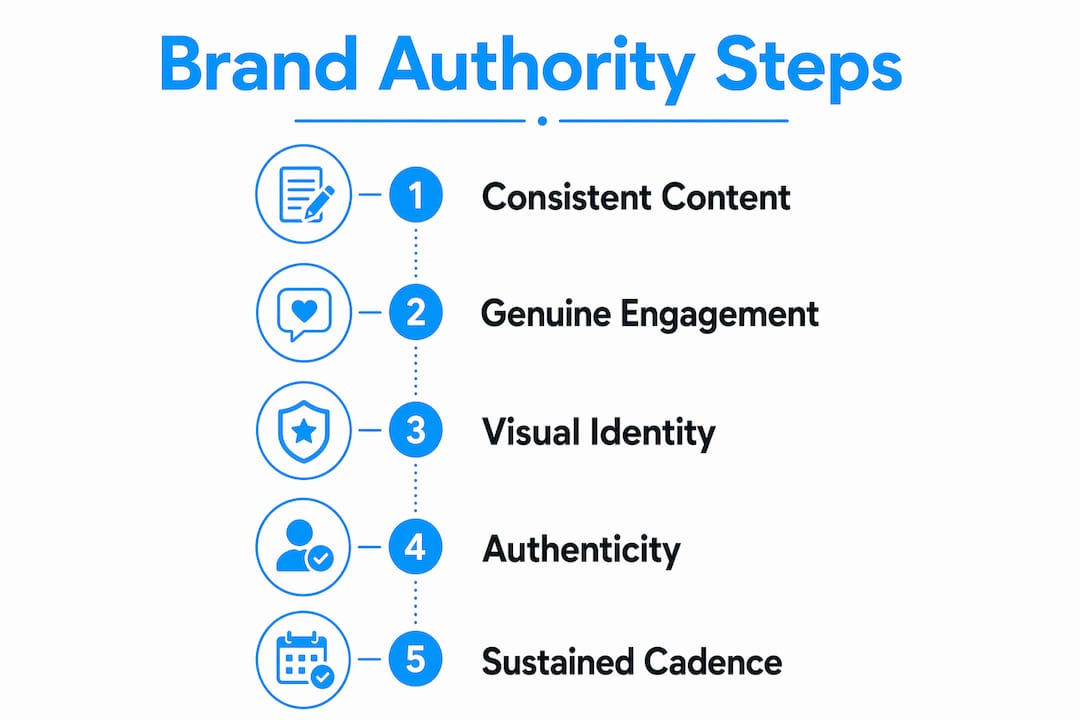
Content calendar template fields:
| Field | Purpose |
|---|---|
| Theme / pillar | Keeps content balanced across your three pillars |
| Format | Post, video, story, carousel, live |
| Owner | Who creates and who approves |
| Publish date | Scheduled in advance, not reactive |
| Linked assets | Image, video, copy doc, source link |
Basic cadence rules:
- Daily: Monitor mentions, respond to comments and DMs, engage with three to five relevant posts
- Weekly: Publish scheduled content, review what performed, brief next week’s posts
- Monthly: Audit pillar balance, update pinned content, review follower growth and engagement rate
How do you build a real community, not just a follower count?
Active listening and fast, genuine responses create disproportionate trust. Many consumers feel more loyal to a brand that replies to their questions on social, and fast response is widely rated as important to their trust in a brand. That is not a soft metric.
Daily engagement checklist:
- Listen: search your brand name, product name, and key industry terms each morning
- Respond: reply to every comment and DM within four hours during business hours
- Amplify: reshare or quote customer posts with permission; tag the original creator
UGC consent template (adapt for your brand):
Tactics to surface customer voices:
- Ask a specific question at the end of every post (“What’s the one thing you’d change about X?”)
- Run a monthly “share your result” prompt with a branded hashtag
- Feature one customer story per month as a dedicated post, with their name and date
For growing your social presence organically, community engagement is the single highest-leverage activity. Algorithms reward content that generates genuine replies, not passive scrolling.
How should you run influencer partnerships as a performance channel?
Treat creators as a performance channel with defined goals, a written brief, and measurement from day one. Later’s influencer playbook frames this as a shift from paying for reach to buying outcomes, and it is the right frame. Vanity metrics — impressions, follower counts — tell you almost nothing about whether a campaign built authority or drove revenue.
Creator brief template:
- Goal: What business outcome does this campaign serve?
- Message: The one idea the creator must communicate
- Deliverables: Number of posts, formats, deadlines
- Usage rights: Can you repurpose content for paid ads?
- Disclosure: #ad or #sponsored label required per ASA rules
- KPIs: Conversion rate, cost per acquisition, ROAS
Documenting influencer agreements covering usage rights and deliverables protects both parties and unlocks the ability to reuse creator content in paid media later.
Creator tier guide:
| Tier | Follower range | Best use case |
|---|---|---|
| Nano | 1K | Hyper-local, niche communities, high trust |
| Micro | 100K | Sector-specific authority, better ROI for SMEs |
| Macro | 1M | Brand awareness, product launches |
| Mega | 1M+ | Mass reach, major campaigns |
Micro- and nano-influencers typically deliver higher engagement rates and better ROI for small and medium-sized businesses than macro or mega tiers. Start there. You can also explore influencer marketing strategies that focus on measurable brand growth for a broader framework.
How do you use social proof to demonstrate real authority?
Social proof must be verifiable and connected to dated, named evidence to be persuasive. A screenshot of a five-star review with no date and no name is easy to dismiss. A named case study with a specific outcome and a date is not.
Proof-collection checklist:
- Ask for reviews within 48 hours of a positive outcome, not weeks later
- Request permission to use the review or result in social content
- Date-stamp every testimonial and case study before publishing
- Link case studies to a named operator’s LinkedIn or public profile where possible
Micro case study template:
Client: [Name or anonymised sector] | Date: [Month, Year] | Challenge: [One sentence] | Result: [Specific, measurable outcome]
Converting testimonials into social posts:
- Pull one specific sentence from a review and pair it with a relevant image
- Add the client’s first name and sector (with permission)
- Include the date the result was achieved
Awards and press coverage belong in your bio and pinned content, not buried in a monthly round-up post nobody reads.
What KPIs and timelines should you actually track?
Measure business outcomes, not vanity metrics. Tie social activity to conversions and retention wherever possible, and use UTM tags and unique discount codes to attribute creator and campaign activity accurately.
KPI table:
| Category | Metric | Reporting cadence |
|---|---|---|
| Awareness | Reach, impressions, follower growth | Monthly |
| Engagement | Engagement rate, saves, shares | Weekly |
| Conversion | Click-through rate, leads, sales | Monthly |
| Retention | Repeat engagement, DM conversations | Quarterly |
| Authority | Mentions, press coverage, inbound links | Quarterly |
3–6–12 month benchmarks:
- Month 3: Consistent posting cadence established; engagement rate above platform average
- Month 6: Inbound enquiries attributable to social; growing share of voice in your niche
- Month 12: Recognisable brand voice; case studies generating organic shares; measurable conversion uplift
For a deeper look at which metrics to prioritise, Greediersocialmedia’s guide to social media KPIs covers the full reporting framework.
What UK legal and cultural rules affect your social authority?
Follow ASA and CMA guidance for influencer disclosure and handle user data in line with UK GDPR. Getting this wrong does not just create legal risk; it destroys the trust you have spent months building.
Legal checklist:
- Label all paid partnerships with #ad or #sponsored, placed prominently, not buried in hashtags
- Keep records of all paid partnership agreements for at least two years
- Obtain explicit written consent before reposting UGC or using customer images in ads
- Under UK GDPR, do not store personal data collected via social competitions without a lawful basis
Cultural trust signals that matter in the UK market:
- Named operators and founders with verifiable public profiles (LinkedIn, Companies House)
- Response times: UK consumers expect replies within business hours; same-day is the standard
- Date-stamped materials signal recency and accountability
- Registered business details visible on your website and linked from social profiles
The ASA’s influencer disclosure guidance and the ICO’s UK GDPR resources are the primary sources to check before running any paid or data-collecting campaign.
What does the research say about trust gaps and what actually works?
A large trust deficit means verifiable, dated, named content and consistent behaviour are the strongest signals available. The numbers are stark.
According to the Hiebing State of Trust 2026 report, trust starts internally and is communicated through actions, not campaigns. Consumers are auditing behaviour, not just reading messaging. Every response, every partnership decision, every correction is a trust signal.
Sophisticated visitors also expect a verifiable existence test: founders and key team members should have multi-year public footprints on LinkedIn or X that predate the company where possible. A brand whose leadership has no public history raises immediate red flags.
The practical implication: date-stamp your content, name your people, publish your failures alongside your wins, and respond fast. 60% of consumers expect a response within approximately ten minutes on social. That is a customer service standard, not a marketing one.
Brand consistency across channels reinforces every one of these trust signals. Inconsistency, even in small things like a different logo crop or an off-tone reply, chips away at the credibility you are building post by post.
Establish Brand Authority Social Media: Key Takeaways
Establishing brand authority on social media requires consistent, verifiable content, fast genuine engagement, and a documented strategy tied to measurable business outcomes.
| Point | Details |
|---|---|
| Start with verifiable content | Date-stamp case studies, name operators, and publish specific outcomes from week one. |
| Respond fast and genuinely | 90% of consumers rate fast response as important to brand trust; aim for same-day replies. |
| Pick two platforms and go deep | Depth on two platforms beats a thin presence across five; expand only once a system is repeatable. |
| Measure outcomes, not vanity | Track engagement rate, click-through, and inbound leads; review weekly and monthly. |
| Greediersocialmedia accelerates the process | Their authentic engagement services and profile optimisation help UK brands build credibility faster without compromising account security. |
Why slow, visible consistency beats the big launch
The conventional wisdom in social media marketing is that you need a moment: a viral post, a celebrity partnership, a campaign that breaks through. That framing is wrong, and the trust data makes it clear why.
Authority is not built in a single post. It is built in the accumulation of small, consistent, verifiable actions over months. A brand that publishes a dated case study every fortnight, responds to every comment within four hours, and names its operators publicly will outperform a brand that runs one expensive influencer campaign and then goes quiet. Every time. The Hiebing State of Trust 2026 finding that trust starts internally and is communicated through actions is not a soft observation. It is a description of how credibility actually compounds.
The brands that struggle are usually the ones waiting for the right moment to “launch” their authority strategy. There is no launch. There is only the next post, the next response, the next case study. Start that today, and the compounding begins immediately.
Greediersocialmedia: faster authority, without the guesswork
Building authority through consistent content and genuine engagement is the right approach. The hard part is doing it at pace when you are also running a business.
Greediersocialmedia has supported over a million users since 2013, helping UK businesses and creators grow their social presence through authentic engagement strategies that build real credibility. Their services deliver real followers, likes, and views without requiring account passwords, keeping your accounts secure while accelerating the visibility that authority needs to take hold. If you are resource-constrained, launching a new brand, or need to compress a six-month growth timeline into weeks, their targeted approach is worth a look. Check their social media growth hacks page to see which services fit your current stage, or explore their small business growth strategy guide if you are building from scratch.
Further reading and sources
- How to Build Brand Trust in 2026 — Avadhesh: covers the 15% transparency stat, response expectations, and the Hiebing State of Trust findings
- How to Actually Build Trust in Your Brand — Flux.LA: the post-AI-spam edition; covers date-stamping, verifiable operators, and named work as trust signals
- Influencer Marketing Strategy: A Playbook for 2026 — Later: the results-driven framework for treating influencer work as a performance channel
- How to Create a Social Media Influencer Strategy — MS Growth Lab: creator brief templates, tier guidance, and attribution methods
- Social Media KPIs Marketers Should Track in 2026 — Greediersocialmedia: KPI prioritisation and reporting framework for UK social programmes
- The Role of Social Media in Branding: 2026 Guide — Greediersocialmedia: context on how social presence supports brand authority for UK clients
FAQ
How do you establish brand authority on social media?
Publish consistent, dated, verifiable content on two or three platforms, respond to every comment and message promptly, and build a library of named case studies and results. Authority compounds over months, not days.
What is the 5-3-2 rule on social media?
Per ten posts: five should be educational or useful content, three should be proof or social-proof pieces, and two should be personality or behind-the-scenes posts. The ratio keeps your feed balanced between expertise and authenticity.
How long does it take to build authority on social media?
Most brands see measurable engagement improvements within three months of consistent posting. Recognisable authority, inbound enquiries, and organic shares typically develop over six to twelve months of sustained, verifiable content.
What is the 3-3-3 rule in social media?
Definitions vary, but a common version divides content into three categories: three posts that educate, three that engage your community, and three that promote or prove your offer. It serves a similar balancing purpose to the 5-3-2 framework.
Does buying followers help build brand authority?
Fake followers inflate numbers but destroy engagement rates and credibility. Greediersocialmedia’s approach focuses on real followers who interact genuinely, which supports authority rather than undermining it.