
Drip feed likes means spreading a batch of purchased likes across hours or days instead of dumping them on a post all at once, so growth looks organic rather than obviously bought. Done well, it lowers the chance of tripping platform spam detection and can nudge the algorithm the way real momentum does. It’s no substitute for a post worth liking, and it doesn’t remove the policy risk that comes with any paid engagement.
TL;DR:
- Drip feed likes spread a total order over days or weeks with adjustable batch size, interval, and repeat cycles to mimic organic growth patterns.
- Regularly timed batches at natural intervals are less likely to trigger platform detection systems that flag uniform, spike-like engagement.
- Using drip feed on posts with existing organic engagement enhances visibility and sustained reach, but it offers limited follow-on engagement from the purchased likes.
- Platforms prohibit inauthentic engagement, and enforcement can remove likes or limit reach, making strategic, moderate campaigns safer and more effective.
- Outsourcing drip feed to specialized providers ensures safer, paced delivery without risking account security or violating platform policies.
Table of Contents
- What does drip feed mean for likes?
- How does drip feed interact with platform detection?
- Benefits and risks: when drip feed helps and when it backfires
- How to run a safer drip-feed campaign
- Why Greedier Social Media’s approach is a practical option
- What drip-feed campaigns actually look like in practice
- Drip-feed likes vs organic growth: what the numbers actually mean
- Is buying drip-feed likes legal and where does the ethics get murky?
- When should a marketer choose drip-feed over organic-only growth?
- Get gradual delivery done properly with Greedier Social Media
- Drip Feed Likes: Sources
- FAQ
What does drip feed mean for likes?
“Drip-feed” is borrowed from drip marketing, where content or messages release gradually instead of all at once. Applied to likes, it means the same principle: rather than 500 likes landing on a photo in one burst, they arrive in smaller batches, spread over a set window. You’ll also see it called drip delivery, gradual delivery, or slow delivery, and all three terms describe the same mechanic.
Most providers configure a drip campaign with four variables, as Neofollower’s help centre explains:
- Total quantity: the full number of likes ordered, say 1,000.
- Batch size: how many arrive per drop, for example 50.
- Interval: the gap between batches, often every 30 minutes to a few hours.
- Repeats: how many times the batch/interval cycle runs until the total is delivered.
Run the maths on that example and you get 20 batches of 50, spread across a delivery window commonly set between 7 and 30 days, though shorter windows of a few hours to a couple of days exist for time-sensitive posts. Layering likes across several recent posts, rather than pouring everything into one, spreads the signal further and looks closer to how a genuinely growing account behaves.
How does drip feed interact with platform detection?
Platforms weight early engagement heavily. A post that picks up steady likes in its first hour or two tends to get pushed to more feeds, and that early velocity is one of the strongest signals platforms use to decide how far to distribute a post. A single spike, especially one that arrives in the space of a minute, doesn’t look like that. It looks like exactly what it is.
Gradual batches read as more natural to both the algorithm and to any human scrolling your likes list. Detection systems tend to flag a handful of recognisable fingerprints:
- Likes arriving at perfectly regular intervals (every 60 seconds, for instance)
- A cluster of accounts liking multiple unrelated posts in the same short window
- An engagement rate wildly out of proportion to your follower count
- Likes concentrated entirely outside your audience’s usual active hours
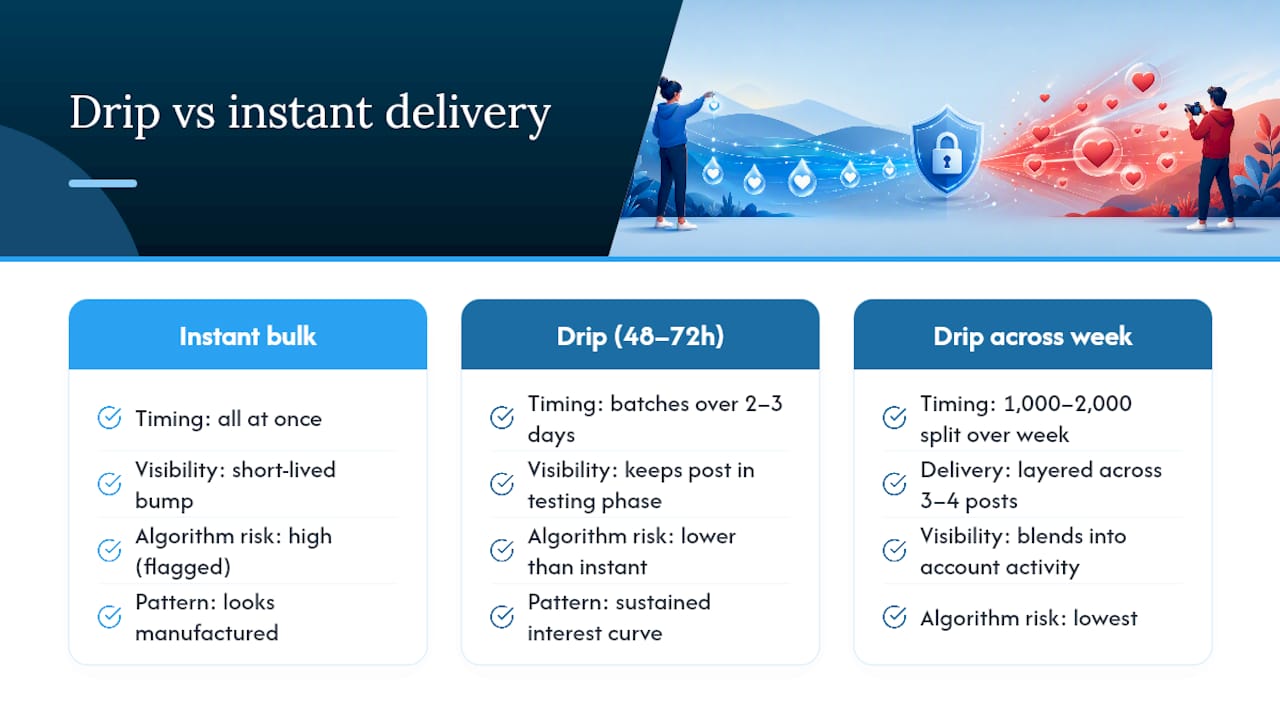
A useful comparison: an instant spike of 1,000 likes in 10 minutes on a 2,000-follower account is a statistical outlier that stands out immediately. The same 1,000 likes spread across 48 hours, in batches of 40 to 60 every couple of hours, blends into the account’s normal rhythm and is far harder to distinguish from organic interest.
Benefits and risks: when drip feed helps and when it backfires
Used sensibly, drip-feed likes solve a specific problem: they give a post the early push it needs to clear the algorithm’s first hurdle, without the artificial-looking spike that draws scrutiny. Consistent small boosts across several posts, rather than one dramatic jump on a single photo, tend to produce steadier reach over time.
The risks sit on the other side of the same coin:
- Policy violation. Every major platform bans purchased engagement in its terms, and enforcement teams do remove or suppress inauthentic activity when they catch it.
- Wasted spend. Removed likes mean you’ve paid for engagement that vanishes, sometimes taking momentum with it.
- Credibility loss. Likes from clearly irrelevant or low-quality accounts, if visible, undermine trust faster than having fewer likes ever would.
The right use case is amplifying a post that already has decent creative and a fighting chance organically, not propping up content nobody would engage with anyway. A red flag worth heeding: if you find yourself increasing volume every week just to maintain the same appearance of traction, that’s a sign the strategy has become a crutch rather than a boost.
Pro Tip: Cap any single drip campaign at a volume your account could plausibly earn organically within that window. If your account averages 40 likes a post, ordering 3,000 drip-fed likes on one photo will look exactly as odd as an instant spike, just spread over more hours.
How to run a safer drip-feed campaign
Getting the settings right matters more than picking a big number and hoping for the best. Here’s a practical sequence to work through before you commit to a campaign.
- Size the batch to your account, not the package on offer. A 500-follower account and a 50,000-follower account shouldn’t run the same drip settings. Match batch size and interval to your typical organic engagement velocity, scaling up only as your baseline grows.
- Pick a delivery window that suits the post. Time-sensitive content (a launch, an event) suits shorter windows measured in hours to a couple of days; evergreen posts can sit inside the 7 to 30 day range with no urgency.
- Pair the likes with real signals. Likes without comments, saves or shares create an engagement ratio that looks lopsided. Combining drip-fed likes with genuine replies and consistent posting makes the whole picture more believable, and tightening your captions and hashtags helps the organic side keep pace.
- Watch your Insights, not just the like count. Reach, saves, and profile visits tell you whether the boost is translating into anything beyond a bigger number. A sudden drop in any of these mid-campaign is worth investigating before you order more.
- Know the advanced version exists, but don’t rush into it. Experienced marketers sometimes run staggered, overlapping campaigns, a longer follower drip running alongside shorter like campaigns on recent posts, to create varied engagement waves that look even less uniform. It adds complexity and monitoring overhead, so it’s worth mastering single campaigns first.
Pro Tip: Stagger campaigns across your last three or four posts rather than betting everything on one. It spreads the signal and gives you a natural-looking pattern of “recent posts doing well” instead of one outlier.
Why Greedier Social Media’s approach is a practical option
If you’d rather hand the mechanics to someone who runs them daily, a specialist provider can offer social engagement packages for creators and businesses. The model is built around two things that matter most once you’ve read this far: security and pacing.
- No password required. Orders are fulfilled without ever asking for your account login, which removes one of the biggest risk points in this entire category.
- Delivery may be targeted to a relevant audience depending on provider services.
- Gradual, sensibly paced delivery that follows the same principle covered above: batches and intervals designed to look like normal account activity, not a sudden spike.
- Support you can actually reach if a campaign needs adjusting or a question comes up mid-order.
Anyone who wants to see how this looks in practice for a specific platform can check the Instagram likes service for the current package structure before deciding whether managed delivery suits their account better than running it themselves.
What drip-feed campaigns actually look like in practice
A small independent clothing brand launching a new product line typically won’t see a single post go viral from paid likes alone. What tends to happen instead: a drip campaign on the launch photo, delivered over three or four days in batches spaced a few hours apart, keeps the post visible to the algorithm for longer than an unassisted post would manage. Combined with a handful of genuine comments and shares, the post accumulates a following curve that looks like sustained interest rather than a manufactured spike.
Creators running Reels see a similar pattern. A Reel drip-fed likes over 48 hours, paired with engagement-focused editing choices, often holds its position in the algorithm’s testing phase longer than a Reel that gets no early support at all and drops out of circulation within hours.
The common thread across these scenarios isn’t the size of the order. It’s the pacing. A creator who orders 2,000 likes delivered instantly on one post usually sees a short-lived bump that platforms are quick to flag if the ratio to followers looks implausible. The same 2,000 likes spread across a week, layered over three or four posts instead of one, tends to hold up better and blends into a broader pattern of account activity that looks like it belongs there.
None of this replaces a strong hook or decent visuals. Drip-feed works as an amplifier on content that already has something going for it, not as a fix for a post nobody would otherwise stop scrolling for.
Drip-feed likes vs organic growth: what the numbers actually mean
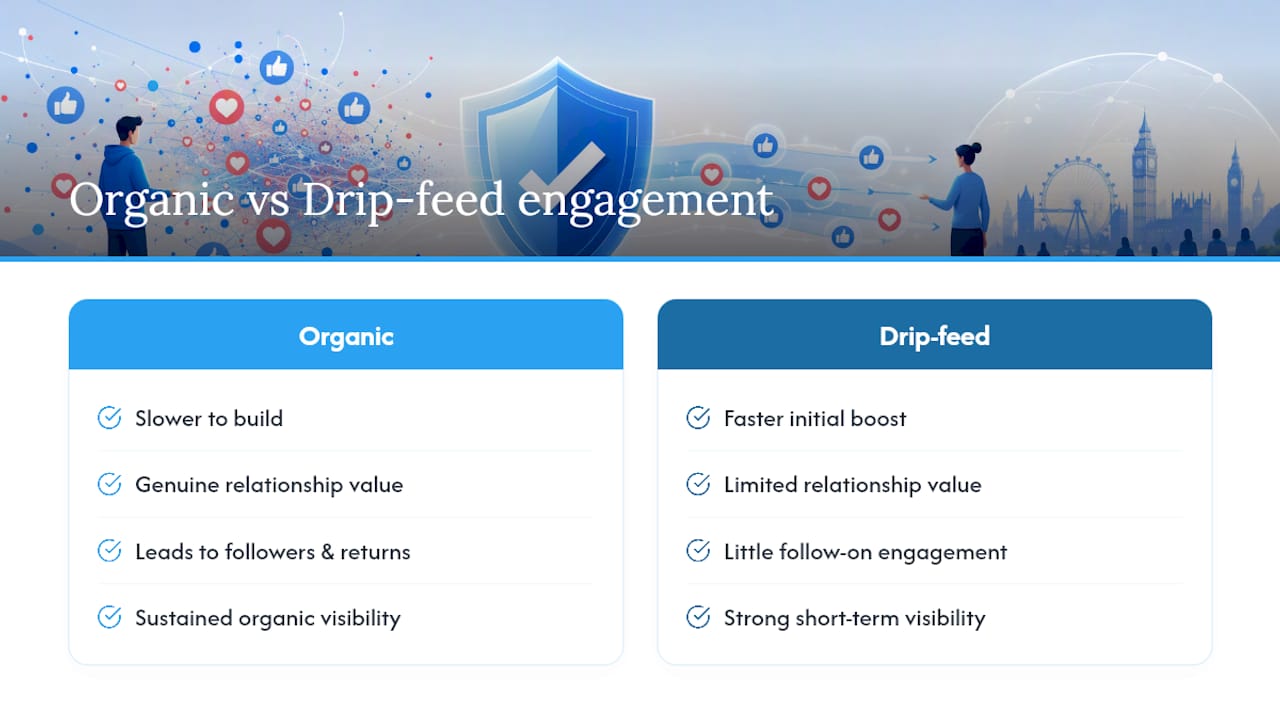
Organic growth compounds. A post that earns likes because people genuinely stopped to engage tends to bring some of those people back, follow the account, and interact with the next post too. Drip-fed likes don’t carry that same follow-on effect. The accounts liking a drip-fed post, particularly on cheaper packages, often have no ongoing relationship with your content once the campaign ends.
Where drip-feed earns its place is in the gap organic growth leaves open: the cold start. A new account or a quiet post has no early momentum to build on, and platforms are reluctant to distribute content with zero traction. A modest, well-paced drip campaign gives a post enough of an initial push to clear that first algorithmic filter, the same one organic accounts clear naturally once they’ve built an engaged following.
The honest comparison looks like this: organic engagement is slower to build but carries genuine relationship value, comments that lead to sales, followers who return, shares that reach new audiences. Drip-fed likes move faster but the value is mostly limited to the visibility boost itself, unless it’s paired with content strong enough to convert that visibility into real interaction. Used together, a paced drip campaign supporting a post that’s already got solid organic bones, the two aren’t in competition. Used as a replacement for organic effort entirely, drip-feed likes tend to plateau fast because there’s no underlying relationship keeping people coming back.
Is buying drip-feed likes legal and where does the ethics get murky?
Buying likes isn’t illegal in the UK in the sense of criminal law, there’s no statute banning a consumer from purchasing social media engagement. The complication sits entirely with platform terms of service, which is a contractual matter between you and the platform, not a legal one between you and the state.
Every major platform’s terms explicitly prohibit inauthentic engagement, and enforcement teams do act on it, removing likes, limiting reach, or in repeat cases suspending accounts. That’s the real risk, a platform-level consequence rather than a legal one, but it’s worth taking seriously if the account in question is generating income.
The ethical question is separate again. A brand presenting purchased likes as a genuine measure of audience interest, particularly to potential sponsors or investors who might make decisions based on that number, is presenting a misleading picture. That’s a reputational risk as much as an ethical one: credibility, once questioned, is hard to win back. The practical middle ground most marketers land on is treating paid engagement as a visibility tool rather than a metric to publicise, and keeping the bulk of any public-facing engagement figures grounded in what the content has genuinely earned.
When should a marketer choose drip-feed over organic-only growth?
The account’s stage matters more than the marketer’s preference here. A brand-new account with nothing to point to yet gets real value from a modest drip campaign, it solves the cold-start problem organic strategies can’t fix quickly on their own. A mature account with an established audience gets much less from it, and risks more credibility if the boost looks disproportionate to its usual numbers.
Budget and credibility trade off against each other too: spending on drip-feed to buy time while you build genuinely strong content is a reasonable bet, spending on it instead of building that content is money that won’t compound. My rule of thumb: use drip-feed to give good content the early push it deserves, never to disguise content that wouldn’t otherwise earn attention.
— Luna
Get gradual delivery done properly with Greedier Social Media
Running your own drip campaign means juggling batch size, interval timing, and constant monitoring, on top of everything else on your plate. Greedier Social Media handles that pacing for you, delivering real engagement to UK accounts without ever asking for your password, so you get the natural-looking growth curve this guide has walked through, minus the manual setup.
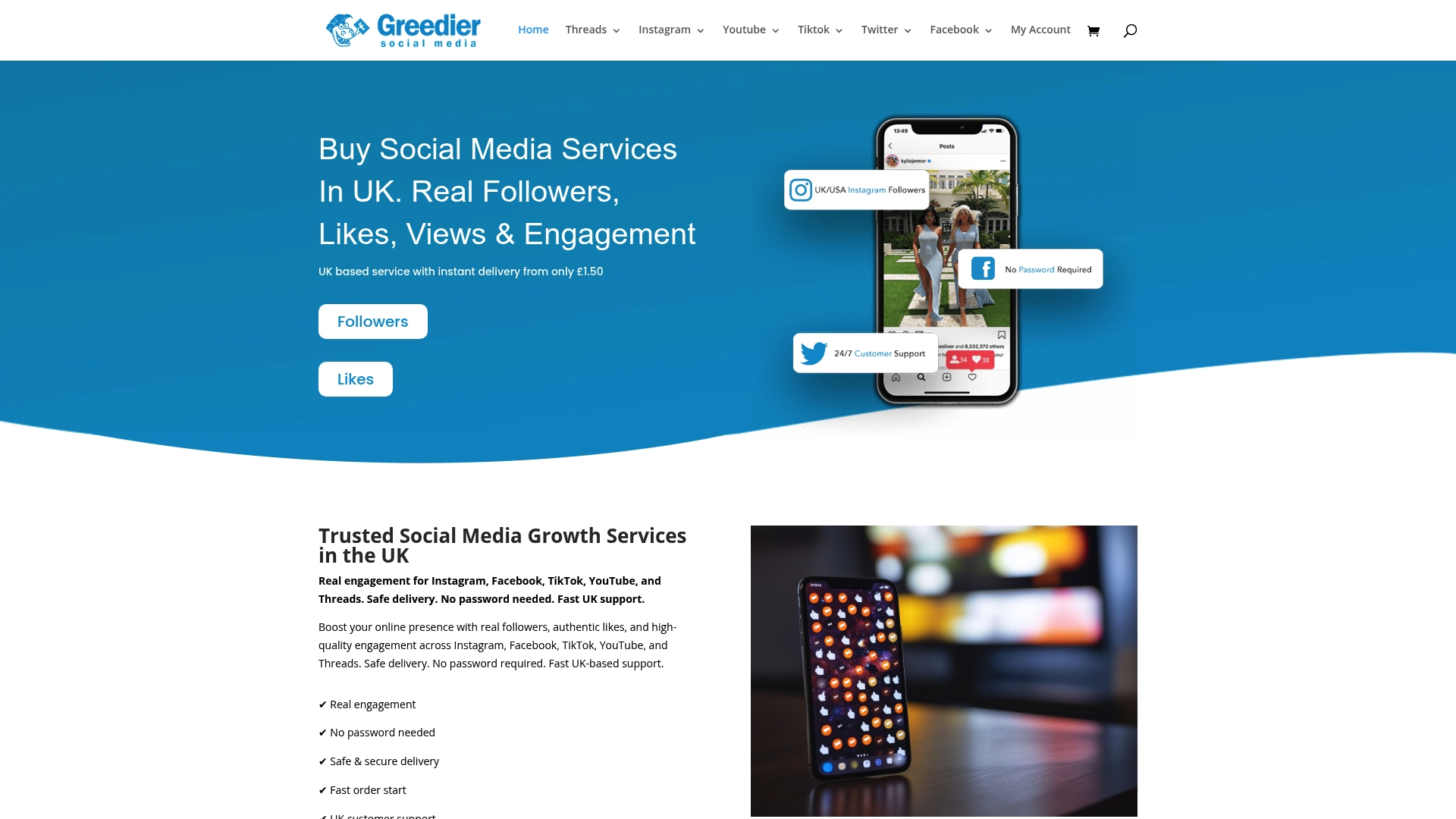
Packages cover likes, followers and views across Instagram, Facebook, TikTok, YouTube and Threads, all built around the same gradual, sensibly paced delivery principles covered above. If a post or profile needs an early push rather than a risky overnight spike, the Instagram likes packages show current options and pricing, and you can get a quote or place an order in a few minutes without handing over any account credentials.
Drip Feed Likes: Sources
- 25 Proven Ways to Get More Likes On Instagram (2026 tips)
- What “Like IG” Actually Means — And How to Get More Instagram Likes in 2026 – Pedro Vaz Paulo Coachings
FAQ
What does the slang term “drip-feed” mean?
“Drip-feed” originally describes releasing something gradually and continuously, like an IV drip, rather than all at once. Applied to social media, it means delivering engagement or content in small, spaced batches instead of a single burst.
How much does it cost to buy 1,000 Instagram followers?
Pricing varies widely by provider, delivery speed and follower quality, so there’s no single standard rate across the market. Check a specific Instagram followers package for current UK pricing rather than relying on a generic figure.
What is drip-feed content, and is it different from drip-feed likes?
Drip-feed content usually refers to scheduling posts or assets to publish gradually over time, a content strategy rather than an engagement tactic. Drip-feed likes is a delivery method for purchased engagement, spreading likes across batches and intervals rather than releasing them instantly.
What does it mean to “drip-feed” something in general use?
Outside social media, to drip-feed something means giving it out in small amounts over an extended period rather than delivering it all at once. The same logic applies whether you’re talking about information, funding, or, in this case, likes on a post.
Does drip-feed delivery guarantee my likes won’t be removed?
No method removes all risk, since platforms can still detect and act on inauthentic engagement regardless of pacing. Gradual delivery lowers the chance of triggering spam filters compared with an instant spike, but choosing a reliable, password-free provider and pairing it with genuine engagement gives you the best odds of a campaign holding up.