
Brands cannot see a creator’s follower list the way the creator can, so they judge an account by its pattern: how the following grew, who engages, where the audience lives and whether likes, comments and views line up across posts. If you buy followers, the aim is an audience that passes those checks, which means real-looking profiles, a UK-relevant audience and engagement that matches your following. That is the standard we build our packages around at Greedier Social Media, and the rest of this guide shows you what brands look at and how to present a profile that holds up.
TL;DR
- Brands rarely rely on one number. They read the shape of your data: the growth curve, comment quality, audience geography and engagement across many posts.
- No single tool settles the question. Agency practitioners combine software flags with a human review of comments, content and location.
- Audience location matters most for UK brands: a following concentrated in countries the brand does not sell to is a red flag.
- Followers alone are not the whole picture. Likes, views and comments that fit your follower count are what make an account look healthy.
- Our UK-targeted, password-free packages cover followers, likes and views, so your audience and engagement can move together.
Table of Contents
- What a brand can and cannot see
- The signals brands check
- Why a follower count on its own is never enough
- A quick self-audit before you pitch a brand
- Why tools disagree, and what that means for you
- Tailoring your presence by platform
- Going deeper on the warning signs
- Perspective
- Choosing a package that fits your account
- FAQ
- Sources
What a brand can and cannot see
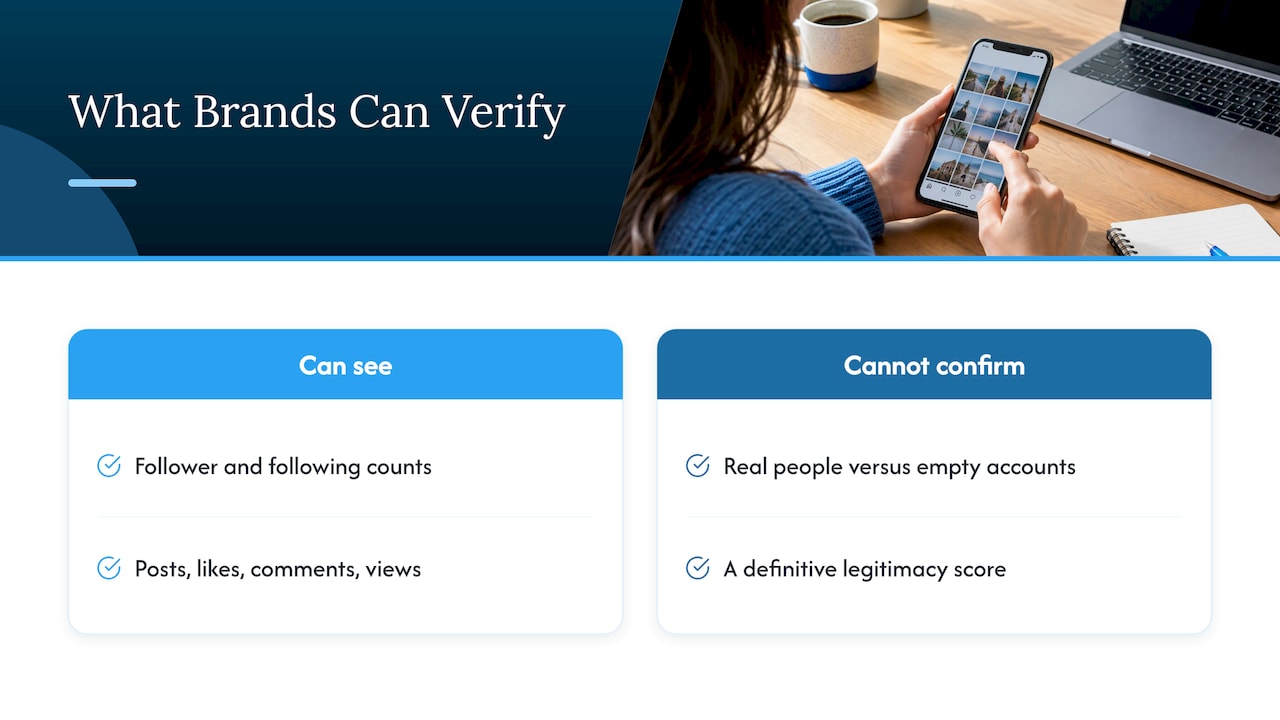
A brand evaluating you sees your public profile: follower count, following count, posts, likes, comments and views. It cannot open your follower list and sort real people from empty accounts with certainty. Reporting by Digiday in 2024 quotes influencer-agency practitioners who say no single tool reliably determines whether an influencer’s following is legitimate. Their approach is to let software shortlist or flag creators, then have a person read the comments, judge content quality and check the audience fits the market.
That is useful for you to know. It means a brand’s verdict comes from several signals taken together, and each one is something you can look at yourself before a brand does.
The signals brands check
1. The growth curve
A brand scrolling your history is looking for sudden jumps that no post explains. A guide written for UK brands lists unexplained follower jumps among the common warning signs. A jump that follows a viral Reel or a collaboration has an obvious cause. A jump with no cause invites questions.
What this means for you: keep a record of what drove each rise. A product launch, a giveaway, a feature on another page. If you add followers through a package, plan content around that moment so the curve has a story.
2. Comments
Generic, repeated comments (a string of emojis, or the same short phrase under every post) are one of the first things a reviewer reads. Comments that mention the content are the opposite signal. The same UK-focused guide names repeated generic comments as a warning sign.
What this means for you: reply to comments, ask questions in captions and pin the best ones. A comment section that shows conversation reads as a community.
3. Who the followers are
Reviewers sample followers and look at the profiles: a photo, a bio, some posts, a plausible following list. Tools score this too. For Instagram, one detection platform explains that its audience-credibility model considers profile images, follower patterns, account age, posting activity, bio completeness and growth patterns. Those are exactly the traits of an ordinary account.
The same page adds a point worth remembering: some suspicious-looking followers accrue organically, so a perfect score is not a realistic expectation for anyone. Brands know this. They are looking for a pattern, not a flawless audience.
4. Audience location
For a UK brand, this is often the deciding check. An audience concentrated in countries where the brand does not sell is flagged as a mismatch, however large it is. Brands ask for native analytics showing reach, audience location and age, including the UK audience share.
This is where targeting pays off. Our followers, likes and views are UK-targeted (with UK/USA targeting available), so the audience on your analytics screen looks like the market a UK brand wants to reach.
5. Engagement across posts, not one post
Brands compare likes, comments and views across many posts and over time, rather than judging a single post. The same UK guide recommends reviewing roughly a year of posts and checking they hang together.
There is a trap in simple rules of thumb. Kolect, an influencer-analytics company, reports a median Instagram engagement rate of 0.82% in its own creator database and warns that a flat 1% cut-off would wrongly flag many ordinary accounts. Engagement should be compared with creators of similar size on the same platform. So a brand is asking whether your numbers look like your peers’, not whether they hit an arbitrary target.
Why a follower count on its own is never enough
Most of the checks above are about what surrounds the followers. An account with 20,000 followers and 40 likes per post looks out of balance, whatever the source of the followers. An account with 5,000 followers, steady likes, views on every Reel and real comments looks healthy.
That is why we sell the full set, not just followers:
| What brands compare | What supports it | Our related service |
|---|---|---|
| Follower count against a UK audience | UK-targeted followers | Instagram followers from £1.99 |
| Likes per post against followers | Likes on recent posts | Instagram likes from £0.99 |
| Views on Reels and videos | Views that match your reach | Reel views from £0.59 |
| Steady growth over weeks | Monthly top-ups | Auto Instagram followers, £15.00 to £100.00 per month |
| Consistent likes on every post | Likes on each new post | Auto Instagram likes from £9.99 per month |
Prices are as published on our site and are one-off packages unless marked per month.
A quick self-audit before you pitch a brand
Do this the way a brand would, ideally 10 minutes at a time.
- Scroll back a year. Note every follower jump and write down what caused it. If you cannot explain one, make sure your next posts give the audience a reason to stay.
- Read your last 20 comments. Count how many mention the content. Reply to the ones that do.
- Compare three posts. Likes, comments and views should be in a believable proportion to each other and to your follower count.
- Open your insights. Check audience country and age. For UK brand deals, the UK share is the number they will ask about.
- Compare with peers. Look at three accounts of a similar size in your niche, on the same platform, and see where you sit.
- Prepare to show it live. Kolect notes that creator-provided screenshots can be cropped or edited, so brands increasingly ask for a live screen recording of native analytics. Have your insights ready to share that way.
If your numbers are lopsided, the fix is usually balance: more likes and views to match the following, or a UK-targeted follower top-up that brings your audience location in line with the market you are pitching to.
Why tools disagree, and what that means for you
Audit tools do not agree with one another. Phyllo, another analytics company, explains that there is no agreed ground-truth definition of a fake follower, so tools using different samples and definitions return different scores. The same article points out that low engagement alone does not prove followers were bought: dormant real users and mismatched real followers look similar.
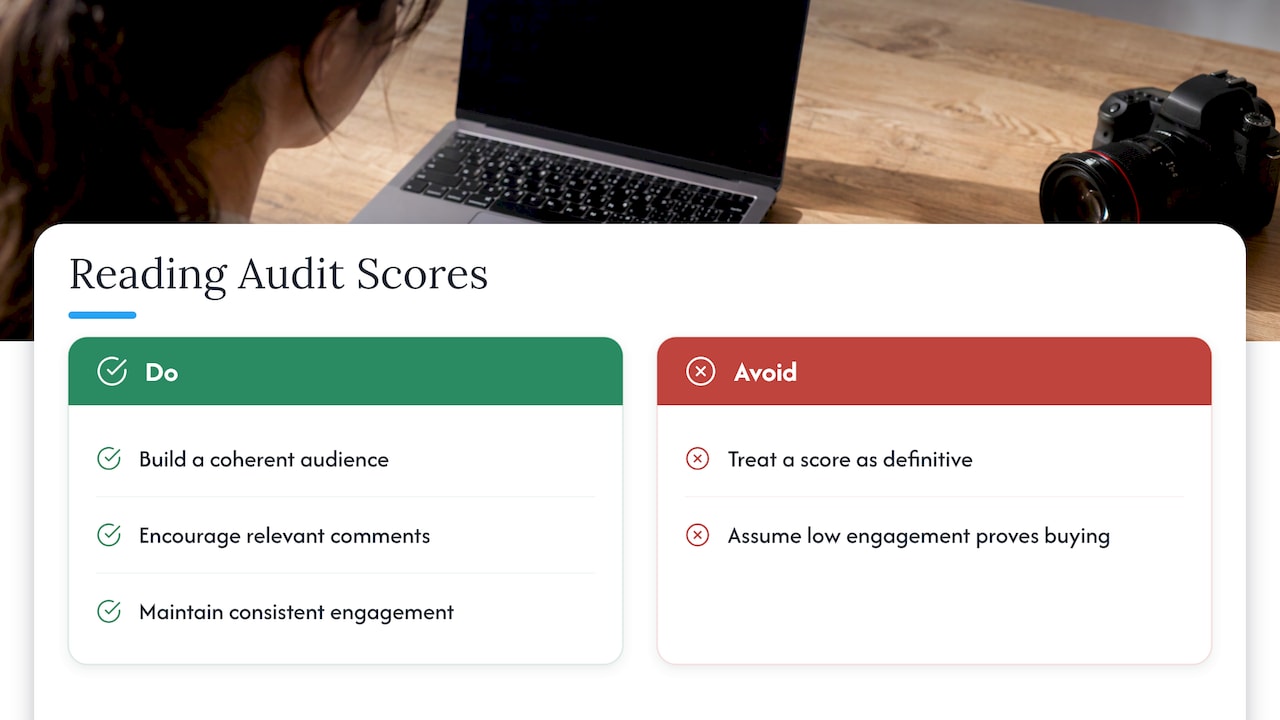
For a creator or small business, that is reassuring. A brand reading a percentage score treats it as an estimate. What persuades them is the full picture: a coherent audience, relevant comments and consistent engagement. Build that picture and a single tool score matters less.
Tailoring your presence by platform
Instagram. Brands look hardest here. Keep followers, likes and Reel views in proportion. Our Instagram packages cover followers, likes, video views, IGTV views and Reel views.
TikTok. Views drive discovery, so views and likes carry as much weight as followers. If you are weighing the two, our guide on TikTok followers versus video views explains how they work together.
YouTube. Subscribers, views and likes should look like a normal channel. We compare them in YouTube subscribers versus video views.
Facebook. Page followers, Page likes and post likes are all available, so a business page can show a following and engagement on its posts together.
Going deeper on the warning signs
If you want the full list of what reviewers look for, we cover it in common fake follower warning signs and in how to spot fake engagement in influencer marketing. For the difference between an audience that interacts and one that merely exists, read our guide to authentic engagement. If you want to understand how a provider’s delivery should look, how to verify followers and vet a provider walks through it.
If your concern is how far a following goes toward credibility, how many followers you need to be credible gives practical ranges by account type.
Perspective
We have worked with UK businesses and creators since 2013, and more than a million customers have used our services. The question we hear most is not whether a following can be built quickly, but whether it will stand up when a brand looks closely.
Our answer is that brands judge patterns, so the pattern is what you should invest in. Real engagement, delivered to a UK-targeted audience, with followers, likes and views moving together, gives a reviewer a coherent account to assess. That is why our packages cover all three and why we deliver without asking for your password: your login stays with you.
Speed matters to a small business that has a launch or a pitch coming up. Instant delivery means your numbers are in place when the opportunity arrives, and our UK-based support is there if you want help choosing a package that fits your account.
Pair that with good content and replies to your comments, and your profile tells one consistent story.
Irwin Lee
Choosing a package that fits your account
If you are preparing for brand outreach, our Instagram followers start at £1.99 and run up to £229.99 one-off, with likes from £0.99 and Reel views from £0.59. For steady growth, auto followers run from £15.00 to £100.00 per month and auto likes start at £9.99 per month. TikTok followers range from £3.99 to £399.99, YouTube subscribers from £11.99 to £259.99, and Facebook Page followers from £3.99 to £149.99.
Our packages deliver real engagement, UK-targeted and instantly, with no password needed. You can browse everything on our Instagram page or start from the Greedier Social Media home page.
On ad accounts, remember the audience also matters for paid campaigns: see how followers affect ads.
FAQ
Can brands tell if I have bought followers?
A brand cannot see your follower list in full, so it judges the pattern: growth history, comments, a sample of follower profiles and your audience location. Practitioners say software flags creators and people then review the context. An account with a believable audience and balanced engagement gives them little to question.
What do brands look at first?
Usually the growth curve and the comments, because both are visible without any tool. After that they ask for native analytics showing audience country and age. For UK campaigns, the share of your audience in the UK is the figure they care about most.
Is a low engagement rate proof of fake followers?
No. Engagement varies by platform and account size, and Kolect’s own data shows a median Instagram rate of 0.82%, so a fixed cut-off would flag many ordinary accounts. Brands compare you with similar creators on the same platform. Keeping likes and views in proportion to your following helps your numbers sit within that range.
How can I show a brand my analytics?
Offer a live screen-share of your native insights rather than screenshots, which can be cropped or edited. Show reach, audience location and age. Have a year of posts ready so they can compare engagement over time.
Sources
- How influencer agencies vet and navigate past fake influencers and followers (Digiday)
- Fraud Guide: Influencer Checks for UK Brands
- Fake followers 101: Understanding audience quality (Modash Help Center)
- How to identify fake followers: 10-minute check (Kolect)
- Fake Follower Detection: The Signals and Where They Fail (Phyllo)