
Instant likes are a one-off order: you pick a post, pay once, and the likes arrive on that post. Auto likes are a monthly subscription: every new post you publish is detected and receives likes without you ordering again. Choose instant for a single post that matters. Choose auto for an account that posts regularly and needs every upload to look active from the first minutes.
That is the short answer. The rest of this guide covers how each works, what they cost, what the timing settings do, where the risks sit, and what to do if you would rather not pay for likes at all.
TL;DR
- Instant likes are a one-off purchase for a specific post. Our Instagram likes packages run from £0.99 to £189.95.
- Auto likes are a recurring plan that tops up every new post. Ours start from £9.99 per month.
- Delivery speed matters less than who the likes come from and how steadily they arrive. Real-looking, steady engagement beats a sudden spike.
- Paid engagement carries platform and UK advertising risk. Know both before you buy, and disclose paid partnerships properly.
- Post twice a week or less? Instant. Post most days? Auto.
Table of Contents
- What each option actually means
- How the two compare
- When instant likes are the better choice
- When auto likes are the better choice
- Delay, frequency and speed: the settings that matter
- The risks, stated plainly
- Our view: what we have learned serving UK accounts
- Which one should you pick? A quick decision guide
- A worked example
- Doing it without paying for likes
- Our Instagram likes options
- FAQ
- Sources
What each option actually means
Instant likes (sometimes called one-time likes) are bought per post. You paste the link to a post, choose a quantity, check out, and the likes are delivered to that post. When you want likes on the next one, you order again.
Auto likes (also called automatic likes) are a subscription. You give the service your public profile name, and it watches for new uploads. When you publish, it sends the likes included in your plan to that post, then does the same for the next one. You set the plan once and it keeps working until you cancel.
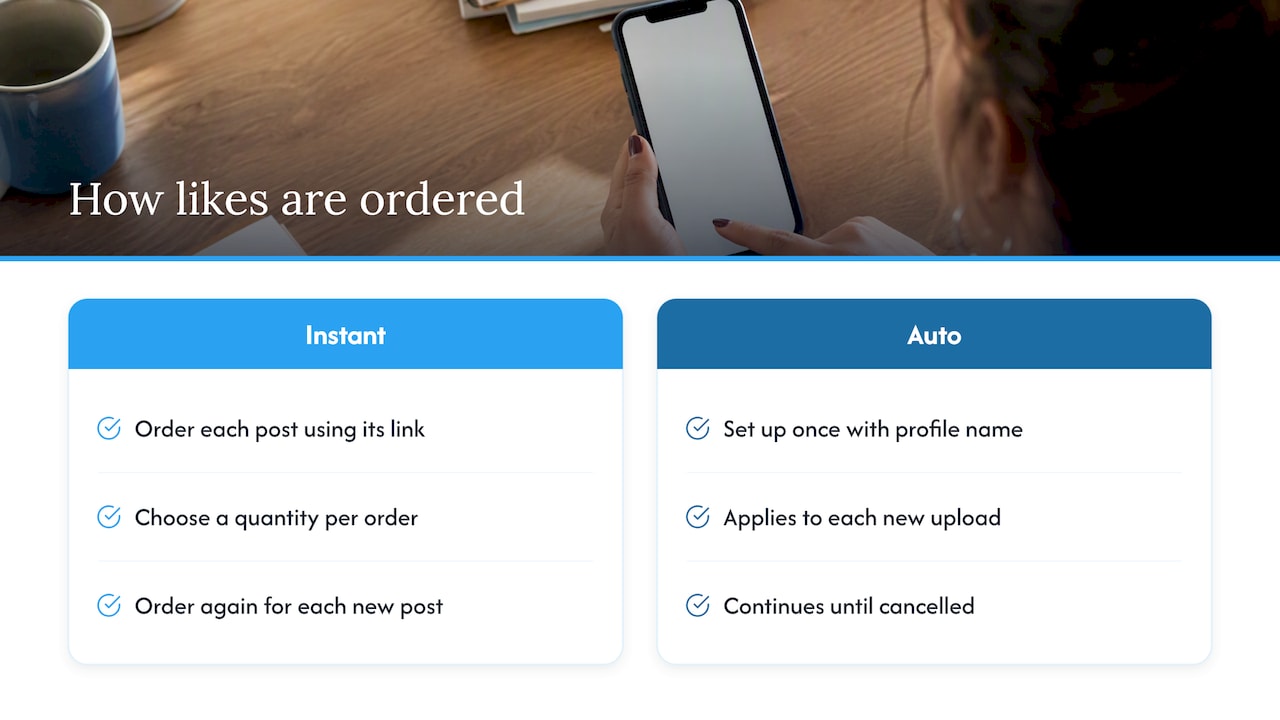
The confusion in the phrase “auto likes vs instant” comes from the fact that these are not opposites. “Instant” describes how quickly a purchase lands. “Auto” describes whether you have to keep ordering. A subscription can deliver quickly, and a one-off order can be spread out over time. What you are really choosing between is one post at a time and every post, automatically.
How the two compare
| Instant (one-off) | Auto (subscription) | |
|---|---|---|
| Payment | Once per order | Monthly |
| Applies to | One post you choose | Every new post |
| Effort | Order each time | Set up once |
| Best for | Launches, campaigns, a post that needs a push | Regular posters, brand accounts, creators |
| Cost control | You pay only when you order | Predictable monthly spend |
| Risk of forgetting | High: a post goes live with no activity | Low: handled at publishing |
| Our price | £0.99 to £189.95 | From £9.99 per month |
The prices are those published on our site for Instagram likes and the auto likes plan, and they are the ones you will see at checkout.
When instant likes are the better choice
Instant likes suit moments, not routines. Think of:
- A product launch or announcement post. One post carries the whole campaign, so you want it to look lively when people arrive from a newsletter or a story.
- A reel you plan to promote. If you are putting ad budget behind a post, early engagement gives new viewers something to react to.
- A trial. If you have never bought engagement, a small order on one post shows you how delivery works before you commit to anything recurring.
- An irregular posting pattern. A subscription you barely use is money wasted. A café that posts a few times a month is better paying per post.
The weakness is obvious: if you post often, you will be ordering again and again, and the one post you forget to top up will look flat next to the others. We cover that consistency problem in more detail in our guide to auto likes versus one-time purchases.
When auto likes are the better choice
Auto likes suit accounts where consistency is the point.
- Brands that post several times a week. Each post gets its early engagement without anyone remembering to place an order at 8am.
- Creators who post at fixed times. The service reacts to the upload, so your launch window is covered.
- Agencies and marketers handling several accounts. One recurring plan per account removes a daily chore.
- Accounts that want an even grid. Wildly different like counts from post to post look odd to a new visitor. A steady baseline looks like a steady audience.
The trade-off is commitment. You pay monthly whether you post three times or thirty, so match the plan to your real posting rate. If you want the full picture of how a subscription behaves, see our auto likes subscription guide.
Delay, frequency and speed: the settings that matter
Readers often ask about delay, frequency and speed settings. Different providers expose different controls, so check what your plan page offers before paying. The principles behind them are the same everywhere.
Speed. Faster is not automatically better. A post that jumps from nothing to hundreds of likes within seconds looks very different from one that climbs over several minutes. If a provider lets you choose, a quick start followed by a steady climb looks closest to how real attention behaves. We deliver instantly and without needing your password, which is why you only ever hand over a post link or public username.
Delay. A short delay between publishing and the first likes can look more natural than a like landing the second a post goes live. Real followers take a moment to see a notification. If your plan has no delay control, that is fine: the ordering of the climb matters more than the first second.
Frequency. For auto plans, frequency is simply how many posts per month the plan covers and how many likes each receives. Work it backwards: posts per month multiplied by likes per post gives the monthly total. Size the plan to the posts you will actually publish, and keep the like count in a believable range for your follower count. A 600-follower account with 5,000 likes per post invites questions.
A practical rule: set the like count to roughly what a healthy, engaged post on your account might earn organically, then let real engagement add to it.
The risks, stated plainly
Paying for engagement is not risk-free, and any provider telling you otherwise is selling, not advising.
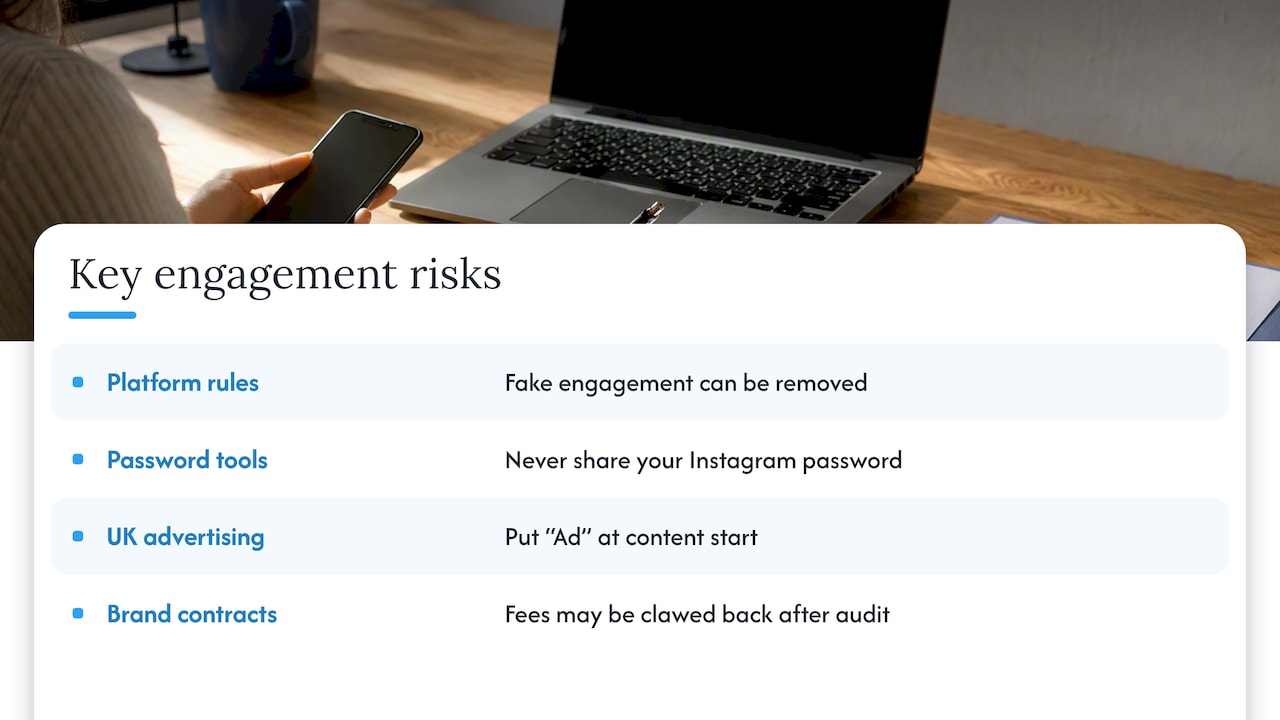
Platform rules. Instagram has said it uses machine learning to identify and remove accounts that use third-party apps to inflate their audience, and it removes the inauthentic likes, follows and comments those accounts generate. Meta also revised its inauthentic behaviour policy in December 2025, consolidating it around deception and evasion of enforcement. The practical consequence: engagement that looks fake can be removed, and the risk rises with scale and sloppiness.
Password-based tools. Any service that asks for your Instagram password is handing a stranger the keys. This is the single clearest dividing line. We never ask for it.
UK advertising rules. The ASA’s guidance is that influencer marketing must be obviously identifiable as advertising under section 2 of the CAP Code. ProfileTree’s UK guide adds that a discount code or a link on its own is not enough, and that a clear label such as “Ad” should come at the start of the content. If you are a creator and a paid partnership post has been boosted with bought engagement, the amplification may itself need thought.
Brand contracts. The same source notes that brand contracts often allow fees to be clawed back if non-organic engagement is found during an audit. If you work with sponsors, read your contract before ordering anything for those posts.
None of this means paid likes are pointless for a small business trying to look credible to a first-time visitor. It means they are a tool with limits, not a substitute for content people want to see.
Our view: what we have learned serving UK accounts
We have been doing this since 2013 and have served over a million customers, so we have seen the same mistakes repeatedly.
The commonest is treating likes as the goal. They are a signal. A new visitor lands on a profile, sees a post with a handful of likes and a post with a decent crowd, and makes a snap judgement about whether this account is worth following. Likes help with that first impression. They do nothing for the second, when the visitor reads the caption and decides whether you are useful.
The second mistake is mismatch: an instant purchase for an account that posts daily, or a subscription for an account that posts monthly. Count your posts before you choose.
The third is ignoring where the likes come from. Our position is that engagement should come from real accounts, delivered without a password and aimed at UK and USA audiences, because a UK shop followed by accounts from nowhere near its delivery area looks wrong to anyone who checks. If a provider cannot tell you what kind of accounts it uses, walk away.
Our honest advice: use paid likes to remove the empty-room effect, and put your energy into the content and community that make people stay.
— Irwin Lee
Which one should you pick? A quick decision guide
Answer these in order:
- How many times do you post per month? Fewer than about eight: instant. More: look at auto.
- Is one post carrying a campaign? Yes: instant, sized for that post.
- Do you need every upload to look active at launch time? Yes: auto.
- Can you commit to a month? If not, start with a small instant order.
- Do you work with sponsors? Read your contract first, whichever you choose.
A sensible pattern for many small businesses is to start with one small instant order, watch how the post performs over a few days, and only then move to a monthly plan if posting is regular.
A worked example
Take a UK bakery with 1,800 followers that posts five times a week. Its organic posts earn 30 to 60 likes. Ordering instant likes for each post means about twenty orders a month, each requiring a link and a checkout. A subscription removes that work, and the owner only decides the monthly level once. If the bakery then runs a seasonal reel it wants to push harder, it can add a single instant order on that post.
Now take a freelance photographer who posts two portfolio pieces a month. A subscription would be paid for roughly two uses. Two small instant orders cost less and give her control over which pieces get the push.
The same service, two different answers. Your posting rate decides it, not the label.
Doing it without paying for likes
Paid likes should sit alongside organic work, not replace it. If you want likes that come from people who actually care, the basics are unglamorous:
- Post when your audience is online and reply to comments quickly.
- Use captions that ask a specific question rather than a generic prompt.
- Lead with a strong first frame on reels.
- Collaborate with local accounts who share your customers.
We lay these out in how to increase your Instagram likes organically and creative ways to increase your Instagram likes.
For businesses that want growth tied to sales, a fixed-fee social media strategy for ecommerce brands is the kind of outside help worth considering. If you run a restaurant or café, loyalty and marketing ideas for restaurants show how repeat customers can be built outside the feed altogether.
Our Instagram likes options
If you have decided which model fits, this is what we offer:
- One-off Instagram likes: from £0.99 to £189.95, applied to the post you choose.
- Auto Instagram likes: from £9.99 per month, applied to your new posts.
- Auto Instagram followers: £15.00 to £100.00 per month, if you want your follower count to move steadily as well.
Delivery is instant, needs no password, and comes with UK-based support if you have a question before or after ordering. Start with the Instagram packages, or read about our automatic Instagram likes before you subscribe.
FAQ
What does auto likes mean?
Auto likes are likes delivered automatically to each new post you publish, usually through a monthly plan. The service watches your public profile and sends the agreed number of likes when a new post appears. You do not need to place a new order for every upload.
Are auto likes the same as instant likes?
No. Instant likes are a one-off purchase for a chosen post, while auto likes are a recurring plan covering future posts. A subscription can still deliver quickly, so speed alone does not separate them. The real difference is whether you order post by post or once for everything.
Why is Instagram auto-liking posts on my account?
Usually because you have connected a third-party app, or you or someone with access has set up an automated service. Check your connected apps and change your password if you do not recognise one. Services like ours never need your password, so there is nothing to connect.
Is it safe to use auto likes?
It is lower-risk when the service uses no password, steady delivery and real-looking accounts, but it is never risk-free because Instagram removes inauthentic activity. Keep numbers believable for your follower count. If you are a creator with brand deals, check your contract first.
Sources
- Removing Fake Likes, Follows & Comments, Instagram
- Meta Has Streamlined its Community Guidelines Regarding the Inauthentic Behaviour, Platform Governance Archive
- Recognising ads: Social media and influencer marketing, ASA
- Types of Social Media Influencers: UK Costs & ROI, ProfileTree