

A large follower count alone doesn’t show whether a Facebook Page is working. There’s no single engagement-rate benchmark for every UK business: comments, shares, clicks and enquiries from the people you want to reach are more useful signs of relevance. For Facebook page growth in the UK, focus on local conversations, useful content, relevant Facebook groups and targeted ads. The right mix depends on your audience and business goals.
It’s understandable to want a clear benchmark. But an engagement rate is more meaningful when you consider who is interacting, what they respond to and whether those actions support your business. Local engagement can help make that picture clearer.
This article explains how to build engagement through conversations with followers and nearby businesses, targeted advertising, shareable content and Facebook groups. You’ll see how each approach can support Page growth, and why a steady, relevant presence is more useful than chasing empty numbers.
Key Takeaways
- Make follower conversations useful and timely, and build relationships with nearby businesses to encourage local interaction.
- Professional ad support can help promote relevant posts to audiences selected around your business goals and location.
- Influencer and customer-created content can add real-world perspectives when it fits your audience and brand.
- Facebook groups offer another way to join local discussions and connect with people around shared interests.
1. How professionals engage with followers and other local businesses
A professional Facebook Page starts with a clear business name, category and profile image. Complete the About section with accurate UK contact details, opening hours, location and a concise description of what you offer. Add a suitable call-to-action button, such as one that lets visitors contact your business, to give them a clear next step. Consistent branding across the cover image, profile image and posts helps visitors recognise your Page, and working with specialists such as Branding TITANS™ can help establish a distinct visual identity and clear messaging.
Day-to-day engagement needs a response plan, not just regular posting. Monitor comments and messages, answer practical questions in your business’s voice, and route enquiries to the right person. For example, a local café can answer a menu question directly, then share a relevant update instead of a generic sales message. Keep replies timely, useful and respectful, especially when feedback is critical.
Local relationships make social media more relevant. Identify nearby businesses, community organisations and events that share your audience, then engage through thoughtful comments or suitable shared posts. A bookshop, for example, might congratulate a neighbouring school on a community event. Make sure any collaboration works for both audiences and reflects your Page’s values. Genuine interaction builds recognition more effectively than repeated requests for follows.
UK promotions need careful wording. Follow Meta’s promotion policies and applicable UK advertising and consumer-protection rules. Clearly state the promoter, entry method, eligibility, closing date and prize terms, and don’t imply that Facebook sponsors or administers the competition. Meta’s ranking systems assess signals such as likely relevance and interactions to decide which posts to show; no single posting pattern guarantees reach. To set up and optimise a Page, create it, complete its business details, add an appropriate call to action, then review audience responses and adjust your posts. Bought likes carry a different risk: a large audience with little genuine interest can leave engagement looking weak, while inauthentic activity can raise platform-policy concerns.
2. Promoting posts and targeting audiences with professional ad support
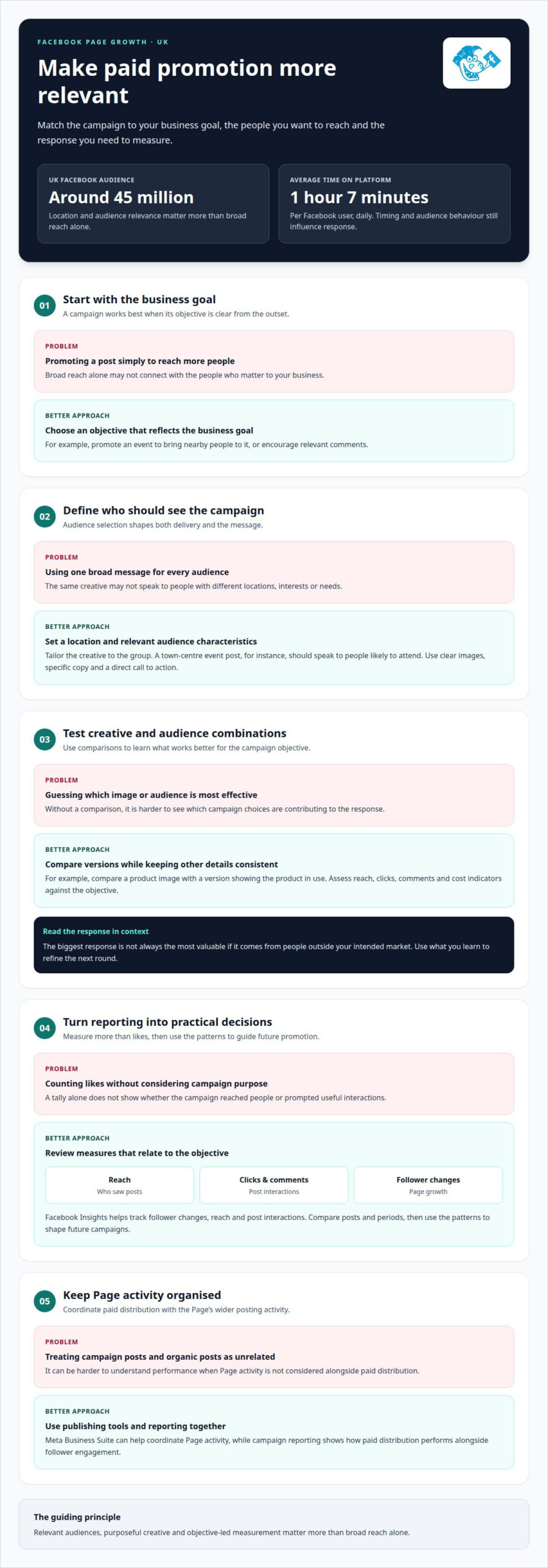
Paid promotion can extend a useful post beyond the Page’s existing followers. For Facebook page growth in the UK, a professional first matches the campaign objective to the business goal, such as bringing nearby people to an event or encouraging relevant comments. Facebook had around 45 million users in the UK, so location and audience relevance matter more than broad reach alone. A local tradesperson, for example, can focus promotion around the places they serve.
Audience selection shapes who sees each campaign. Define a location, interests and other available audience characteristics, then tailor the creative to that group. A post about a town-centre event, for example, should speak to people likely to attend rather than use the same message for every audience. Clear images, specific copy and a direct call to action make the purpose easier to understand.
Testing helps identify which combinations work better. Compare different creative or audience groups while keeping other campaign details consistent. For instance, one version might feature a product image, while another shows the product in use. Assess results against the campaign objective, including reach, clicks, comments and cost indicators, then refine the next round. The biggest response isn’t always the most valuable if it comes from people outside your intended market.
Publishing tools support this process by keeping campaign posts and organic posting organised. Meta Business Suite can help coordinate Page activity, while campaign reporting shows how paid distribution performs alongside follower engagement. The average Facebook user spends 1 hour and 7 minutes on the platform daily, giving businesses opportunities to appear in active feeds. Timing and audience behaviour still influence the response.
Facebook Insights helps you measure Page growth through follower changes, reach and post interactions. Compare those measures across posts and periods, then use the patterns to guide future campaigns. For example, stronger comments on a local announcement may suggest that community-focused content deserves further promotion. This supports Facebook page growth in the UK by turning reporting into practical decisions, rather than a tally of likes alone.
3. Sharing influencer and user-generated content with professional support
A content plan gives influencer and customer-created material a clear role on Facebook. Map themes to your business calendar, then schedule a mix of original posts, creator features and customer stories. A garden centre, for example, might pair seasonal planting advice with a customer’s finished garden. This keeps posting purposeful instead of relying on occasional reposts. You can also adapt suitable ideas for Instagram, tailoring each caption and format to that platform.
User-generated content gives followers a real example of a product or service in use. Before sharing a customer’s photo, ask permission, agree how to credit the contributor and keep the original context intact. A local restaurant could feature a diner’s meal photo with an agreed credit. This gives the post a specific story and recognises the contributor, rather than treating their content as free material.
Influencer content works best when the creator’s audience and style suit your business. Brief the creator on the intended message, provide accurate product details and review the final material for clarity. The result should sound natural to the creator’s followers, not like a copied advert. Facebook is a major video network: two billion people watch videos there every day. A short demonstration or local visit can give audiences a practical reason to stop and engage.
Professional content creation turns those ideas into assets suited to each placement. Facebook Reels are limited to 90 seconds, so a demonstration needs a focused opening and one clear takeaway. Stories expire after 24 hours, making them useful for timely updates, such as an event reminder. A publishing calendar can assign each asset a format, caption and posting date, then review comments and shares after publication. For teams looking to streamline their post drafting and marketing copy, explore Fismbot – Grow your business: AI social content and email tools, plus expert support for marketing, websites and technology that just works. Success means learning which stories prompt meaningful responses, not simply filling the Page with content.
4. Building and participating in Facebook groups with professional support
A Facebook group gives people a shared space to discuss a place, interest or customer need. More than 1.8 billion Facebook users are active in groups at least once a month. Around 52% find groups and discussions helpful for connecting around shared interests. For a UK business, the strongest fit is a clear community purpose, such as local gardening advice or independent retail recommendations, not a stream of sales posts.
Professional support can shape group guidelines, onboarding questions and a moderation approach before inviting members. For example, a neighbourhood food business could set rules against spam, explain which local area the group serves and welcome questions about seasonal produce. Regular prompts then give members a reason to contribute. A moderator can answer recurring queries, remove irrelevant posts and share useful Page updates without turning every discussion into advertising.
Groups can support a Page when each format has a distinct purpose. Share a Facebook post with a group only when it answers a current discussion, then adapt the topic into a Reel for people who prefer a visual explanation. Cross-post selectively: copying the same message everywhere can feel repetitive and may not suit each audience. Local examples, such as a market-day update or community-event reminder, make content more relevant.
To assess progress, professionals review membership trends alongside active discussions, useful comments and referrals to the Page. Raw numbers alone can hide whether members match the intended audience. A group serving a particular town, interest or generation needs posts that reflect those needs. If the goal is also to increase visible Page support, explore Facebook Page Likes as a separate option. Keep group conversations valuable first, so promotion supports a community rather than replacing it.
Greedier Social Media: Facebook Page Likes
Greedier Social Media offers Facebook Page Likes for businesses looking to increase the visible audience around their Page. This can complement local engagement, useful posts and group participation, but it doesn’t replace genuine conversations or guarantee that new followers will become customers.
Consider this option when you want to add a paid engagement measure alongside your wider Facebook presence. Keep your Page information current and your content relevant, so visitors can understand what your business offers and choose whether to interact. Greedier Social Media also offers Instagram Followers, Instagram Likes and Auto Instagram Followers for businesses building visibility across platforms.
For a straightforward next step, contact Greedier Social Media to discuss Facebook Page Likes.
Choose a clear next step for your Page
Set a practical objective for your Facebook Page before deciding what to prioritise. You might want to strengthen visible social proof, build recognition on Instagram or support a broader presence across platforms. A clear objective helps you judge whether each activity fits your business, rather than chasing growth for its own sake. Facebook Page growth in the UK is most useful when the audience and purpose behind it are aligned.
Greedier Social Media offers Facebook Page Likes, alongside Instagram Followers, Instagram Likes and Auto Instagram Followers. These options may suit businesses looking to add paid engagement to their social presence. They don’t replace relevant content or meaningful interaction, so keep your wider goals in view as you decide what support fits.
For a straightforward next step, Contact Greedier Social Media to discuss your needs. A considered plan can help you move forward with confidence.
Frequently Asked Questions
What is a good engagement rate on Facebook?
A useful reference point is Facebook’s average engagement rate of 0.15% per post, but it isn’t a universal target. Compare posts measured in the same way and consider reach, reactions, comments, shares and clicks together. A post reaching a smaller, relevant audience may matter more than one with broad exposure and few meaningful actions. Track the metric that matches the Page’s goal.
What are the best ways to grow a Facebook Page organically in the UK?
Organic growth comes from making your Page easy to find and worth following. Use a recognisable business name, accurate category and searchable description, then link to the Page from your website, email signature and other channels you control. Publish useful recurring features, such as a product-care tip or an answer to a common customer question. Invite satisfied customers to follow, but don’t make positive feedback a condition.
How often should UK Facebook Pages post, and what content performs best?
Post at a pace your business can sustain, then adjust based on audience response rather than following a universal schedule. Practical content can include stock updates, answers to common questions or a behind-the-scenes look at how a service works. Match each post to a clear audience need. If quality or response times suffer, reduce posting frequency before adding more content.
How can UK businesses target local customers with Facebook Page posts and ads?
Use location-specific wording in organic posts, such as the areas you serve, and connect updates to relevant local needs. For paid campaigns, set the geographic audience around your business’s service area, then tailor the copy and imagery. Separate campaigns when locations or customer groups have different needs. Compare enquiries and other useful actions from each audience, not reach alone.
How does Facebook’s algorithm rank Page posts and recommend content?
Facebook’s ranking systems assess signals such as likely relevance and interactions to decide which posts to show. No single posting pattern guarantees reach.