
Threads follower retention is the share of the people who follow you who are still following, and still seeing and reacting to your posts, weeks later. You keep followers by starting with an audience that fits your niche, posting on a steady rhythm and joining conversations. You prove it by tracking net follower change against your posts, not by watching one number. For UK businesses and creators, our Threads service delivers real followers without needing your password, and the routine below is what turns that starting audience into one that stays.
TL;DR
- Retention is not one number: compare net follower change, follower versus non-follower views, and replies, week by week.
- Small daily dips are normal. Accounts get removed, locked or go inactive, and followers come and go.
- Meta’s own advice is to post 2 to 5 times a week, reply, join topic-tag conversations and offer a distinct point of view.
- Followers stay when they know what to expect from you: pick a niche and keep to it.
- A real, UK-targeted starting audience gives your posts someone to react to from day one; the routine below keeps them engaged.
Table of Contents
- What follower retention means on Threads
- Why your follower count drops
- Why views do not always turn into followers
- Build followers who are likely to stay
- A weekly routine that keeps followers engaged
- Is your growth lasting or a spike?
- Starting with an audience, then keeping it
- Get a UK Threads audience to build on
- Our view: retention is a habit you build after the first follower
- FAQ
- Sources
What follower retention means on Threads
On most platforms, “retention” sounds like a subscription metric. On Threads it is simpler: of the people who followed you, how many are still there, and how many of them actually respond to what you post.
Threads gives you two raw materials. Threads Insights shows your total follower count and a graph of changes over a period you choose. It also splits views between followers and non-followers, which tells you whether your content reaches people outside your circle and whether your existing audience is paying attention.
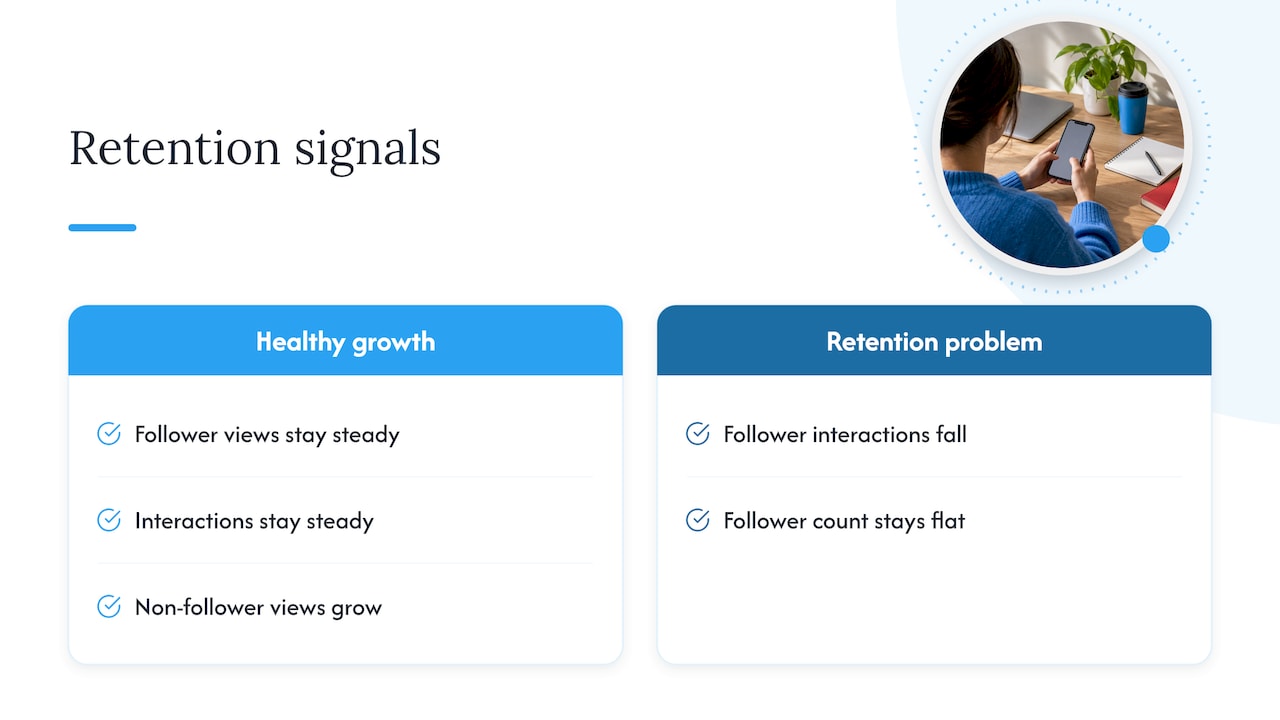
That split is the core of a retention check. If your followers’ views and interactions hold steady while non-follower views grow, you are adding audience without losing interest. If follower interactions fall while the count stays flat, people are still listed as following you but have stopped engaging. That is a retention problem even though the number looks fine.
Meta also made post-level data available in the app itself: Adam Mosseri announced mobile Insights in October 2024 so creators could review how each Threads post performs without leaving their phone.
The one number to calculate: net follower change
Threads does not report how many people unfollowed you on a given day. Metricool notes that the Threads API returns total follower count rather than separate gained and lost figures, so the balance measure available is net change: followers gained minus followers lost across a period. The same guide also defines followers per post as the average number of followers gained per published post.
Both are easy to work out by hand:
- Net follower change = follower count at the end of the week minus the count at the start.
- Followers per post = net change divided by the number of posts you published that week.
Example: you start a week on 1,000 followers, publish 4 posts and finish on 1,060. Net change is +60 and followers per post is 15. Next week you publish 4 posts and finish on 1,070: +10, 2.5 per post. Nothing about the first week tells you why the second slowed, but the pattern tells you where to look. Which posts went out? Did you reply to comments? Did you change topic?
Why your follower count drops
A falling count is rarely a verdict on your content. There are several ordinary causes:
- Inactive or spam accounts being cleared. Accounts that get banned, suspended or locked stop appearing in follower lists, and your count falls with them. This is the usual reason for a small, unexplained daily dip.
- People unfollowing. Someone followed out of curiosity and your posts were not what they wanted. That is retention information you can act on.
- Moderation mistakes. In October 2024 TechCrunch reported moderation problems affecting Instagram and Threads accounts, with Meta attributing identified mistakes to human reviewers who lacked conversation context. If your posts or account behave oddly, use the in-app appeal route.
- Ranking changes. When the feed surfaces your posts less, fewer people respond and fewer new people arrive, which makes losses more visible.
The practical response is not to panic over a single day. Record the count on the same day each week and judge the trend over four to six weeks.
Why views do not always turn into followers
Many owners see healthy views and almost no new followers. Views measure a post being shown; following is a decision about the next fifty posts. People follow when a post suggests that your account will keep giving them something specific.
For scale, a Metricool study of 39,762,999 posts from 1,059,949 accounts reported 1,536.09 impressions per Threads post in its 2025 dataset. That figure is global across the study, not UK-only, so use it as a rough sense of reach, not a target. Metricool itself advises marketers to narrow the view to their own market, and your own Insights are the better benchmark.
When views are good but follows are not, check three things:
- Does your profile say who it is for? A bio that names your niche and location gives a visitor a reason to follow.
- Do your top posts hint at a series? One-off jokes win views; recurring formats win follows.
- Is there a visible conversation? Posts with replies from you look alive and invite the visitor in.
This is also where a starting audience matters for small businesses and creators. A page with a few followers looks untested to a stranger, so the visitor who would have followed hesitates. Our Threads followers growth guide covers how UK social proof affects that first decision.
Build followers who are likely to stay
Retention is decided mostly before someone follows: by who they are and what they expected. Buffer’s guidance for growing on Threads points the same way: focus on a niche, use relevant tags, post consistently, reply to people, be authentic and helpful, and avoid overly promotional posts.
Choose a niche and say it plainly
A local bakery that posts about baking, Saturday queues and the town it is in will attract people who want that. A bakery that posts about everything attracts nobody in particular. Write your bio, pinned post and first ten posts for one kind of reader.
Use topic tags to meet the right people
Threads uses one topic tag per post. Meta’s own tips for growing an audience recommend joining relevant topic-tag conversations and contributing a distinctive point of view. A tag puts your post in front of people who already care about the subject, which is the audience most likely to stay.
Bring existing customers across
The easiest followers to keep are the ones who already know you. Buffer recommends cross-promoting your Threads profile through Instagram Stories and other existing channels, using a direct profile link so the step is one tap. For UK shops, add the link to receipts, in-store signage and your email footer.
Sound like a person, not a catalogue
Digiday’s report on how Ladbible approached Threads describes the publisher tailoring content for existing and newer followers rather than copying its Facebook and X output, and monitoring comments and sentiment. Brand lessons from it: write for this platform, keep a positive tone, and read the replies.
HubSpot’s reporting on Shopify, Canva and HubSpot found practitioners treating Threads as a place for frequent, informal posts rather than waiting for polished content.
A weekly routine that keeps followers engaged
Threads is built around public conversation, so the routine centres on replies and rhythm, not on broadcasting.
Step 1: Post 2 to 5 times a week
Meta’s guidance is to post 2 to 5 times a week and to use Insights to see which days reach more people. Start at three and increase only if you can keep the quality. Some practitioners quoted by HubSpot suggest at least one post a day while you test formats; that suits a team with someone dedicated to it, not a one-person shop.
What goes wrong: bursts of ten posts followed by two silent weeks. Followers who joined during the burst find nothing new and drift. Our piece on the benefits of consistent social media posting explains why rhythm matters more than volume.
Step 2: Reply to every comment in the first hours
Buffer recommends replying to comments on your own posts and joining other people’s conversations because the platform is oriented around public dialogue. Its 2025 analysis reported that replying on your own posts could increase engagement by up to 42% per post. That is Buffer’s result for its dataset, not a guarantee, but the direction is clear: replies keep people in the thread and give them a reason to come back.
Step 3: Spend ten minutes a day on other people’s posts
Reply thoughtfully to accounts in your niche: local businesses, customers, trade voices. A useful reply is a free introduction to that person’s audience, and it brings in followers who arrived through a conversation, which is a good sign for staying power.
Step 4: Review on the same day each week
Open Insights and record four things in a simple sheet:
| Measure | Where to find it | What it tells you |
|---|---|---|
| Follower count | Insights, followers | Start and end of week for net change |
| Posts published | Your profile | Divide net change by this for followers per post |
| Follower vs non-follower views | Insights, views | Whether you reach new people and hold current ones |
| Replies received | Post-level Insights | Whether the conversation is alive |
Hootsuite’s guide suggests recording weekly follower totals and comparing them with post volume and engagement, then noting which posts line up with growth spikes. Repeat those formats and drop the ones that preceded dips.
Step 5: Group followers by when they arrived
If you add followers in waves (a campaign, a feature, a boost), compare each wave’s activity a few weeks later. Waves that keep replying and viewing are your audience; waves that go quiet tell you which source or message to change. We explain the method in cohorts beat vanity counts.
Is your growth lasting or a spike?
A spike is one post doing well and everything flat before and after. Lasting growth is a slow slope with a few bumps. Buffer’s analysis of 1.7 million posts found Threads showed steadier audience growth than X in its comparison and recommended conversation-driven posts for longer-term engaged followers. Its reading is that Threads suits predictable, community-style compounding better than reliance on the occasional viral hit.
Three signs that growth is healthy:
- Net change stays positive across most weeks, not just the week of one big post.
- Follower views and replies rise, or at least hold, as the count rises.
- New followers arrive through several routes: tags, replies, your other channels.
One case from HubSpot’s 2025 reporting: a creator combining humour, relatability and consistent engagement gained 1,500 followers. The ingredients were ordinary. The consistency was the point.
Starting with an audience, then keeping it
A new Threads account has a cold-start problem: nobody replies to a page that nobody follows. That is the gap we built our Threads service for. It gives UK businesses and creators real followers, targeted to the UK, delivered without asking for your password, so your first posts land in front of an account that already looks established.
The retention work is then the routine above. If you want the full plan for what to post once followers arrive, read our content strategy after buying followers and the guide to building a Threads audience fast. For a wider look at what UK buyers should know, see the complete UK strategy guide.
Get a UK Threads audience to build on
Our Threads service is made for small businesses, creators and marketers who want credible numbers while they build a posting habit. Orders are placed online, delivery needs no password, and support is UK-based, which is useful when you want to ask about the right package for your account. We have served over a million customers since 2013. If you also run Instagram, the same approach is available on our Instagram packages.
Start on the Threads service page to see the current options.
Our view: retention is a habit you build after the first follower
Most owners ask us how many followers they need. The better question is what happens in the week after they arrive.
We see it as two jobs. The first is getting a credible, relevant audience in place so a stranger visiting your profile sees a real brand. The second is giving that audience a reason to stay: a niche, a rhythm and replies that show a person is behind the account.
That is why our service is built around real followers, UK targeting and delivery without passwords, and why we write guides on what to post afterwards. Growth you can measure week by week, and a routine you can sustain, beat any single number on the screen.
Irwin Lee
FAQ
Why did I lose followers on Threads overnight?
Most often it is accounts being removed: banned, suspended, locked or inactive profiles stop appearing in follower lists. A few people may also have unfollowed. Check the weekly trend in Insights before changing anything, and appeal in the app if you think your own account was wrongly restricted.
Can I see who unfollowed me on Threads?
Not directly. Threads reports total follower count and changes over a period, so net change is the figure to track. Note your count on the same day each week and compare it with what you posted.
How often should I post to keep followers?
Meta’s guidance is 2 to 5 times a week, with replies and topic-tag conversations alongside. Choose a number you can keep for months, since regular posts matter more than occasional bursts.
Why do my posts get views but no followers?
Views show a post was shown; following needs a reason to expect more. Make your bio specific, repeat formats people can recognise and reply to comments so visitors see an active account.
Sources
- Threads analytics: A no-stress guide, Hootsuite
- Adam Mosseri on Threads Insights, Threads
- Threads Metrics, Metricool Help Center
- 2026 UK Social Media Statistics, Metricool
- Instagram blames some moderation issues on human reviewers, TechCrunch
- Get More Followers on Threads, Buffer
- 5 tips for growing your audience, Threads
- How Ladbible is getting a feel for Threads, Digiday
- How Shopify, Canva and HubSpot are excelling on Threads, HubSpot
- Is Threads losing steam?, HubSpot
- What we learned from analysing 1.7M posts, Buffer