
Paying for followers is only as safe as the checkout you use and the questions you ask before it. A safe payment means three things: nobody asks for your Instagram password or login codes, you pay by a method that leaves you a way to dispute the charge, and the seller is a real business with published terms, a refund policy and a person to contact. This guide covers all three, then explains honestly what a safe payment cannot protect you from.
TL;DR
- Never hand over your password, backup codes or two-factor codes. A legitimate service does not need them.
- Pay by credit card where you can. Action Fraud says debit cards are not covered by section 75 of the Consumer Credit Act, though a chargeback may be available.
- Refuse crypto, gift cards, wire transfers and requests to pay through private messages.
- A safe checkout protects your money, not your account. Purchased followers carry their own platform and legal risks, so start small and keep the numbers realistic.
Table of Contents
- What a safe payment looks like
- Which payment methods protect you most
- Red flags before you pay
- What a safe payment does not cover
- What the price tells you
- Our view: pay safely, then do the unglamorous work
- A five-step checklist before you order
- Ready to start small?
- If something goes wrong
- FAQ
- Sources
What a safe payment looks like
It is easy to confuse two questions. The first is whether your money and card details are safe. The second is whether the thing you bought will do you any good. This section deals with the first. The later sections deal with the second.
A follower service needs very little from you: your public username or the link to the post, the package you chose, and your payment details. That is all. Because it only needs a public profile to deliver, it never needs to log in as you.
Bitdefender’s UK guidance on paid follower scams lists requests for passwords, backup codes or two-factor codes as red flags and says a legitimate marketing service should not need them. Handing those over gives a stranger control of the account you are trying to grow, along with anything connected to it: your email, your ad account, your customers’ messages.
On our side, every order at Greedier Social Media is password-free. You give us a username or a post link, choose a package, and pay. If any seller, ours or anyone else’s, asks for more than that, stop.
The same checks Action Fraud gives for any online shop
Follower sellers are online retailers, so the general rules for shopping online apply. Action Fraud advises UK shoppers to research a retailer before buying, to use a credit card where possible, and to check for a secure browser connection. It also reminds shoppers that a padlock in the address bar does not prove a retailer is legitimate. The padlock only means the connection is encrypted. It says nothing about who is on the other end.
So the padlock is the minimum, not the test. The real test is whether you can find out who runs the business and what happens if the order does not arrive.
Which payment methods protect you most
The method you pay with decides what you can do if something goes wrong. Based on Action Fraud’s guidance, this is how the common options compare.
| Payment method | What protection it offers | Notes |
|---|---|---|
| Credit card | Section 75 of the Consumer Credit Act may apply, and chargeback may be available | Action Fraud recommends a credit card where possible |
| Debit card | Not covered by section 75, though chargeback may be available | Fine for small orders, but with less recourse |
| PayPal, Apple Pay, Google Pay | Can shield your card details from the seller | Each has its own terms, so read them for disputes |
| Crypto, gift cards, wire transfer | Effectively none | Bitdefender lists these as payment red flags |
| Payment through DMs or unofficial channels | None | A common sign of a scam |
A few practical points follow from this.
Use a credit card for larger orders. Section 75 can matter once an order is big enough to hurt if it fails. Check the conditions with your card provider, because the rules have limits on the value of the item and on how you paid.
A digital wallet adds a layer, not a guarantee. Action Fraud notes that PayPal, Apple Pay and Google Pay can shield payment details but come with their own terms. Treat them as a way of not giving your card number to a small seller, not as insurance.
Be wary of payment methods that cannot be reversed. Bitdefender’s guidance flags requests for crypto, gift-card or wire-transfer payment and payment through unofficial channels. Once that money has gone, there is nobody to ask for it back.
Red flags before you pay
Run through this list before entering a single card digit.
- A request for your password or any login code. Walk away, whatever the price.
- No company details. You should be able to find who operates the business, an email or contact route, and terms.
- No refund or privacy policy. Bitdefender’s checklist includes a transparent method, company details, refund and privacy policies, and working support.
- Pressure to pay outside the website. A seller who moves you to a chat app or a payment link sent by message is avoiding the checkout that protects you.
- Promises that sound too good. Guaranteed viral growth, or a fixed number of followers in minutes with no explanation of how, is a sales line, not a service description.
- No support you can test. Send a pre-sale question. How fast and how clearly they reply tells you what a problem will look like later.
The last one is the cheapest check there is. We reply to UK customers through our support team, and you can see how that works on our page for social media managers who want support first.
What a safe payment does not cover
Here is the honest part. A clean checkout protects your money. It does not change what purchased followers are, how platforms treat them, or what the law expects of you if you run a business account.
Platform and quality risk
The independent evidence is consistent. BBC News reported that buying fake followers and likes could damage an influencer’s chances and the wider industry, and it quoted a strategist saying algorithms mean buying 100,000 followers will not make you an influencer. HubSpot’s July 2026 guidance says purchased followers are often bots or inactive accounts, can lower engagement and reach, complicate measurement, and may lead to restrictions under Instagram’s anti-spam rules. GoDaddy UK makes the same point: bought followers often do not engage and can be detected.
That is why we do not pretend a follower package replaces content. Our own pages on what happens when you buy Instagram followers and on expecting a 30 to 60 day purge set out the same cautions.
Legal risk for businesses and creators
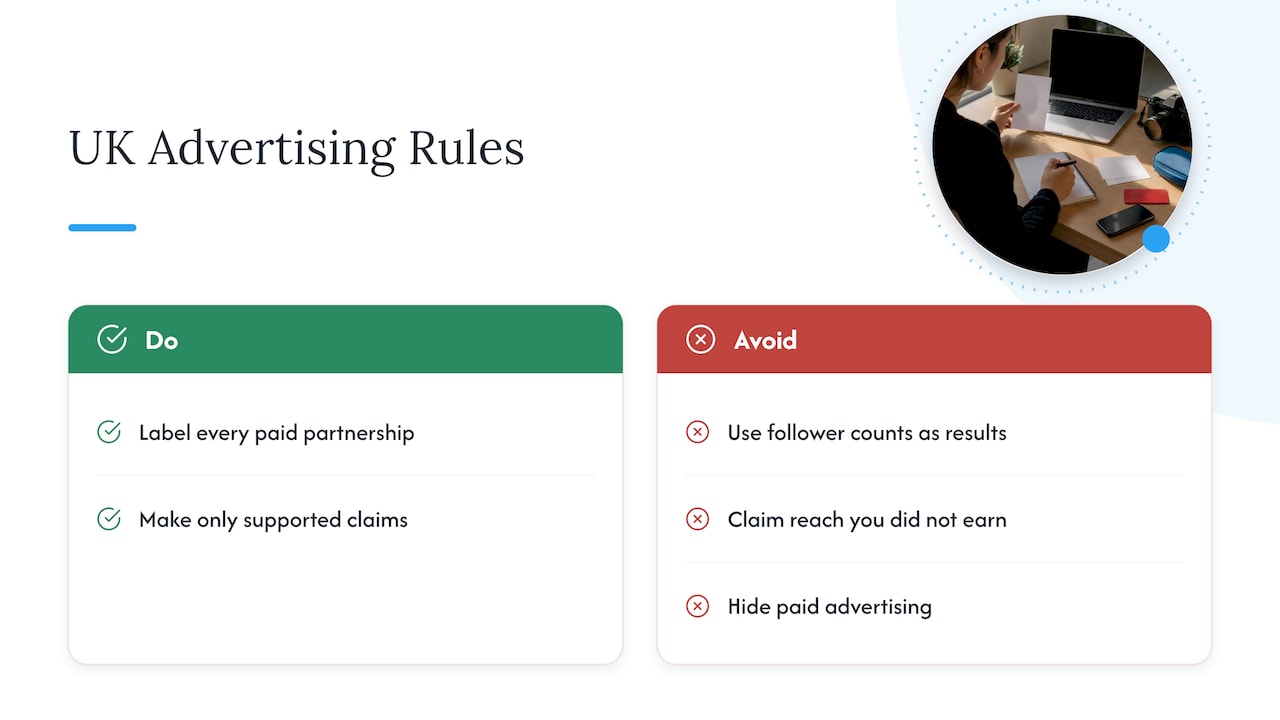
If you run a brand account, the bigger issue may be what your audience numbers imply. The UK government’s social media endorsement guidance, updated on 3 September 2025, says hidden advertising is illegal and warns against unsupported claims or presenting paid-for results as personally achieved. Incentivised commercial posts must be labelled.
Fake reviews are a separate matter. The CMA said on 7 April 2025 that the DMCC Act 2024 includes an explicit ban on posting and commissioning fake reviews. Followers and likes are not reviews, but the principle runs through UK consumer law: do not give your audience a false picture. The CMA’s older letter to marketing agencies makes the point that marketing through social media is legal, but misleading readers or viewers can breach consumer-protection law and lead to enforcement.
The practical reading: never use a follower count as evidence of results in a pitch, never claim a reach you did not earn, and keep every paid partnership labelled. Our guide to five checks and UK ad rules before you pay goes deeper.
Outside the UK, the US Federal Trade Commission’s 2019 consumer alert recorded enforcement against a company for selling fake followers. It is not UK law, but it shows regulators treat inflated counts as potentially misleading.
What the price tells you
Price is part of safety, because very cheap and very instant often means very low quality. BBC News reported in November 2019 that sellers offered 1,000 followers for about £7.70 to £11.60. Its test purchases, paid for by credit card, produced computer-generated names, generic profile pictures and rapid delivery, all signs of low-quality accounts. Mailchimp says 1,000 followers can cost $10 to $50 or more depending on provider and plan, and that purchased followers are often bots or inactive accounts.
Prices from 2019 are a record of that market then, not a quote for today. What lasts is the lesson: a price tells you little on its own, so judge the seller by its terms, support and delivery description.
For reference, our published Instagram prices are set per package:
- Instagram followers: £1.99 to £229.99, one-off
- Instagram likes: £0.99 to £189.95, one-off
- Instagram video views: £0.59 to £54.99, one-off
- Auto Instagram followers: £15.00 to £100.00 a month
Picking the smallest package first is the safest way to test any provider, including us. Our page on how many followers to buy explains a 30 to 90 day test plan.
Our view: pay safely, then do the unglamorous work
We have served over a million customers since 2013, and the question we hear most is no longer whether followers can be bought. It is how to do it without being robbed or locked out. Our answer has three parts.
First, the order process should be boring. A username, a package, a payment and a delivery. Anything more elaborate, such as logins, codes or off-site payments, is a reason to leave. That is why our delivery is password-free and our support is UK-based.
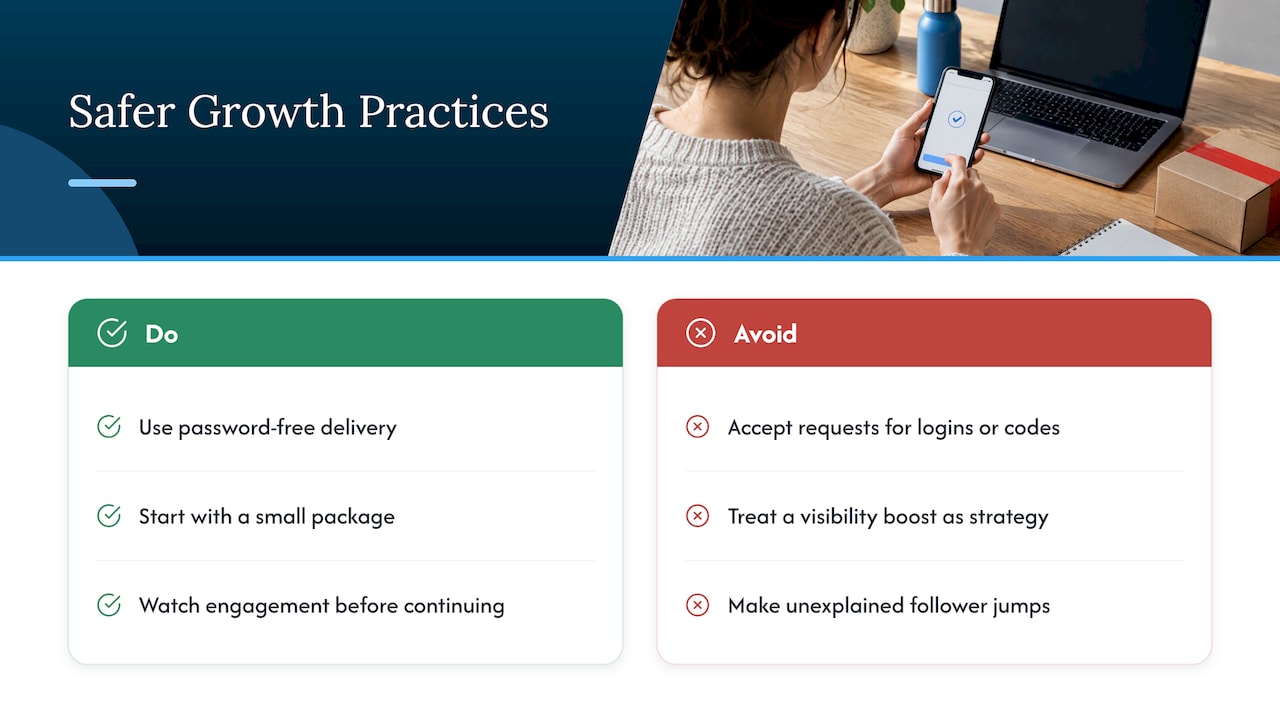
Second, we are straightforward that a follower package is a visibility boost and not a strategy. A small business with a new account can look empty, and some customers use a starting package so that a first-time visitor does not find a ghost town. That can help with first impressions. It will not make strangers buy from you. Content, replies and consistency do that, and our guide on organic Instagram growth techniques covers them. Wider thinking on how to maximise organic reach for your business is worth pairing with any paid boost.
Third, keep the numbers believable. A sudden jump that your posts could never explain is the thing that gets noticed, by the platform and by your own audience. Go small, watch what happens to your engagement, and only then decide whether to continue.
— Irwin Lee
A five-step checklist before you order
- Read the terms and refund policy and find the company’s contact details.
- Send a question to support and see how quickly a human answers.
- Confirm the order needs only a username or link. Anything else is a stop sign.
- Choose the payment method with the most protection you have: a credit card for bigger orders, or a wallet if you prefer not to share card details.
- Start with the smallest package and watch delivery and engagement for a few weeks before buying more.
If you are comparing several providers, our safe-buying guide for the UK walks through the same logic in more detail.
Ready to start small?
If you have run the checks above and want a UK-focused service with password-free ordering and UK support, our Instagram packages start at £1.99 for followers and £0.99 for likes. You can look through the full range on our Instagram packages page. If you run a business account, begin with a small order and compare it with your normal engagement before going further.
Prefer other platforms? We also sell TikTok, YouTube and Facebook packages, each with the same username-only ordering.
If something goes wrong
Speed matters more than anything else here. Action Fraud’s guidance for UK shoppers sets out what to do:
- Contact your bank straight away, using the official number on your card or its app, not a number from the seller. If your card details were misused, ask the bank to block the card.
- Report lost money to Action Fraud, or to Police Scotland if you are in Scotland.
- If the item never arrived or was not as described, use Citizens Advice guidance on your rights.
- Change your Instagram password and review connected apps if you ever shared login details, and switch on two-factor authentication. This is a precaution, not a payment step, but a handed-over password is the thing that turns a small loss into a big one.
Keep screenshots of the order page, the confirmation email and any chat with the seller. They are what your bank will ask for.
FAQ
Is it safe to pay for Instagram followers?
The payment can be safe if the seller asks only for a username or post link, you use a traceable payment method and the business has clear terms. The followers themselves carry separate risks: BBC News and HubSpot both warn that purchased followers can be inactive, hurt engagement and risk platform restrictions. Start small and keep growth believable.
Which payment method is safest for followers?
A credit card generally gives the most protection, since Action Fraud recommends one where possible and section 75 of the Consumer Credit Act may apply. Debit cards are not covered by section 75, though chargeback may be available. Avoid crypto, gift cards and wire transfers, which are hard or impossible to reverse.
How much should I pay for 1,000 followers?
There is no single price. In 2019 BBC News found sellers offering 1,000 followers for roughly £7.70 to £11.60, but those followers looked fake, and Mailchimp says prices can run from $10 to $50 or more. Ignore the headline price and judge the terms, support and delivery description. Our current package prices are listed on our Instagram page.
Do I ever need to give my password?
No. Password, backup code and two-factor code requests are red flags according to Bitdefender’s UK guidance, and a legitimate marketing service does not need them. Our orders need only your username or post link.
Can I be in legal trouble for buying followers?
Buying followers is not itself a crime, but using inflated numbers to mislead customers or brands can breach UK consumer-protection law, and hidden advertising is illegal under the government’s endorsement guidance. If you run a business account, label paid partnerships and never present purchased numbers as proof of results. For specific cases, speak to a solicitor or Citizens Advice.
Sources
- Shopping online securely, Action Fraud
- Instagram paid follower scams, Bitdefender
- Why paying for followers and likes is bad news, BBC Newsbeat
- How to buy an Instagram following, BBC News
- Why you shouldn’t buy Instagram followers, HubSpot
- Why you shouldn’t buy Instagram followers, GoDaddy UK
- Social media endorsements guidance, GOV.UK
- CMA on the new consumer protection regime, GOV.UK
- CMA open letter to marketing departments and agencies
- Fake followers: A social media hoax, FTC
- Buying Instagram followers, Mailchimp
- How to maximise organic reach for your business