

There’s no reliable way to avoid suspicion when buying followers. Fake followers can breach Instagram’s terms and put an account at risk, while a sudden increase may prompt questions from genuine users, brands and partners. A growth spike alone, however, doesn’t prove that followers were bought.
It’s understandable to want a larger audience without putting your account or reputation at risk. This guide explains why follower services can raise concerns, how to assess unusual growth, and what follower audits can and can’t tell you. It also distinguishes purchased metrics from growth that follows a viral post, collaboration or media coverage, helping you make a more informed choice.
Key Takeaways
- Compare audience patterns with similar accounts, but treat audit scores as prompts to investigate rather than proof of wrongdoing.
- Look for context behind a growth spike, such as a collaboration or viral post, before drawing conclusions.
- Consider how inactive followers can affect engagement signals, audience trust and potential brand partnerships.
- Learn which account behaviours platforms may flag, and why individual signals can have legitimate explanations.
Can buying followers get your account banned?
Buying fake Instagram followers can breach Instagram’s terms and risk account penalties. The platform uses algorithms to detect violations involving purchased followers, and there’s no dependable way to conceal artificial growth from account checks. The practical answer to how to avoid suspicion when buying followers is to avoid fake growth and choose a transparent approach that protects your credibility.
Compare an account’s audience with similar profiles before assessing its quality. Look at accounts in the same niche with comparable audience sizes and posting histories. Check whether engagement is consistent across different content, rather than judging by one high-performing Reel. A food account, for example, may get a different response to recipes than to behind-the-scenes posts.
Third-party audits sample followers and assess signals such as account completeness, activity, follower-to-following ratios and posting history. Scores vary because tools use different methods, and small samples may not represent the whole audience. Treat an audit as a reason to investigate, not proof of wrongdoing. New users and people who follow many accounts may also be misclassified.
Safer alternatives include paid advertising, creator partnerships and investing in high-quality visual content that attracts genuine viewers. For organisations seeking standout promotional footage across the UK, professional aerial filming and photography providers such as impactaerial.co.uk can help create compelling media that drives organic reach. If you’re considering how to avoid suspicion when buying followers, focus instead on transparent growth and meaningful results.
In the UK, the Digital Markets, Competition and Consumers Act 2024 rewrote consumer law from 6 April 2025. The Competition and Markets Authority can fine businesses up to 10% of global worldwide turnover for misleading commercial practices. Keep commercial claims about follower counts and audience quality accurate.
Before a UK campaign, review an influencer’s first-party analytics, audience patterns and relevant results. Begin with a smaller campaign and assess the agreed deliverables, reach and conversions. If a growth graph looks unusual, ask neutrally what happened during that period. A viral post, collaboration, media coverage, giveaway, account migration or paid promotion may explain the increase.
Distinguishing suspicious growth spikes from legitimate events
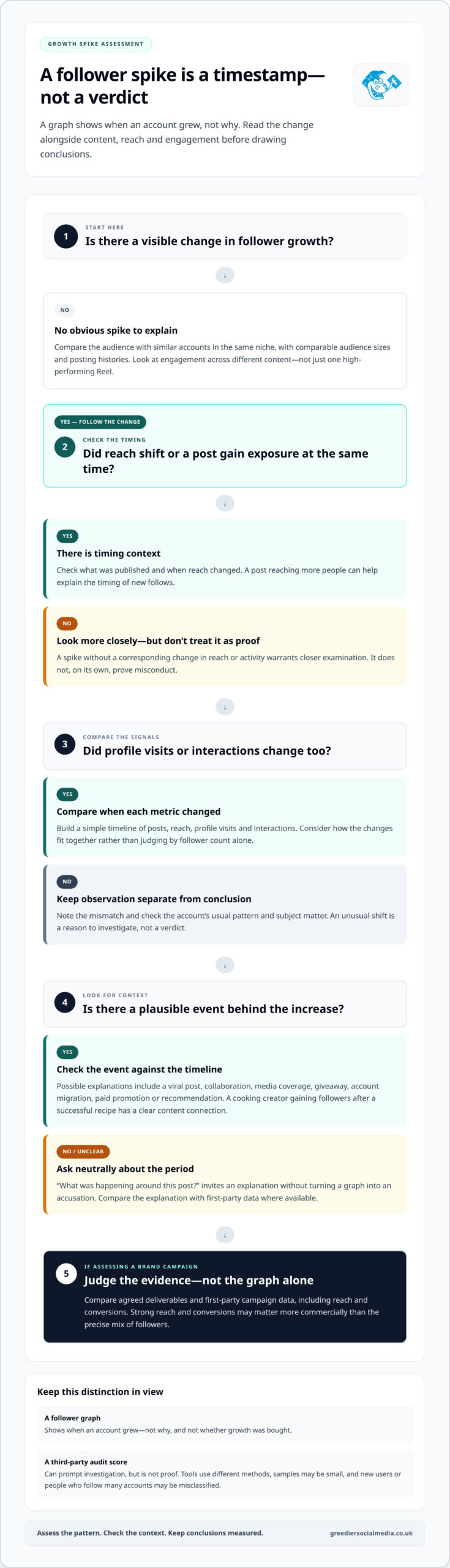
A follower graph shows when an account grew, not why. Read a spike alongside content and engagement metrics. If audience numbers rise after a post reaches more people, that timing provides context. A graph alone cannot establish that growth was bought or identify its cause.
Build a simple timeline around the change. Note which posts were published, when reach shifted, and whether profile visits or interactions changed too. A collaboration, for example, may bring visitors who follow after seeing the creator mentioned. Compare the timing across these metrics rather than treating follower count as a verdict on its own.
Check whether the change fits the account’s usual pattern and subject matter. A cooking creator gaining followers after a recipe performs well has a clear content connection. A sudden audience shift with no corresponding change in reach or activity warrants closer examination, but doesn’t prove misconduct. Keep observations separate from conclusions.
Ask about the period neutrally. “What was happening around this post?” invites an explanation without turning a graph into an accusation. A creator may point to a recommendation, press coverage or another source of exposure. Note the explanation and compare it with first-party campaign data, such as reach and conversions.
For a brand campaign, assess the agreed deliverables and outcomes after publication. Strong reach and conversions may matter more commercially than the precise mix of followers. If results disappoint, use campaign data to guide your next decision. Treat third-party audit scores as prompts for investigation, not final judgements.
For a more considered approach to audience growth, explore Instagram growth options alongside the evidence behind any spike.
Risks of buying Instagram followers and likes
A larger Instagram count can look impressive, but it doesn’t show whether people care about your content. Fake followers and bought likes can inflate visible metrics without creating genuine conversations, enquiries or sales. A profile with 25,000 followers and four likes per post may prompt shoppers to question its credibility. A 0% engagement rate can also look like a warning sign, especially when recent posts receive little response.
The mismatch can affect more than appearances. Instagram considers how often a user interacts with an account when deciding what content to show. If purchased accounts don’t engage, your follower total may rise while meaningful interaction remains low. This can make your statistics a less accurate picture of your audience and make it harder to see which posts resonate. Cultivating genuine interactions often comes down to effective social strategy and copywriting, skills offered through online training providers like the College of Media and Publishing.
There’s a commercial risk too. Brands may check whether an influencer’s followers are genuine before agreeing to a campaign. Inflated numbers can mislead sponsors or partners about an account’s real reach. If campaign results don’t match the promised audience size, trust can suffer. Bought followers also aren’t genuine prospective customers, so they don’t represent real business growth or sales.
Fake accounts may post irrelevant or inappropriate comments beneath your content. A spam-like reply on a product post can put off genuine visitors and damage the account’s reputation. Instagram regularly tracks and removes fake followers, so an account can lose 8,000 followers overnight. That sudden drop may be visible to customers and partners.
Instagram ranking considers factors such as post freshness, typical engagement with different post types, and how many accounts a user follows. Purchased followers can distort engagement statistics and make campaign planning less reliable. If reach or views fall, review recent post performance and account activity. Don’t treat a dip alone as proof of a penalty; assess whether genuine users are still seeing and engaging with your content.
How do social platforms detect fake followers and suspicious activity?
Instagram uses algorithms to detect violations involving purchased fake followers. The exact signals aren’t public, but account patterns can help distinguish genuine activity from artificial growth. A profile with incomplete details, little posting history and unusual follower activity may attract scrutiny. No single characteristic proves that an account has bought followers.
Repeated behaviour can be more revealing than a single metric. Identical comments across several accounts, or a cluster of comments arriving within seconds, may look coordinated. Comments unrelated to a post can also raise questions. But genuine users sometimes repeat phrases or respond quickly, so context matters.
Platforms can assess activity across accounts, not just within one profile. Repeated exchanges, where the same group likes or comments on one another’s posts, may look artificial. A genuine community can also support its members’ content. Consider whether interactions relate to the post and fit the account’s usual activity.
Third-party audience audits assess signals such as account completeness, posting history and follower-to-following ratios. Results vary because each tool uses its own scoring method. Samples may cover only a small part of an audience, so treat an audit as a prompt for closer review, not a platform decision.
Audits can also misread legitimate users. New accounts, people who follow many profiles but rarely post, and users in regions or languages an audit tool wasn’t designed to assess may appear suspicious. Review the wider context before drawing conclusions. A single public signal cannot prove an account has fake followers or engagement.
For a measured next step, explore Instagram follower growth with account credibility and genuine engagement in mind.
Greedier Social Media
Greedier Social Media offers Instagram growth services for businesses looking to build their profile. Instagram Followers, Instagram Likes, Auto Instagram Followers and Auto Instagram Likes address different metric goals. These services change visible numbers, but don’t replace genuine audience interest or guarantee engagement, sales or a particular platform outcome.
Consider your priorities before choosing a growth service. If you want to increase your Instagram numbers, weigh the potential benefits against the risks discussed above, including account penalties and reduced trust if growth looks artificial. Make a measured decision by understanding what the service changes and what it cannot deliver.
For a straightforward conversation about your Instagram growth goals, contact Greedier Social Media.
Choose your next growth step with care
Understanding how to avoid suspicion when buying followers starts with being clear about what a higher number can and can’t show. Set a purpose for any growth decision, then consider whether the visible metric supports that goal or could create a misleading impression. Keep credibility and the experience of your genuine audience at the centre.
Before acting, decide what you want people to do after they discover your profile. A stronger presence should support your wider business priorities, not distract from them. Take a measured approach and keep expectations grounded in what the numbers represent.
If you’re ready to discuss your Instagram growth goals, contact Greedier Social Media. Make your next step a considered one, and keep building with confidence.
Frequently Asked Questions
Are follower growth services and apps safe to use?
Follower services carry risks, particularly if they add fake Instagram followers or ask for account access. Buying fake Instagram followers can breach Instagram’s terms and put your account at risk. Before using any app, consider what access it requests and what activity it creates. A rising count doesn’t establish that an account is secure or that new followers will interact meaningfully.
Can you buy “real” or “active” followers?
Some services describe followers as real or active, but those labels don’t show that the accounts care about your content. Someone may follow without commenting, watching or becoming a customer. A local café, for example, needs followers interested in its area and menu, not simply a higher number. Judge growth by whether it supports your audience and business goals.
Does buying followers work in 2026?
It can increase a displayed follower count, but that alone doesn’t deliver a useful audience or business result. In 2026, assess what “work” means for your account: recognition, meaningful interaction, enquiries or sales. A higher number may not help if customers see little relevant activity. Set a clear outcome first, then measure progress against that outcome rather than the count alone.
What are bought followers, really?
Bought followers are accounts added after a payment or service order, rather than people who found and chose to follow a profile. They may be automated, inactive or real users with little interest in the account. A follower who never sees or responds to a bakery’s posts, for instance, increases its count without showing genuine local interest.
What do fake followers actually cost you?
The impact can extend beyond the cost: fake followers may weaken trust, distort performance data and create problems with platform rules. An inflated count can make it harder to judge whether a campaign reached the right people. Consider the time spent interpreting misleading metrics and rebuilding credibility, not just the immediate appeal of a larger public number.
Why is buying social media followers against platform rules?
On Instagram, buying fake followers can breach the platform’s terms. Artificial accounts can make audience figures less representative of genuine interest and complicate fair assessments of content and influence. Rules vary by platform, so don’t assume Instagram’s terms apply identically elsewhere. If you manage accounts on several platforms, review each platform’s own rules before choosing a growth method.