
The right number is the one your channel’s views can support. For most UK creators and small businesses that means a modest top-up, in the low hundreds to a couple of thousand, added gradually alongside content that real viewers are watching. Work out a number from your views per video, your next milestone and your budget, rather than picking a round figure like 1,000 because it sounds good.
This guide shows you how to do that sum. It covers the Partner Programme thresholds, a ratio check against your views, three worked examples and the safe-use points you need to know about YouTube’s rules.
TL;DR
- Base the number on your average views per video, not on a round target. A healthy channel’s views are a sensible share of its subscriber count.
- Small, staged orders suit most channels better than one large order. Our YouTube range runs from £11.99 to £259.99 one-off, so you can start small.
- Subscribers alone do not unlock monetisation. YouTube also requires watch hours or Shorts views, so plan the content as well as the count.
- YouTube’s fake engagement policy applies to inflated metrics, so read it before you order and keep your channel’s content strong.
- Pair any purchase with consistent uploads and retention tracking in YouTube Studio so the new numbers have real viewing behind them.
Table of Contents
- The short answer: start from your views, not from a round number
- What subscribers can and cannot do for a channel
- Pick your number by goal
- Three worked examples
- Order in stages, not all at once
- Know YouTube’s rules before you order
- Perspective: why we say start small and build up
- Build the real audience alongside the purchase
- Ready to choose a package?
- FAQ
- Sources
The short answer: start from your views, not from a round number
Searchers asking this question usually have a milestone in mind: 500, 1,000, 10,000. The milestone matters, but it is the wrong starting point. A subscriber count is read by viewers, brands and YouTube’s own systems alongside your views, so the two need to look like they belong together.
A useful rule of thumb comes from published benchmarks. According to CheckTheWorth’s analysis of subscriber-to-view ratios, channels with 1,000 to 10,000 subscribers typically see views per video of around 5 to 20% of their subscriber number. At 10,000 to 100,000 subscribers it is 3 to 10%, at 100,000 to 1 million it is 2 to 5%, and above 1 million it is 1 to 3%. These are guide figures from a third-party analysis, not YouTube rules, but they show what a believable channel looks like.
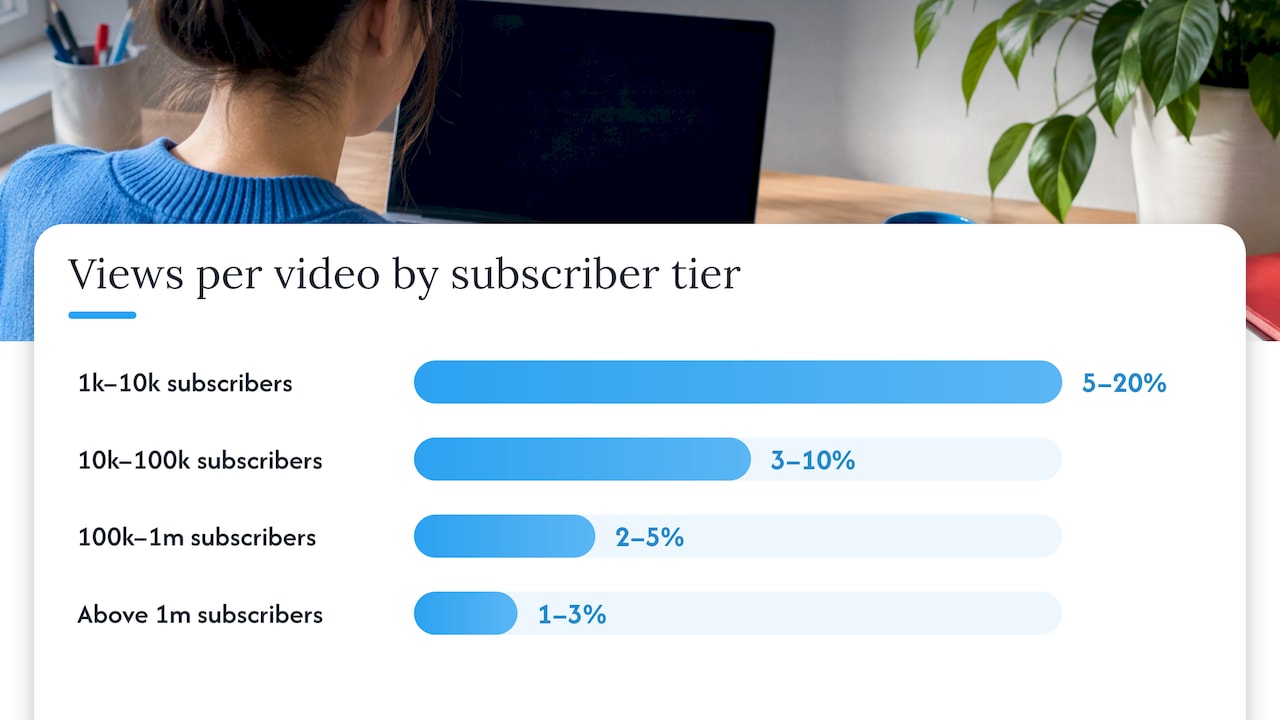
So the sum is simple. Take the average views on your last ten uploads. Divide by 0.05 to 0.20 if you are under 10,000 subscribers. The result is the range of subscriber counts your current viewing level can comfortably sit alongside.
A quick worked calculation
Say your last ten videos average 120 views.
- At 20%, that supports about 600 subscribers.
- At 5%, it supports about 2,400 subscribers.
A total somewhere between 600 and 2,400 looks natural for that level of viewing. If you have 300 subscribers today, a top-up of a few hundred keeps you well inside that range. A jump to 10,000 would not.
What subscribers can and cannot do for a channel
Be clear about the job a purchased subscriber does. It raises the visible number on your channel page. That can help a new channel look established to a first-time visitor, which matters for small businesses and creators trying to build trust quickly.
What it does not do is watch your videos. VidIQ’s guide notes that purchased subscribers do not lift views, watch time or genuine engagement by themselves, and that many are incentivised users who subscribe to earn rewards rather than because they like a channel. ChannelBoost makes a related point: weak early performance signals from inactive subscribers can make it harder for a video to reach real potential viewers.
The practical lesson is about proportion. A small number added to a channel with real viewing barely moves your ratios. A large number added to a channel with little viewing does. That is why the number you choose matters more than the decision to order.
We go deeper on this in our piece on how YouTube’s algorithm interprets purchased subscribers, and in what happens when you buy YouTube subscribers.
Pick your number by goal
Different goals point to different quantities. Here is how we would think about each.
| Your goal | Sensible approach | Why |
|---|---|---|
| A new channel that looks empty | A small starter order in the low hundreds | Gives a first-time visitor something that looks established without outrunning your views |
| Reaching 500 for the entry tier of the Partner Programme | Close the gap between your current count and 500 | The count is only one of the requirements, so watch hours and uploads still need to be real |
| Reaching 1,000 for full eligibility | Top up in stages while publishing consistently | Views, watch hours or Shorts views must also be earned |
| A business channel for credibility | Match the count to the views your videos get | Customers look at the whole page, not only the number |
Why 500 and 1,000 are the numbers people ask about
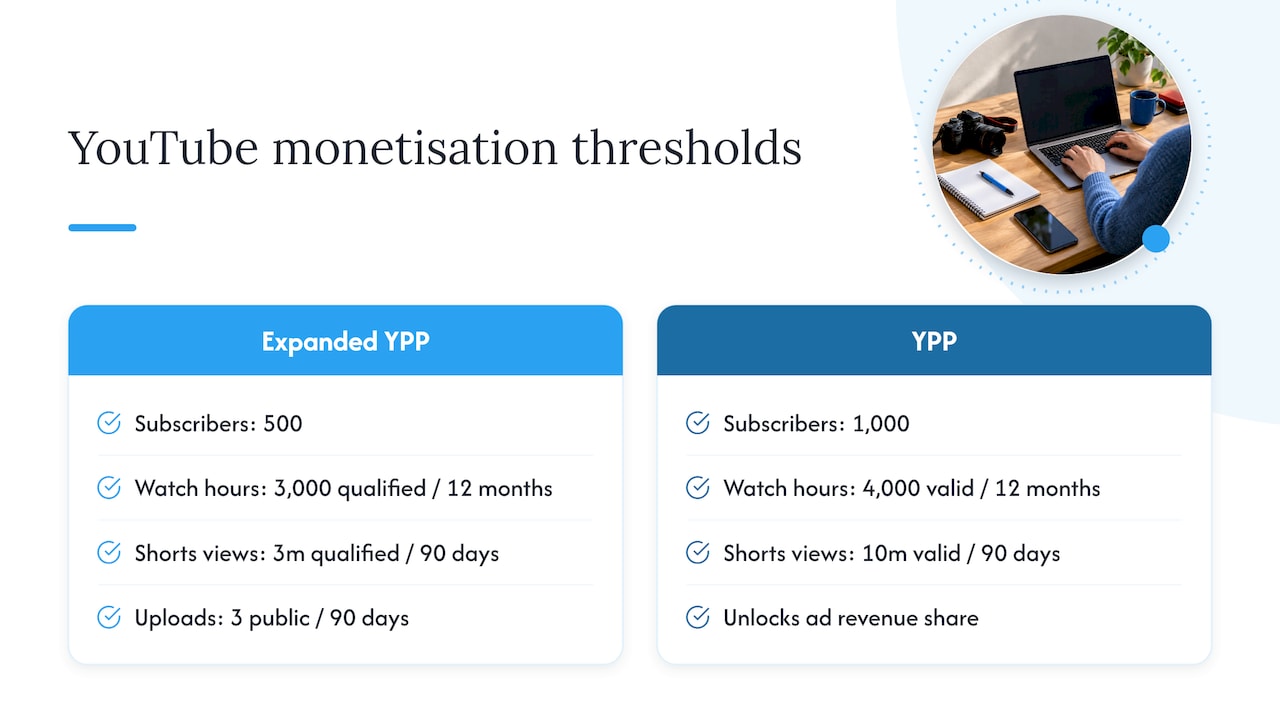
These figures come straight from YouTube’s monetisation rules. According to YouTube’s Partner Programme eligibility page, you need 1,000 subscribers plus either 4,000 valid public watch hours in the last 12 months or 10 million valid public Shorts views in the last 90 days. Shorts views in the Shorts feed do not count toward the 4,000 watch hours.
There is also a lower tier. YouTube’s expanded Partner Programme opens at 500 subscribers with three public uploads in the last 90 days, plus either 3,000 qualified watch hours in the last 12 months or 3 million qualified Shorts views in the last 90 days. That tier unlocks fan-funding features rather than the ad revenue share.
The lesson: the subscriber figure is one of several gates. Buying 1,000 subscribers while sitting on 300 watch hours leaves you well short of the requirement. Plan your number around the gap you cannot close with content alone, and plan your uploads around the rest.
Three worked examples
These are illustrations of the method, not results we are promising.
A local business with a new channel
A garden design firm in Leeds has 40 subscribers and averages 60 views on its project videos. Using the 5 to 20% guide, 60 views supports roughly 300 to 1,200 subscribers. A starter order that takes the channel into the low hundreds fits comfortably. The firm then uses the next few months to publish a project walkthrough every fortnight and watch retention in YouTube Studio.
A creator chasing the 500 tier
A UK gaming creator has 380 subscribers, three uploads in the last 90 days and 2,100 watch hours. The subscriber gap is 120. A small order closes it, but the real work is the 900 watch hours still missing. The creator spends the purchase budget’s equivalent in time on longer, better-structured videos instead of buying a bigger number.
A channel that already has traction
A cooking channel has 4,000 subscribers and averages 450 views per video, about 11%. That sits inside the typical 5 to 20% band. The owner considers a 5,000 top-up, which would push the ratio to around 5% on current views. That is at the very edge of the range, so a smaller, staged order of 1,000 to 1,500 makes more sense while views grow.
Order in stages, not all at once
A channel whose subscriber count climbs by thousands overnight with no change in views looks odd to anyone who checks. Staging the order, with gaps in between, lets your numbers move in step with your content.
A staged plan for a small channel might look like this:
- Order a small starter package and publish two or three videos.
- Check your average views and retention in YouTube Studio after a few weeks.
- If views are rising, top up with a second modest order.
- Re-run the ratio sum before each order.
We offer YouTube subscriber packages from £11.99 up to £259.99 as one-off orders, so a staged plan does not need a large upfront spend. Delivery pace is something we build around: our service is designed to deliver without needing your password, and a gradual approach is the one we recommend for most channels.
Know YouTube’s rules before you order
This is the part to read carefully. YouTube’s fake engagement policy prohibits artificially inflating metrics such as views, likes and subscribers, and says that channels found breaching it can receive strikes or be terminated. The policy also covers promoting third-party services that inflate metrics inside your videos, descriptions, comments and live streams.
Safe use follows from that:
- Do not mention or link to any growth service in your videos, descriptions, comments or live streams.
- Never share your YouTube password with anyone. Our service does not ask for one.
- Keep the purchase small relative to your real viewing, so your channel’s numbers stay coherent.
- Keep publishing real content. YouTube reserves the right to remove monetisation from any channel that breaks its policies, whatever its subscriber count, and every channel meeting the thresholds goes through a review of automated systems and human reviewers.
- Expect YouTube to clean up inactive accounts from time to time. AIJourn reports that YouTube removed 2.8 million channels for spam violations in the first quarter of 2025, and that such sweeps are not announced. Counts across the platform can shift, which is another reason to keep your numbers modest and your content strong.
If you are applying to the Partner Programme, read the current requirements on YouTube’s own pages before you apply, as they can change.
Perspective: why we say start small and build up
We have served over a million customers since 2013, and the same question comes up again and again: how many should I buy?
Our answer has not changed. Start with a number your content can carry. A channel with real viewing and a modest, well-timed boost looks like a channel on the way up, and that is what viewers, collaborators and customers respond to.
We built our service around real engagement, UK-targeted delivery and no password requirement, because creators and small businesses told us they wanted a boost without handing over account access. We stand behind that approach and we back it with fast UK-based support.
Use the subscribers as the starting push, then give people a reason to stay: consistent uploads, clear titles, strong first thirty seconds. Orders and content work best together, and the creators who do well with us are the ones who do both.
Irwin Lee
Build the real audience alongside the purchase
Whatever you buy, the channels that keep growing are the ones that keep earning viewers. Three habits make the biggest difference.
Read your retention before spending more
Open YouTube Studio and look at average view duration and where viewers drop off. MobileMall’s guidance is to let your content prove it holds an organic audience before investing in paid promotion. That is a sound order of work, and it tells you which videos deserve your attention first.
Use YouTube’s own promotion on videos that already work
YouTube Studio includes a Promotions feature for paying for reach. According to ChannelBoost, it works best when it amplifies content that is already performing well, so choose your best video, not your newest.
Treat organic search and traffic as a system
A channel sits inside a wider presence: your website, your search visibility and your other social profiles. A practical order of work for organic traffic helps you decide what to fix first so that the people arriving at your channel are the right ones.
For more on channel growth, see our guides to YouTube subscriber growth tips and subscribers versus views, and why targeting UK subscribers organically before paying to promote can pay off.
Ready to choose a package?
If you have run the ratio sum and know your number, our YouTube subscriber, likes and views packages cover the range, from £11.99 to £259.99 one-off for subscribers, £2.99 to £85.99 for likes and £4.99 to £269.99 for views. Delivery is UK-targeted and password-free, and our UK-based support team can help you pick a starting size.
Because views matter as much as subscribers, many customers pair a subscriber order with a views order so the numbers sit together naturally. You can see the full subscriber range on our Buy YouTube Subscribers UK page.
FAQ
Is 1,000 subscribers the right number to buy?
Only if your views can support it. A channel averaging a few dozen views per video will look more natural with a few hundred. Use the ratio sum above, and remember that YouTube’s Partner Programme also needs watch hours or Shorts views, not subscribers alone.
Do bought subscribers count towards the Partner Programme?
The subscriber threshold is only one requirement. You also need valid public watch hours or Shorts views, and YouTube reviews every channel that meets the thresholds. YouTube can also remove monetisation from channels that breach its policies, so keep your content and numbers consistent.
How fast should subscribers be delivered?
A gradual pace tends to suit most channels, because it keeps your count moving in step with your views. For a small channel, a staged plan of modest orders with gaps between them is the approach we recommend.
Is 500 subscribers good for a new channel?
Yes. It is the entry point to YouTube’s expanded Partner Programme, which opens fan-funding features when you also have three public uploads in 90 days and either 3,000 qualified watch hours or 3 million qualified Shorts views.
Sources
- Fake YouTube Subscribers, How to Detect Them | CheckTheWorth
- The Truth About Buying YouTube Subscribers | VidIQ
- Buying YouTube Subscribers: Why It Hurts (2026) | ChannelBoost
- You Can Buy the Subscribers, You Cannot Buy an Audience | MobileMall
- Fake engagement policy | YouTube Help
- The YouTube Partner Programme overview and eligibility | YouTube Help
- Overview of the expanded YouTube Partner Program | YouTube Help
- Buying YouTube Subscribers: Why It Backfires | AIJourn
- How to Improve Organic Traffic: A Practical Order of Work | Page One Brand