
To target the UK on Facebook, set your location to the country, region, city or postcode district you serve, keep the other controls light, and give people a Page that looks worth following when they arrive. Targeting decides who sees you. The Page they land on decides whether they stay. We cover both, because a UK audience that finds a Page with real UK followers and engagement is far more likely to act than one that finds an empty profile.
TL;DR
- Set location first: country, region, city, radius or postcode district, using Meta’s “living in or recently in” option, and switch off location expansion if you need strict geography.
- Meta now treats interests, gender and age range above the minimum as suggestions under Advantage+. Location, minimum age and exclusions are the controls it still follows.
- Use Custom Audiences from your own customers and visitors only, and follow UK GDPR when you upload lists.
- Measure UK reach in Ads Manager by country, region and placement, not by total likes.
- A Page with UK-targeted followers and likes gives your targeted ads the social proof they need. We offer Facebook Page followers, Page likes and post likes for UK Pages.
Table of Contents
- Why the UK is worth targeting on Facebook
- Location settings: the control that still works
- Audience types: cold, warm and lookalike
- What Meta removed, and what that means for your setup
- Refine without choking your reach
- UK privacy and advertising rules to respect
- Measure whether you are reaching the right UK people
- The Page behind the ad: social proof for UK visitors
- Start with a UK-ready Facebook Page
- Our view on Facebook UK targeting
- FAQ
- Sources
Why the UK is worth targeting on Facebook
Facebook remains the broadest social network in Britain. Ofcom’s Online Nations report says Facebook and Messenger reached 93% of UK online adults in May 2025, with an average of 43 minutes a day. Sprout Social, citing DataReportal, puts UK Facebook users at 38.8 million, around 55% of the population.
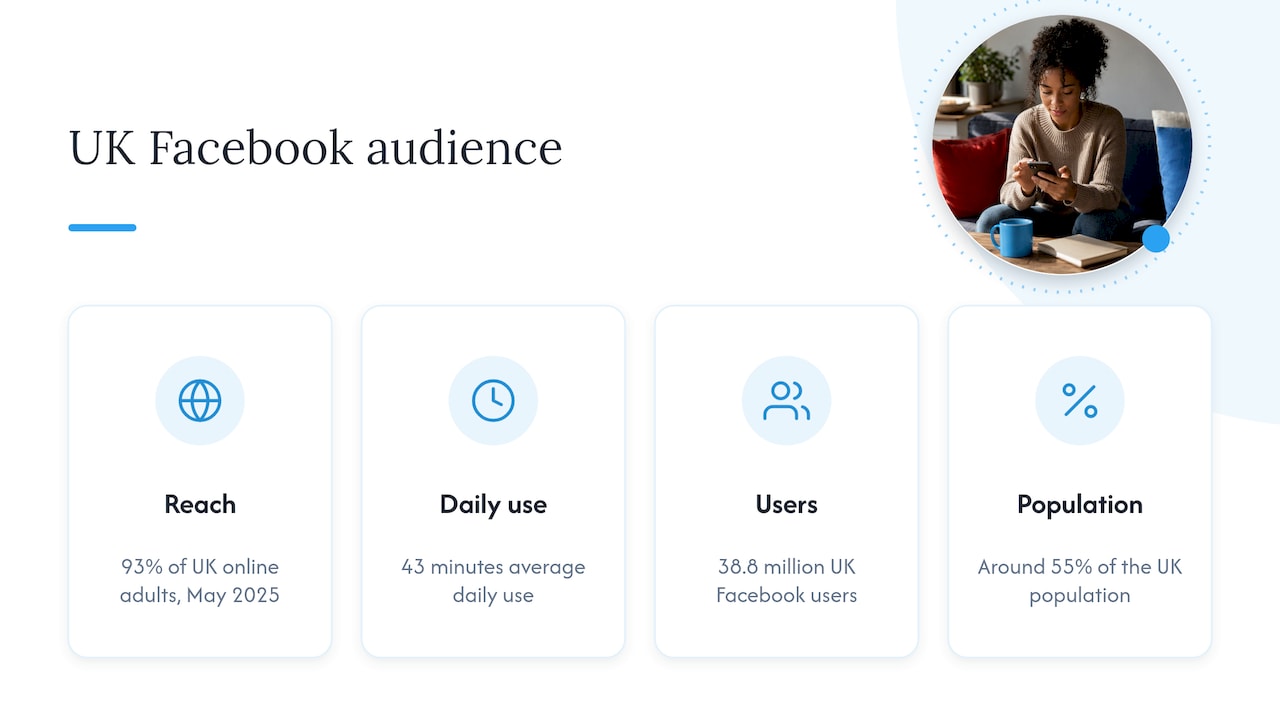
The audience skews older. Sprout Social notes that 25 to 44 year olds make up almost half of UK users, and that older Millennials and Gen X have the highest median household disposable income in the UK. For a local shop, a tradesperson, a restaurant or a higher-priced product, that is a useful audience. Marketplace and Groups also support local marketing.
Because the pool is large, the real job is not finding UK people. It is choosing the part of the UK that can buy from you, and making sure they trust what they find.
Location settings: the control that still works
Location is the most reliable targeting input you have. According to Outra’s guide to the targeting changes, you can set it by country, region, city, a radius of 1 to 50 miles, or postcode district. Meta uses a single option, “People living in or recently in this location”, and you can include or exclude areas.
In practice, match the setting to how you trade:
| Business type | Sensible location setting |
|---|---|
| Online shop shipping across Britain | United Kingdom, with Northern Ireland checked against your delivery terms |
| Regional service (for example a cleaner covering the North West) | Region or a set of cities |
| Café, salon or gym | A radius of a few miles around the premises |
| Delivery or home-visit trade | Postcode districts you actually cover |
The Department of Health and Social Care’s campaign guidance also advises using Facebook’s audience tools to choose location by postcode or place, along with age and other characteristics.
Switch off location expansion when geography is strict
Since a 2024 change, Meta has a checkbox that broadens delivery to people showing intent to travel to or buy in your chosen location. According to Joli’s UK Meta ads guide, it is often on by default and UK advertisers can turn it off. If you run a venue in Leeds and only want people in Leeds, check it.
Postcode districts versus radius
A radius is quick and works well around a single site. Postcode districts are better when your service area is uneven, such as a handful of districts on one side of a river or a set of villages. Whichever you pick, check the estimated audience size before you launch. A radius that is too small can leave you with a group that tires of the same ad within days.
Audience types: cold, warm and lookalike
The Digital Culture Network describes three audience types that cover most UK campaigns:
- New (cold) audiences: people who have not met you, chosen by location and age, for awareness.
- Custom audiences (warm): people who visited your website, watched your videos, engaged with your Page or are on a customer list you uploaded. These suit consideration and sales.
- Lookalike audiences: new people who resemble an existing audience. According to Joli, Meta needs a source of at least 100 people from the same country, and a 1% UK lookalike covers roughly 400,000 to 500,000 people.
Custom audiences matter more now that detailed targeting has shrunk. Page engagers and video viewers are warm audiences you build simply by being seen and engaged with, which is one reason an active Page pays back beyond vanity.
For a deeper look at how to divide audiences by behaviour, location and age, see our guide to audience segmentation types.
What Meta removed, and what that means for your setup
Many older UK tutorials tell you to stack interests and behaviours. That advice has aged. Outra reports that sensitive targeting categories were removed in January 2022, detailed targeting exclusions in January 2025, and more options were merged or retired in June 2025, with ad sets using them stopping on 15 January 2026.
Under Advantage+ audience, positive targeting such as interests is advisory. Meta still follows location, the minimum age and your exclusions. That makes Custom Audience exclusions the dependable way to keep people out, for example excluding past buyers from a new-customer offer.
The practical rule: set hard controls only for things that must hold (UK location, legal minimum age, exclusions), then let the creative do the filtering. Joli calls this creative-led segmentation. A clear Manchester-specific headline and image attract Manchester people more efficiently than a stack of interest filters.
Refine without choking your reach
Narrow targeting feels precise but often costs more. Meta’s developer guidance says an ad set needs at least 50 optimisation events in 7 days for learning to stabilise, advises consolidating overlapping audiences into fewer ad sets, and warns that an audience that is too small can raise costs and cause creative fatigue.
For a small UK business, that translates to:
- Fewer ad sets, more budget in each. One UK-wide ad set for ages 25 to 65+ usually beats four near-identical ones.
- Minor edits only. Big changes can reset learning, so adjust one thing at a time.
- Test creative, not slices. Change images, offers and wording rather than slicing the audience ever thinner.
- Run for at least a week. The Digital Culture Network notes Meta recommends a minimum duration of 7 days, with review taking up to 24 hours before launch.
If you want a plain explanation of how audience choices affect setup, learning and results, how audience targeting works covers the principles. Our own piece on how social campaigns are optimised in 2026 takes the same ideas into day-to-day practice.
UK privacy and advertising rules to respect
Targeting UK users means working under UK law and Meta’s own standards.
- Customer lists are direct marketing. According to GPM (27 October 2026) as summarised in our research, uploading a customer list falls under UK GDPR. Upload only your own customers’ data, say so in your privacy notice, remove anyone who has objected and keep a record of where each list came from.
- People can opt out of targeting. The BBC reported in March 2025 that Meta settled with campaigner Tanya O’Carroll after the Information Commissioner’s Office disagreed with Meta’s argument that ads aimed at groups were not direct marketing. Organisations must give users a clear way to opt out.
- Advertisers are responsible. Meta’s Advertising Standards say Meta does not use sensitive personal data for ad targeting and that advertisers must comply with all applicable laws.
- Special ad categories. Housing, jobs and credit ads have stricter rules and limited targeting, which must be declared at campaign level, as the Digital Culture Network explains in its Meta Ads Q&A.
- Neutral names. The Lancashire Chamber of Commerce advises neutral custom audience names and avoiding URLs or form fields that reveal sensitive information.
If your campaign touches health, finances or another regulated area, speak to your data protection adviser or solicitor before uploading lists.
Measure whether you are reaching the right UK people
A targeting setup is only as good as its report. Meta’s guidance lists amount spent, impressions, link clicks, results, CPM, CTR, CPC and cost per result as the metrics to watch. In Ads Manager, use Breakdown to split results by country, region, age, placement and creative, and check the Quality, Engagement and Conversion rate rankings against other ads in the same auction.
A simple weekly check for a UK campaign:
- Open the breakdown by region. Is spend landing where your customers are?
- Compare cost per result across placements. Move budget to what works.
- Look at which creative earns the lowest cost per result and retire the weakest.
- Check the Page itself: are new followers and likes arriving from the UK?
The last step is often forgotten. Ads send people to a Page or post, and what they see there shapes whether they follow, message or buy.
The Page behind the ad: social proof for UK visitors
When a UK user clicks your ad and then looks at your Page, a very low follower count or a post with no reactions can make a good offer look untested. Our article on how buying followers affects ads goes through how a stronger Page supports paid campaigns.
This is where UK-focused Page growth fits with UK ad targeting. Targeted ads find people. A Page with a UK following gives those people a reason to trust you. We offer UK-targeted, instant, password-free delivery, so you never share your login to get started. If you are choosing between a national audience and a local one, our pages on geo-targeted followers, UK-targeted followers and city-targeted followers in the UK explain the options.
For wider Facebook planning, our Facebook marketing solutions article covers how Page growth sits within a full strategy, and our piece on Facebook Page growth trends for British brands shows where UK Pages are heading.
Start with a UK-ready Facebook Page
We have supported over a million customers since 2013, and our Facebook range is built for UK businesses and creators who want a Page that looks established when targeted traffic arrives. Facebook Page followers and Page likes each run from £3.99 to £149.99 as a one-off purchase, and Facebook post likes run from £3.99 to £79.99. Delivery is instant, UK-targeted and needs no password, and our UK support team is on hand if you have questions.
See the full range on our Facebook services page, pick the package that fits your Page, and run your UK campaign with the proof people look for.
Our view on Facebook UK targeting
Most advice on Facebook targeting asks how finely you can slice an audience. We think the better question is what a UK visitor sees in the three seconds after they click.
Meta has moved towards automation. Location, minimum age and exclusions are the dependable controls, and the rest is largely the platform’s judgement. That puts more weight on what you control: the creative, the offer and the Page. A visitor deciding whether to trust a new local business looks at followers, likes and reactions, and they decide quickly.
That is why we focus on real, UK-targeted engagement delivered instantly and without passwords. Small businesses and creators do not need a complicated setup. They need a Page that backs up the targeting they have paid for, so that the people Meta finds also stay.
Set your location precisely, keep your ad structure simple, respect UK data rules, and make sure the Page that greets your audience is ready for them.
Irwin Lee
FAQ
How do I target people in the UK on Facebook?
In Ads Manager, open the audience section of your ad set and choose your location: the United Kingdom, a region, a city, a radius or postcode districts. Meta’s “living in or recently in” option then applies. Add a minimum age and any exclusions, and let Advantage+ handle the rest.
What percentage of the UK uses Facebook?
Ofcom reports that Facebook and Messenger reached 93% of UK online adults in May 2025. DataReportal figures cited by Sprout Social put UK users at 38.8 million, around 55% of the population. Meta’s ad tools give reach estimates, not monthly active users, so treat figures as guides.
Can I still target by interests in the UK?
Interest and behaviour options have been reduced, and under Advantage+ audience they act as suggestions rather than strict limits. Location, minimum age and exclusions remain firm controls. Strong creative that speaks to your UK customers does much of the filtering instead.
Do UK GDPR rules apply to uploading a customer list?
Yes. Uploading your own customer list counts as direct marketing under UK GDPR. Use only your own customers’ data, mention it in your privacy notice, remove people who have objected and keep records of where the list came from. Ask a data protection adviser if you are unsure about your lists.
Sources
- Online Nations Report 2025, Ofcom
- UK Social Media Marketing Demographics 2026, Sprout Social
- Meta Removed Detailed Targeting: What UK Advertisers Can Do, Outra
- Run a Facebook Advertising Campaign, DHSC Campaign Resource Centre
- Meta Ads for Restaurants, Hotels and Bars: UK guide, Joli
- Reaching Your Audience: Making Your Meta Ads More Effective, Digital Culture Network
- Understanding and optimizing your ad campaign, Meta for Developers
- Meta Ads Q&A answers, Digital Culture Network
- Facebook to stop targeting ads at UK woman after legal action, BBC News
- Introduction to the Advertising Standards, Meta Transparency Centre
- Navigating Meta’s New Data Sharing Restrictions, Lancashire Chamber of Commerce
- Audience targeting explained, Baby Love Growth