

Yes, Instagram does remove fake followers. Its clean-ups target spam accounts, fake profiles and long-inactive users, and past platform-wide clean-ups removed millions of followers. A sudden drop can reflect account removals, not just people choosing to unfollow.
It’s reasonable to question what a rising or falling follower count really says about your audience. The number alone can’t tell you whether followers are genuine, active or interested in your content.
This guide explains which signs may indicate a fake follower and how to assess an account’s audience without treating every quiet profile as suspicious. You’ll also learn what to do when you spot likely fake accounts, how removals can affect engagement, and when a change in your count may simply reflect Instagram’s ongoing clean-up.
Key Takeaways
- Review suspicious profiles for several warning signs before deciding whether they look inauthentic.
- Compare an influencer’s audience quality with their engagement, not just their follower count.
- Keep a record of suspicious accounts and use Instagram’s account tools to report or remove them where appropriate.
- Look for patterns in account behaviour rather than treating one unusual profile detail as proof.
What actions should I take after identifying fake accounts?
Start with a measured review, not a mass removal. Instagram has removed millions of followers in clean-ups targeting spam accounts, fake profiles and long-inactive users. It describes this as ongoing enforcement of platform integrity standards, rather than a new policy shift. A falling count may therefore reflect platform removals, not a sudden loss of genuine interest.
Before acting, note the suspicious profiles and why each one stands out. Record account names, profile details and recurring signs, such as copied posts or unrelated comments. One clue does not prove an account is fake. Look for patterns across several details, then decide whether to report or remove the profile.
- Review the profile. Check its posts, biography, profile image and comments. Compare these details with the account’s apparent activity and the kind of content it engages with.
- Remove a follower you don’t want. Use Instagram’s follower controls for profiles you’ve assessed as suspicious. This changes who follows your account, but does not establish why the profile appeared.
- Report clear abuse. Use Instagram’s reporting option when a profile appears to be impersonating someone, sending spam or behaving deceptively. Choose the reason that best matches what you observed.
- Secure your account. Review connected apps and account access, then revoke anything you no longer recognise. Avoid sharing your password with follower-checking tools.
- Track the result. Note your follower count and engagement before and after the review. Check again after Instagram’s next clean-up, rather than reacting to every small change.
Some drops happen quickly. One influencer reportedly lost around 300 followers shortly after reaching 11,000. That example shows why a sudden change alone doesn’t prove that genuine users have unfollowed you. Manual checks can take days or weeks, depending on account size, so focus first on profiles showing several warning signs.
Assessing influencer audience authenticity
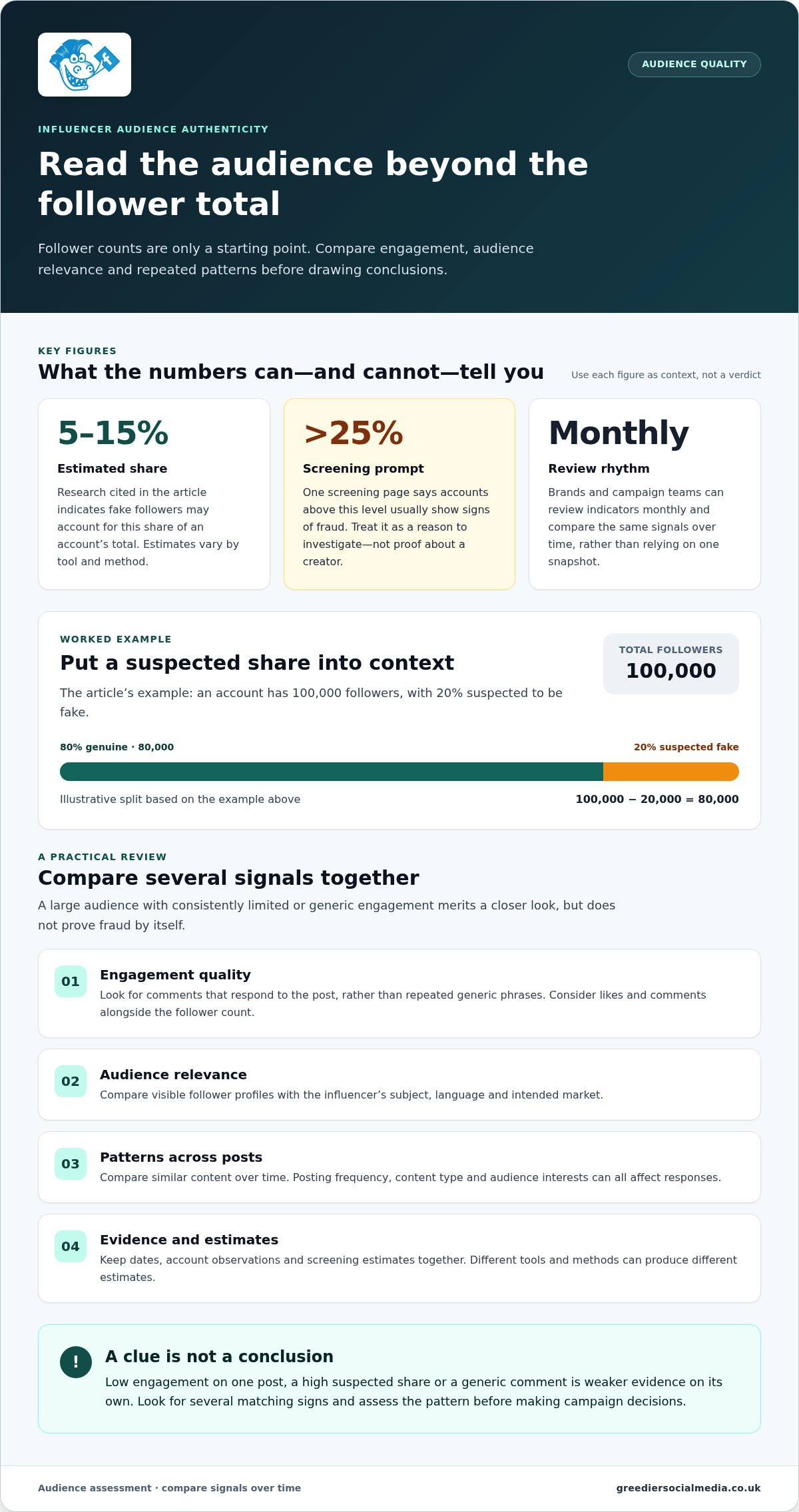
Assess audience quality using several signals, not follower totals alone. Compare an influencer’s follower count with likes, comments and the relevance of those interactions. A large audience alongside consistently limited or generic engagement merits closer review. It doesn’t prove fraud by itself: posting frequency, content type and audience interests also affect responses.
Use proportions to put a suspected share into context. For example, an account with 100,000 followers and 20% fake followers would have 80,000 genuine followers. A screening page describes accounts with more than 25% fake followers as usually showing signs of fraud. Treat that threshold as a prompt for investigation, not a verdict about an individual creator.
Estimates also vary between tools and methods. Studies cited in the research indicate that fake followers may account for 5% to 15% of an account’s total. A monthly review can help brands and campaign teams spot changes, especially when assessing multiple influencer partnerships. Compare the same indicators over time, rather than relying on one snapshot.
- Check engagement quality. Look for comments that respond to the post, rather than repeated generic phrases.
- Review audience relevance. Compare visible follower profiles with the influencer’s subject, language and intended market.
- Compare posts over time. Note whether engagement patterns shift sharply between similar content.
- Record the evidence. Keep dates, account observations and screening estimates together before making campaign decisions.
For example, a UK food creator with strong views but comments unrelated to recipes warrants a closer audience review. A low response on one post alone is weaker evidence. Use multiple signals and repeat the assessment monthly. If you’re planning audience growth alongside these checks, explore Instagram audience support as a separate consideration.
What is a fake follower?
A fake follower is an account that adds to a profile’s audience without representing a genuine, active person interested in its content. It may be automated, fabricated or abandoned. Instagram’s clean-ups also target spam profiles and long-inactive users, so removed accounts have not necessarily all behaved in the same way.
Profile details can provide clues. Fake followers often have 0-10 posts or very few posts overall. They may also follow more than 1,000 accounts. These patterns are useful for screening, but they aren’t proof on their own. A new Instagram user might have no posts, whilst a real person may follow many accounts.
Look for combinations of signs instead of judging a single detail. For example, an account with no posts, a generic profile image, an unusual username and unrelated comments merits a closer look. Compare those details with the profile’s apparent purpose. A local artist with a quiet account is different from a profile posting copied promotions and following thousands of unrelated users.
- Check the profile history. Review posts, captions and visible activity. Repeated copied content can add context to a sparse profile.
- Read the interactions. Generic comments that could fit any post are less meaningful than specific responses about the content.
- Look at following behaviour. Following over 1,000 accounts is a screening clue, especially alongside an empty profile.
- Assess the overall pattern. Several matching signs make a profile more suspicious than one unusual detail alone.
Distinguish between fake, inactive and simply quiet accounts. An inactive account may belong to a genuine person who rarely uses Instagram. A bot may perform repetitive actions, while a fabricated profile may imitate a person or brand. These differences matter when reviewing your audience: a low post count alone can’t tell you which explanation applies.
Use these indicators to prioritise a careful review, not to label people publicly. Record the specific clues you see, then decide whether further action is needed. This reduces mistaken judgements and keeps your audience assessment grounded in observable behaviour.
How does Instagram detect fake or bot followers?
Instagram removes spam accounts, fake profiles and long-inactive users through ongoing platform enforcement. The precise detection process isn’t described in the available facts, so don’t treat any single profile clue as Instagram’s definitive test. A sparse bio or low post count alone can’t establish that an account is a bot.
You can assess account activity by looking for signs that distinguish genuine interactions from repeated or inauthentic behaviour. For example, an account posting identical comments across unrelated profiles looks different from a person commenting specifically on a friend’s photograph. A profile’s history, interactions and activity patterns offer more context than its follower count alone.
Instagram describes its clean-ups as enforcement of platform integrity standards, not a new policy shift. The aim is to remove accounts that distort platform activity. Removing spam and fake profiles can make engagement metrics a better reflection of genuine activity, which can affect how content is ranked and distributed in the app.
- Account behaviour: Repeated, automated-looking actions can form a pattern that differs from varied human activity.
- Profile signals: A low number of posts may be one clue, but must be considered alongside other details.
- Interactions: Copied comments on unrelated posts can suggest spam, especially when paired with other warning signs.
- Ongoing review: Platform clean-ups can remove fake and inactive accounts over time, changing follower totals and engagement figures.
A quiet account with few posts may still belong to a real person. A profile combining copied comments, repetitive activity and unrelated interactions presents a stronger pattern for scrutiny. Instagram’s removals can also affect creators’ engagement rates, depending on how many inactive followers disappear. A lower count after a clean-up doesn’t, by itself, mean genuine followers have left.
Keep your own assessment focused on observable patterns rather than guesses about Instagram’s internal systems. To support a broader Instagram presence, explore Instagram growth options alongside authentic audience engagement.
Greedier Social Media: Instagram Followers
Greedier Social Media offers Instagram Followers for account owners whose separate goal is to grow their follower count. This service is distinct from identifying or removing suspicious accounts. A higher total doesn’t prove that an audience is genuine or engaged, so assess follower quality and interactions alongside growth.
Instagram Likes are another option for accounts looking to add engagement signals. Auto Instagram Followers and Auto Instagram Likes suit those seeking automated options for the respective metrics. Treat these offerings as one part of your wider Instagram activity, not as a way to validate audience authenticity or reverse Instagram’s clean-ups.
If you’ve reviewed your audience and want to explore these Instagram options, visit greediersocialmedia.co.uk.
Choose your next Instagram growth step
Whether Instagram removes fake followers is only one part of building a credible account. Decide what progress means for your profile: a clearer focus, more relevant conversations or content that better reflects your goals. Keep your next move centred on the audience you want to reach, rather than pursuing a follower total in isolation.
Before making changes, write down the outcome you want and how you’ll recognise it. For example, you might prioritise more meaningful interactions or a stronger connection with people interested in your content. A clear objective gives you a practical reference point for reviewing your account and choosing what to do next.
If you’re ready to work on your Instagram presence, Greedier Social Media can be part of your next step. Explore an approach that suits your aims, while keeping audience quality in view. Contact Greedier Social Media to discuss moving forward. Take the next step with a clear goal and confidence in your direction.
Frequently Asked Questions
Does Instagram automatically remove fake followers?
Yes, Instagram removes fake and spam accounts through ongoing platform clean-ups. Your follower count can change when these accounts are removed, even if you haven’t changed your profile. If your total falls while recent posts and audience activity remain steady, for example, the drop may reflect account removals. Compare your account insights over time rather than treating one change as proof that genuine followers have left.
How can I check whether my Instagram followers are fake?
Review a sample of profiles and compare their details with the way they interact with your content. Look for combinations such as copied biographies, promotional comments unrelated to your post, and profile details that don’t match the account’s activity. For example, a profile repeatedly commenting the same advert beneath unrelated posts deserves closer attention. Treat these clues as prompts to review, not definitive proof about someone’s identity.
How can I remove fake followers from an Instagram account?
You can remove an individual follower from your Instagram follower list. Find the profile, open its options and select the removal control. If the account continues unwanted contact, blocking it can prevent further interaction with your profile. Review suspicious profiles individually and keep notes of your decisions. Avoid sharing your login details with external tools that claim to clean your follower list automatically.
Can you report fake followers or bot accounts to Instagram?
Yes. Open the suspected account’s profile, select its options menu and choose the reporting function. Select the reason that best describes the account, such as spam or impersonation, and follow Instagram’s prompts. Report conduct you can identify, rather than reporting an account solely because it has few posts or limited activity. A report alerts Instagram to a concern; removing the profile from your followers list is a separate action.