
Bought likes work best as one layer of a campaign, not as the campaign itself. They give a post visible social proof in its first hours. A clear goal, a tracked offer and a paid audience then turn that attention into enquiries and sales. This guide shows how to combine the two, what to measure, and which UK and platform rules to keep in mind so your account stays in good standing.
TL;DR
- A boosted post is paid distribution through Meta. Bought likes are a one-off package of visible engagement. They do different jobs, and a campaign can use both.
- Treat likes as social proof on a post that already has a goal, an audience and a call to action. Do not expect them to sell for you.
- Judge the campaign on business numbers (cost per lead, cost per purchase, return on ad spend), not on the like count.
- Meta’s rules and UK consumer law both apply. Never present bought likes as customer reviews or endorsements, and always label paid partnerships.
- Pair any purchase with organic habits: consistent posting, replies to comments and creative worth sharing.
Table of Contents
- What “boosting with bought likes” actually means
- Boost Post or a proper campaign?
- Where bought likes genuinely help a campaign
- What the evidence says about likes alone
- Using bought likes within the rules
- Perspective
- A step-by-step campaign plan
- Building authentic engagement alongside
- Matching the platform
- Start with a package that fits your campaign
- FAQ
- Sources
What “boosting with bought likes” actually means
Two different things get called boosting, and mixing them up is the main reason campaigns disappoint.
Meta’s Boost Post button turns an existing Facebook or Instagram post into an ad. HubSpot’s walkthrough describes the flow: pick a goal, choose an automatic, local or manual audience, set a budget and duration, then submit the post for review. Hootsuite adds that boosted posts carry a sponsored or promoted label and can include a call to action.
Bought likes are a separate purchase. You pay a provider for a package of likes on a post or page, delivered to your account without handing over a password. The money does not go to Meta, and it does not buy an audience you chose. It buys visible engagement.
So a campaign “boosted with bought likes” is really two levers on the same post:
- Paid reach, where Meta shows the post to people you target.
- Social proof, where the number under the post tells those people others have engaged.
The reasoning behind combining them is simple. A stranger who sees an ad with a handful of likes has less reason to pause than one who sees a post that already looks established. That is the job bought likes are designed to do. Everything after the pause, the click, the enquiry, the sale, depends on the campaign around them.
Boost Post or a proper campaign?
The pages ranking for this topic nearly all make the same point: a boost starts from a post, while a campaign starts from a goal. A UK comparison from Amy Metcalfe Marketing puts it well: a boosted post begins with existing content and lets you pick an audience and budget, whereas a social ad begins with a goal and call to action and gives you a headline and audience to build around. Hootsuite likewise says a full campaign gives more control over objectives, targeting, creative and optimisation.
Here is how that plays out when you add bought likes.
| Boost Post | Full ad campaign | |
|---|---|---|
| Starting point | An existing post | A business goal |
| Typical objective | Engagement, reach | Leads, purchases, bookings |
| Targeting control | Basic | Detailed |
| Tracking | Platform metrics | Pixel and conversion events |
| Best use of bought likes | Quick social proof on a launch or announcement post | Social proof on the post that carries the ad |
| Main risk | Paying for likes that never become customers | Over-complicating a small budget |
A practical rule: if you want people to read, follow or share, a boost with social proof is a sensible start. If you want enquiries or sales, build a conversion campaign and let the likes support the creative rather than lead it.
Where bought likes genuinely help a campaign
We would rather be specific than vague here. Bought likes earn their place in a few situations.
A launch with no history
A new page or a first product post starts at zero. Nobody wants to be the first to like something. Starting a post with an initial base of likes removes that cold-start problem, so the paid audience you bring in sees a post that looks active.
A credibility check before a partnership
Brands, venues and local press look at an account before they reply. A page with visible activity looks more serious than an empty one. If you are approaching sponsors or collaborators, it helps to have your recent posts look as established as the work behind them.
A short, high-stakes window
A sale weekend, an event announcement or a product drop has a narrow window. Social proof on the post matters most in its first hours, which is when a package delivers. Our own guides on how long bought likes lift a post and what 100 bought likes do for reach cover that timing in more detail, so you can plan the likes and the ad spend to land together.
Testing creative
If you run two versions of a post, giving both the same starting engagement keeps the comparison fairer. The difference in clicks and conversions then comes from the creative and the offer, not from one version having a head start.
What the evidence says about likes alone
The consistent finding across marketing and media sources is that likes do not convert on their own. That is worth planning around rather than ignoring.
A UK marketing analysis from DMAC Media warns that boosted-post results can overemphasise vanity metrics, because likes, comments and shares do not necessarily turn into stock sold, appointments, leads or revenue. It recommends judging paid social on cost per lead, cost per purchase and return on ad spend instead.
The BBC has also reported UK industry concern that bought followers can mislead brands about an influencer’s real audience and hurt the influencer’s own credibility.
What we take from this, as a provider, is a design brief for how to use our products:
- Use likes to support a post that already has a clear purpose.
- Do not let the like count become the result you report.
- If you work with influencers, check their audience quality. Our guide to spotting fake engagement in influencer marketing and the piece on how brand partnerships evaluate influencers show what agencies look at. For a wider view of influencer metrics and brand ROI, that article is worth your time before you sign a deal.
Using bought likes within the rules
This is the part many guides skip, and it is where a careful buyer protects themselves. There are two rulebooks: the platform’s and UK law.
Meta’s rules
Meta’s Spam policy prohibits buying, selling or exchanging engagement, including likes, shares, views, follows and clicks. It also says Meta may restrict accounts that show spam or inauthenticity signals, even at lower frequencies. Meta sets the rule, so the sensible approach is to keep any purchase small relative to your real activity, spread it out, and avoid patterns that look automated, such as thousands of likes arriving on a post that has never had a comment.
Two habits help:
- Keep ratios believable. A post with 2,000 likes and no comments looks odd to people as well as to systems. Grow comments and shares organically alongside. Our article on making purchased engagement look natural walks through pacing and mix.
- Never share account access. Our services work without your password, which keeps your login in your hands.
UK consumer and advertising law
The law does not turn on the like button itself. It turns on whether customers are misled.
The Competition and Markets Authority has told marketing agencies in an open letter that businesses must market honestly and openly, and that misleading consumers on social media can breach consumer-protection law and lead to enforcement by the CMA or Trading Standards. It also says people should be able to tell genuine opinion from paid-for advertising.
More recently, Osborne Clarke’s analysis of the DMCCA notes the new prohibitions cover submitting, commissioning or publishing fake consumer reviews, including likes or thumbs-up given in respect of other review content. The UK Government’s principles for social media platforms say hidden advertising and fake reviews are not allowed.
In plain terms, for a UK business:
- Do not use likes as proof of customer satisfaction. A like total on a post is not a review. Never write “loved by 5,000 customers” because a post has 5,000 likes.
- Do not tie bought likes to review content. Likes on a customer’s testimonial, or a thumbs-up on someone’s review of you, fall into the territory the law targets.
- Label paid content. The ASA says people should recognise an ad before they read, like or interact with it, and that a prominent #ad or the platform’s disclosure tool is generally the clearest approach. It reported in its 2022 sanctions announcement that disclosure was followed only 35% of the time on Instagram ad posts in its 2021 monitoring.
- Keep giveaway claims verifiable. An ASA ruling found an Instagram giveaway unfair because bonus Story shares from private accounts could not be independently verified. If you run a prize draw, count entries you can check.
For a deeper look at the Facebook side, see our guide on when buying Facebook likes misleads customers in the UK.
Outside the UK, regulators take similar views. The Dutch authority ACM, in a 2021 enforcement notice, said fake likes and followers can give a more positive impression of a business than reality. It cited a shop with 98,000 bought followers and 27,000 bought likes. That is a useful benchmark for scale: it was the combination of inflated numbers and misleading customers that drew action.
Perspective
We have been supplying engagement to UK small businesses and creators since 2013, and the pattern we see in campaigns that go well is consistent. The likes are never the plan. They are the first 30 seconds of the plan.
Think of a shop window. People judge a shop by whether anyone seems to be inside. Visible activity on a post is that same signal, and for a small business with no history it can be the difference between someone scrolling past and someone stopping to read your offer. That is why we built our packages for instant, UK-targeted delivery with no password needed: the likes should arrive while your ad is live, not a week later.
What we ask of customers is to do the rest of the work properly. Set one goal per campaign. Write a clear call to action. Track the result with a pixel. Answer the comments. When a customer does that, our likes make their paid reach work harder, because the people the ad brings in meet a post that looks alive.
We also tell customers to stay on the right side of the rules: keep purchases proportionate, never describe likes as reviews, and label every paid partnership. Used that way, bought likes are a sensible, low-cost tool for a small brand that needs to look established while it builds the real thing.
Irwin Lee
A step-by-step campaign plan
Here is a plan we would give a small UK business with a modest budget. Adjust the numbers to your own.
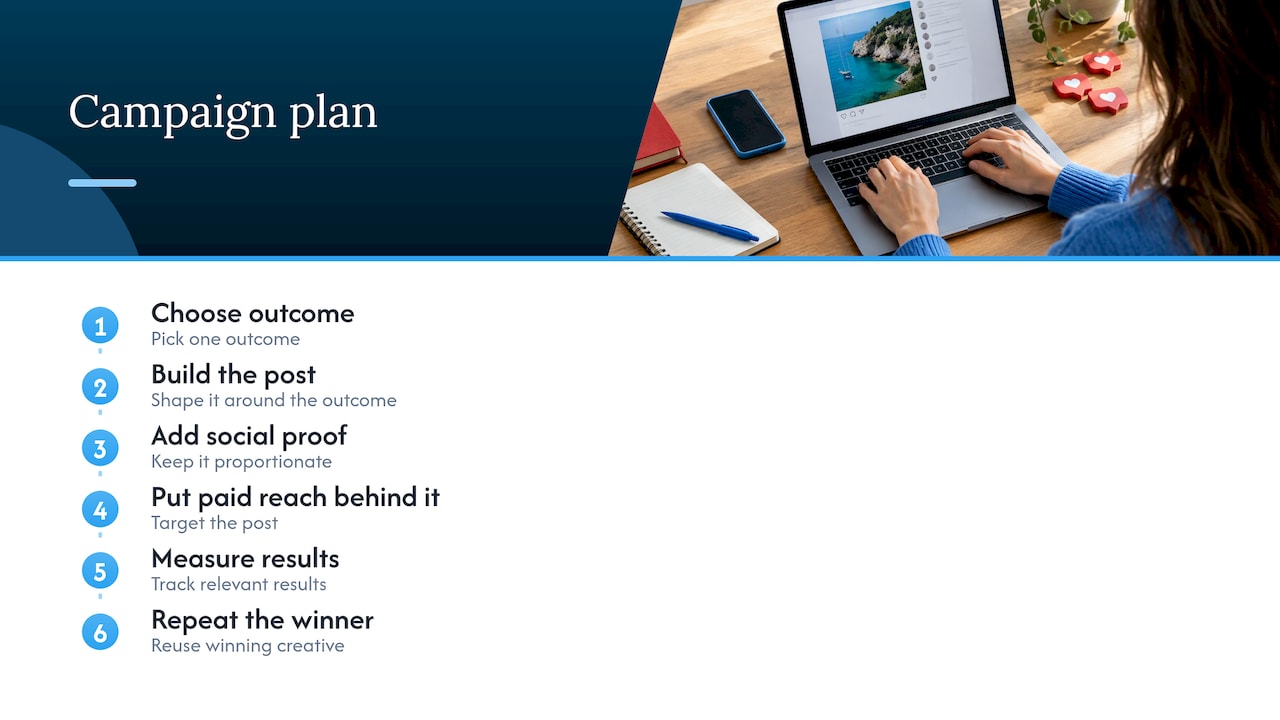
Step 1: Pick one outcome
Choose the single result that pays the bills: enquiries, bookings, online orders or email sign-ups. IAB UK’s measurement toolkit recommends defining campaign objectives first, then setting KPIs and selecting metrics to match, and cautions against leaning too heavily on click-through rate.
Step 2: Build the post around that outcome
One image or video, one offer, one call to action. If the post is a Reel, our Instagram video views page explains how views and likes work together on short video.
Step 3: Add the social proof
Order a package sized to your account, not to your ambition. A small business with a few hundred followers does not need thousands of likes on one post. Look at the packages on our Instagram and Facebook pages and choose a size that looks plausible next to your normal activity.
Step 4: Put paid reach behind it
If you want sales, build a conversion campaign in Ads Manager. If you only want visibility on a launch, a boost is fine. HubSpot also notes a boost can fail Meta’s review if it conflicts with advertising policies, so check your wording before the launch day.
Our note on how followers affect your ads explains how page size and post engagement interact with paid reach.
Step 5: Measure what matters
A UK paid-social guide from gotPhoto separates performance measures (reach, impressions, spend, cost per click), interaction measures (clicks, comments, shares), click measures (link clicks, CTR) and conversion measures tied to the customer action you want. It recommends a conversion-tracking tool such as the Meta Pixel when you want to see what people do after viewing an ad.
A simple scorecard:
| Measure | What it tells you | Good for |
|---|---|---|
| Reach and impressions | How many people saw the ad | Awareness |
| Link clicks and cost per click | Whether the post makes people act | Creative testing |
| Cost per lead | What an enquiry costs | Service businesses |
| Cost per purchase | What a sale costs | Shops |
| Return on ad spend | Revenue against spend | Budget decisions |
| Like count | Social proof on the post | Context only |
If the like count rises but cost per purchase does not fall, the problem is the offer, the landing page or the targeting. Fix those before spending more.
Step 6: Repeat what worked
Keep the winning post and creative, drop the rest, and treat each new campaign as a test. Our guide to techniques for gaining Instagram followers pairs well with this stage, once you have found a post style that converts.
Building authentic engagement alongside
Paid likes should sit on top of habits that bring real interaction. The ones we see work for UK small businesses:
- Post on a rhythm you can keep. Three decent posts a week beat daily bursts followed by silence.
- Answer every comment in the first hour. Replies keep conversations going and make later visitors feel the page is attended.
- Use local detail. Name the town, the market stall, the street. Local customers share local content.
- Ask a question in the caption. Specific questions get comments; “thoughts?” does not.
- Use short video. Reels and TikToks reach people who do not follow you yet.
- Show real customers, with permission. It is honest and it persuades.
Our article on increasing Instagram likes organically goes through these in more detail, and the post on Instagram’s likes-count changes explains what to do if your audience can no longer see public counts.
Matching the platform
The same logic holds across platforms, with different packages:
- Instagram: likes, followers and Reel or video views support a post that carries an ad. See the Instagram packages.
- Facebook: page likes and post likes help a page look established before you run local ads. See the Facebook packages.
- TikTok: views carry more weight than likes on discovery. Our guide to TikTok followers versus video views explains when to pick which.
- YouTube: subscribers and views serve different goals, as covered in YouTube subscribers vs video views.
Start with a package that fits your campaign
If you are planning a launch or a promoted post this month, our Instagram likes start from £0.99 and run up to £189.95 as one-off packages, so you can match the size to a small test or a bigger push. Delivery is instant, UK-targeted and password-free, and our support team can help you choose a size that suits your account.
Browse the options on our Instagram likes and views page or start from the Greedier Social Media homepage.
FAQ
Is boosting a post the same as buying likes?
No. Boosting pays Meta to show your post to a chosen audience and is labelled as sponsored. Buying likes pays a provider for visible engagement on a post or page. They can be used together, but they are separate purchases with separate goals.
Will bought likes get me sales?
On their own, no. Likes give a post social proof, but sales come from the offer, the audience and the call to action. Track cost per purchase or cost per lead to see whether the campaign works, rather than the number of likes.
Do bought likes break Meta’s rules?
Meta’s Spam policy prohibits buying, selling or exchanging engagement, and it may restrict accounts that show signs of inauthentic activity. To use likes responsibly, keep purchases proportionate to your real activity, never share your password and keep organic comments and shares growing too.
Can I mention my like count in my marketing?
Be careful. UK law targets misleading consumers, and the DMCCA covers fake reviews and likes given in respect of review content. Do not present a like total as customer satisfaction or as reviews, and label any paid partnership clearly with #ad or the platform’s disclosure tool.
How many likes should I buy for one campaign?
Choose a number that looks plausible beside your usual engagement. A small account is better served by a modest package on one key post than by a large one. Our prices for Instagram likes run from £0.99 to £189.95, so you can start small and scale after you see the results.
Sources
- How to Boost a Post on Social Media, HubSpot
- Boosted posts vs. ads: What to know in 2026, Hootsuite
- Social ads vs boosted posts on Meta, Amy Metcalfe Marketing
- Why Boosted Posts Could Be Harming Your Meta Ads Performance, DMAC Media
- Instagram: Why paying for followers and likes is bad news, BBC
- Spam, Meta Transparency Center
- CMA letter to marketing agencies about online reviews and endorsements
- CMA puts fake reviews and endorsements in UK under the spotlight, Osborne Clarke
- Reviews and endorsements: principles for social media platforms, GOV.UK
- ASA escalates sanctions against influencers who repeatedly break the rules
- ASA Ruling on Meggan Kirkland
- ACM forces online store to stop using fake likes and fake followers
- Measuring Digital Advertising in a Multi-Media Context, IAB UK
- Paid Social Media Marketing guide UK, gotPhoto
- Influencer marketing unveiled: boost brand visibility and ROI