

A larger follower count isn’t the same as a stronger return. Calculating ROI on purchased followers means comparing revenue you can attribute to converted followers with the full campaign investment: subtract the investment from attributable revenue, divide by the investment, then multiply by 100. Use pounds for UK revenue and costs, and treat the result as meaningful only when you can trace conversions back to the campaign.
It’s sensible to look beyond follower numbers. Followers may increase visibility, but revenue depends on whether people engage, click through and buy. A clear tracking method helps separate measurable sales from activity that has yet to show a financial return.
This article explains how to record campaign investment, estimate revenue from converted followers and calculate ROI. It also compares cost per follower with customer acquisition cost, helping you assess whether audience growth contributes to business results.
Key Takeaways
- Set a clear campaign objective and timeframe before measuring results, so you know which outcomes matter.
- Use trackable links or promotional codes to connect follower activity with website visits and sales.
- Estimate the value of converted followers using purchases and customer lifetime value, not follower totals alone.
- Compare the cost of gaining followers with customer acquisition cost to see whether audience growth is contributing to revenue.
Campaign investment and revenue tracking
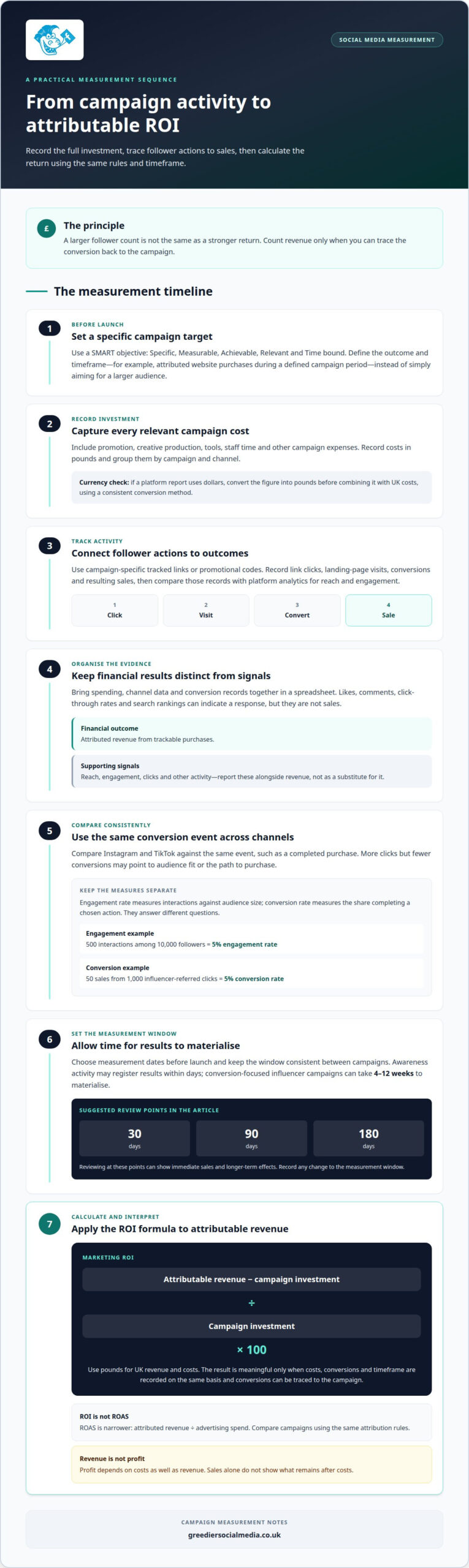
Start by defining the campaign’s goal, then record every relevant investment. A useful target follows SMART principles: Specific, Measurable, Achievable, Relevant and Time bound. For example, set a target for attributed website purchases during a defined campaign period, rather than simply aiming for a larger audience.
Include all costs that contribute to the campaign, not just promotion spend. Record creative production, tools, staff time and other campaign expenses in pounds. Group these entries by campaign and channel. If a platform report uses dollars, convert the figure into pounds before combining it with UK costs, using a consistent conversion method.
Which metrics and tracking tools help attribute revenue to social media followers? Track link clicks, landing-page visits, conversions and resulting sales. Use campaign-specific tracked links or promotional codes to connect follower activity with purchases, then compare those records with platform analytics for engagement and reach.
Separate revenue from other useful signals. Likes, comments, click-through rates and search rankings can show how people respond, but they aren’t sales. Report them alongside attributed revenue so audience activity and financial outcomes remain distinct. A spreadsheet can bring campaign spending, channel data and conversion records together.
Compare campaigns using the same definitions and measurement window. For example, assess Instagram and TikTok activity against the same conversion event, such as a completed purchase. This makes the results easier to interpret. If one channel generates more clicks but fewer conversions, the difference may point to audience fit or the path to purchase.
Choose measurement dates before launch. Awareness activity may register results within days, while conversion-focused influencer campaigns can take 4-12 weeks to materialise. Reviewing performance at 30, 90 and 180 days can show both immediate sales and longer-term effects. Don’t change the measurement window between campaigns without recording the change.
Then calculate marketing ROI consistently: subtract investment from attributable sales growth, divide by investment and multiply by 100. The figure is useful only when its costs, conversions and timeframe are recorded on the same basis.
How to Measure Social Media Return on Investment (ROI)?
Use a consistent formula to assess whether social media activity creates financial value: subtract the campaign investment from attributable revenue, divide by that investment, then multiply by 100. Sales and profit are different: profit depends on costs as well as revenue. Keep revenue and profit distinct; sales alone don’t show what remains after costs.
Return on ad spend (ROAS) answers a narrower question: how much revenue each pound of advertising generates. Divide attributed revenue by advertising spend. Compare ROAS across campaigns using the same attribution rules, and consider profit separately. Strong revenue can still leave little profit after product, delivery and other operating costs.
Influencer tier also affects interpretation. A smaller creator may be a closer fit for a defined audience, while a larger account can offer broader exposure. Compare conversions, engagement and audience relevance, not follower totals alone. The goal matters: awareness campaigns need reach measures, while sales campaigns need trackable purchases or qualified leads.
Do Instagram, TikTok and other platforms prohibit buying followers? Platform rules differ, so there’s no universal answer. Read the terms for the specific platform and distinguish purchased follower growth from activity that manipulates engagement or other metrics.
Can buying followers lead to account penalties or reduced reach? Platform enforcement depends on its rules and how activity is assessed. If follower activity conflicts with those rules, account restrictions or reduced distribution are possible. A higher count can also weaken engagement rates if added followers don’t interact.
Measure the campaign against its original target and record the calculation method. Keep organic sales growth separate from campaign-attributed revenue, where the records allow. This helps prevent existing demand from being credited to a social campaign. For follower growth that supports a wider measurement plan, explore Instagram follower options alongside your performance targets.
Estimating revenue from converted followers
Estimate revenue by connecting follower activity to measurable actions, then assigning value to completed purchases. Keep awareness metrics separate from conversions so visibility isn’t mistaken for sales.
Engagement and Conversion Rates
Engagement rate measures interactions such as likes, comments and shares against an audience size; conversion rate measures the share completing a chosen action. Both help assess follower performance, but they answer different questions. For example, 500 interactions among 10,000 followers equal a 5% engagement rate. Compare that with link clicks and purchases to see whether engagement progresses towards revenue.
Check the audience behind each metric. A higher follower total can change the engagement-rate denominator without adding people who interact. Review comments, link activity and audience relevance alongside the percentage. For a sales campaign, count completed purchases; for a lead campaign, count submitted enquiries. These measures show whether the channel is producing the response the campaign set out to achieve.
Sales, Visits and Leads from Purchased Followers
Purchased followers don’t automatically create sales, website visits or leads; those outcomes depend on people taking action. A follower who clicks a tracked link can visit a landing page, and someone who completes its form becomes a lead. Track each step to distinguish audience growth from actual customer activity.
For example, 50 sales from 1,000 influencer-referred clicks represent a 5% conversion rate. Apply the same method to a follower campaign by recording its attributed clicks and resulting purchases. Multiply completed purchases by their average order value to estimate revenue, then separate repeat-purchase value if you’re assessing customer lifetime value.
Awareness still matters. Reach counts unique users who see content, while impressions count total displays. Use these metrics to understand exposure, not as substitutes for revenue. Compare awareness, visits, leads and sales by channel, using consistent attribution. Tracked links and promotional codes can connect social activity with transactions, while platform analytics show post performance. Combine these records with order or enquiry data, then exclude sales that can’t reasonably be attributed to the campaign.
Cost per follower and customer acquisition
Cost per follower shows how much you spend to add each follower. Divide campaign investment by the number of followers gained during the same period. Use consistent calculations across platforms and actual campaign costs, not just a partial advertising figure. This metric describes audience growth, not the cost of gaining a paying customer.
Customer acquisition cost (CAC) measures the spending required to gain customers. Divide the relevant acquisition costs by the number of new customers attributed to those activities. Include the costs that contributed to acquiring them, then compare campaigns using the same attribution window. A lower cost per follower doesn’t automatically mean a lower CAC: followers must take further actions to become customers.
Treat the two measures as stages in a relationship. Follower cost reflects audience entry; CAC reflects a completed customer outcome. Connect follower growth with tracked visits, enquiries and purchases, then identify which conversions can reasonably be attributed to the campaign. Platform analytics can show engagement, while sales records show whether it led to customers.
Customer lifetime value (CLV) adds another useful comparison. It estimates the profit earned from a customer’s purchases over the relationship. A CLV-to-CAC ratio of 3:1 or higher is typically described as healthy. Assess profit, not just revenue, and use the same customer and cost definitions across campaigns. This makes the ratio more informative than follower totals alone.
Don’t treat an audience metric as a substitute for customer value. One email subscriber could be worth more than 100 social followers who never buy or click, depending on the business and buying behaviour. Use follower cost to assess growth, then use CAC and lifetime value to assess commercial outcomes. If follower growth is part of your plan, explore follower growth options alongside the measures that matter to your business.
Greedier Social Media
Greedier Social Media offers Instagram Followers, Instagram Likes and related Instagram growth options for businesses building their social presence. These services can support a plan to grow account metrics, but follower numbers alone don’t demonstrate revenue. Track engagement, visits and purchases separately to understand the commercial results.
Consider these options when your goal includes growing an Instagram audience or increasing visible post engagement. Set a clear purpose for the activity, then compare its results with wider business measures. If your priority is generating sales directly, follower growth alone won’t replace conversion tracking or customer acquisition analysis.
Use this ROI framework to assess whether audience growth supports your objectives. Contact Greedier Social Media to discuss Instagram followers, likes and other social media engagement options.
Make your next growth decision with confidence
Treat your next campaign as a learning cycle, not just a pass-or-fail result. Before it begins, decide what evidence would justify continuing, changing the approach or stopping. That decision rule makes calculating ROI on purchased followers more useful by connecting the result to a practical business choice.
Keep a brief record of what changed between campaigns, such as the audience, content or conversion route. Interpret new results in that context rather than treating every rise in follower count as commercial progress. If the figures show attention without customer action, reassess how people move from a social post to a purchase.
Greedier Social Media can help you explore social growth options that fit your aims. Contact Greedier Social Media to discuss the next step for your account. A clear measurement plan gives you a stronger basis for moving forward.
Frequently Asked Questions
How do you calculate ROI on purchased social media followers?
For calculating ROI on purchased followers, compare revenue you can trace to the campaign with its full investment. Subtract investment from attributable revenue, divide the result by investment, then multiply by 100. Keep the calculation separate from broader sales figures if you can’t connect those sales to follower activity. For a fair comparison, use the same attribution rules for each campaign.
What costs should be included when buying social media followers?
Include the follower purchase and other campaign expenses that directly support the activity, such as content production or relevant staff time. Record each item once to avoid double-counting. If staff costs are shared across campaigns, allocate only the portion linked to this one, using a consistent method. Keep costs in pounds and use the same accounting period as your revenue figures.
How can you measure engagement and conversions from purchased followers?
Track interactions and business actions separately. Review likes, comments, profile visits and link clicks alongside completed forms, bookings or purchases. Use a distinct tracked link or promotional code for each campaign, then compare recorded conversions with website analytics and order records. This can show where people drop off, such as clicking through but leaving before a purchase.
How does ROI from purchased followers compare with organic growth and paid advertising?
Compare each route by its costs, attributable outcomes and purpose, not follower totals alone. Organic growth may involve content and staff time; paid advertising includes media spend and can be assessed using return on ad spend. Purchased follower growth measures audience increase, but its financial return depends on attributable customer actions. Keep each channel’s costs and conversions distinct.
How long should you measure results when calculating follower-purchase ROI?
Choose a measurement window that reflects your customers’ path to purchase. A quick online order may be attributed sooner than a considered service purchase. Set the window before launch, keep it consistent across comparable campaigns, and include conversions that happen after the first interaction. Review early signals separately from final revenue so delayed decisions aren’t mistaken for campaign failure.
What are the risks of buying followers, including fake accounts and low engagement?
Followers with little interaction or limited relevance can raise the count without strengthening customer interest. This may lower the apparent engagement rate and make audience reports less useful. A mismatch between follower totals and comments, clicks or enquiries can also affect how potential customers view an account. Review meaningful actions and audience relevance alongside headline metrics, and consider platform rules before making a purchase.