
Yes, in practical terms. We know of no UK law that makes it a crime for a creator or business to pay for likes on their own TikTok videos. What decides whether a purchase stays on the right side of the rules is what you do with the numbers afterwards: what you tell brands, customers and advertisers, and whether you hand over your login. Three rule books apply, and they do different jobs: UK consumer and advertising law, TikTok’s own platform policy, and the labelling rules for paid promotion. This guide separates them so you can decide with a clear head.
We sell TikTok likes to UK creators and small businesses, so we get these questions all the time. Our TikTok likes packages run from £2.99 to £119.99 one-off and need no password, which already removes one of the biggest practical problems.
TL;DR
- Paying for likes on your own account is not a criminal offence under UK law as far as we know. Misleading people with the resulting numbers is where the law bites.
- TikTok’s policy is a separate matter: it prohibits services that artificially increase engagement, which is a platform rule rather than a UK statute.
- The consumer protection rules that tightened in April 2025 target fake reviews and undisclosed incentives, so keep likes and reviews clearly apart.
- Never share your TikTok password with anyone selling engagement. Use a service that works from a video link only.
- If you pitch to brands, report your numbers honestly and be ready to back them with analytics.
Table of Contents
- Three rule books, three different questions
- What UK law actually targets
- The advertising rules: where creators and brands get caught
- What TikTok’s own policy says
- Keep your login to yourself
- How to buy likes responsibly: a practical routine
- Who this matters most to
- Our view
- Ready to try it on one video?
- FAQ
- Sources
Three rule books, three different questions
People search “is it legal” and get one blunt answer from a seller or a blog. In reality you are asking three separate questions.
| Question | Who sets the rule | What it covers |
|---|---|---|
| Is it against the law? | UK Parliament, the CMA, the ASA | Misleading consumers, fake reviews, undisclosed ads |
| Is it allowed on the app? | TikTok | Community and integrity policies, For You feed eligibility |
| Is it honest to my audience and partners? | Advertising codes, contracts | How you describe your reach and engagement |
Mixing these up causes most of the confusion. A platform rule is enforced by TikTok, with consequences inside the app. A law is enforced by a regulator and can carry fines. We take each in turn.
What UK law actually targets
The law does not regulate a like count as such. It regulates misleading commercial practices: telling customers or business partners something false or misleading to win their money or trust.
The key change is recent. From April 2025, a banned practice on fake and concealed incentivised reviews became automatically unfair and illegal, and the CMA can issue fines and directions directly. The CMA is the Competition and Markets Authority, the UK’s consumer regulator. Its fake reviews guidance defines a fake review as one that purports to be based on a person’s genuine experience but is not, and says the rule reaches influencers, marketing companies and anyone acting for a trader.
What does that mean for likes?
- A like on a video is an engagement signal, not a consumer review. Buying likes on its own is not the same thing as commissioning fake reviews.
- The line gets close if you present bought engagement as customer opinion. For example, a shop that screenshots a bought-like total and calls it proof that customers love a product is making a claim about people’s experiences. Do not do that.
- Comments are different from likes. Paid comments written as customer praise are much closer to fake reviews, so keep comment purchases out of anything that works as a testimonial.
The CMA also confirmed that, because the law does not apply retrospectively, its first three months were about helping businesses comply, with fines likely to be lower early on. That grace period is long over, so treat the rules as live.
For a deeper look at the follower side of this, see our guide on avoiding DMCCA fines when buying TikTok followers.
The advertising rules: where creators and brands get caught
The ASA (Advertising Standards Authority) enforces the CAP Code, the UK advertising rulebook. Two rules matter here. Rule 3.1 says marketing must not materially mislead, and rule 3.7 says you must hold documentary evidence for claims readers will take as objective, both set out in the CAP Code.
In plain terms: if you tell a brand “my videos average 5,000 likes” or “my audience is highly engaged”, you must be able to prove it. A follower or engagement total that hides bought or inactive accounts can breach the code by omission even when the number is accurate, and superlatives such as “best engagement in my niche” are treated as comparative claims needing evidence.
This gives you a simple working rule:
- Use bought likes as a launch signal for a video, not as the number you sell.
- When you build a media kit, quote reach, watch time, follower location and audience age from your TikTok analytics, which are figures you can screenshot or export.
- Do not describe a boosted like count as organic.
Paid partnerships need labelling too
If you post about a brand in return for money, gifts or any incentive, you must say so. The ASA says an “ad” label must be prominent, upfront and visible without clicking, and that burying it in hashtags is not enough. GOV.UK guidance for brands adds that any incentive counts as payment and that brands can be held responsible for misleading content published on their behalf. On TikTok, this also means switching on the branded content toggle, as TikTok’s terms require.
This has nothing to do with buying likes, but it is the part of social media law that catches people most often, so it belongs in any honest answer.
What TikTok’s own policy says
TikTok does not treat this as a legal matter. It treats it as a platform integrity matter. Its policies prohibit the trade or marketing of services that artificially increase engagement, such as selling followers or likes, and say the platform will remove fake followers or likes when it becomes aware of inflated metrics.
So be clear on the distinction. Buying likes is not illegal, but it sits outside TikTok’s stated terms. The consequence of that is a platform consequence, not a legal one: the platform may strip engagement it identifies as artificial. Our own page on TikTok’s policy on bought likes walks through the wording for UK creators and brands.
Two things follow in practice:
- Keep volumes sensible. A video with 40 views and 4,000 likes looks wrong to a human viewer as well as to a system. Match the purchase to the scale your content can plausibly reach.
- Know your goals. Creators who rely on TikTok’s official brand-partnership routes or creator programmes should read our note on how buying followers can affect creator rewards before deciding what to buy.
Keep your login to yourself
The single most useful safety point has nothing to do with the law. Never give your TikTok password to a seller. Security researchers at Malwarebytes advise against sharing your TikTok password with any boosting service, because handing over credentials can put the whole account at risk.
Our packages are delivered without a password. You supply the video link, choose the package and place the order. If any provider asks you to log in or share account details, that is a reason to walk away from that provider.
How to buy likes responsibly: a practical routine
This is the routine we would give a friend running a small UK business or a creator account.
1. Decide what the likes are for
Likes work as social proof: a viewer who lands on a video with visible activity is more likely to stay and watch. That is a reasonable use. Using them to manufacture a claim to a client is not. Write down which of the two you are doing.
2. Choose the right video and size
Pick content that is already good: a clear hook, decent sound and a point. Paid likes give a good video a push; they cannot rescue a weak one. Start small. The lowest likes packages begin at £2.99, which is plenty to test on a single video.
3. Match likes to views
A believable video has a natural ratio between views and likes. If you buy likes, consider pairing them with views so the numbers hold together. Our guide to TikTok followers versus video views explains how the two interact, and views start at £1.99 on the TikTok page.
4. Make it look natural
Spread purchases across several videos rather than loading one. We cover the thinking in how to make purchased engagement look natural.
5. Keep your records honest
When you report to a client, use analytics. A dashboard export is evidence; a memory of a good month is not. If a brand asks about audience quality, give them real reach, location and age data from TikTok rather than a like total.
6. Never blend likes with reviews
Keep bought engagement away from testimonials, “customers love it” claims and any content that reads as customer opinion. That is the part of the law that has real teeth.
Who this matters most to
Small businesses and local shops. Your risk is a misleading claim to customers. Use likes to make a launch video look alive; do not quote the number as proof of satisfaction. If you also run Facebook, our note on when buying Facebook likes misleads customers covers the same ground.
Creators and influencers. Your risk is a media kit that overstates your reach. Quote analytics. If you pitch for paid work, remember that brands vet audiences. Guidance from the trade body BCMA calls for audience-quality checks and disclosure of tools used, so be ready for the questions.
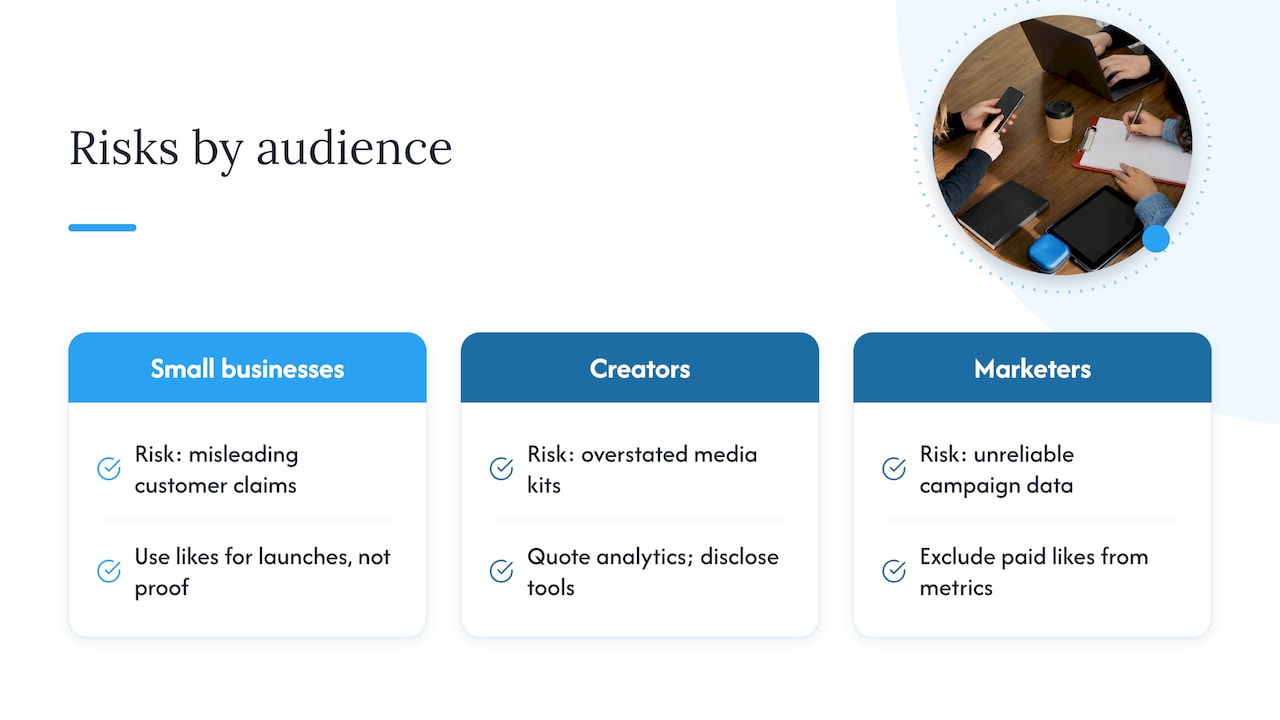
Marketers. Your risk is data. Engagement that does not come from your target audience will not convert, so keep paid likes out of the numbers you use to judge campaign performance. Our write-up on how bought likes behave in the algorithm and the wider strategic guide for UK brands set out how to measure around them.
Our view
Most of the worry around this topic comes from mixing up “not allowed by the app” with “illegal”. They are different, and a creator deserves to hear both answers straight.
We have served over a million customers since 2013, and the people who get the best from paid likes treat them as a nudge at the start of a video’s life. They use them on content they are proud of, in sensible amounts, and they report their results honestly.
That is why we built our service around UK-targeted delivery with no password needed and fast UK support. You give us a video link, we deliver, and you stay in full control of your own account. Used this way, bought likes help a small business or creator look established while the real audience arrives.
If you take one thing from this guide: the number on the screen is a starting point, and the story you tell about it is what matters.
Irwin Lee
Ready to try it on one video?
If you want to start small, pick one video you are proud of and choose a likes package from our TikTok page. TikTok likes start at £2.99 and go up to £119.99 one-off, with delivery targeted at UK audiences and no password required. If you are building a following alongside, followers start at £3.99.
If you would rather talk it through first, our UK support team can help you choose a package that suits your account’s size.
FAQ
Is it illegal to buy TikTok likes in the UK?
We know of no UK law that makes paying for likes on your own account a criminal offence. The legal risk comes from misleading people with the result, for example by presenting bought engagement as customer reviews or overstating your reach to a brand. TikTok’s policy is a separate rule set that applies inside the app.
Can I be fined for buying TikTok likes?
The CMA’s fining powers cover unfair commercial practices such as fake reviews and concealed incentives, not a simple like purchase. A fine becomes a real prospect if you use the numbers to deceive consumers or business partners. Keep your claims to figures you can prove from your analytics.
Do I have to tell brands I have bought likes?
You must not mislead them. If a brand asks about your engagement or audience, answer accurately and back it with your TikTok analytics. Quoting a total that hides purchased activity can breach the CAP Code by omission, so base your pitch on reach, watch time and audience data.
Is it safe to give a seller my TikTok password?
No. Security researchers advise against sharing your password with any boosting service. Choose a provider that needs only a video link, which is how our packages work.
Does paid likes labelling apply to my own posts?
An “ad” label is required when you are paid or incentivised by a brand to post, not because you bought likes. In that case, label it prominently upfront and use TikTok’s branded content toggle.
Sources
- Reviews and social media endorsements: what businesses and content creators must know (GOV.UK)
- CMA208: Fake reviews guidance
- The CMA’s approach to consumer protection
- The CAP Code
- How UK creators can use the CAP Code and ASA rulings
- ASA: Recognising ads on social media and influencer marketing
- GOV.UK: Social media endorsements guidance for brands
- TikTok Transparency Center report, September 2025
- Malwarebytes: Buying TikTok views or followers
- BCMA Influencer Marketing Guidelines and Best Practice UK