
You can win brand deals with a follower base you have topped up, as long as the audience looks, behaves and reads like the one the brand wants to reach. Brands do not judge a follower count on its own. They compare it with your engagement, your audience location, your comments and your content history. Real, UK-targeted followers, backed by likes and views that fit the same picture, give you the strongest case when a brand opens your profile.
This guide explains what UK brands and agencies check, how to set up your profile so it passes, what to watch in the contract and how to disclose paid work properly.
TL;DR
- Brands vet the whole profile: growth pattern, engagement against follower count, comment quality and audience location. The headline number is only the start.
- Real followers who are UK-targeted match the audience most British brands are paying to reach.
- Keep likes, views and comments in proportion to your followers, and keep posting so the profile reads as one active account.
- Read any contract clause on artificially increased engagement, and label every paid post clearly as an ad.
- Our Instagram packages start at £1.99 for followers and £0.99 for likes, delivered without a password.
Table of Contents
- What brands actually look at before they sign you
- Why audience fit matters more than a big number
- How to build a profile a brand will say yes to
- Check your own profile the way a brand would
- Platform by platform: where to put your effort
- Contracts, clauses and disclosure in the UK
- Pricing yourself once the numbers are right
- Our offer for creators and small businesses
- Our view on brand deals and follower growth
- FAQ
- Sources
What brands actually look at before they sign you
A brand manager or agency rarely decides on a follower count. Vetting is a short review of signals, and each one has a simple answer if you prepare for it.
Influur’s vetting guide for brands lists five signs of inauthentic engagement: fast unexplained audience growth, engagement that does not fit the audience size, generic or repetitive comments, an audience whose location or profile does not match, and a content history that does not support the partnership. The same guide states that follower count alone cannot prove how an audience was built, and that no single indicator settles the question. Brands treat these signals as prompts for a closer look.
The influencer fraud report from Captiv8 gives a more numerical view. It says historical follower-count spikes and a high count with low engagement are the things reviewers look for. It also suggests expecting around 20% of impressions relative to follower count on YouTube, Facebook and Instagram, and treats a post with 2,000 likes but fewer than five comments as a pattern worth questioning.
Here is how that translates into a checklist you can run on your own account first.
| What the brand checks | What it wants to see | What you do |
|---|---|---|
| Growth curve | A line that rises in step with your posting and campaigns | Plan purchases around content releases and choose package sizes that fit your account |
| Engagement vs followers | Likes, comments and views in believable proportion | Add likes and views to posts alongside followers |
| Comments | Specific, varied replies | Reply to comments, ask questions in captions, pin good threads |
| Audience location | Mostly the brand’s market | Choose UK-targeted delivery for UK campaigns |
| Content history | Posts that make sense for the brand’s category | Publish a run of on-topic posts before you pitch |
Our own guides cover the same ground from the brand side: how brand partnerships evaluate influencers and how to spot fake engagement in influencer marketing. Reading them tells you what the person on the other side of the table is looking at.
Why audience fit matters more than a big number
The case for a smaller, well-matched audience is strong, and it works in your favour. GWI’s influencer research found that 48% of influencer followers in the US and UK want influencers to be trustworthy, and that over half of consumers trust influencers with 50,000 or fewer followers the most. A brand is not hunting for the biggest account. It wants a believable one.
A UK study by DECTech of 1,518 Instagram users points the same way. It found that influencers with more followers are only marginally more influential, with no extra halo beyond additional reach. The same report measured a 4.3% engagement rate for influencer marketing and found it about 36.7% cheaper than press advertising. For a small UK business or a micro creator, that is the commercial argument: a focused, engaged audience is worth money to a brand even at modest size.
This is where real, UK-targeted followers earn their place. A follower base in the right country gives a UK brand the geography it is paying for. It also gives your posts the social proof that makes a new visitor stop and look, which is what brings real comments and saves. Our piece on why UK-targeted followers pay off for SMEs goes through the numbers for smaller businesses.
How to build a profile a brand will say yes to
Think of the follower count as the front door. The brand will walk through to the rest of the house, so the whole profile has to hold together. Work through these steps in order.
1. Decide what the brand needs to see
Start from the deal you want. A local café, a UK skincare label and a gaming accessory brand each want a different audience. Write down the country, age range and interests of the people they sell to, then check that your content and audience speak to them.
2. Top up with followers that match
Choose followers delivered to your market. Our Instagram followers range from £1.99 to £229.99 one-off, so you can pick a size that suits the account you have rather than overshooting it. Delivery is instant and needs no password, and we deliver real followers rather than bots. For a UK pitch, UK targeting is the setting that matters most, and our guide to buying UK-targeted followers and the UK rules explains how to choose.
3. Bring likes and views up to the same level
A post with followers but no response is the pattern reviewers pick out first. Likes start at £0.99 and run to £189.95 one-off on Instagram, and video, Reel and IGTV views run from £0.59 to £54.99. Applying these to your recent posts keeps the ratios consistent across the grid. If you are building out video, our Instagram video views page explains how views support reach, and the guide on making purchased engagement look natural for your style shows how to keep the mix looking like your account.
4. Keep the account active
A steady posting rhythm is the strongest signal of all. Post on a schedule you can hold, reply to comments in the first hour and use Stories to show your face and your day. A brand scrolling back through three months of consistent, on-topic content sees a creator who delivers. If you want a subscription route, our auto followers plan runs from £15.00 to £100.00 per month and auto likes start from £9.99 per month, which suits creators who prefer a regular top-up to a single order.
5. Add real conversation
Generic or repetitive comments are one of the five signs brands look for. The answer is simple: write captions that ask something specific, answer people by name and keep a short list of questions your audience likes. Our guide to techniques to gain more followers on Instagram and the piece on increasing your Instagram likes organically give you routines that work alongside any package.
6. Build a media kit that tells the story
Brands ask for a media kit, and it is where you control the narrative. Include your platform stats, your audience location split, average views per post and a few examples of content you have made for similar brands. Screenshots of your own analytics, taken from the platform, are the standard evidence. Numbers that agree with each other across the kit and the live profile are what make a pitch feel safe to approve.
Check your own profile the way a brand would
Before you send a pitch, run a ten-minute review of your account. Open your last twelve posts and note likes, comments and views for each. Divide likes by followers and see whether the figure holds across posts rather than jumping around. Read the comments as a stranger would and ask whether they sound like different people. Open your audience insights and check that the country split matches the market you are pitching.
Then look at your growth line in the platform’s insights. A tidy, rising line is easy to explain. If you have a sharp step, have the reason ready: a viral Reel, a giveaway, a collaboration or a planned campaign. Brands accept an explained spike, because Influur’s guidance is explicit that growth spikes are prompts for review, not verdicts.
Our guide to common fake follower warning signs in 2026 lists what reviewers notice, and how to verify followers and vet a follower provider helps you choose a supplier whose audience stands up to this review. Brands also use tools to score audiences. Digiday reports agencies use audience scores and engagement checks such as comparing likes and comments with post impressions, so a profile where every number agrees with the others passes cleanly.
Platform by platform: where to put your effort
Instagram. This is the main platform for UK brand deals. Followers, likes and Reel views all matter, and a balanced mix across them reads best. See our Instagram followers page.
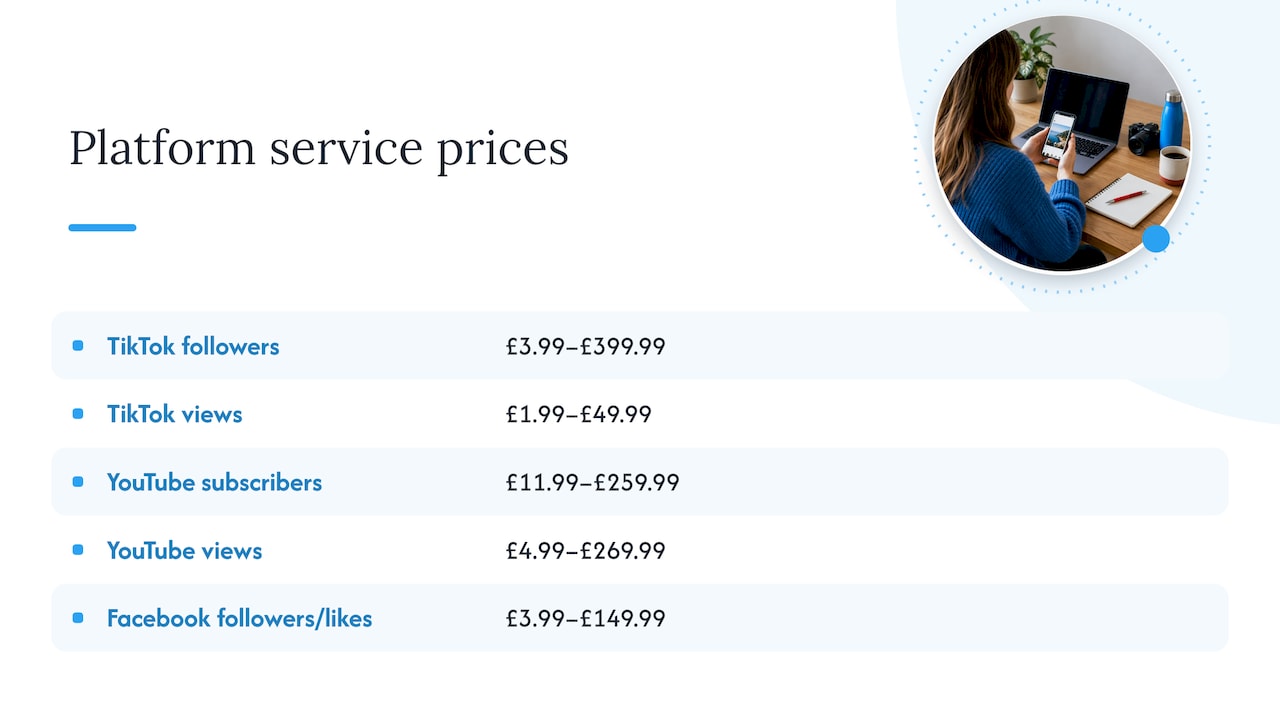
TikTok. Views carry more weight than followers on a feed driven by video, so our guide on TikTok followers versus video views helps you split your budget. TikTok followers range from £3.99 to £399.99 and views from £1.99 to £49.99. If you are in TikTok’s creator programmes, read our note on buying followers and creator rewards first.
YouTube. Brands look at average views per video against subscribers. Subscribers run from £11.99 to £259.99 and views from £4.99 to £269.99. Our comparison of YouTube subscribers and video views shows how to balance them.
Facebook. For local businesses, Page followers and likes (£3.99 to £149.99) build the credibility a new customer sees before they visit. See Facebook followers versus Page likes.
Contracts, clauses and disclosure in the UK
This is the part of a brand deal where care pays off most, so read it slowly.
Read the engagement clause
UK brands and agencies increasingly write audience warranties into influencer contracts. ISBA, the body for UK advertisers, launched model influencer contracts in 2018 with clauses requiring talent to commit not to use practices that artificially increase perceived engagement, such as bots driving artificial traffic. Digiday reports one agency recommends a clause stating the influencer has not bought and will not buy followers, engagements or views.
If your contract has a clause like this, read its exact wording and ask the brand to explain what it covers before you sign. Never sign a warranty you are unsure about. If the wording is unclear on a high-value deal, ask a solicitor to read it.
Expect due diligence
The ISBA Influencer Code of Conduct, published in 2024, expects brands and agencies to carry out due diligence when selecting influencers and to work with influencers to understand the nature and demography of their audience. In practice you will be asked for audience data. Have your analytics screenshots ready, with a clear country and age split.
Label every paid post
The Advertising Standards Authority (ASA), the UK’s advertising regulator, says that because people struggle to recognise influencer ads, it is likely to expect a prominent “ad” label at the start of the content, visible immediately without clicking. Law firm Lewis Silkin’s summary of the CMA’s updated guidance adds that creators who take payment or another incentive must make this clearly identifiable, for example with “advertisement feature” or “advertisement promotion”, and that free gifts come with an instruction to label the content “Ad”.
Since 6 April 2025 the Digital Markets, Competition and Consumers Act has given the CMA direct power to fine businesses for breaking consumer law, with fines of up to 10% of global turnover. Put the label first in the caption, keep it on Stories and Reels, and agree the wording with the brand in writing.
Pricing yourself once the numbers are right
Once your profile reads well, price on what the brand gets, not on your follower count alone. Quote a rate per deliverable (a Reel, a set of Stories, a carousel) and attach your average views and the share of your audience in the UK. Brands working to a budget compare cost per view and cost per engagement across creators, so a UK-heavy audience with steady views is easier to price and easier to approve than a larger account with a scattered one.
Start with smaller campaigns, such as a product gift plus a fee, and use the results to build a case study. A short report with views, saves, link clicks and a quote from the brand is the strongest thing you can add to your media kit, and it lets you raise your rate on the next deal.
Our offer for creators and small businesses
We have supplied engagement packages to UK clients since 2013 and have served over a million customers. You choose a package for Instagram, TikTok, YouTube or Facebook, pay once at checkout and receive real, UK-targeted engagement with instant delivery and no password. If you want to talk it through, our UK-based support team is on hand.
Start with Instagram followers, likes and views, or see everything we offer on the Greedier Social Media home page.
Our view on brand deals and follower growth
Most creators who ask us about brand deals have the same worry: will a brand take me seriously? Our answer is that brands take a profile seriously when it looks like a business worth working with. That means a UK audience, engagement that fits and a steady stream of content.
We built our packages around that idea. Real followers, likes and views, targeted to the UK and USA, delivered instantly and without a password, give a small account the footing it needs to be considered. Since 2013 we have worked with over a million customers, and the pattern is plain: the ones who treat a package as a launch pad, and then post consistently and talk to their audience, are the ones who get noticed.
A strong follower count opens the conversation. Your content, your replies and your professionalism close the deal. Use both.
Irwin Lee
FAQ
Can brands tell if I have bought followers?
No platform labels a follower as bought, and brands cannot see where your audience came from. They look at signals such as growth pattern, engagement against follower count, comment quality and audience location. Followers who match your market, supported by proportionate likes and views, keep these signals consistent.
How many followers do I need to get brand deals?
There is no fixed number. GWI found over half of consumers trust influencers with 50,000 or fewer followers the most, so many UK brands work with smaller creators. A clear niche, a UK audience and steady engagement matter more than a large count.
Should I choose UK-targeted followers for UK brand deals?
Yes. UK brands want to reach UK customers, and audience location is one of the first things they check. UK-targeted followers give your insights the country split a British brand expects to see.
Do I have to label brand deal posts as ads?
Yes. If you receive payment or another incentive, the ASA expects a prominent “ad” label at the start of the content. Agree the exact wording with the brand and apply it on every format, including Stories and Reels.
What should I do if a contract asks me to confirm how I grew my audience?
Read the clause carefully and ask the brand what it covers before you sign. For a larger deal, ask a solicitor to review it. Do not sign a statement you are unsure about.
Sources
- Influur: influencer vetting and fraud detection for brands
- Captiv8: influencer fraud best practices report
- GWI: influencer marketing report
- DECTech: The Influence of Influencers
- Digiday: how influencer agencies vet fake influencers and followers
- ISBA: model influencer contracts
- ISBA: Influencer Marketing Code of Conduct 2024
- ASA: recognising ads on social media and influencer marketing
- Lewis Silkin: CMA updated guidance on fake and misleading reviews
- GoKraken Socials: DMCC Act and follower hazards for businesses