
Age-targeted followers are people in a specific age bracket, such as 18 to 24 or 45 to 54, who follow your account. In practice you shape your age mix through three levers: the platform you grow on, the content you publish, and the country your audience sits in. Followers are never labelled with a birth date by the platform. This guide shows how UK businesses and creators use those levers, which platform suits which age group, and how to check the audience you end up with.
TL;DR
- Your follower age mix is mostly set by platform choice: in the UK, Instagram and TikTok lean younger, while Facebook has its strongest daily reach among older adults.
- Age data on social platforms is an estimate. Check it in your own analytics, not just in a headline statistic.
- Country targeting is the part you can control most directly when you buy engagement. Our packages target the UK and USA.
- Judge success by what followers do (views, saves, enquiries, sales), not by the follower count alone.
- Set your target age bracket first, then pick the platform, then build the audience.
Table of Contents
- What age-targeted followers actually means
- Why platform choice does most of the age targeting
- Five ways to pull in the age group you want
- Paid platform targeting versus buying followers
- What we offer and what we target
- How to check your audience is the right one
- Measuring whether it works
- Our perspective
- Start building your UK audience
- FAQ
- Sources
What age-targeted followers actually means
When people search for this term, they usually mean one of two things. Some want a follower package that delivers people of a certain age. Others want to attract a particular age group to their page, for example women in their thirties for a skincare brand.
Follower demographics are the data describing who follows a profile: age ranges, gender, location and interests. Platforms show you this in their analytics, usually in bands such as 18 to 24 and 25 to 34. That is where the practical limit sits. The platforms infer much of this data. Advertising rules recognise the same thing: targeting a particular age range can rely on data users provide, data inferred from behaviour, or information collected from devices.
So treat any age promise with the same care you would give any audience estimate. The most dependable tools you have are the platform, the content and the location. Our own guide to buying UK-targeted followers covers the location side in detail.
Why platform choice does most of the age targeting
Before you worry about the exact age of each follower, choose a platform where your target group already spends time. The UK picture differs sharply by age.
Younger adults: Instagram, TikTok and YouTube
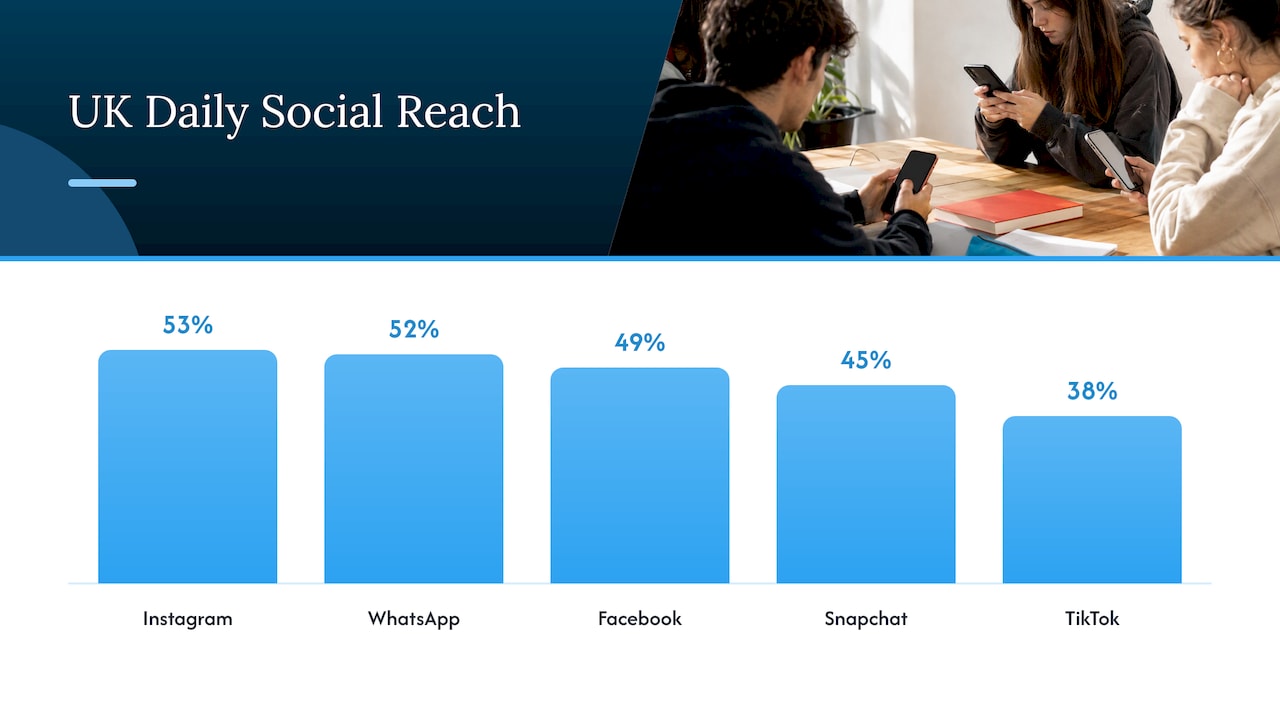
UKOM/Ipsos data from August 2023 found that among 15 to 24 year olds in the UK, Instagram (53%) and WhatsApp (52%) reach just over half on an average day, slightly ahead of Facebook (49%), Snapchat (45%) and TikTok (38%). Sprout Social’s UK report adds that YouTube and TikTok dominate the 18 to 24 group.
TikTok is also where attention goes. Metricool reports that the average active UK user spends 49 hours and 29 minutes a month on TikTok’s Android app, against 19 hours and 10 minutes on YouTube. It also notes that 77% of Gen Z use TikTok for product discovery.
Instagram is wider than its reputation
It is easy to assume Instagram is only for the young. The data says otherwise. Fifty5Blue’s 2026 report found that the largest share of Instagram users in Great Britain is aged 35 to 44, and that the 65+ group grew 76% over five years. Statista’s data also shows 25 to 34 year olds as Instagram’s largest UK audience group.
The practical point: an Instagram account can attract anyone from students to people in their fifties. What decides it is your content and your offer.
Older adults: Facebook
For over-55s in the UK, Facebook has the highest daily reach at 62%, while Instagram reaches under a quarter of older people daily. Sprout Social also reports that Facebook remains the most effective platform for reaching UK consumers aged 45 and above. Affect Group’s benchmarking shows the 55+ segment as the largest age band of Meta’s UK ad audience in absolute terms alongside 25 to 34, with younger people leaning to Instagram and older people to Facebook.
Quick comparison
| Target age group | Platforms worth prioritising | What the UK data says |
|---|---|---|
| 16 to 24 | TikTok, Instagram, YouTube | Highest engagement with short video; Instagram and TikTok reach many in this group daily |
| 25 to 34 | Instagram, YouTube, Facebook | Largest segment of active UK social users and Instagram’s biggest UK age group |
| 35 to 54 | Instagram, Facebook | 35 to 44 is the largest share of Instagram users in Great Britain |
| 55+ | Highest daily reach of the major platforms among over-55s |
Use a table like this to rule out obviously wrong channels, not to pick a winner. As one UK analysis puts it, demographics show which platforms can reach an age group, and your own customer research should choose between whatever remains. If you are still deciding how to segment, read how audience targeting works and our own piece on types of audience segmentation.
Five ways to pull in the age group you want
- Write for one person in your bracket. A 20-year-old and a 50-year-old respond to different language, pace and references. Pick one and write to them.
- Match the format to the age. Short vertical video suits younger audiences. Longer posts, local news and community-style updates tend to suit Facebook’s older audience.
- Use local signals. Location tags, UK spelling, UK prices and local events attract UK followers. Our guide on why the UK market differs goes deeper.
- Collaborate with creators whose audience fits. A creator’s audience matters more than their size. If your brand is aiming at women aged 30 to 45, a creator whose followers are mostly 18 to 24 is not reaching your buyers.
- Build visible social proof early. New visitors judge a profile in seconds. A credible follower count, steady likes and healthy views make the right people more likely to stay and follow.
The fifth point is where paid engagement fits. If you want a faster start, see our guide to fast social media followers and our accelerated growth guide for UK accounts.
Paid platform targeting versus buying followers
The two are different things, and mixing them up causes most of the confusion around this keyword.
Platform advertising lets you choose an age range. Facebook and Instagram share one ad targeting system, where the available age range runs from 13 to 65+. That targets who sees an ad, not who follows you afterwards. Even then, a 2026 German study that recruited 18 to 29 year olds through Instagram ads found that quotas were only partially controllable in real-world conditions, with notable deviations by gender. The researchers describe demographic targeting as defining an initial search space rather than a fixed outcome.
Buying engagement is a different tool. It gives a profile credibility and momentum, so that the organic visitors you attract with your content are more likely to follow. That is how we describe our own packages: our service is designed to deliver real followers, likes and views, with UK and USA targeting, instant delivery and no password required.
What we offer and what we target
We are clear about what we control. Our packages are targeted by country, UK or USA. We do not describe any package as selecting followers by their exact age, because the platforms do not provide that as a verified field. What you can do is combine the right platform, the right content and UK-targeted engagement.
Published prices on our site, all one-off unless stated:
| Platform | Product | Price range |
|---|---|---|
| Followers | £1.99 to £229.99 | |
| Likes | £0.99 to £189.95 | |
| Video views | £0.59 to £54.99 | |
| TikTok | Followers | £3.99 to £399.99 |
| TikTok | Views | £1.99 to £49.99 |
| Page followers | £3.99 to £149.99 | |
| YouTube | Subscribers | £11.99 to £259.99 |
There are also monthly plans: auto Instagram followers run from £15.00 to £100.00 per month, and auto Instagram likes start from £9.99 per month.
How to check your audience is the right one
Whether your followers came from content, creators or paid support, check them the same way: in your own analytics.
- Look at the age bands. Open your insights and see which age ranges lead. Favikon suggests that 50% or more of an audience in your core age bracket is a good fit signal, with 60% or more in your target countries.
- Check the gender split. The same guide suggests staying within 20 points of your intended ratio.
- Compare the location. For a UK business, the share of followers in the UK matters more than the total.
- Watch behaviour, not just numbers. Unusual patterns do not automatically mean a problem. Giveaways, reposts and platform recommendations can all produce odd-looking spikes, so keep native platform data separate from third-party tools and look at several signals together.
If your product is age-restricted
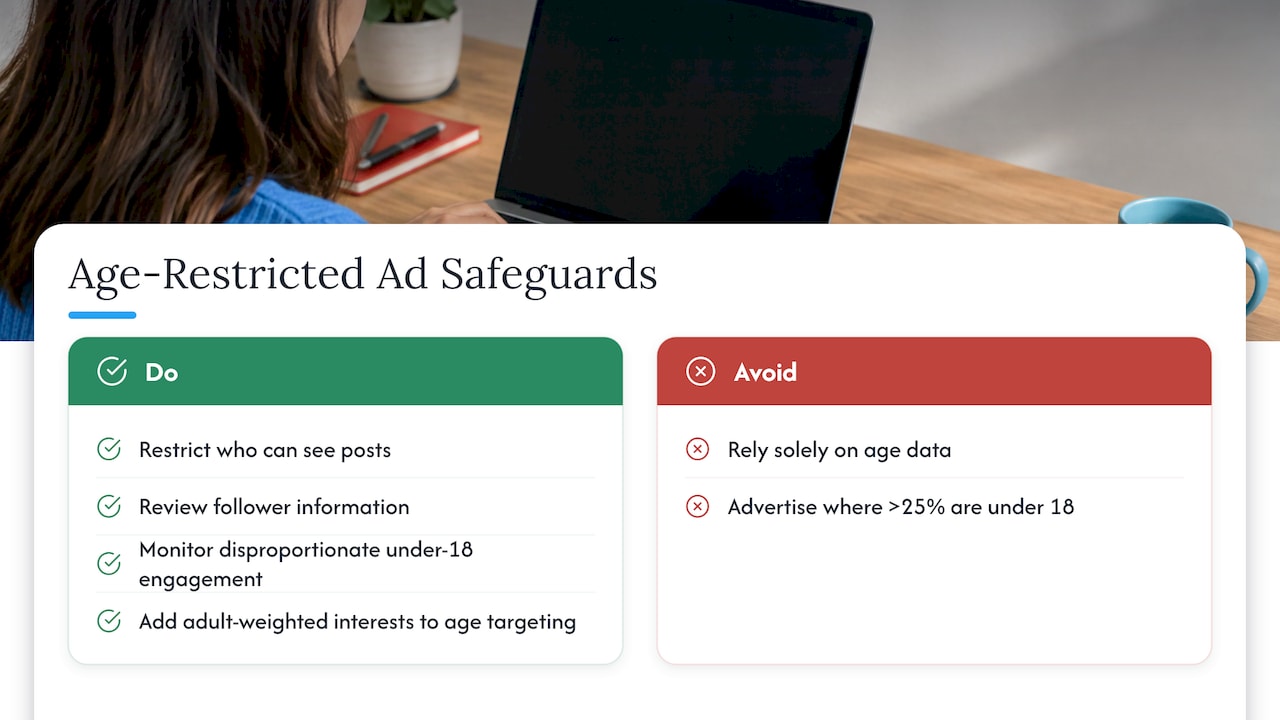
Brands selling alcohol, gambling or similar products have a legal duty here. The ASA says that for age-restricted ads, ads must not appear where more than 25% of the audience is under 18, and that marketers should not rely solely on age data. On your own social accounts, the ASA expects you to restrict who can see posts, review follower information, and monitor for disproportionate engagement from the protected age group.
An ASA ruling in 2025 shows the stakes: a drinks brand could show that 50.9% of an influencer’s audience was aged 18 to 24, but could not say what share was under 18, and the complaint was upheld. If you sell age-restricted products, speak to your compliance adviser before choosing any audience strategy, and use the ASA’s guidance as your baseline. The ASA also states that age data alone is unlikely to be enough, and that marketers should combine age targeting with interest-based targeting, choosing interests weighted towards adults.
Measuring whether it works
A bigger follower count is not the goal. The IPA warns that the most common digital measurement mistake is simply quoting the number of followers, fans, views or impressions, and recommends setting targets before a campaign starts.
A simple framework for an age-focused plan:
- Set the target. For example: 40% of followers aged 25 to 34 within three months.
- Pick three metrics that prove it. Share of followers in the target age band, saves or shares per post, and clicks or enquiries.
- Compare against a baseline. Record the figures before you start.
- Review monthly. If the wrong age group is engaging, change the content or the platform before adding more volume.
As a rule, judge content by views, saves and sales, since comment counts understate your real audience.
Our perspective
Most people who ask us about age-targeted followers are really asking a trust question: will the people who find my profile look like my customers?
Our view is that the answer starts with where you build and what you post, and that a credible, UK-focused profile is what turns a visitor into a follower. A page with a few dozen followers and little activity gives a new visitor no reason to stay. A page with real followers, steady likes and healthy views does.
That is why we focus on real engagement, UK and USA targeting, instant delivery and no password requests. We have supported over a million customers since 2013, and the pattern is consistent: the accounts that do best pair that early momentum with content written for one clear audience.
We would rather tell you plainly what we target, which is country, than promise something the platforms cannot verify.
Irwin Lee
Start building your UK audience
If you have chosen your platform and your audience, the next step is giving your profile the credibility to convert visitors. Our packages deliver real followers, likes and views to UK-focused accounts without needing your password, and our UK-based support team can help you choose a size that fits your plan.
Browse the Instagram packages, the Facebook packages for an older-leaning audience, or the TikTok packages for younger viewers. For YouTube, our guide to targeting UK subscribers explains how to combine organic work with promotion.
FAQ
What age group is Instagram most popular with in the UK?
It depends on the measure. Among 15 to 24 year olds, just over half use it on an average day. By share of users, Statista reports that 25 to 34 year olds are the largest UK group, and Fifty5Blue found 35 to 44 leading in Great Britain. In short, Instagram’s audience is broad, centred on 25 to 44.
What age group does Facebook target?
Facebook is open to anyone aged 13 and over, and its advertising system lets you choose any range from 13 to 65+. In UK usage terms, it reaches older adults strongly: 62% of over-55s use it daily, according to UKOM/Ipsos data.
Can I choose the exact age of my followers?
Not reliably. Platforms estimate age from inferred data, and even paid ad targeting only sets a starting search space. What you can control is the platform, the content, the location and the way you check your analytics afterwards. Our packages are targeted by country, not by individual age.
How do I know if my followers match my target age?
Open your platform insights and look at the age bands, gender split and top locations. A useful benchmark is at least half of your audience in your core age bracket and most of it in your target country. Review it monthly and adjust your content if the mix drifts.
Sources
- Follower Demographics: Understanding and Leveraging Your Audience (The Social Cat)
- Age-restricted ads online (ASA, 2025)
- Protecting Children on Social Media (ASA)
- Alcohol: Targeting and Appeal to Under 18s (ASA)
- Social media use by age (UKOM)
- 16-24 65+ (Fifty5Blue)
- Audience of Meta Ads in the United Kingdom (Affect Group)
- UK Social Media Marketing Demographics (Sprout Social)
- UK: Instagram usage by age and gender (Statista)
- 2026 UK Social Media Statistics (Metricool)
- UK social media demographics and what they mean for you (Global Bridge Labs)
- How to Check Influencer Audience Demographics (Favikon)
- Creator Audience Quality Audit (3bet Media)
- When Quotas Meet Algorithms (Survey Practice)
- The Expert Guide to Measuring Not Counting (IPA)
- How to Target by Age on Facebook Ads (Coinis)
- Audience targeting explained